

Microsoft’s short MSRC attestation that “Azure Linux includes this open‑source library and is therefore potentially affected” is accurate for CVE‑2025‑22043, but it is a product‑scoped inventory statement — not proof that other Microsoft products cannot carry the same ksmbd code; defenders should treat Azure Linux images as confirmed carriers while performing artifact‑level discovery across other Microsoft artifacts. rview
CVE‑2025‑22043 is a medium‑severity Linux‑kernel vulnerability that upstream maintainers describe succinctly as “ksmbd: add bounds check for durable handle context.” The practical result of the fix is the insertion of a missing bounds check in the in‑kernel SMB server (ksmbd) code to prevent an out‑of‑bounds access; the vulnerability was cataloged in April 2025 and given a CVSSv3 base score in the mid‑5 range (roughly 5.5), with the primary impact classified as availability (local attack vector, low complexity, low privileges required).
ksmbd is the Linux kernel’s in‑tree SMB/CIFS server implementation. It is an alternative to userland Samba and is integrated directly into kernel trees and distribution kernels. Because it is upstream kernel code, any Linux distribution or kernel image that includes the ksmbd subsystem (built in or as a module) can include the vulnerable code until a patched kernel or backport is applied. Multiple distributors (Debian, Ubuntu, SUSE, Oracle, Amazon Linux) have tracked the CVE and released package‑level guidance and fixes in their kernels.
Microsoft’s public FAQ language for several Linux kernel CVEs — including the phrasing you quoted — follows a consistent pattern: it calls out Azure Linux (the Microsoft‑maintained distro lineage) as a product that “includes this open‑source library and is therefore potentially affected,” and it commits to publishing machine‑readable CSAF/VEX attestations and updating CVE product mappings if other Microsoft products are discovered to ship the same upstream component. That wording is deliberate and operational; it is an attestation of inventory for Azure Linux, not an exclusivity guarantee for the entire Microsoft product portfolio.
Put simply:
Microsoft’s MSRC wording is visible and machine‑readable in its CVE/VEX entries (the phrasing you quoted is the product attestation language Microsoft has been using while it expands CSAF/VEX coverage). That statement is best read as an authoritative answer to “Does Azure Linux include the implicated upstream component?” — and the answer is yes. Microsoft’s promise to update mappings if more products are discovered is an important transparency signal, but it leaves a residual verification duty for customers.
High‑priority immediate steps
However, an attestation naming a single product is not a proof that no other Microsoft product could include the same vulnerable component. Because ksmbd is upstream kernel code that can appear in many kernel builds and artifact types, defenders must run artifact‑level discovery (kernel config checks, SBOM reconciliation, image scanning) across their estates — including WSL kernels, Marketplace images, AKS node images, and any Microsoft‑distributed images they consume — until Microsoft expands its CSAF/VEX mappings or provides SBOMs for additional artifacts.
In short: prioritize patching Azure Linux (confirmed), but do not assume exclusivity — verify the rest of your Microsoft artifacts, apply vendor and distribution kernel fixes where available, and strengthen your SBOM and image‑scanning hygiene so the next kernel CVE does not leave you in the dark.
Source: MSRC Security Update Guide - Microsoft Security Response Center
CVE‑2025‑22043 is a medium‑severity Linux‑kernel vulnerability that upstream maintainers describe succinctly as “ksmbd: add bounds check for durable handle context.” The practical result of the fix is the insertion of a missing bounds check in the in‑kernel SMB server (ksmbd) code to prevent an out‑of‑bounds access; the vulnerability was cataloged in April 2025 and given a CVSSv3 base score in the mid‑5 range (roughly 5.5), with the primary impact classified as availability (local attack vector, low complexity, low privileges required).
ksmbd is the Linux kernel’s in‑tree SMB/CIFS server implementation. It is an alternative to userland Samba and is integrated directly into kernel trees and distribution kernels. Because it is upstream kernel code, any Linux distribution or kernel image that includes the ksmbd subsystem (built in or as a module) can include the vulnerable code until a patched kernel or backport is applied. Multiple distributors (Debian, Ubuntu, SUSE, Oracle, Amazon Linux) have tracked the CVE and released package‑level guidance and fixes in their kernels.
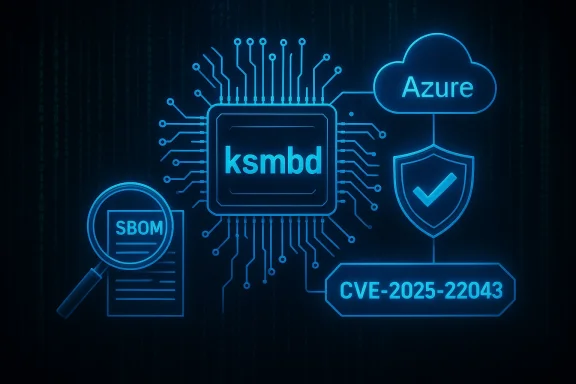 What Microsoft actually said — reading the attestation
Microsoft’s public FAQ language for several Linux kernel CVEs — including the phrasing you quoted — follows a consistent pattern: it calls out Azure Linux (the Microsoft‑maintained distro lineage) as a product that “includes this open‑source library and is therefore potentially affected,” and it commits to publishing machine‑readable CSAF/VEX attestations and updating CVE product mappings if other Microsoft products are discovered to ship the same upstream component. That wording is deliberate and operational; it is an attestation of inventory for Azure Linux, not an exclusivity guarantee for the entire Microsoft product portfolio.Put simply:
- Microsoft has confirmed Azure Linux images include the ksmbd code implic and therefore treats those images as potentially affected.
- Microsoft has not publicly listed other Microsoft products as affected for that CVE at the time of the advisory; the absence of an attestation for other products does nts are free of the same upstream code.
Technical summary of the flaw and impact
What the bug is
- The fix is a bounds check in ksmbd’s durable handle context path. Upstream commit messages and distribution advisories describe the change as preventing an out‑of‑bounds/read or write that could corrupt internal kernel state. The kernel vulnerability is categorized as local and primarily affects availability (e.g., kernel oops or crash) rather than direct confidentiality or integrity degradation.
Likely attack surface and worst‑case outcomes
- The attack vector is local (an attacker requires the ability to interact with ksmbd interfaces on the host). Exploits in the ksmbd subsystem have historically been used to trigger kernel crashes or reliability issues; in a hostile environment, kernel instability can cause denial‑of‑service and may serve as a stepping stone for privilege escalation in some chained exploit scenarios. Distribution advisories mark the confidentiality and integrity impacts as none while scoring availability as high for certain attack permutations.
Which builds/components are affected
- Any kernel build that includes ksmbd (either built‑in or as a loadable module) from the vulnerable upstream tree is in scope. Whether a given product is affected therefore depends on:
- The kernel version shipped and whether the ksmbd changes were present,
- The kernel configuration (CONFIG_KSMBD or related options) used when building the kernel,
- Whether a distribution or vendor backported the upstream fix into their stable kernel series.
Is Azure Linux the only Microsoft product affected?
Short answer: No — not necessarilyicrosoft has publicly attested that Azure Linux images include the vulnerable upstream component and are therefore potentially affected; that is an authoritative, product‑level statement for Azure Linux customers.- However, an attestation naming a single product is not the same as an exhaustive global scan: Microsoft explicitly states it will update CVE mappings if additional Microsoft products are later found to ship the same component. Until such mappings are published, other Microsoft artifacts must be treated as unverified rather than proven safe.
- Large vendors ship many images and artifacts that derive from common upstream sources. The same kernel code can appear in:
- Custom VM images (Marketplace images or vendor‑published base images),
- AKS node images or container host kernels,
- WSL2 kernel binaries distributed to Windows clients,
- Appliance‑style images used by specific Azure services,
- Internal build artifacts and developer toolchains used to produce container base images.
Cross‑checking the public record (verification)
To ground this advisory in independently verifiable facts, consult multiple sources that track CVE‑2025‑22043 and the ksmbd fix. Independent vendor and distro trackers (Debian, Ubuntu, SUSE, Oracle) list the same upstream description and similar severity metadata, confirming the technical nature of the fix and the local/availability focus of the impact. These distributors also show how fixes are rolled into individual kernel series and which releases are flagged vulnerable versus patched, reinforcing that exposure depends on the kernel image and configuration, not merely on vendor branding.Microsoft’s MSRC wording is visible and machine‑readable in its CVE/VEX entries (the phrasing you quoted is the product attestation language Microsoft has been using while it expands CSAF/VEX coverage). That statement is best read as an authoritative answer to “Does Azure Linux include the implicated upstream component?” — and the answer is yes. Microsoft’s promise to update mappings if more products are discovered is an important transparency signal, but it leaves a residual verification duty for customers.
Practical guidance — what to do right now
If you are responsible for systems that run Microsoft artifacts in any part of your estate, adopt a conservative, evidence‑driven approach: treat the Azure Linux attestation as a confirmed hit, and verify other Microsoft artifacts you run.High‑priority immediate steps
- Inventory and identify:
- Determine whether you run AzurKS nodepools, custom images based on Azure Linux). If so, prioritize patching those images. Microsoft’s attestation makes Azure Linux the obvious first line of work.
- Scan your environment for kernels that include ksmbd. Useful detection checks:
- On running Linux hosts: uname -r; then inspect kernel config for ksmbd flags (e.g., cat /boot/config-$(uname -r) | grep -i ksmbd).
- Check loaded modules: lsmod | grep ksmbd or grep -i ksmbd /proc/modules.
- If you build kernels or base images, search kernel config fragments and your build recipes for CONFIG_KSMBD or references to ksmbd.
- Patch and update:
- For Azure Linux instances, apply the kt publishes for the affected images as they become available; Microsoft’s CSAF/VEX entries and product updates will reflect remediation status.
- For distribution‑managed systems, apply vendor kernel patches (Debian/Ubuntu/SUSE/Oracle releases have entries for CVE‑2025‑22043). Verify you’re on a patched kernel tree version before redeploying.
- Contain/mitigate if you cannot patch immediately:
- If you do not need in‑kernel SMB server functionality, consider blacklisting the ksmbd module (echo "blacklist ksmbd" > /etc/modprobe.d/blacklist-ksmbd.conf) and rebuilding initramfs if needed.
- Implement host‑level mitigations (restrict access to SMB ports, enforce network segmentation, and use firewall rules to limit access to the service endpoints).
- Scan container images and marketplace assets:
- Many exposures come through container base images. Inspect your container images’ SBOMs and dependency lists for kernels or prebuilt images that might include the vulnerable ksmbd code.
- Verify WSL2 and Microsoft‑distributed kernels:
- If you manage Windows endpoints that rely on WSL2, check whether the WSL kernel binary version distributed by Microsoft includes the ksmbd subsystem in the shipped configuration (this depends on the kernel config used by the WSL kernel). If in doubt, treat the WSL kernel as an artifact than until Microsoft’s VEX/CSAF coverage explicitly lists it.
- Identify Azure Linux instances in inventory and mark them high priority.
- Query running kernels for CONFIG_KSMBD or ksmbd module presence.
- Apply vendor or Microsoft kernel updates; where unavailable, schedule rebuilds of images that include ksmbd.
- Blacklist ksmbd if functionally acceptable.
- Validate container runtime and image pipelines to ensure no baked‑in vulnerable kernels are promoted to production.
- Reconcile SBOMs and artifact inventories against what Microsoft has attested; escalate to Microsoft support if you discover a Microsoft artifact that contains the vulnerable component but is not listed in MSRC mappings.
Why Microsoft’s attestation approach is useful — and where it falls short
Strengths- Actionable prioritization: Naming Azure Linux gives customers an immediate, auut where to start patching. For teams overwhelmed by triage, that direction reduces noise and lets scarce patching resources focus on a known affected product.
- Transparency commitment: Microsoft’s pledge to publish CSAF/VEX artifacts and to expand attestoncrete move toward machine‑readable supply‑chain transparency, which helps automation and reduces manual inventory work in the long term.
- Attestation ≠ exhaustive scanning: A single product attestation does not prove the absence of the vulnerable component elsewhere in the vendor’s portfolio. Vendors ship many artifacts; the same upstream code can appear in multiple places without being reported immediately. Treat non‑attested artifacts as “not yet verified” rather than “safe.”
- Dependence on vendor mapping speed: The usefulness of VEX/CSAF depends on the speed and completeness of vendor mapping work. Customers with complex, fast‑moving estates for attestations — they must run independent artifact scans and SBOM reconciliation.
- Artifact identity complexity: Whether a product contains vulnerable code is an artifact‑level property (a function of the exact binary, its build recipe, and the kernel config), not simply a product label. This makes full automation challenging without complete SBOM coverage and consistent artifact metadata across the enterprise.
Enterprise risk posture: recommended policy changes
- Treat vendor attestations as high‑value telemetry but not the sole source of truth. Integrate vendor VEX/CSAF feeds into you cross‑check them against your own SBOMs and image inventories.
- Enforce SBOM generation and retention for all container images and VM images; require that CI pipelines produce module‑level inventories for kernels included in images. These SBOMs make it feasible to answer questions like “Which images shipped a kernel that enabled ksmbd?” without an exhaustive manual search.
- Maintain a short list of kernel subsystems you treat as security‑sensitive (ksmbd, network drivers, crypto stacks, filesystems). Ensure you can quickly query builds and image recipes for those subsystems when a new kernel CVE is released.
- Automate image scanning and policy enforcement: fail builds that promote images which contain kernels with unpatched CVEs in the SBOM.
Where claims are unverifiable and what to ask Microsoft
There are a few things external observers cannot verify from public data:- Microsoft’s internal inventory: only Microsoft can prove whether a given internal artifact or managed service image includes ksmbd until the company publishes a VEX attestation or SBOM for that artifact. External scans of publicly available Marketplace images can help, but privately built or internal artifacts require vendor confirmation or artiverify. Flag any such gap as “unverified.”
- WSL kernel content: Microsoft publishes WSL kernel sources and binaries, but whether the WSL kernel distributed to a particular release or channel includes ksmbd depends on the exact kernel config and build used for that distribution; ask Microsoft for an explicit attestation if you need a definitive answer for WSL kernels in your environment.
- Product‑level VEX/CSAF artifacts that list the scope (images, kernel versions, product SKUs) Microsoft has verified as affected or not affected.
- SBOMs or kernel configuration manifests for images you consume from Microsoft (Marketplace images, AKS node images, WSL kernels).
- Timeline and remediation guidance for specific Microsoft images you depend on.
Conclusion
Microsoft’s MSRC entry for CVE‑2025‑22043 is clear and useful: Azure Linux includes the upstream ksmbd code implicated by the CVE and should be treated as potentially affected. That attestation is authoritative for Azure Linux customers and gives a clty.However, an attestation naming a single product is not a proof that no other Microsoft product could include the same vulnerable component. Because ksmbd is upstream kernel code that can appear in many kernel builds and artifact types, defenders must run artifact‑level discovery (kernel config checks, SBOM reconciliation, image scanning) across their estates — including WSL kernels, Marketplace images, AKS node images, and any Microsoft‑distributed images they consume — until Microsoft expands its CSAF/VEX mappings or provides SBOMs for additional artifacts.
In short: prioritize patching Azure Linux (confirmed), but do not assume exclusivity — verify the rest of your Microsoft artifacts, apply vendor and distribution kernel fixes where available, and strengthen your SBOM and image‑scanning hygiene so the next kernel CVE does not leave you in the dark.
Source: MSRC Security Update Guide - Microsoft Security Response Center
