

CVE-2025-22058 is a Linux kernel bug that causes a UDP memory-accounting leak — and while Microsoft’s public guidance has explicitly named Azure Linux as a product that “includes this open‑source library and is therefore potentially affected,” that statement is a product‑scoped attestation, not a declaration that Azure Linux is the only Microsoft product which could possibly carry the vulnerable kernel code.
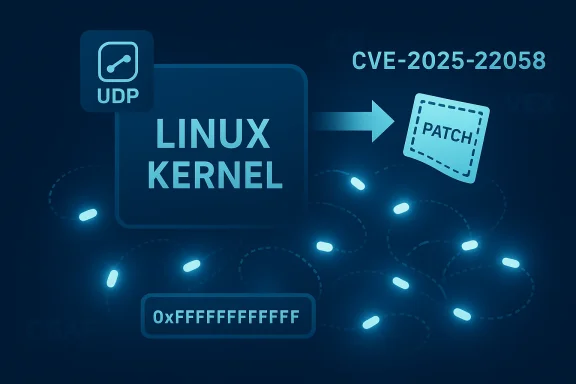
CVE-2025-22058 was assigned to a defect in the Linux kernel’s UDP memory-accounting path. The bug manifests when a user application sets an extreme receive buffer (SO_RCVBUF) value; an integer overflow in the UDP rmem release logic can cause the kernel’s reported UDP memory usage to spike to very large values (examples observed at 524,288 pages), and that counter can stick or even double when sockets are terminated. The practical effect is memory accounting corruption that can lead to allocation failures, packet drops and local denial-of-service conditions.
Upstream maintainers and stable kernel trees assigned clear fix commits: the vulnerability was introduced many releases ago and was backported/fixed into several stable branches (the Linux CVE team and stable changelogs list multiple fixed stable versions). Distributors (Debian, Ubuntu, Red Hat, SUSE, Amazon Linux and others) incorporated these upstream fixes into their kernel packages and published advisories and patches.
Why this matters to Microsoft customers: when a vendor — Microsoft in this case — inspects their product builds and finds upstream open-source code that contains a CVE, they can publish a product-level attestation that the product “includes the open-source library and is therefore potentially affected.” Microsoft has done that for Azure Linux and has committed to publishing machine-readable CSAF/VEX attestations for Azure Linux and to expand that program over time. The Mately scoped: it confirms Azure Linux as a known carrier but does not deny the possibility that other Microsoft artifacts might include the same kernel code.
Interpretation and implications:
That said, the question “Is Azure Linux the only Microsoft product that includes the open-source library and is therefore potentially affected?” requires a careful, two-part answer: Microsoft has explicitly attested Azure Linux as a carrier (so yes — Azure Linux is affected and should be remediated per Microsoft’s guidance), but no technical rationale makes it the exclusive possible carrier of the vulnerable kernel code across Microsoft’s product portfolio. Any Microsoft artifact that ships or runs a Linux kernel build — particularly WSL kernels, Azure-tuned kernels used in Marketplace images and managed node images — should be inventoried and verified. Until Microsoft publishes additional CSAF/VEX attestations for those artifacts, operators must treat them as not yet attested rather than proved safe.
If you run Azure Linux, apply the azl kernel updates Microsoft provides as a first priority. If you run WSL or other Microsoft-supplied Linux artifacts, run the inventory and verification steps above and update the kernel per your vendor’s guidance. The combination of upstream fixes, distributor advisories and Microsoft’s attestation provides a clear remediation path — but only if enterprises take the additional step of verifying all Microsoft-supplied Linux artifacts in their environments.
Source: MSRC Security Update Guide - Microsoft Security Response Center
 Background / Overview
CVE-2025-22058 was assigned to a defect in the Linux kernel’s UDP memory-accounting path. The bug manifests when a user application sets an extreme receive buffer (SO_RCVBUF) value; an integer overflow in the UDP rmem release logic can cause the kernel’s reported UDP memory usage to spike to very large values (examples observed at 524,288 pages), and that counter can stick or even double when sockets are terminated. The practical effect is memory accounting corruption that can lead to allocation failures, packet drops and local denial-of-service conditions.Upstream maintainers and stable kernel trees assigned clear fix commits: the vulnerability was introduced many releases ago and was backported/fixed into several stable branches (the Linux CVE team and stable changelogs list multiple fixed stable versions). Distributors (Debian, Ubuntu, Red Hat, SUSE, Amazon Linux and others) incorporated these upstream fixes into their kernel packages and published advisories and patches.
Why this matters to Microsoft customers: when a vendor — Microsoft in this case — inspects their product builds and finds upstream open-source code that contains a CVE, they can publish a product-level attestation that the product “includes the open-source library and is therefore potentially affected.” Microsoft has done that for Azure Linux and has committed to publishing machine-readable CSAF/VEX attestations for Azure Linux and to expand that program over time. The Mately scoped: it confirms Azure Linux as a known carrier but does not deny the possibility that other Microsoft artifacts might include the same kernel code.
Technical anatomy: what the bug does and where the fix landed
What actually fails
- The defect is an integer overflow / accounting issue in the UDP receive-side memory accounting paths (functions like udp_rmem_release and related helpers). When an application sets SO_RCVBUF to an extreme value (for example INT_MAX), a calculation overflow causes the kernel to account incorrectly for socket memory.
- That incorrect accounting can cause the kernel’s /proc/net/sockstat UDP mem counters to spike and not reduce when sockets close; under certain conditions the value doubles after a forced drain, producing persistent, inflated memory usage that leads to allocation failures and packet drops.
Where fixes were applied upstream
- The Linux CVE announcements and stable‑tree changelogs list the corrective commits and the stable release snapshots that include the fix (upstream stable merges are listed across 6.1/6.6/6.12/6.13/6.14/6.15 series depending on the distribution and backport). Operators should treat a kernel older than the fixed stable release for their distribution as potentially vulnerable until verified.
Which distributions published advisories
- Multiple major distributions published advisories and packages that include the upstream fix: Amazon Linux, Red Hat, SUSE, Ubuntu, Debian and others have kernel updates that address CVE-2025-22058. Verify your distro advisory and applied kernel package.
Microsoft’s published position — what they said and what it means
Microsoft’s short, public answer on a number of Linux CVE pages follows the same pattern: “Azure Linux includes this open‑source library and is therefore potentially affected by this vulnerability. … If impact to additional producill update the CVE to reflect this.” That wording is an authoritative product-level attestation for Azure Linux: Microsoft has completed the inventory for that product and confirmed the implicated upstream component is present in the Azure Linux build outputs. It is not a universal negative for every other Microsoft product.Interpretation and implications:
- Attestation = confirmed carrier for that product. If you run Azure Linux images (azl kernels / Azure Linux images) you should treat them as in-scope and follow Microsoft’s remediation guidance.
- Attestation ≠ exclusivity. The wording explicpen: if Microsoft later discovers the same upstream code in other product artifacts they will update the CVE/VEX mapping. Absence of a published attestation for other Microsoft artifacts is not proof those artifacts are safe — it simply means Microsoft has not yet published an inventory mapping for them.
Is Azure Linux the only Microsoft product that can include the vulnswer: No — technically and practically, Azure Linux is not the only Microsoft product that could carry the vulnerable Linux kernel code. However, Azure Linux is the only Microsoft product Microsoft has publicly attested (so far) to include the implicated component for this CVE.
Why:- Microsoft builds and publishes Linux kernels for more than one scenario. Notable examples include:
- Azure Linux kernels that ship in Microsoft-curated Azure images (the azl kernel variants used in Azure Linux). Microsoft publishes CSAF / VEX attestations and maps specific azl kernel versions to Azure Linux when they complete the inventory.
- Windows Subsystem for Linux (WSL / WSL2): Microsoft supplies a Microsoft-built Linux kernel binary for WSL2 (the msft WSL kernel project), and that kernel receives independent updates from Windows. If a WSL kernel build includes the vulnerable kernel version (or omits the fix), WSL systems would technically be carriers. Microsoft documents how to use and update the WSL kernel and publishes kernel sources.
- Azure Marketplace images and managed node images (AKS): Marketplace/VM images and managed node pools may run kernels provided by the distribution publisher or by Microsoft as Azure‑tuned kernels; those kernels must be treated as distinct artifacts that require verification.
Practical verification checklist: how to confirm whether a Microsoft artifact you rely on is affected
Below are concrete steps defenders and sysadmins should run in their environment. Use this as a checklist and adapt to your environment.- Inventory Microsoft-supplied Linux artifacts in your estate
- Search for Azure Linux VM images, Marketplace images, AKS node pools, WSL installations, and any Microsoft-published container/VM images.
- Treat each artifact as a potential carrier until verified.
- Check kernel versions and whether the upstream fix is present
- On a running Linux instance: run uname -r and record the kernel release string; then cross-check against the distributor’s advisory to see whether that kernel package includes the upstream fix for CVE-2025-22058. The upstream announcements list the stable commits and fixed versions — treat any kernel older than the fixed snapshots as potentially vulnerable.
- For WSL: inside the WSL distribution run uname -r; Microsoft also provides WSL kernel release notes and the update mechanism (wsl --update / Microsoft Store updates). If WSL is using an older kernel that predates the fix, update per Microsoft guidance.
- Patch or update according to vendor guidance
- For Azure Linux, follow Microsoft’s Azure Linux upgrade tutorial and the vendor fixes listed in their CSAF/VEX remediations (Microsoft published azl kernel security updates tied to their product).
- For WSL, apply the WSL kernel update path (wsl --update or use the Microsoft-released kernel binaries) and ensure client machines apply the updated WSL kernel.
- For other distributions running on Azure VMs (Ubuntu, RHEL, SUSE, Debian, Amazon Linux), install the distribution kernel update packages that include the upstream fix — distributors published advisories and updates.
- Temporary mitigations while you patch
- Avoid allowing applications to set SO_RCVBUF to extreme values (INT_MAX). If you control the application code, restrict socket buffer sizes to practical, limited values. Several vulnerability writeups and advisories call out this practical workaround.
- For environments where immediate kernel upgrades are impractical, schedule maintenance windows and micro-updates or isolate affected workloads where possible.
- If you need definitive attestation for a Microsoft product
- Check Microsoft’s MSRC / Security Update Guide and the company’s CSAF/VEX product mappings. Microsoft has begun publishing machine-readable VEX/CSAF attestations (initially for Azure Linux) and will expand mappings; if you need a formal attestation for a specific Microsoft artifact other than Azure Linux, contact Microsoft support or consult Microsoft’s published CSAF/VEX files for the product in question.
Critical analysis — strengths, gaps and operational risks
Strengths in Microsoft’s approach
- Product-scoped transparency: Microsoft’s choice to publish CSAF/VEX entries and to explicitly map Azure Linux artifacts to CVEs is meaningful progress for customers; product-level attestations reduce ambiguity for operators running those images. Microsoft committed publicly to the VEX/CSAF program and started with Az Azure operators a deterministic remediation path.
- Upstream and distributor coverage: The Linux kernel maintainers assigned the CVE and applied fixes; major distributions backported patches and published advisories. That broad ecosystem action reduces attacker dwell time and gives defenders multiple vendor-supplied update paths.
Gaps and cautionary points
- Attestation is narrow by design. Vendors typically attest to the product families they maintain; they rarely assert the absence of the same code in other artifacts. Microsoft’s Azure Linux attestation therefore helps Azure customers but leaves uncertainty for other Microsoft-supplied artifacts until Microsoft expands VEX mappings. Customers should not equate “not attested” with “not present.”
- Multiple Microsoft kernel artifacts exist. WSL, Azure-tuned kernels used in Marketplace images, and other Microsoft-published kernel binaries are separate artifacts. Any of them could include vulnerable code if they are built from kernel sources older than the upstream fix or if a particular build omitted the backport. This is a supply-chain mapping problem — and it cannot be solved by assuming the Azure Linux attestation covers all Microsoft products.
- Endpoint visibility is often lacking. Enterprises frequently overlook WSL instances on developer laptops or unmanaged endpoints; a vulnerable WSL kernel might be a low-and-slow attack surface that is easy to forget during server-centered patch campaigns. WSL kernel updates are distributed differently (client update flow), so desktops and laptops need separate tracking and patching.
Recommended actions for defenders and operators
- Treat Azure Linux attestation as a firm “in-scope” signal. If you run Azure Linux images, prioritize applying Microsoft’s azl kernel updates and follow the Azure Linux upgrade guidance tied to the VEX/CSAF mapping.
- Inventory and verify all Microsoft-supplied kernels in your estate. Include WSL on desktops, Marketplace images, AKS node pools, and any Microsoft-distributed images or kernel binaries. Do not assume non‑attested Microsoft products are unaffected; verify.
- Patch promptly and test. Appges (distribution or Microsoft) that include the fix. For WSL, update via the WSL update mechanism. For Azure VMs, use your patching pipelines or image upgrade paths to deploy updated kernels.
- Apply short-term mitigations where necessary. If you can’t patch immediately, mitigate by constraining socket buffer usage in applications and by isolating vulnerable hosts or workloads until upgrade is possible. Advisories explicitly call out SO_RCVBUF usage as a triggering factor and recommend avoiding extreme buffer sizes.
- Request VEX/CSAF coverage for additional Microsoft artifacts if you require formal assurance. If your compliance posture needs explicit attestation for WSL, Azure Marketplace images, or other Microsoft-supplied artifacts, open a support ticket or request the VEX/CSAF mapping from Microsoft; the company has committed to updating CVE mappings when they find additional carriers.
Closing assessment
CVE-2025-22058 is an operationally meaningful kernel defect: it can silently inflate memory accounting, cause packet drops and degrade system stability. The Linux kernel community assigned the CVE and merged fixes into stable trees; major distributions and vendors rolled those fixes into their kernels and advisories. Microsoft has done the responsible thing in publicly mapping Azure Linux to the vulnerable upstream component and committed to machine-readable VEX/CSAF attestations that give Azure customers a direct remediation path.That said, the question “Is Azure Linux the only Microsoft product that includes the open-source library and is therefore potentially affected?” requires a careful, two-part answer: Microsoft has explicitly attested Azure Linux as a carrier (so yes — Azure Linux is affected and should be remediated per Microsoft’s guidance), but no technical rationale makes it the exclusive possible carrier of the vulnerable kernel code across Microsoft’s product portfolio. Any Microsoft artifact that ships or runs a Linux kernel build — particularly WSL kernels, Azure-tuned kernels used in Marketplace images and managed node images — should be inventoried and verified. Until Microsoft publishes additional CSAF/VEX attestations for those artifacts, operators must treat them as not yet attested rather than proved safe.
If you run Azure Linux, apply the azl kernel updates Microsoft provides as a first priority. If you run WSL or other Microsoft-supplied Linux artifacts, run the inventory and verification steps above and update the kernel per your vendor’s guidance. The combination of upstream fixes, distributor advisories and Microsoft’s attestation provides a clear remediation path — but only if enterprises take the additional step of verifying all Microsoft-supplied Linux artifacts in their environments.
Source: MSRC Security Update Guide - Microsoft Security Response Center
