

A subtle one‑byte out‑of‑bounds read in a content‑sniffing routine has forced a widespread emergency patching wave across Linux distributions and GNOME‑based stacks: CVE‑2025‑2784 is a heap buffer over‑read in libsoup’s content sniffer — specifically in the function that skips “insignificant” whitespace while trying to determine content type — and it can be triggered by a crafted HTTP response from a server.
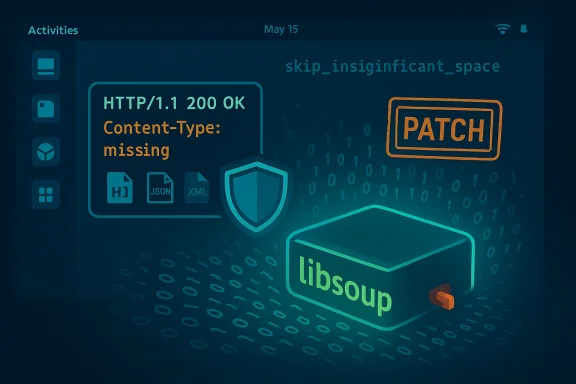
Libsoup is the GNOME HTTP client/server library used by desktop applications, background services and many server components that rely on GNOME networking plumbing or WebKit‑GTK. The recent vulnerability is located in the content sniffing code that reads incoming HTTP responses and attempts to guess a Content‑Type when one isn’t supplied or is ambiguous. That sniffing path includes a helper called skip_insignificant_space (alternatively referenced in some advisories as skip_insight_whitespace in vendor records), which was found to allow a one‑byte read past the end of a heap buffer under specific, crafted inputs.
At first glance the bug sounds small — “one byte” — but the operational consequences matter because:
Practical checks for operators:
Treat any memory‑safety bug as a remediation priority, even if the initial description sounds minimal: in practice, one‑byte leaks and parser edge cases have repeatedly produced both availability and confidentiality consequences for real systems. Apply the patches, add tests for the content‑sniffer code paths, and tighten network and runtime boundaries for processes that handle untrusted HTTP responses.
Source: MSRC Security Update Guide - Microsoft Security Response Center
 Background / Overview
Libsoup is the GNOME HTTP client/server library used by desktop applications, background services and many server components that rely on GNOME networking plumbing or WebKit‑GTK. The recent vulnerability is located in the content sniffing code that reads incoming HTTP responses and attempts to guess a Content‑Type when one isn’t supplied or is ambiguous. That sniffing path includes a helper called skip_insignificant_space (alternatively referenced in some advisories as skip_insight_whitespace in vendor records), which was found to allow a one‑byte read past the end of a heap buffer under specific, crafted inputs.At first glance the bug sounds small — “one byte” — but the operational consequences matter because:
- the flaw is reachable over the network (the client-side reader processes a response from a remote server), and it affects multiple supported libsoup branches used across distributions and products; and
- out‑of‑bounds reads, even of a single byte, can leak memory contents, destabilize the process, or be a stepping stone in more complex exploitation chains. Vendor trackers therefore assigned a High or Important severity to the issue in many package advisories.
What the bug is, in plain technical terms
How content sniffing works in libsoup
When a libsoup client receives an HTTP response without an explicit or reliable Content‑Type header, the library uses a sniffing routine to inspect the initial bytes of the payload and guess the type (HTML, XML, JSON, MP4, etc.). This logic is implemented in soup‑content‑sniffer.c and uses a set of small helper routines to step through whitespace and test for known magic sequences.The fault: skip_insignificant_space
skip_insignificant_space is intended to advance a read pointer across spaces and control characters that aren’t significant for the sniffing heuristics. Under a crafted response layout — typically when inputs present unexpected buffer boundaries or truncated segments — the function computes an index and then reads a byte beyond the allocated buffer. The result is a heap out‑of‑bounds read (CWE‑125). Vendors have consistently described this as a one‑byte read past the end of a heap buffer; however, one byte is often enough to reveal adjacent memory or to destabilize memory safety checks, so defenders must treat it seriously.Exploitability and realistic impact
- Attack vector: network — a client that connects to a malicious HTTP server can receive the crafted response that triggers the condition.
- Attack complexity: vendors stabilize around “High” or “Important” severity classifications because an attacker can trigger the condition remotely, but the actual exploitability to achieve a full compromise is more nuanced: out‑of‑bounds reads are typically confidentiality or stability issues unless combined with other memory‑corruption primitives.
- Practical outcomes: a remote malicious server can cause a libsoup‑based client to read adjacent memory (potential information disclosure), cause a crash (denial of service for that client process), or in rare, context‑specific cases be part of a chain that leads to further compromise. Several distribution advisories flag availability consequences and recommend patching as an operational priority.
Which products and versions are affected
Multiple feeds and vendor trackers list affected packages across both libsoup2.4 and libsoup3 lines — the exact affected set depends on distribution packaging and backports. Red Hat’s CNA entry and distribution errata enumerate affected platform packages; Debian and Ubuntu trackers list fixed package versions and the upstream commits that close the issues. Upstream fixes appear in the 3.6.x maintenance line, and many distributions have shipped 3.6.5 (or equivalent backports) to remediate the problem.Practical checks for operators:
- Inspect the installed libsoup package(s) and version in your environment (libsoup2.4 vs libsoup3 packaging varies by distro).
- Confirm whether your distribution’s security errata or patch queue includes a libsoup update that addresses CVE‑2025‑2784 (and companion CVEs in the content‑sniffer code paths).
Why this matters operationally (blast radius and supply‑chain reach)
Libsoup is embedded in many GNOME apps and is a dependency of components that sit in both desktop and server stacks (for example, tooling that uses WebKit‑GTK or background updaters that make HTTP calls). A vulnerable libsoup in a client library means:- Any software that acts as an HTTP client against untrusted servers can be directed to a malicious host that delivers a crafted response to trigger the bug.
- Embedded or vendor‑shipped appliances and container images that include older libsoup builds are at risk until vendors rebuild images or backport fixes. Oracle and SUSE advisories explicitly list errata for mults.
- The vulnerability’s presence alongside several other sniffing and header‑parsing bugs discovered in the same timeframe increases the operational urgency: multiple distinct parsing defects in the same module raise the chance that some deployments may still be exposed via different functions or lines of code.
Vendor response and patched releases (what was done)
Multiple vendors and distributions followed a rapid remediation path:- Upstream libsoup maintainers fixed the vulnerable sniffing routines and released maintenance updates in the 3.6.x series (distributions reference 3.6.5 as the mitigated release in many packaging trees).
- Red Hat published errata and mapped the CVE across RHEL variants; Oracle’s CVE repository and SUSE security advisories list the fix in their errata.
- Debian and Ubuntu reported patches and backports in their trackers, adjusting packaging and adding test coverage for the affected sniffing paths. Debian’s bug reports show specific patches and references to upstream commits that resolve the issue.
Mitigation, detection and remediation checklist
If you operate software or platforms that include libsoup (client libraries, desktop apps, background services, containers, appliances), follow this prioritized checklist:- Inventory
- Locate all packages and binary artifacts that include libsoup2.4 or libsoup3 libraries. Use package manager queries (rpm, dpkg) and static binary scans for embedded libsoup code.
- Patch
- Apply your distribution’s security updates that include the libsoup patch (many vendors have already released errata). For environments that cannot immediately patch, consider rebuilding your product with an upstream patched libsoup release.
- Hardening & workarounds (temporary)
- Constrain which remote hosts your clients can communicate with using egress filtering or network policies; if a client should never talk to arbitrary internet hosts, enforce that at the network/host level.
- Run high‑risk client processes in constrained sandboxes: reduce privileges, use seccomp filters, or run them as unprivileged containers to limit impact if they crash or misbehave.
- Detection & monitoring
- Watch for unexplained crashes, backtraces or abnormal core dumps in libsoup‑using processes following HTTP calls. Crash reporters and system logs are strong indicators of attempted exploitation or malformed traffic.
- Test
- If your product vendor‑bundles libsoup, add regression tests that exercise content sniffing and boundary conditions; several distributions have added tests as part of their backports and packaging.
- Supply chain hygiene
- For container images and appliances, rebuild base images with the patched libsoup packages and redeploy. Do not rely on “it’s only one byte” excuses when producing long‑lived images or firmware.
Risk analysis: strengths of the response and remaining risks
Notable strengths
- Fast vendor coordination: mainstream distributions (Red Hat, SUSE, Debian/Ubuntu, Oracle and Fedora) rapidly tracked and released updates; upstream maintainers pushed fixes into maintenance releases. This reduces the window of exposure for patched deployments.
- Diverse mitigations: packaging teams not only patched the code but in many cases added tests and clarified intended usage of certain server APIs (for example, notes that SoupServer isn’t intended to be exposed to untrusted clients), reducing implicit attack surface.
Residual/longer‑term risks
- Unpatched or embedded copies: projects and vendors that vendor‑copy libsoup code into their binaries (instead of using system packages) may remain vulnerable until they rebuild. Large fleets of containers, appliances andpical blind spots.
- Multiple sniffing and header parsing issues found at the same time: the content‑sniffer area had several related fixes in a single release window, which increases the chance of missed variants or incomplete coverage in backports. Administrators should treat the package holistically and ensure they apply all related patches.
- Limited but real confidentiality risk: while a one‑byte out‑of‑bounds read may sound minor, the potential for information disclosure or memory‑layout discovery in some contexts is real — especially in multi‑tenant agents or long‑lived processes that handle sensitive in‑memory data.
Technical deep dive: why “one byte” matters in practice
It’s important to translate the low‑level phrasing used in advisories into operational realities.- Memory layout: many modern allocators store small metadata closely around buffers. A one‑byte read beyond a buffer boundary can reveal metadata or adjacent content from another allocation. When processes manage secrets or cached data in memory, even a few bytes of leakage can be meaningful.
- Crash vs leak: an out‑of‑bounds read may cause an immediate crash depending on memory protections or read location (leading to denial of service). Some environments log the crash and auto‑restart the service, but repeated crashes create availability problems at scale. Systems that don’t restart gracefully may leave services unavailable until manual intervention. This echoes established operational patterns for parser‑driven DoS and memory‑safety issues across ecosystems.
- Attack chaining: sophisticated attackers look for small primitives they can chain together. An out‑of‑bounds read can be combined with other vulnerabilities (use‑after‑free, integer overflows, predictable allocator behavior) to escalate or pivot the impact. Security teams should therefore treat memory‑safety flaws conservatively.
Recommended timeline and remediation priorities for defenders
- Immediate (within 24–72 hours)
- Inventory all endpoints and images that include libsoup (clients and servers), and begin patching high‑exposure systems (clients that talk to untrusted HTTP servers, front‑line workstations used for browsing untrusted content, CI runners that consume external URLs).
- Short term (1–2 weeks)
- Patch remaining systems, rebuild and redeploy container images, apply vendor hotfixes and ensure any vendor appliances you use have shipped and applied fixes. Confirm via package manager metadata that fixed versions are installed.
- Medium term (1–3 months)
- Add targeted detection and regression tests for content sniffing and header parsing. Harden client processes that accept responses from untrusted servers and consider stricter egress controls where operationally feasible.
- Ongoing
- Replace vendor‑embedded copies with system packages where feasible, and require security sign‑off for any future packaging that vendor‑bundles network libraries. Keep an eye on upstream commits and CVE mappings as additional related fixes have been found on.
Practical notes for developers and packagers
- If you maintain an upstream or downstream product that bundles libsoup, rebuild against the patched release and run the new upstream test cases that touch the content sniffer; maintainers for Debian and other distributions specifically added these tests to their packaging to prevent regressions.
- On server‑side usage: libsoup includes both client and server APIs. Upstream clarified documentation in recent releases to emphasize that SoupServer is not intended for direct exposure to arbitrary, untrusted clients without additional fronting or filtering — treat server deployments behind untrusted client endpoints carefully and prefer hardened, dedicated server frameworks for public endpoints.
- For embedded builds or statically linked binaries, perform a binary search for the string names (e.g., skip_insignificant_space, soup-content-sniffer) and verify whether the binary contains the vulnerable code; if so, plan a rebuild.
Conclusion
CVE‑2025‑2784 is a concentrated example of how a small memory‑safety bug in a widely used parsing/sniffing routine can trigger outsized operational work: a remote, one‑byte out‑of‑bounds read in libsoup’s content sniffer affects clients that talk to untrusted servers, spans multiple distribution lines and required coordinated upstream and downstream patches. The good news is that upstream and major distributions responded quickly and provided fixes; the remaining challenge for administrators and product teams is to find every copy of libsoup in their stacks — including vendor images, embedded builds and containers — and apply the corresponding updates or rebuilds.Treat any memory‑safety bug as a remediation priority, even if the initial description sounds minimal: in practice, one‑byte leaks and parser edge cases have repeatedly produced both availability and confidentiality consequences for real systems. Apply the patches, add tests for the content‑sniffer code paths, and tighten network and runtime boundaries for processes that handle untrusted HTTP responses.
Source: MSRC Security Update Guide - Microsoft Security Response Center
