

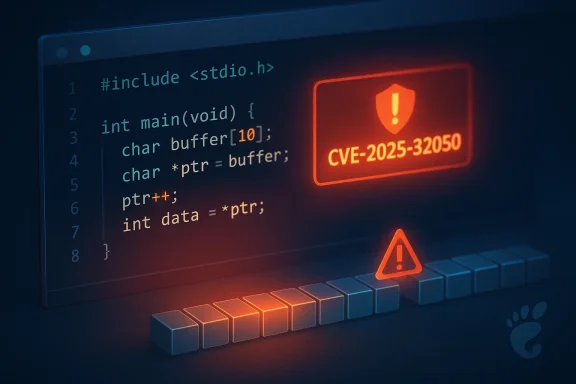
A newly published vulnerability in the GNOME HTTP library libsoup — tracked as CVE-2025-32050 — exposes an integer overflow / buffer under-read in the library’s append_param_quoted() routine that can crash applications or leak memory and has already prompted coordinated vendor advisories and fixes across major Linux distributions.
libsoup is a widely used C library that implements HTTP client and server functionality for GNOME and many Linux desktop and embedded projects. It is also embedded in third‑party applications that build or manipulate HTTP headers and parameters. The newly disclosed defect lives in the function append_param_quoted(), a helper used to format parameter=value pairs where the value is quoted and may require escaping.
At a high level the bug occurs when length calculations or pointer arithmetic inside append_param_quoted() overflow or otherwise miscompute a destination index. Under specific inputs and buffer conditions the function can read memory before the start of the destination buffer — a buffer under-read — and in practice this can cause segmentation faults (crashes), disclosure of adjacent memory contents, or, under extreme and carefully engineered heap layouts, potentially give rise to more powerful memory-corruption primitives. Vendors that have triaged and published advisories characterize the issue as having high availability impact while the CVSS base score settled in the medium range due to high attack complexity and other contextual factors.
This article explains the technical root cause in approachable detail, summarizes vendor response and affected packages, offers step‑by‑step mitigation and detection guidance for operators, and provides a candid assessment of risk and residual exposure for organizations that use libsoup directly or through third‑party software.
The routine is performance‑oriented C code that typically manipulates raw pointers and characters rather than higher‑level safe constructs; that design yields compact, fast code but requires careful bounds calculations.
Treat this vulnerability as an operational priority if you host public HTTP services or use third‑party software that could push untrusted values into header formatting logic. Patch quickly, but thoughtfully: validate rebuilt artifacts, scan images and CI caches, and apply short‑term mitigations where patch rollout is delayed. Finally, use this incident as a prompt to harden test suites with boundary and fuzzing checks so similar pointer/arithmetic mistakes are caught before production.
Source: MSRC Security Update Guide - Microsoft Security Response Center
 Background / Overview
libsoup is a widely used C library that implements HTTP client and server functionality for GNOME and many Linux desktop and embedded projects. It is also embedded in third‑party applications that build or manipulate HTTP headers and parameters. The newly disclosed defect lives in the function append_param_quoted(), a helper used to format parameter=value pairs where the value is quoted and may require escaping.At a high level the bug occurs when length calculations or pointer arithmetic inside append_param_quoted() overflow or otherwise miscompute a destination index. Under specific inputs and buffer conditions the function can read memory before the start of the destination buffer — a buffer under-read — and in practice this can cause segmentation faults (crashes), disclosure of adjacent memory contents, or, under extreme and carefully engineered heap layouts, potentially give rise to more powerful memory-corruption primitives. Vendors that have triaged and published advisories characterize the issue as having high availability impact while the CVSS base score settled in the medium range due to high attack complexity and other contextual factors.
This article explains the technical root cause in approachable detail, summarizes vendor response and affected packages, offers step‑by‑step mitigation and detection guidance for operators, and provides a candid assessment of risk and residual exposure for organizations that use libsoup directly or through third‑party software.
The technical story: how an append helper became a public CVE
What append_param_quoted() is supposed to do
In HTTP headers and cookies it is common to emit parameters of the form name="value", where the value may contain characters that must be escaped (for example quotes or backslashes). append_param_quoted() is a convenience routine that builds such fragments into a destination buffer: append the parameter name, append an equals sign and a quoted value, escaping embedded quotes, and terminate the result.The routine is performance‑oriented C code that typically manipulates raw pointers and characters rather than higher‑level safe constructs; that design yields compact, fast code but requires careful bounds calculations.
Where the math goes wrong
The core weakness is an arithmetic / indexing error in how the function computes the amount of room available in the destination buffer and advances its internal pointer while escaping characters. Two key failure modes are:- Integer arithmetic overflow when deriving a size or index from input lengths (for example, computing dest_offset + needed_space). If the intermediate calculation wraps, the code can believe there is more space than exists.
- Unchecked pointer arithmetic while copying and escaping characters. If the destination pointer is advanced or decremented incorrectly, subsequent reads or writes can occur before the start of the allocated buffer.
Why an under‑read matters
A buffer under‑read is slightly different from an overrun: the code reads memory before the buffer. Consequences include:- Crashes and Denial of Service — dereferencing invalid memory or copying garbage can trigger segmentation faults and process termination.
- Information disclosure — the code might incorporate bytes read from memory preceding the buffer into headers or log output, leaking stack/heap contents or secrets.
- Exploit primitive — in complex heap layouts and under favorable conditions an under‑read or small memory corruption can be combined with other issues (heap grooming, predictable allocators) to escalate into arbitrary code execution. That path is typically hard and unproven in many advisories, but it cannot be categorically dismissed.
Who is affected, and how broadly
- Any software that links against the vulnerable versions of libsoup and calls code paths that format header parameters which rely on append_param_quoted() is potentially affected.
- Desktop GNOME components, networked agents, middleware, IoT images, and custom server code that embed libsoup as a dependency are all in-scope.
- Important supply‑chain nuance: statically linked binaries or vendor products that bundled an affected libsoup at build time remain vulnerable until rebuilt with a patched libsoup, even if the host OS package is updated.
Vendor response and packaging status (practical snapshot)
Within days of public disclosure maintainers and Linux vendors published advisories and fixed packages. The coordinated response covered:- Security advisories and package updates from major distributors (multiple vendor advisories and errata were published).
- Patch changes in the libsoup codebase that add bounds checks, fix the arithmetic logic, and stop unsafe pointer advances.
- Distribution backports to stabilize long‑term releases and offered ESM/extended fixes where appropriate.
Practical remediation: a prioritized playbook
Apply the following steps immediately and in order of operational impact.- Inventory first
- Identify all hosts, containers, and images that include libsoup (both libsoup2.4 and libsoup3 variants may appear).
- Search for statically linked or bundled binaries that might include libsoup code (use strings, ldd, or vendor documentation; reconstructed version strings in binaries often reveal build-time libsoup versions).
- Patch and replace
- Install vendor security updates for libsoup from your distribution package channels.
- For container images and appliances, rebuild base images with updated packages and redeploy.
- For third‑party or in‑house static binaries, rebuild the application with an updated libsoup or request an updated release from the vendor.
- Mitigate immediately where patching is delayed
- Apply network filtering or WAF rules to block obviously malformed parameter values or suspiciously long quoted parameters targeting HTTP endpoints that use libsoup.
- Apply process-level resource limits (ulimit, container memory limits) and restart supervisors to reduce the blast radius of repeated crashes.
- Where feasible, sandbox or isolate the affected service so crashes do not cascade to core systems.
- Validate and test
- Run fuzzing or regression tests that exercise header-parameter paths, especially with long and quoting‑heavy inputs.
- Exercise recovery: ensure services restart cleanly and do not leave corrupted state or credentials in logs after a crash.
- Post‑remediation hardening
- Add input length checks and stricter sanitization in application code before handing data to libsoup helpers.
- Where performance budgets allow, prefer higher‑level APIs or GString-like resizable buffers with length checks rather than raw pointer arithmetic.
- Include fuzz and boundary tests in CI for any code that formats or parses network protocol strings.
Detection and incident response: hunting indicators
- Repeated crashes or segmentation faults in processes that use libsoup immediately after HTTP requests with unusual parameter payloads.
- Core dumps or crash reports showing stack traces inside libsoup helper functions, or logs that record malformed header assembly attempts.
- Unexpected memory contents appearing in headers or logs (evidence of memory disclosure).
- Network traffic with excessive quoting or escape characters in URI/query/header parameter values — useful if you can replay such requests against test environments to reproduce the crash.
- Collect core dumps and reproduce crashes in an isolated lab where you can capture exact request payloads and heap state.
- If you can reproduce with a small HTTP sample, sweep your fleet for similar request patterns in access logs to determine whether attempts were opportunistic or targeted.
- Where a breach is suspected (for example, memory contents containing secrets were leaked), assume compromise and rotate secrets, credentials, and certificates as a precaution.
Code-level guidance for developers
The root categories of fix are straightforward engineering discipline:- Validate every length calculation before use; check for integer overflow when computing sizes or offsets.
- Use size_t consistently for buffer sizes and perform explicit overflow checks such as:
- if (len > SIZE_MAX - extra) { fail; }
- Prefer bounded APIs:
- Use safe formatting helpers (snprintf with explicit buffer sizes, or GString with g_string_append_printf() while checking g_string_length()).
- Centralize escaping logic so it operates on temporary, resizable buffers and only copies into the final destination once sizes are known and validated.
- Add unit tests and fuzz harnesses that intentionally pass maximal-length and escape-heavy inputs to the parameter formatting path.
Risk assessment — separating technical fact from risk theatre
- Immediate practical impact: denial of service (DoS) is the most realistic, widespread outcome. Applications that format untrusted input into headers may crash or become unresponsive when fed crafted inputs.
- Confidentiality and integrity impacts are context dependent. Simple callers that only format header fragments are less likely to leak secrets, but a library call that later copies or prints the result could expose memory content.
- Remote code execution (RCE) is theoretically possible but requires a precise, exploitable heap layout or additional weaknesses in the host application. Public vendor advisories and NVD initial records do not assert reliable RCE in the wild; treat RCE claims cautiously unless an exploit proof exists for your exact runtime and environment.
Supply‑chain and deployment nuances you cannot ignore
- Containers and images: many organizations deploy unpatched base images that persist across clusters. Rebuilding images with patched packages is non‑negotiable.
- Statically linked or bundled libsoup: binary artifacts built by vendors or in CI pipelines may embed vulnerable libsoup code. Patching the host OS does nothing to change such artifacts — you must rebuild and redeploy the binary.
- Third‑party vendors: ask vendors of appliances, agents, and middleware whether they have shipped fixed builds. If they have not, insist on timelines or take compensating controls (network segmentation, alternative tooling).
- CI/CD: add checks that flag known-vulnerable versions of libsoup at build time to prevent creating new vulnerable artifacts.
Defensive testing and continuous assurance
This vuln is a reminder to integrate parsing and formatting fuzzing into your CI pipeline, particularly for libraries that handle network protocols. Recommended steps:- Add a simple fuzz harness that calls the parameter formatting path with random lengths, quotes and escape characters.
- Run the harness against both old and patched libsoup builds to validate the fix.
- Automate container/image scans for CVE identifiers and ensure build pipelines fail when base images contain high or medium severity unpatched CVEs.
What to tell management and stakeholders
- The problem is real and actionable: it causes crashes and can leak memory. It has been assigned CVE-2025-32050 and vendors released patches.
- Impact severity is operational: expect potential service disruption if public-facing endpoints use vulnerable libsoup paths.
- Recommended organizational action: prioritize patching public-facing endpoints and rebuild any statically linked applications. If a full patch rollout will take time, apply network rules, memory caps, and increased monitoring immediately.
- Do not underestimate the supply-chain angle: even if OS packages are updated, unpatched binaries may remain in deployment images and CI caches.
Strengths and weaknesses of the response so far
Strengths:- The upstream project and major distributions reacted quickly with patches and advisories, enabling operators to take direct remediation steps.
- The vulnerability is well understood (clear code paths and reproducible crash modes), which helps defenders design specific tests and mitigations.
- The fix is practical: correct arithmetic checks and bounds validation eliminate the root cause without architectural changes.
- Static or bundled binaries remain a persistent risk until rebuilt.
- Some obscure usage patterns or bespoke applications may still call the vulnerable code in ways that bypass simple detection (for example, private forks or in-house modified libsoup).
- Attack complexity is high for RCE, but the threshold for causing DoS is low — this makes noisy opportunistic probing a likely nuisance vector, which can still cause real operational pain.
Incident checklist (one‑page action summary)
- Inventory: find all instances of libsoup across hosts, containers, and binaries.
- Patch: apply distribution updates or rebuild with patched libsoup.
- Rebuild: recompile static binaries / vendor appliances with patched libraries.
- Mitigate: add WAF rules to block suspicious quoting patterns; apply resource limits.
- Test: run fuzz/regression tests on header/parameter formatting paths.
- Monitor: watch for crashes, core dumps, and anomalous requests targeting parameter-heavy endpoints.
- Communicate: notify vendors, customers, and internal teams of remediation status and timelines.
Final verdict — what operators should actually do today
CVE-2025-32050 is not an abstract academic bug: it is a practical, exploitable implementation error in a widely deployed HTTP library. The immediate and most likely consequence in real‑world environments is service disruption (DoS) and potential memory disclosure, and the fix path is straightforward — update packages and rebuild binaries that embed vulnerable code.Treat this vulnerability as an operational priority if you host public HTTP services or use third‑party software that could push untrusted values into header formatting logic. Patch quickly, but thoughtfully: validate rebuilt artifacts, scan images and CI caches, and apply short‑term mitigations where patch rollout is delayed. Finally, use this incident as a prompt to harden test suites with boundary and fuzzing checks so similar pointer/arithmetic mistakes are caught before production.
Source: MSRC Security Update Guide - Microsoft Security Response Center
