

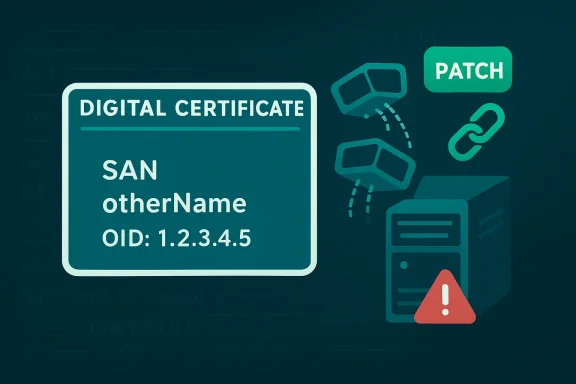
A double‑free in GnuTLS’s Subject Alternative Name export logic — tracked as CVE‑2025‑32988 — can be triggered by a crafted certificate containing an otherName SAN with a malformed type‑id OID, allowing the library to free the same ASN.1 node twice (via asn1_delete_structure()), which in real deployments can cause immediate process crashes, sustained denial‑of‑service, and in some allocator/configurations could lead to memory corruption. This is a supply‑chain risk that touches any product or service that links against vulnerable GnuTLS releases or ships binaries that vendor the library; vendors and operators should treat it as an urgent patching and rebuild priority.
GnuTLS is a widely used TLS and X.509 handling library in Linux distributions, appliances, embedded devices, and many server products. CVE‑2025‑32988 was publicly disclosed in July 2025 and has since been cataloged by major vulnerability databases and distro vendors. The root cause is incorrect ownership bookkeeping when exporting SAN entries that contain an otherName value: if the type‑id OID inside the otherName is malformed or otherwise invalid, the library’s export path calls asn1_delete_structure() on a node it did not own, producing a classic double‑free (CWE‑415). That double‑free can crash processes (DoS) or — depending on heap layout and allocator behavior — escalate to memory corruption.
Two practical points about scope and supply‑chain impact:
Exploitability assessment summary:
CVE‑2025‑32988 is a concrete reminder that memory‑management mistakes in certificate handling libraries are not theoretical: they have real operational consequences for availability and potentially for confidentiality/integrity in specific environments. The fix path is straightforward (apply patched packages and rebuild images), but the operational challenge is ensuring you reach every carrier — packages, images, appliances, and vendor binaries — before an attacker finds and weaponizes the parsing edge case. Act now: inventory, patch, rebuild, and validate.
Source: MSRC Security Update Guide - Microsoft Security Response Center
 Background / Overview
GnuTLS is a widely used TLS and X.509 handling library in Linux distributions, appliances, embedded devices, and many server products. CVE‑2025‑32988 was publicly disclosed in July 2025 and has since been cataloged by major vulnerability databases and distro vendors. The root cause is incorrect ownership bookkeeping when exporting SAN entries that contain an otherName value: if the type‑id OID inside the otherName is malformed or otherwise invalid, the library’s export path calls asn1_delete_structure() on a node it did not own, producing a classic double‑free (CWE‑415). That double‑free can crash processes (DoS) or — depending on heap layout and allocator behavior — escalate to memory corruption.Two practical points about scope and supply‑chain impact:
- The defect is reachable via public GnuTLS APIs, meaning applications that parse, export, or manipulate X.509 SANs via normal library functions can be impacted without special privileges.
- Because GnuTLS is included in many distribution packages, container images, and t, the vulnerability propagates transitively: a vulnerable distro package, a statically linked binary, or a baked‑in container image are all legitimate carriers. Vendor attestations (for example, product‑scoped statements by cloud vendors) matter for triage but do not replace per‑artifact inventory.
What the technical record shows
The flaw — how it occurs
- The function path that exports SAN entries containing an otherName does ownership tracking incorrectly. When the type‑id OID is invalid or malformed, the code calls asn1_delete_structure() on an ASN.1 node that the function does not actually own. Later, when the parent or another caller tries to free the same structure, the allocator sees a second free for the same address — a double‑free.
- Double‑free is a memory‑management error that often produces immediate crashes (SIGABRT / process termination) but can also enable memory corruption patterns depending on allocator, free hooks, heap grooming, or linking with sanitizers.
Trigger model and attack surface
- Trigger: a malformed X.509 certificate or certificate structure that includes an otherName SAN whose type‑id OID is invalid or malformed. Because certificate handling is an exposed surface for many TLS servers, proxies, validators, and certificate‑management tools, the input vector is realistic for network‑facing services.
- Scope: any binary that uses the vulnerable GnuTLS code path — including dynamically linked system packages, statically linked third‑party binaries, container images, and appliances. In many cases vendors have backported fixes; in other cases a rebuild is required.
Severity and scoring — why scores differ
Different authorities have produced different CVSS v3.x scores for this CVE. For example:- The NVD records a high impact vector (CVSS v3.1 base ~8.2) emphasizing the network exploitable memory‑corruption risk.
- Several distribution trackers and vendor pages list a medium base score (CVSS 3.1 ~6.5), which often reflects a conservative assessment of attack complexity or mitigations in typical packaging.
- Attack complexity and assumptions — some scorers treat the exploit complexity as low because the malformed certificate can be supplied by a remote actor; others rate complexity high if exploitation requires precise heap conditions or vendor‑specific usage patterns.
- Practical impact variance — in many deployments the most likely, repeatable outcome is a crash/DoS (availability impact); a smaller subset of environments with predictable heap layout could see memory corruption leading to code execution. Scorers pick different expected outcomes when settling on a single numeric score. Operators should adopt the higher severity when deciding triage priority for network‑facing services.
Who and what is affected
Affected components
- GnuTLS releases prior to the fixed upstream release (packagers list “< 3.8.10” or similar in many advisories). Vendors updated packages and backports shortly our environment runs older GnuTLS libraries (3.8.9 and earlier, or vendor builds based on those), you are in‑scope.
- Any product that links to or vendors GnuTLS: Linux distributions (RHEL, Fedora, Ubuntu, SUSE, Debian, Amazon Linux), appliances (storage, networking, middleware), container images, and embedded devices. Vendor advisories (Amazon, IBM, Oracle, Red Hat, SUSE) list packages and fixed releases.
- Third‑party binaries that statically link GnuTLS or vendor a copy inside their build artifacts remain vulnerable until rebuilt and republished, even if the host OS packages are updated. This is a standard supply‑chain caveat.
Priority list for operators
- Highest priority: externally exposed TLS terminators, reverse proxies, API gateways, certificate‑validation services, and software that consumes untrusted certificates (for example, automated collectors that parse remote cert chains). These are directly reachable by remote attackers.
- Medium priority: internal services that parse certificates from semi‑trusted peers or run in mixed‑trust environments (log aggregators, internal proxies).
- Lower priority: systems where GnuTLS is present but the affected code path is never used (still patch, but schedule after exposed services).
Mitigation and remediation
Vendor patches and recommended upgrades
Multiple vendors and distributions have published fixes and package updates. The practical remediation is:- Update GnuTLS to the vendor‑provided patched package (many distros moved to or package the upstream 3.8.10 release that contains fixes). Where a distribution has provided a backport, install the distribution update. For container images and statically linked binaries, rebuild images and artifacts against the fixed library. (packages.fedoraproject.org)
Detection and inventory (immediate, hours)
- Inventory binaries and packages:
- RPM systems: rpm -qa | grep -i gnutls
- DEB systems: dpkg -l | grep -i gnutls
- Containers: inspect image package lists (or run an ephemeral container and query /usr/lib, /usr/lib64, /var/lib/dpkg/status).
- Scan images with your container scanner (Snyk, Trivy, Clair, vendor scanners) to find images containing the vulnerable library.
- Search for statically linked or vendored copies (strings | grep -i gnutls in binaries can help but is noisy). Where SBOMs exist, consult them — SBOMs often show transitive linkage to GnuTLS.
Remediation (next 24–72 hours depending on exposure)
- Patch the system package or apply vendor‑published package updates. Reboot or restart services as required.
- Rebuild and redeploy any container images that include the vulnerable library. Remember that updating the host package does not fix immutable container images.
- Rebuild and republish any statically linked binaries or vendor artifacts that include the library embedded at build time. A binary rebuild is required because runtime package updates cannot modify code already bundled into an executable.
Temporary mitigations if you cannot patch immediately
- Restrict network exposure. Limit ingress to services that parse certificates. Use firewall rules, WAF policies, or internal routing to reduce direct exposure.
- Input validation/ingress filtering. Where possible, reject or quarantine certificate inputs that contain nonstandard OIDs or unexpected certificate structures. This is application‑specific and not universally feasible.
- Process hardening. Run services under process supervisors that limit blast radius (systemd service restarts, container restarts, resource limits). Add monitoring to detect crashes and automated remediation steps.
Detection: indicators and post‑patch validation
Recommended checks after applying patches:- Verify package version: rpm -q gnutls or dpkg -s gnutls and confirm the vendor advisory’s fixed version. Many advisories list exact package versions; use those as authoritative.
- Run integration tests that exercise TLS certificate parsing and SAN/otherName handling paths (unit tests that validate certificate import/export flows are particularly useful).
- Monitor logs for sudden process terminations, core dumps, or OOM/crash patterns in services that were using GnuTLS prior to the update. Post‑patch, absence of crashes during certificate parsing is a good signal.
Exploitability, PoC status, and real‑world risk
Several vulnerability feeds and trackers recorded the CVE as exploitable remotely and cited PoC code availability claims. Some aggregator pages list public PoCs hosted on code repositories; however, unverified PoC claims vary in quality and may not be reliable or complete. Treat public PoCs with cautiooC code against production systems is dangerous and can itself cause corruptions or outages. Before using any third‑party PoC, review it in a lab environment and validate its behavior against patched/unpatched binaries.Exploitability assessment summary:
- Likely: Denial‑of‑Service — repeating the malformed input will reliably crash many vulnerable processes. This is the most immediate realistic impact.
- Uncertain but possible: Memory corruption / escalation — because the bug is a double‑free, there are scenarios where heap manipulations could lead to arbitrary memory corruption and potential code execution. Those scenarios depend on allocator, binary protections (ASLR, hardened allocators), and application environment. Many vendors rated the most likely impact as availability (DoS) while not ruling out memory corruption in specific conditions.
Operational recommendations (practical checklist)
- Inventory: Find all hosts, containers, and artifacts that include GnuTLS. Use package managers, SBOMs, and image scanners.
- Patch hosts: An vendor’s GnuTLS security update immediately for exposed systems. Confirm restart/reload plans for services that need it.
- Rebuild images: Rebuild container images and statically linked binaries that include GnuTLS and redeploy. Don’t rely on host updates to fix immutable artifacts.
- Verify: Confirm updated package versions and validate certificate parsing flows. Monitor for crashes.
- Mitigate if you can’t patch: Restrict exposure, apply ingress validation where practical, and increase logging/monitoring for suspicious certificate inputs.
Why this matters: supply‑chain and vendor attestation nuance
Large vendors are rolling out machine‑readable VEX/CSAF attestations that state which of their products were found to include vulnerable upstream componentare valuable, but they are usually product‑scoped and phased; a single vendor line that "Product X includes library Y" is an authoritative attestation for that named product, not an exhaustive statement that no other vendor artifacts can include it. In other words: treat vendor attestation as a triage priority signal, not proof that other artifacts are safe — and always perform artifact‑level scanning for your estate. This principle applied to GnuTLS CVEs in 2025 and remains operationally important when triaging distribution‑level advisories.Example vendor responses and fixed versions (representative)
- Upstream / release: GnuTLS documentation and release artifacts show the library series and the 3.8.10 manual/release metadata; many distros packaged 3.8.10 as the post‑fix release. Confirm the upstream release notes for exact commit references in your environment.
- Ubuntu: published a CVE listing and updated packages (Ubuntu security notices show package fixes). Confir in the Ubuntu advisory for the release you run.
- Amazon Linux (ALAS): issued ALAS advisories and marked Amazon Linux 2023 images as fixed in August 2025.
- Red Hat / SUSE / Debian / Oracle: released advisories and errata with fixed package versions or backports; consult the vendor errata for the precise RHSA/DLA/RH versions to apply.
Risks, caveats and unanswered questions
- Public exploits and PoCs reported on aggregator sites are inconsistent; do not assume a polished, reliable exploit exists in the wild that gives remote code execution. The most clearly reproducible impact remains denial‑of‑service. However, a conservative defensive posture assumes possible exploitation paths beyond DoS until proven otherwise.
- Vendor CVSS scores differ; use the higher severity for triage on internet‑facing services. The presence of both medium and high numeric scores across authorities reflects reasonable disagreement about how easy full corruption or escalation is in practice.
- Because many vendor artifacts (Marketplace images, third‑party appliances) are outside a single vendor’s attestation scope, operational teams must still scan their image registries, Marketplace artifacts, and SBOMs to find hidden carriers. Microsoft’s product‑scoped CSAF/VEX attestations are useful but not exhaustive — treat them as a prioritization tool.
Final action checklist (concise)
- Inventory hosts, containers, and artifacts for GnuTLS presence (rpm/dpkg/image scans).
- Apply vendor security updates for GnuTLS now for all internet‑facing and certificate‑parsing services.
- Rebuild and redeploy container images and any statically linked binaries that vendor GnuTLS.
- Monitor logs for crashes, core dumps, and unexpected TLS parsing errors.
- Restrict ingress and add stricter validation for certificate inputs until all exposed artifacts are patched.
- Ingest vendor VEX/CSAF attestations and SBOMs into automation, but still perform independent artifact scans.
CVE‑2025‑32988 is a concrete reminder that memory‑management mistakes in certificate handling libraries are not theoretical: they have real operational consequences for availability and potentially for confidentiality/integrity in specific environments. The fix path is straightforward (apply patched packages and rebuild images), but the operational challenge is ensuring you reach every carrier — packages, images, appliances, and vendor binaries — before an attacker finds and weaponizes the parsing edge case. Act now: inventory, patch, rebuild, and validate.
Source: MSRC Security Update Guide - Microsoft Security Response Center
