

ABB and CISA have republished an industrial-control advisory for CVE-2025-3756, a denial-of-service flaw in ABB’s IEC 61850 MMS communication stack affecting selected System 800xA, Symphony Plus SD Series, Symphony Plus MR, and S+ Operations deployments worldwide. The vulnerability is not a Windows bug, not an Internet worm, and not a remote takeover story. It is something more familiar to engineers who live with operational technology: a narrow protocol-handling weakness that becomes serious when it sits on a network segment operators assumed was already safe.
That distinction matters. A medium CVSS score can look routine on a vulnerability dashboard, but in a plant, substation, or water facility, “availability only” is often the impact category that keeps people awake. CVE-2025-3756 is a reminder that the most important security boundary in industrial systems is rarely the software patch itself; it is the network architecture that decides whether a malformed packet can ever reach the equipment.
The advisory describes a flaw in ABB’s implementation of the IEC 61850 communication stack for MMS client applications. An attacker with access to the IEC 61850 network can send a specially crafted packet that forces certain ABB communication interfaces or controllers into fault mode, or crashes the S+ Operations IEC 61850 communication driver if the attack is repeated.
That is not the cinematic version of industrial hacking. There is no claim of arbitrary code execution, stealthy process manipulation, credential theft, or sabotage of safety logic. The listed effect is denial of service: PM 877, CI850, and CI868 hardware may fault and require a manual restart; S+ Operations may lose its IEC 61850 connectivity while the broader HMI node remains otherwise available.
But industrial denial of service has a different weight than enterprise denial of service. In an office network, a crashed service may mean a ticket, a failover, and a grumpy meeting. In a control environment, a communication module entering fault state can mean a field visit, an operational workaround, a forced shift in procedure, and a debate over whether the production or utility process can continue safely without a normal telemetry or control path.
This is why the advisory’s most important phrase is not the CVSS score. It is the assumption that the attacker already has access to the IEC 61850 network. That assumption is doing a lot of work. If the network is properly segmented, monitored, and firewalled, the vulnerability is constrained. If the network is flat, bridged into corporate IT, reachable through a stale VPN, or accidentally exposed through a misconfigured remote-access appliance, the advisory becomes a very different story.
The ABB advisory is careful to distinguish between MMS and GOOSE, two protocol families that often appear in IEC 61850 discussions. MMS is the relevant piece here. GOOSE communication, according to the advisory, is not affected by this specific vulnerability.
That distinction will matter to engineers, because IEC 61850 is not a single blob of “grid traffic.” It is a family of services and communication patterns. A vulnerability in one stack or service does not automatically compromise every IEC 61850 function in a site, just as a Windows print-spooler bug does not automatically mean every SMB, Kerberos, or RDP component is broken.
Still, the security lesson is broader than ABB. Industrial networks have spent decades adopting standard Ethernet, standard IP, standard remote access, and standard integration patterns. The benefit has been flexibility, vendor interoperability, and better visibility. The cost is that packet-handling code once reachable only in tightly controlled physical environments is now more likely to sit somewhere near routable infrastructure, jump hosts, engineering workstations, and third-party service paths.
That is the recurring bargain of modern OT. The industry gained manageability by making systems more connected. It then had to rediscover, painfully, that connected systems inherit the failure modes of connectivity.
That messiness is not a clerical annoyance. It is the operational reality of control-system security. In enterprise IT, administrators can often think in product families, release channels, and monthly patch rings. In OT, the installed base is a geological record: controllers installed for one project, HMIs upgraded during another, communication modules inherited from a brownfield expansion, and firmware tracks pinned because a validated process depends on them.
ABB’s remediation schedule reflects that reality. S+ Operations 3.4 was released in January 2026 with the fix. PM 877 firmware 3.53 or later was planned for the first quarter of 2026. CI850 fixes are planned in version C_0 or later in the second quarter of 2026. AC800M 7.0 was released in December 2025, while AC800M 6.1.1-3 is planned for the second quarter of 2027.
That spread is notable. For some customers, a fixed version exists today. For others, the patch path is tied to a future maintenance window, product track, or firmware release. In that gap, segmentation and exposure reduction are not temporary niceties. They are the primary control.
Security teams should resist two bad instincts here. The first is to panic because the affected products live in critical infrastructure sectors such as energy, water and wastewater, chemical, and critical manufacturing. The second is to dismiss the bug because the score says medium.
The more useful reading is that the score encodes a conditional risk. If the IEC 61850 segment is genuinely isolated and accessible only to authorized devices and management paths, the vulnerability is a controlled maintenance issue. If that segment is reachable from broader plant networks, shared engineering workstations, remote vendor access, or loosely governed VPNs, the score understates the operational headache.
Availability has always been the awkward sibling in vulnerability management. Confidentiality bugs get headlines because data theft is easy to explain. Integrity bugs get attention because unauthorized modification feels dramatic. Availability bugs in OT are often treated as less sophisticated, even though stopping a communication function can be enough to force operators into degraded modes.
In this case, the advisory says affected hardware devices can be forced into fault state and require manual restart. That manual restart requirement is the quiet operational sting. A vulnerability that can be cleared only by hands-on intervention is not simply a packet problem; it is a staffing, access, shift-coverage, and incident-response problem.
That nuance matters because OT advisories can easily be flattened into alarmist shorthand. “HMI affected” sounds worse than “a specific IEC 61850 communication function on an HMI node can be made unavailable.” ABB and CISA are drawing a boundary around the impact, and defenders should preserve that boundary in their own internal risk memos.
At the same time, “only the communication function” should not be treated as “therefore unimportant.” The value of an HMI or operations node is not its ability to keep a desktop session alive; it is its role in supervision, control, and operator awareness. If a protocol driver that provides visibility into IEC 61850-connected assets is repeatedly crashed, the local operational impact depends on how the site uses that data.
This is where asset owners have to do the work that advisories cannot do for them. A vendor can state the vulnerable versions and technical effect. Only the plant, utility, or integrator can say whether that IEC 61850 path is operationally critical, redundant, monitored, alarmed, or merely present because of a legacy integration nobody has touched in years.
The recommended mitigation is familiar because it is still the best answer: do not expose process-control and IEC 61850 networks directly to the Internet; keep control-system networks behind firewalls; isolate them from business networks; and use secure, maintained remote-access methods when remote access is unavoidable. Familiarity should not make those recommendations feel optional. Most serious OT incidents begin with a boring sentence that someone assumed had already been handled.
The practical question for administrators is not “Do we have a firewall?” It is whether the firewall policy allows only legitimate IEC 61850 client communications, whether the path is documented, whether unused routes have been removed, and whether an attacker who compromises a normal IT endpoint can pivot to the IEC 61850 segment.
For WindowsForum readers, the Windows angle is indirect but real. The affected ABB components are industrial automation products, not Windows components. But the access paths around them often involve Windows engineering workstations, Windows-based HMIs, domain-joined jump hosts, remote-access tools, file shares, and patch-management exceptions. In many plants, the route to the PLC or communication module begins with a compromised general-purpose machine that was never supposed to be part of the safety argument.
That is why OT security increasingly looks like identity and network hygiene wearing a hard hat. Multifactor authentication for remote access, least-privilege engineering accounts, hardened jump servers, endpoint detection where supportable, and strict separation between corporate and control networks are not glamorous mitigations. They are the walls that decide whether a protocol parser bug remains theoretical.
In industrial settings, restarting equipment may require coordination with operations, maintenance, safety personnel, and sometimes external vendors. It may need to wait for a process window. It may trigger documentation requirements. If equipment is remote, geographically distributed, or inside a high-security facility, the response time can stretch far beyond the few minutes implied by the word “restart.”
This is also why repeated exploitation matters. A one-time fault is a disruption. A packet that can repeatedly force a component into fault state becomes a denial-of-service tool with operational persistence. The attacker does not need to own the controller forever if they can keep knocking a communication path down faster than the site can restore it.
The advisory says ABB had not received reports of exploitation when the advisory was originally issued, and that the vulnerability was privately reported. That is good news. It means defenders are not reading about a bug after watching it appear in incident reports.
But private disclosure is not a sleep aid. Publication changes the information environment. Once a vulnerability is described, asset owners should assume that researchers, adversaries, and opportunists will study the affected stack, the product lines, and the network conditions required to reproduce the fault. The right response is not panic; it is accelerated verification of exposure.
This is where industrial security inventories often fail. A CMDB may know that a plant has ABB. It may even know “800xA.” It may not know which CI868 modules are installed, what firmware is running, whether S+ Operations includes IEC 61850 connectivity, or whether a retired communication route is still reachable. In the office world, imperfect inventory is an inconvenience. In OT, it is the difference between a targeted maintenance plan and a guessing exercise.
The advisory says customers can review installations to determine whether they are using an impacted product and that no additional analysis tools are needed for that determination. That is helpful, but only if the installation record is accurate. If the team has to discover firmware versions by logging into systems during a narrow maintenance window, the administrative burden becomes part of the vulnerability.
The lesson is not that every site needs a massive new asset platform tomorrow. It is that operational technology needs inventories that match the way vendors issue advisories. Product family is not enough. Defenders need module identity, firmware version, communication role, network zone, remote-access path, and operational criticality.
That matters because many asset owners do not have a direct, living relationship with every vendor whose equipment sits in their facility. Equipment may have been installed by an integrator, inherited through acquisition, supported by a contractor, or frozen under a long-term service arrangement. CISA republication helps push vendor advisories into the broader vulnerability-management ecosystem where security teams are already looking.
The flip side is that republication can create a false sense of novelty. CISA’s April 30, 2026 republication date is not the same as the original ABB release date of April 13, 2026. For teams triaging alerts, that distinction matters. A “new” CISA page may describe a vendor advisory that has already been available for weeks, and remediation timelines may refer to releases already out or still pending.
That date confusion is common in vulnerability operations. CVE publication, vendor advisory release, national CERT republication, NVD enrichment, scanner-plugin release, and exploit-code chatter can all happen on different days. Mature teams track the chain, not just the most recent alert timestamp.
That does not make Windows the villain. It makes Windows the connective tissue. If an attacker needs access to an IEC 61850 network, they may not start by attacking ABB hardware directly. They may phish an engineer, compromise a remote-access account, exploit an unpatched VPN endpoint, abuse a shared admin credential, or pivot from a corporate workstation into an engineering subnet that was supposed to be isolated by policy rather than by enforceable controls.
For IT pros who support industrial environments, this advisory is an invitation to test assumptions. Can a compromised office laptop route to the IEC 61850 network? Can a help-desk admin reach an engineering workstation that can reach the ABB devices? Are vendor remote sessions brokered through a monitored jump host, or do they land wherever convenience won the last maintenance outage? Are firewall rules written around named business needs, or around a decade-old “any-any until commissioning is done” exception?
Those questions are less exciting than reverse engineering a packet parser, but they are more likely to determine whether CVE-2025-3756 is exploitable in a real facility. OT security is often won or lost before the first exploit packet is sent.
The ABB schedule reinforces that patch management is not a single event. S+ Operations customers can look to version 3.4 or later. PM 877 customers need 3.53 or later. CI850 customers are waiting for C_0 or later. AC800M customers may be on a 7.0 path now or a 6.1.1-3 path planned for 2027. The right plan depends on the installed base.
That makes risk acceptance more explicit. If a site cannot patch a vulnerable module immediately, the compensating controls need to be named, tested, and owned. “It is on an isolated network” should become a verified statement with diagrams, firewall rules, route tables, remote-access logs, and periodic review. “No Internet exposure” should include the uncomfortable edge cases: cellular modems, vendor appliances, temporary commissioning laptops, and unmanaged switches in cabinets nobody has opened lately.
Patch management in OT is less about chasing every CVE than about deciding which failure modes are unacceptable. A crafted packet that can force a device fault is exactly the kind of vulnerability that should push teams to examine whether their recovery assumptions are realistic.
That last point is crucial. IT may own vulnerability scanners and identity controls. OT may own the process risk. Operations may own the decision to take equipment out of service. Vendors may own the firmware path. If those groups meet for the first time during an incident, the incident has already become more expensive.
The advisory also rewards sites that treat protocol allow-listing seriously. If only known clients should speak to a given IEC 61850 service, the firewall should reflect that. If S+ Operations implements only client services and is not intended to listen for incoming connection requests, then network policy should not allow arbitrary inbound traffic to test that statement.
None of this eliminates the need to patch. It changes the shape of urgency. A vulnerable device on a tightly controlled subnet with monitored and restricted access is a managed risk while awaiting a maintenance window. The same device on a porous plant network is a deferred incident.
Source: CISA ABB System 800xA, Symphony Plus IEC 61850 | CISA
That distinction matters. A medium CVSS score can look routine on a vulnerability dashboard, but in a plant, substation, or water facility, “availability only” is often the impact category that keeps people awake. CVE-2025-3756 is a reminder that the most important security boundary in industrial systems is rarely the software patch itself; it is the network architecture that decides whether a malformed packet can ever reach the equipment.
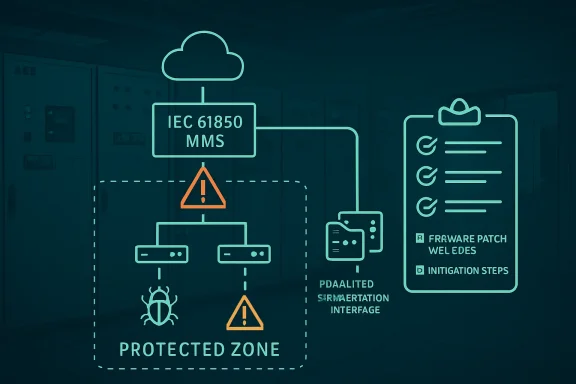 The Bug Is Small; the Blast Radius Is Architectural
The advisory describes a flaw in ABB’s implementation of the IEC 61850 communication stack for MMS client applications. An attacker with access to the IEC 61850 network can send a specially crafted packet that forces certain ABB communication interfaces or controllers into fault mode, or crashes the S+ Operations IEC 61850 communication driver if the attack is repeated.That is not the cinematic version of industrial hacking. There is no claim of arbitrary code execution, stealthy process manipulation, credential theft, or sabotage of safety logic. The listed effect is denial of service: PM 877, CI850, and CI868 hardware may fault and require a manual restart; S+ Operations may lose its IEC 61850 connectivity while the broader HMI node remains otherwise available.
But industrial denial of service has a different weight than enterprise denial of service. In an office network, a crashed service may mean a ticket, a failover, and a grumpy meeting. In a control environment, a communication module entering fault state can mean a field visit, an operational workaround, a forced shift in procedure, and a debate over whether the production or utility process can continue safely without a normal telemetry or control path.
This is why the advisory’s most important phrase is not the CVSS score. It is the assumption that the attacker already has access to the IEC 61850 network. That assumption is doing a lot of work. If the network is properly segmented, monitored, and firewalled, the vulnerability is constrained. If the network is flat, bridged into corporate IT, reachable through a stale VPN, or accidentally exposed through a misconfigured remote-access appliance, the advisory becomes a very different story.
IEC 61850 Was Built for Interoperability, Not for Magical Isolation
IEC 61850 is one of the protocols that helped modernize substations and electrical automation by making devices from different vendors speak a common language. It is a foundation for digital substations and related automation environments, often carrying time-sensitive messages and structured data between intelligent electronic devices, gateways, controllers, and supervisory systems.The ABB advisory is careful to distinguish between MMS and GOOSE, two protocol families that often appear in IEC 61850 discussions. MMS is the relevant piece here. GOOSE communication, according to the advisory, is not affected by this specific vulnerability.
That distinction will matter to engineers, because IEC 61850 is not a single blob of “grid traffic.” It is a family of services and communication patterns. A vulnerability in one stack or service does not automatically compromise every IEC 61850 function in a site, just as a Windows print-spooler bug does not automatically mean every SMB, Kerberos, or RDP component is broken.
Still, the security lesson is broader than ABB. Industrial networks have spent decades adopting standard Ethernet, standard IP, standard remote access, and standard integration patterns. The benefit has been flexibility, vendor interoperability, and better visibility. The cost is that packet-handling code once reachable only in tightly controlled physical environments is now more likely to sit somewhere near routable infrastructure, jump hosts, engineering workstations, and third-party service paths.
That is the recurring bargain of modern OT. The industry gained manageability by making systems more connected. It then had to rediscover, painfully, that connected systems inherit the failure modes of connectivity.
ABB’s Affected List Is a Map of Real-World Legacy
The affected products are not one neat software package with one version number. They span AC800M System 800xA CI868 modules, Symphony Plus SD Series CI850 modules, Symphony Plus MR Melody Rack PM 877 controllers, and S+ Operations versions. The vulnerable version ranges are correspondingly messy: multiple 6.x AC800M tracks, several Symphony Plus SD firmware branches, PM 877 versions from 3.10 through 3.52, and S+ Operations 2.1, 2.2, 2.3, and 3.3.That messiness is not a clerical annoyance. It is the operational reality of control-system security. In enterprise IT, administrators can often think in product families, release channels, and monthly patch rings. In OT, the installed base is a geological record: controllers installed for one project, HMIs upgraded during another, communication modules inherited from a brownfield expansion, and firmware tracks pinned because a validated process depends on them.
ABB’s remediation schedule reflects that reality. S+ Operations 3.4 was released in January 2026 with the fix. PM 877 firmware 3.53 or later was planned for the first quarter of 2026. CI850 fixes are planned in version C_0 or later in the second quarter of 2026. AC800M 7.0 was released in December 2025, while AC800M 6.1.1-3 is planned for the second quarter of 2027.
That spread is notable. For some customers, a fixed version exists today. For others, the patch path is tied to a future maintenance window, product track, or firmware release. In that gap, segmentation and exposure reduction are not temporary niceties. They are the primary control.
A Medium Score Can Still Hurt in a Plant
CVE-2025-3756 carries a CVSS v3.1 base score of 6.5, rated medium, with adjacent-network attack vector, low complexity, no privileges required, no user interaction, and high availability impact. The CVSS v4 score appears higher in vulnerability feeds, at 7.1, but the underlying story remains the same: an attacker needs network adjacency, yet the exploit path itself is not described as difficult once that access exists.Security teams should resist two bad instincts here. The first is to panic because the affected products live in critical infrastructure sectors such as energy, water and wastewater, chemical, and critical manufacturing. The second is to dismiss the bug because the score says medium.
The more useful reading is that the score encodes a conditional risk. If the IEC 61850 segment is genuinely isolated and accessible only to authorized devices and management paths, the vulnerability is a controlled maintenance issue. If that segment is reachable from broader plant networks, shared engineering workstations, remote vendor access, or loosely governed VPNs, the score understates the operational headache.
Availability has always been the awkward sibling in vulnerability management. Confidentiality bugs get headlines because data theft is easy to explain. Integrity bugs get attention because unauthorized modification feels dramatic. Availability bugs in OT are often treated as less sophisticated, even though stopping a communication function can be enough to force operators into degraded modes.
In this case, the advisory says affected hardware devices can be forced into fault state and require manual restart. That manual restart requirement is the quiet operational sting. A vulnerability that can be cleared only by hands-on intervention is not simply a packet problem; it is a staffing, access, shift-coverage, and incident-response problem.
The S+ Operations Detail Keeps the Story Honest
The advisory makes a useful distinction around S+ Operations. For that product, the reported impact is not that the entire node becomes unavailable. The IEC 61850 communication driver can crash, and repeated attempts can create a denial-of-service condition for the IEC 61850 connectivity function, but the broader S+ Operations node remains available.That nuance matters because OT advisories can easily be flattened into alarmist shorthand. “HMI affected” sounds worse than “a specific IEC 61850 communication function on an HMI node can be made unavailable.” ABB and CISA are drawing a boundary around the impact, and defenders should preserve that boundary in their own internal risk memos.
At the same time, “only the communication function” should not be treated as “therefore unimportant.” The value of an HMI or operations node is not its ability to keep a desktop session alive; it is its role in supervision, control, and operator awareness. If a protocol driver that provides visibility into IEC 61850-connected assets is repeatedly crashed, the local operational impact depends on how the site uses that data.
This is where asset owners have to do the work that advisories cannot do for them. A vendor can state the vulnerable versions and technical effect. Only the plant, utility, or integrator can say whether that IEC 61850 path is operationally critical, redundant, monitored, alarmed, or merely present because of a legacy integration nobody has touched in years.
“No Workaround” Means the Network Becomes the Workaround
ABB’s advisory says no workarounds are available. That is a blunt sentence, and in control environments it usually means three things: patch when a fixed version exists, reduce exposure until then, and validate whether compensating controls actually block the exploit path.The recommended mitigation is familiar because it is still the best answer: do not expose process-control and IEC 61850 networks directly to the Internet; keep control-system networks behind firewalls; isolate them from business networks; and use secure, maintained remote-access methods when remote access is unavoidable. Familiarity should not make those recommendations feel optional. Most serious OT incidents begin with a boring sentence that someone assumed had already been handled.
The practical question for administrators is not “Do we have a firewall?” It is whether the firewall policy allows only legitimate IEC 61850 client communications, whether the path is documented, whether unused routes have been removed, and whether an attacker who compromises a normal IT endpoint can pivot to the IEC 61850 segment.
For WindowsForum readers, the Windows angle is indirect but real. The affected ABB components are industrial automation products, not Windows components. But the access paths around them often involve Windows engineering workstations, Windows-based HMIs, domain-joined jump hosts, remote-access tools, file shares, and patch-management exceptions. In many plants, the route to the PLC or communication module begins with a compromised general-purpose machine that was never supposed to be part of the safety argument.
That is why OT security increasingly looks like identity and network hygiene wearing a hard hat. Multifactor authentication for remote access, least-privilege engineering accounts, hardened jump servers, endpoint detection where supportable, and strict separation between corporate and control networks are not glamorous mitigations. They are the walls that decide whether a protocol parser bug remains theoretical.
The Manual Restart Is the Real Cost Center
Manual restart requirements are easy to underestimate from a spreadsheet. A vulnerability-management platform can record “availability impact: high” and “remediation: vendor fix,” but it cannot model the real cost of dispatching personnel to recover a faulted module in a controlled environment.In industrial settings, restarting equipment may require coordination with operations, maintenance, safety personnel, and sometimes external vendors. It may need to wait for a process window. It may trigger documentation requirements. If equipment is remote, geographically distributed, or inside a high-security facility, the response time can stretch far beyond the few minutes implied by the word “restart.”
This is also why repeated exploitation matters. A one-time fault is a disruption. A packet that can repeatedly force a component into fault state becomes a denial-of-service tool with operational persistence. The attacker does not need to own the controller forever if they can keep knocking a communication path down faster than the site can restore it.
The advisory says ABB had not received reports of exploitation when the advisory was originally issued, and that the vulnerability was privately reported. That is good news. It means defenders are not reading about a bug after watching it appear in incident reports.
But private disclosure is not a sleep aid. Publication changes the information environment. Once a vulnerability is described, asset owners should assume that researchers, adversaries, and opportunists will study the affected stack, the product lines, and the network conditions required to reproduce the fault. The right response is not panic; it is accelerated verification of exposure.
The Product Exception Is a Clue, Not a Footnote
ABB says System 800xA IEC61850 Connect is not affected. That sentence may seem like a narrow product carve-out, but it points to a larger truth: names in industrial portfolios are treacherous. “System 800xA,” “IEC 61850,” and “Symphony Plus” are not enough to determine exposure. Module, firmware track, deployment role, and exact communication component matter.This is where industrial security inventories often fail. A CMDB may know that a plant has ABB. It may even know “800xA.” It may not know which CI868 modules are installed, what firmware is running, whether S+ Operations includes IEC 61850 connectivity, or whether a retired communication route is still reachable. In the office world, imperfect inventory is an inconvenience. In OT, it is the difference between a targeted maintenance plan and a guessing exercise.
The advisory says customers can review installations to determine whether they are using an impacted product and that no additional analysis tools are needed for that determination. That is helpful, but only if the installation record is accurate. If the team has to discover firmware versions by logging into systems during a narrow maintenance window, the administrative burden becomes part of the vulnerability.
The lesson is not that every site needs a massive new asset platform tomorrow. It is that operational technology needs inventories that match the way vendors issue advisories. Product family is not enough. Defenders need module identity, firmware version, communication role, network zone, remote-access path, and operational criticality.
CISA’s Republication Is About Visibility, Not New Technical Drama
CISA’s notice is a republication of ABB’s CSAF advisory, not an independent incident report. The advisory conversion disclaimer says CISA is increasing visibility and providing the vendor advisory as-is. That may sound bureaucratic, but it is part of a useful trend: industrial advisories are increasingly being distributed in machine-readable formats and amplified through national cybersecurity channels.That matters because many asset owners do not have a direct, living relationship with every vendor whose equipment sits in their facility. Equipment may have been installed by an integrator, inherited through acquisition, supported by a contractor, or frozen under a long-term service arrangement. CISA republication helps push vendor advisories into the broader vulnerability-management ecosystem where security teams are already looking.
The flip side is that republication can create a false sense of novelty. CISA’s April 30, 2026 republication date is not the same as the original ABB release date of April 13, 2026. For teams triaging alerts, that distinction matters. A “new” CISA page may describe a vendor advisory that has already been available for weeks, and remediation timelines may refer to releases already out or still pending.
That date confusion is common in vulnerability operations. CVE publication, vendor advisory release, national CERT republication, NVD enrichment, scanner-plugin release, and exploit-code chatter can all happen on different days. Mature teams track the chain, not just the most recent alert timestamp.
Windows Admins Should Care Because the Perimeter Is Usually Windows-Shaped
A vulnerability in ABB industrial equipment can seem outside the WindowsForum comfort zone until you look at how access to OT actually works. Engineering workstations often run Windows. Vendor tools run on Windows. Operators view HMIs on Windows. Remote support lands on Windows jump boxes. Authentication may touch Active Directory. Backups, logs, and historian integrations often traverse Windows infrastructure.That does not make Windows the villain. It makes Windows the connective tissue. If an attacker needs access to an IEC 61850 network, they may not start by attacking ABB hardware directly. They may phish an engineer, compromise a remote-access account, exploit an unpatched VPN endpoint, abuse a shared admin credential, or pivot from a corporate workstation into an engineering subnet that was supposed to be isolated by policy rather than by enforceable controls.
For IT pros who support industrial environments, this advisory is an invitation to test assumptions. Can a compromised office laptop route to the IEC 61850 network? Can a help-desk admin reach an engineering workstation that can reach the ABB devices? Are vendor remote sessions brokered through a monitored jump host, or do they land wherever convenience won the last maintenance outage? Are firewall rules written around named business needs, or around a decade-old “any-any until commissioning is done” exception?
Those questions are less exciting than reverse engineering a packet parser, but they are more likely to determine whether CVE-2025-3756 is exploitable in a real facility. OT security is often won or lost before the first exploit packet is sent.
Patch Management Is the Easy Sentence and the Hard Program
“Apply updates as they become available” is the cleanest line in any advisory and the hardest line in any plant. Industrial patching must account for uptime commitments, vendor qualification, redundant architectures, firmware compatibility, rollback plans, safety cases, and the inconvenient fact that some systems cannot simply be rebooted on a Tuesday afternoon.The ABB schedule reinforces that patch management is not a single event. S+ Operations customers can look to version 3.4 or later. PM 877 customers need 3.53 or later. CI850 customers are waiting for C_0 or later. AC800M customers may be on a 7.0 path now or a 6.1.1-3 path planned for 2027. The right plan depends on the installed base.
That makes risk acceptance more explicit. If a site cannot patch a vulnerable module immediately, the compensating controls need to be named, tested, and owned. “It is on an isolated network” should become a verified statement with diagrams, firewall rules, route tables, remote-access logs, and periodic review. “No Internet exposure” should include the uncomfortable edge cases: cellular modems, vendor appliances, temporary commissioning laptops, and unmanaged switches in cabinets nobody has opened lately.
Patch management in OT is less about chasing every CVE than about deciding which failure modes are unacceptable. A crafted packet that can force a device fault is exactly the kind of vulnerability that should push teams to examine whether their recovery assumptions are realistic.
This Advisory Rewards the Boring Teams
The organizations best positioned for CVE-2025-3756 are not necessarily the ones with the fanciest detection platform. They are the ones with accurate asset records, disciplined network segmentation, known remote-access paths, tested backups, documented restart procedures, and a working relationship between IT, OT, operations, and vendors.That last point is crucial. IT may own vulnerability scanners and identity controls. OT may own the process risk. Operations may own the decision to take equipment out of service. Vendors may own the firmware path. If those groups meet for the first time during an incident, the incident has already become more expensive.
The advisory also rewards sites that treat protocol allow-listing seriously. If only known clients should speak to a given IEC 61850 service, the firewall should reflect that. If S+ Operations implements only client services and is not intended to listen for incoming connection requests, then network policy should not allow arbitrary inbound traffic to test that statement.
None of this eliminates the need to patch. It changes the shape of urgency. A vulnerable device on a tightly controlled subnet with monitored and restricted access is a managed risk while awaiting a maintenance window. The same device on a porous plant network is a deferred incident.
The Practical Read for ABB Sites Running IEC 61850
The concrete work now is less about drama and more about disciplined narrowing of uncertainty. Teams running ABB System 800xA, Symphony Plus, or S+ Operations with IEC 61850 should turn the advisory into an asset and exposure review, not merely a vulnerability ticket.- Confirm whether AC800M CI868, Symphony Plus SD Series CI850, Symphony Plus MR PM 877, or S+ Operations versions listed in the advisory are present in the environment.
- Verify the exact firmware or software versions, because the affected ranges differ by product line and track.
- Treat IEC 61850 MMS exposure as the key risk path, while noting that GOOSE communication is not affected by this specific vulnerability.
- Prioritize available fixed releases where they exist, including S+ Operations 3.4 or later and the relevant PM 877, CI850, and AC800M firmware tracks as they become available.
- Restrict IEC 61850 network access to legitimate communicating systems and confirm that corporate IT, vendor remote access, and general engineering workstations cannot reach the segment unnecessarily.
- Document the manual recovery procedure for faulted PM 877, CI850, and CI868 devices before an incident forces operators to improvise.
Source: CISA ABB System 800xA, Symphony Plus IEC 61850 | CISA
