

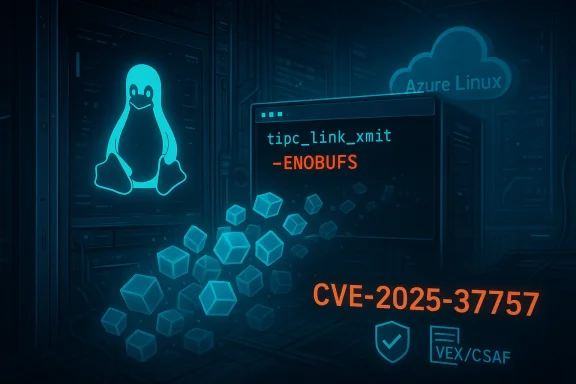
A new Linux-kernel fix tracked as CVE-2025-37757 closes a straightforward but operationally meaningful bug in the Transparent Inter‑Process Communication (TIPC) transmit path: under backlog pressure the tipc_link_xmit() routine could return -ENOBUFS without purging an skb list, leaking memory and potentially allowing a local attacker to exhaust kernel memory and induce denial‑of‑service. Multiple upstream and distributor advisories describe the bug and available patches, and Microsoft’s public guidance names Azure Linux as a product that “includes this open‑source library and is therefore potentially affected” — but that statement is an inventory attestation for Azure Linux, not a blanket guarantee that no other Microsoft product could ship the same vulnerable kernel code. This article explains the technical details of the flaw, what Microsoft’s attestation does and does not mean, how to verify exposure across Microsoft‑owned artifacts (WSL2 kernels, AKS/Marketplace images, and more), and practical steps operators should take to determine and mitigate risk in their environments.
TIPC is a Linux kernel networking subsystem designed for efficient, low‑latency communication between nodes in a cluster environment. It’s not present on every kernel by default — its presence depends on the kernel version and the build configuration (CONFIG_TIPC), and it can be compiled either directly into the kernel or provided as a loadable module. The bug fixed by CVE‑2025‑37757 sits in net/tipc/link.c in the tipc_link_xmit() function: when a backlog transmit queue for system‑importance messages is overloaded, the function returned -ENOBUFS but failed to purge the skb list that had been queued for transmission, leaving memory allocated but unreachable and creating a leak that can be driven into an availability problem. The vulnerability is described in the NVD entry and confirmed by several distribution advisories and vulnerability trackers.
Microsoft’s public statement for this CVE takes the form frequently used in their recently expanded CSAF/VEX program: “Azure Linux includes this open‑source library and is therefore potentially affected.” That phrasing means Microsoft has inventory‑checked its Azure Linux distribution (the Azure Linux kernel and packages) and found the upstream TIPC component in the builds it examined. Microsoft has also communicated that it will expand those machine‑readable attestations (VEX/CSAF) to cover additional Microsoft products if and when those products are discovered to ship the same component. The VEX rollout itself and the reasoning behind product‑scoped attestations is explained in Microsoft’s MSRC blog about VEX.
The practical takeaway for defenders is twofold: treat Azure Linux as a confirmed candidate for remediation, and treat other Microsoft artifacts as unverified until either Microsoft attests them or you inspect the artifact yourself. Absence of an attestation is not proof of absence of exposure. Several downstream Linux distributors and cloud vendors have already produced advisories and patches for CVE‑2025‑37757, underscoring that the vulnerability is real, patched, and tracked across the ecosystem.
Longer explanation:
CVE‑2025‑37757 is a textbook example of how small kernel mistakes produce reliability problems and why transparent, machine‑readable attestations (VEX/CSAF) are useful — but also why those attestations must be understood as scoped inventory statements rather than global proofs. Microsoft’s attestation that “Azure Linux includes this open‑source library and is therefore potentially affected” is accurate and actionable for Azure Linux customers, but safe security practice demands that organizations verify all relevant Microsoft artifacts in their own environments rather than assume universal coverage from a single product mapping. The kernel fixes are available across upstream and distributor trees; apply them where required, and bring your inventory‑and‑patch processes into alignment with the new machine‑readable attestations so you can close these classes of supply‑chain windows faster and with confidence.
Source: MSRC Security Update Guide - Microsoft Security Response Center
 Background / Overview
TIPC is a Linux kernel networking subsystem designed for efficient, low‑latency communication between nodes in a cluster environment. It’s not present on every kernel by default — its presence depends on the kernel version and the build configuration (CONFIG_TIPC), and it can be compiled either directly into the kernel or provided as a loadable module. The bug fixed by CVE‑2025‑37757 sits in net/tipc/link.c in the tipc_link_xmit() function: when a backlog transmit queue for system‑importance messages is overloaded, the function returned -ENOBUFS but failed to purge the skb list that had been queued for transmission, leaving memory allocated but unreachable and creating a leak that can be driven into an availability problem. The vulnerability is described in the NVD entry and confirmed by several distribution advisories and vulnerability trackers.Microsoft’s public statement for this CVE takes the form frequently used in their recently expanded CSAF/VEX program: “Azure Linux includes this open‑source library and is therefore potentially affected.” That phrasing means Microsoft has inventory‑checked its Azure Linux distribution (the Azure Linux kernel and packages) and found the upstream TIPC component in the builds it examined. Microsoft has also communicated that it will expand those machine‑readable attestations (VEX/CSAF) to cover additional Microsoft products if and when those products are discovered to ship the same component. The VEX rollout itself and the reasoning behind product‑scoped attestations is explained in Microsoft’s MSRC blog about VEX.
The practical takeaway for defenders is twofold: treat Azure Linux as a confirmed candidate for remediation, and treat other Microsoft artifacts as unverified until either Microsoft attests them or you inspect the artifact yourself. Absence of an attestation is not proof of absence of exposure. Several downstream Linux distributors and cloud vendors have already produced advisories and patches for CVE‑2025‑37757, underscoring that the vulnerability is real, patched, and tracked across the ecosystem.
What the bug is — technical recap
Where it lives
- Subsystem: net/tipc
- Function: tipc_link_xmit()
- File: net/tipc/link.c
- Symptom: memory leak when backlog queue is full
Impact model
- Attack vector: local (an unprivileged or low‑privileged local process that can send TIPC messages)
- Likely result: resource exhaustion (memory leak) leading to kernel instability or OOM conditions
- Exploitability: requires local access and the ability to generate sustained, malformed or high‑volume traffic to the TIPC transmit path; there are no widespread public proof‑of‑concepts as of disclosure in the advisories reviewed.
Patching and distribution
- Upstream kernel commits were merged and backported into various stable branches; distributors have packaged fixes for supported kernel series.
- Major downstream advisories (SUSE, Amazon ALAS, and others) list the CVE and provide kernel package updates where applicable. Operators running vendor kernels should follow vendor advisories for their specific kernel series.
Microsoft’s attestation: precise meaning and limits
What Microsoft said (and why it matters)
Microsoft’s MSRC program now publishes machine‑readable CSAF/VEX attestations mapping third‑party CVEs to Microsoft products. Their default wording for many Linux kernel CVEs has been to declare the specific Microsoft product(s) they have inventory‑checked as “includes this open‑source library and is therefore potentially affected.” For CVE‑2025‑37757 that product is Azure Linux. That statement is authoritative for Azure Linux — if you operate Azure Linux images, treat them as in‑scope and apply patches or mitigations. Microsoft has explicitly stated they will update CVE/VEX records if additional Microsoft products are identified as affected.What Microsoft did not say
- Microsoft did not assert that only Azure Linux could ever include the TIPC code.
- Microsoft did not certify that Windows, Windows Server, or other Microsoft artifacts are not affected — only that those artifacts have not been publically attested as carriers at the time of the advisory.
- Microsoft did not publish a global scan that proves the absence of TIPC from every Microsoft image or kernel artifact; doing so would be operationally complex and prone to timing mismatch across many internal build pipelines.
Are other Microsoft products likely to include the same code?
Short answer: Yes — it’s possible. But there is no public Microsoft attestation (at the time of the advisory) that explicitly names another Microsoft product as affected beyond Azure Linux.Longer explanation:
- Microsoft maintains and publishes other Linux kernel artifacts — most notably the WSL2 kernel source tree and builds that Microsoft distributes for Windows Subsystem for Linux 2. The WSL2 kernel source is public and maintained in a Microsoft GitHub repository, which demonstrates that Microsoft ships kernel artifacts separate from Azure Linux. Whether TIPC is enabled in a particular WSL2 kernel build depends on the kernel config used for that build.
- Microsoft also supplies images and kernel variants that feed into Azure infrastructure (AKS node images, Marketplace images, custom kernel builds used in certain services). Those artifacts can, in principle, include upstream components that match the CVE if the kernel version and config align.
- In short, any Microsoft‑published or Microsoft‑managed Linux kernel artifact could include tipc because the source code is common upstream; attestation is the only definitive customer‑facing mapping. Microsoft’s VEX program is explicitly designed to expand those mappings over time.
How to verify whether a specific Microsoft artifact is affected
You cannot safely assume the absence of TIPC merely because Microsoft named Azure Linux. Verify by checking the actual artifact—here are practical, repeatable checks you can run on any Linux image or VM.Quick checks (run on the target system)
- Check kernel config for TIPC:
- If /proc/config.gz exists:
- zcat /proc/config.gz | grep CONFIG_TIPC
- Or check /boot/config-$(uname -r):
- grep CONFIG_TIPC /boot/config-$(uname -r)
- Interpret results:
- CONFIG_TIPC=y => compiled in (kernel contains TIPC)
- CONFIG_TIPC=m => compiled as a module (module may be present)
- CONFIG_TIPC is absent or set to n => TIPC not present
- Check loaded modules and available modules:
- lsmod | grep tipc
- modinfo tipc (will show module info if tipc.ko is present in the module path)
- Look for tipc symbols in the running kernel:
- grep -i tipc /proc/kallsyms
- For container images or offline kernels:
- Inspect the kernel image’s config file inside the image (for packaged kernels look for /boot/config-*)
- Extract the initramfs or list modules under lib/modules/ to see if tipc.ko exists
Recommended remediation and mitigation steps
If you operate Azure Linux images- Prioritize patching: apply vendor‑supplied kernel updates from Microsoft for Azure Linux images as soon as they become available in the Azure image pipeline or via your standard patching channels.
- If unable to immediately patch, restrict local access and reduce the attack surface for users who can run processes that exercise TIPC or related network paths.
- Inventory first: run the quick checks above across representative images and kernels you ship or manage.
- If TIPC is present (CONFIG_TIPC=y or m), map the kernel version and check whether the kernel includes the upstream fix range for CVE‑2025‑37757. Use NVD and vendor advisories to identify fixed commit ranges and backported patches.
- Patch the kernel where practically possible: either apply vendor kernel updates, replace images with patched variants, or rebuild custom kernels with the upstream fix backported.
- If patching is delayed, mitigate by lockdown: restrict local access, apply process sandboxing/SELinux/AppArmor rules to limit the ability of unprivileged users to generate sustained TIPC traffic, and monitor for unusual local traffic patterns that could indicate exploitation attempts.
- Identify all Linux images and kernel artifacts in your Microsoft‑managed estate.
- For each artifact, run: zcat /proc/config.gz | grep CONFIG_TIPC OR grep CONFIG_TIPC /boot/config-$(uname -r).
- If CONFIG_TIPC is set to y or m, record kernel version and build identifiers.
- Cross‑check kernel version/build against vendor CVE advisories (NVD, SUSE, ALAS, Microsoft VEX entries).
- Apply patches or replace images where the artifact is confirmed vulnerable.
- For endpoints that cannot be patched immediately, implement compensating controls and monitor.
Practical notes on WSL2 and other Microsoft kernel artifacts
Microsoft ships a WSL2 kernel repository and publishes kernel builds for WSL2; those kernels are real, supported artifacts. Because Microsoft builds and distributes kernel sources for WSL2, those kernels are a plausible carrier for upstream kernel components — but whether any specific WSL2 build includes TIPC depends on the build configuration. Administrators who support Windows endpoints with WSL2 should therefore treat WSL kernels as potentially affected until they verify the kernel config, or until Microsoft publishes an explicit VEX/CSAF attestation for a given WSL kernel artifact. Microsoft’s WSL kernel repo and documentation make it straightforward to inspect the kernel source and configs; operators can also switch to a custom patched kernel for WSL2 using the documented .wslconfig mechanism.Evidence and cross‑checks
- Upstream vulnerability record and description: NVD summarizes the fix and the error path that caused the leak.
- Distributor advisories: SUSE, Amazon Linux (ALAS) and other distribution trackers list the CVE and the fixed kernel package versions; these independent vendor advisories confirm the upstream description and provide packaged remediation.
- Microsoft transparency program: Microsoft’s MSRC blog about the VEX/CSAF rollout documents the phased approach to publishing machine‑readable attestations and explicitly ties the Azure Linux mapping to a scoped inventory process rather than a claim of exclusivity. That VEX/CSAF program underlies the MSRC phrasing that "Azure Linux includes this open‑source library and is therefore potentially affected."
- Community and forum analyses: independent writeups and community threads explain the same attestation nuance: Azure Linux is the product Microsoft has attested so far; other Microsoft artifacts may or may not contain the component, and you should verify them per‑artifact. Those community explanations echo the practical guidance in this article.
- Note on provenance: the pattern of Microsoft attesting Azure Linux first and expanding attestations is visible across multiple CVEs tracked by community analysts and is consistent with Microsoft’s stated VEX rollout approach.
Risks, tradeoffs, and what to watch for
- Risk of false reassurance: treating Microsoft's Azure Linux attestation as an implicit all‑Microsoft guarantee is a common misunderstanding. The real risk is administrative inertia — operators who assume Microsoft’s attestation covers everything may leave other artifacts uninspected.
- Operational tradeoffs: aggressive patching of kernel artifacts (WSL kernels, AKS node images, custom Marketplace images) can be disruptive. Prioritize public cloud and multi‑tenant infrastructure first, then endpoints like developer WSL installations.
- Monitoring and detection: because this is an availability/DoS vulnerability without obvious integrity or confidentiality impact, it’s less likely to generate the same telemetry and signatures as memory corruption exploits. Focus detection on abnormal local resource consumption patterns, repeated allocation failures in kernel logs, and sudden OOM or kernel instability in TIPC‑using hosts.
- Coordination with Microsoft: where Microsoft is the publisher of an artifact you use, rely on the VEX/CSAF feed for authoritative attestations, but supplement that with your own artifact scans. Microsoft has committed to expanding mappings over time; watch MSRC VEX updates for changes.
Final recommendations (for IT/security teams)
- Treat Azure Linux as a confirmed candidate for remediation: follow Microsoft’s patch guidance and the Azure image pipeline.
- Inventory and verify other Microsoft artifacts (WSL2 kernels, AKS nodes, Marketplace images) using the kernel config checks in this article.
- Prioritize patching by exposure: cloud images and multi‑tenant infrastructure first, developer endpoints second.
- Where immediate patches are impractical, apply compensating controls (restrict local access, use sandboxing, monitor resource usage).
- Subscribe to vendor advisories (MSRC VEX/CSAF, NVD, distribution security pages) and incorporate those feeds into your patch management workflow.
- If you find an unpatched Microsoft artifact that includes TIPC and cannot be patched quickly, raise the issue with your Microsoft account team and request a product‑level attestation or an expedited patch roadmap.
CVE‑2025‑37757 is a textbook example of how small kernel mistakes produce reliability problems and why transparent, machine‑readable attestations (VEX/CSAF) are useful — but also why those attestations must be understood as scoped inventory statements rather than global proofs. Microsoft’s attestation that “Azure Linux includes this open‑source library and is therefore potentially affected” is accurate and actionable for Azure Linux customers, but safe security practice demands that organizations verify all relevant Microsoft artifacts in their own environments rather than assume universal coverage from a single product mapping. The kernel fixes are available across upstream and distributor trees; apply them where required, and bring your inventory‑and‑patch processes into alignment with the new machine‑readable attestations so you can close these classes of supply‑chain windows faster and with confidence.
Source: MSRC Security Update Guide - Microsoft Security Response Center
