

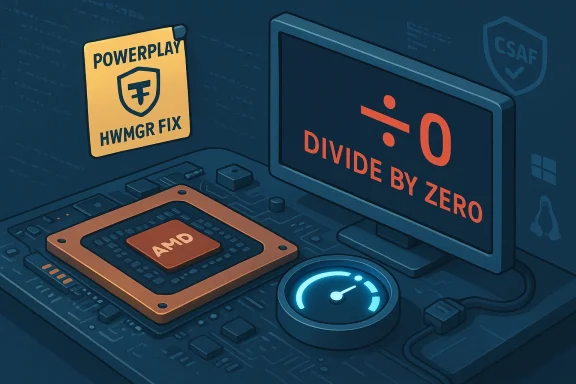
The Linux kernel patch set that closed CVE-2025-37768 fixes a straightforward but impactful arithmetic bug in the AMD DRM driver: under certain conditions the amdgpu power-management code could perform a division by zero when a user-supplied fan speed value exceeded safe bounds, producing a kernel crash and an immediate denial-of-service on the affected host.
CVE-2025-37768 was reported as a divide-by-zero defect in the AMDGPU power-management subsystem — specifically in the drivers/gpu/drm/amd/pm/powerplay/hwmgr code paths used to control fan behavior on a range of AMD hardware. The upstream patch corrects the input validation logic around the fan speed value so the driver refuses out-of-range inputs rather than using them in a calculation that can produce a zero denominator and crash the kernel. This is a robustness/availability bug (denial-of-service) rather than a confidential-data or privilege-escalation issue, but a kernel panic is a serious operational problem in production systems.
From the public advisories and vendor trackers it is clear the kernel community considered the issue a moderate local-privilege robustness flaw: the attacker model requires local access (or the ability to run code as an unprivileged local user) to exercise the vulnerable sysfs/driver interface, but exploitation is trivial once local access exists and can force a full kernel crash. Several downstream distributors backported the fix into their stable kernels and issued vendor advisories and kernel updates.
Put plainly: Microsoft has attested that Azure Linux (the MS-distributed Linux distro lineage) includes the implicated upstream component and therefore is a confirmed, actionable hit. That attestation is authoritative for Azure Linux — but it is not a technical guarantee that no other Microsoft product, image, or kernel artifact ships that same upstream code. The absence of a VEX/CSAF attestation for other Microsoft products is absence of attestation, not proof that those products are unaffected.
Why that nuance matters:
However, there are operational pitfalls that defenders and procurement teams must understand:
Defenders must verify the kernel artifacts they run: check for
Finally, lean into multiple data sources and automation: combine vendor VEX/CSAF attestations, upstream kernel commits, and your internal inventory scans to make confident, rapid remediation decisions. The Microsoft VEX rollout improves transparency — but it does not replace the artifact-level verification every operator must perform to secure their environments.
Source: MSRC Security Update Guide - Microsoft Security Response Center
 Background / Overview
CVE-2025-37768 was reported as a divide-by-zero defect in the AMDGPU power-management subsystem — specifically in the drivers/gpu/drm/amd/pm/powerplay/hwmgr code paths used to control fan behavior on a range of AMD hardware. The upstream patch corrects the input validation logic around the fan speed value so the driver refuses out-of-range inputs rather than using them in a calculation that can produce a zero denominator and crash the kernel. This is a robustness/availability bug (denial-of-service) rather than a confidential-data or privilege-escalation issue, but a kernel panic is a serious operational problem in production systems.From the public advisories and vendor trackers it is clear the kernel community considered the issue a moderate local-privilege robustness flaw: the attacker model requires local access (or the ability to run code as an unprivileged local user) to exercise the vulnerable sysfs/driver interface, but exploitation is trivial once local access exists and can force a full kernel crash. Several downstream distributors backported the fix into their stable kernels and issued vendor advisories and kernel updates.
What Microsoft said — reading the wording carefully
Microsoft’s public guidance for similar Linux CVEs has followed the same pattern in 2025: the company began publishing machine-readable attestations (CSAF/VEX) for Azure Linux in October 2025, and its Security Response Center entries often include a short FAQ answer along the lines of “Is Azure Linux the only Microsoft product that includes this open-source library and is therefore potentially affected by this vulnerability?” The canonical text Microsoft uses explains that Azure Linux has been inventoried and that Microsoft will update the CVE entry if impact to additional Microsoft products is identified. That language is explicitly product-scoped: it states what the company has already verified rather than asserting exclusivity across all Microsoft artifacts.Put plainly: Microsoft has attested that Azure Linux (the MS-distributed Linux distro lineage) includes the implicated upstream component and therefore is a confirmed, actionable hit. That attestation is authoritative for Azure Linux — but it is not a technical guarantee that no other Microsoft product, image, or kernel artifact ships that same upstream code. The absence of a VEX/CSAF attestation for other Microsoft products is absence of attestation, not proof that those products are unaffected.
Is Azure Linux the only Microsoft product that includes this open-source library?
Short answer: No — not necessarily. Microsoft has publicly attested that Azure Linux includes the component, but other Microsoft-distributed Linux kernel artifacts can and do include the same upstream source files; whether any given Microsoft product is actually vulnerable depends on the kernel version, configuration, and whether the vulnerable commit was present or backported in a particular build.Why that nuance matters:
- Microsoft maintains multiple Linux kernel artifacts beyond the Azure Linux distro lineage. Most notably the WSL2 kernel source and build artifacts are published by Microsoft and include the upstream drivers/gpu/drm/amd area — i.e., the amdgpu sources live in the WSL2 kernel tree. That makes WSL2 kernels a plausible carriage mechanism for the same driver code. (github.com)
- Azure cloud images, linux-azure kernel packages, Marketplace appliance images, and other Microsoft-provided kernel binaries are built at different times from possibly different upstream commits and configuration flags. Whether they include the vulnerable code is an artifact-level property.
- Microsoft’s VEX/CSAF rollout was deliberately phased: the company started with Azure Linux as the first product family to which it applied machine-readable attestations. Microsoft’s published blog explains the phased approach and explicitly states they will expand attestations to other products over time.
Evidence that other Microsoft artifacts can carry the same code
There are two practical, verifiable facts defenders should keep in mind:- The upstream Linux kernel commit that fixes CVE-2025-37768 is public and was merged into the kernel trees (the patch and its commit metadata are available in the kernel mailing lists and stable backports). Vendor advisories (SUSE, Oracle, and others) show which downstream package versions include the fix, and these vendors distributed patches to their users.
- Microsoft publishes the WSL2 kernel source on GitHub, and that repository contains the drivers/gpu/drm/amd directory where the amdgpu driver lives. That demonstrates Microsoft-maintained kernel sources do contain the same upstream subsystem; whether a WSL kernel build shipped by Microsoft includes the vulnerable function depends on the tag/branch and .config used. (github.com)
Practical impact and risk assessment
- Attack vector: local. The documented NVD vector shows the vulnerability is exploitable with local access, not remotely. An attacker who can run commands on the host can trigger a kernel panic by writing out-of-range values into the relevant sysfs/fan control interface.
- Exploitability: low barrier once local access exists. The logic that allowed a division by zero was trivial input validation; an unprivileged local user with write access to the relevant interface can cause the crash. This makes the vulnerability useful to an adversary seeking lateral denial-of-service or disruption of a multi-tenant machine, container host, or virtual machine.
- Severity: operationally meaningful. Although CVE-2025-37768 is not a remote RCE or a data-exfiltration vulnerability, it allows immediate and repeated kernel crashes — that translates to availability loss, potential customer impact on cloud VMs, and administrative overhead to restore services.
- Business impact: systems hosting production workloads with AMD GPU hardware (or kernels with amdgpu compiled in) — including VMs, desktops, and WSL2 environments — should treat the issue as requiring prompt attention if they run vulnerable kernel builds or unpatched distributions. Vendor updates are the primary fix; temporary mitigations are limited.
What IT teams should do now — detection and mitigation checklist
This is written for defenders: follow the detection steps first, then apply fixes or mitigations.1. Identify whether your systems contain the affected code
- On each Linux host, check the kernel version:
- uname -r
- Check whether the
amdgpumodule or amdgpu driver is present: - lsmod | grep amdgpu
- modinfo amdgpu
- Inspect the on-disk kernel sources or modules for the specific vulnerable file names or symbols (for example smu7_thermal or the fan control functions):
- grep -R "smu7_thermal" /lib/modules/$(uname -r) || true
- For WSL2 hosts, confirm the WSL kernel version and whether you use a Microsoft-shipped kernel image:
- wsl --status or check the kernel file used by your WSL distribution.
- Cross-check kernel version/patch status with vendor advisories and the upstream kernel commit(s) that fixed the bug.
2. Apply vendor-approved updates (preferred)
- Install the kernel updates your distribution vendor published that contain the CVE fix. Distributors including SUSE, Oracle, and many others issued kernel updates and backports for the amdgpu fixes. Confirm your distro’s advisory and apply updates per your maintenance windows.
3. Short-term mitigations where immediate updates are not possible
- If a patched kernel is not available and you cannot reboot immediately, consider:
- Unloading or blacklisting the
amdgpumodule where it is not required: - echo "blacklist amdgpu" > /etc/modprobe.d/blacklist-amdgpu.conf
- Note: this requires that you are not actively using the GPU in this host; unloading may not be possible if the module is in use.
- Restrict write access to the driver sysfs interfaces so unprivileged users cannot write out-of-range values:
- Identify the affected sysfs paths (for fan control or power-profile sysfs entries) and tighten permissions (chown/chmod) or use udev rules to restrict access.
- In multi-tenant or cloud environments, restrict which accounts or containers have the ability to access host-level device nodes and privileged sysfs interfaces.
- These mitigations are imperfect but may reduce the immediate attack surface until you can apply a patch and perform a controlled reboot.
4. For cloud and WSL customers
- Azure Linux customers: apply the vendor updates published for Azure Linux images as soon as they are available.
- WSL2 users: if you rely on Microsoft's WSL2 kernel image, verify the WSL2 kernel release you are running and update WSL packages or apply an updated kernel VHD from Microsoft if published. Because Microsoft’s WSL2 kernel sources include the amdgpu subsystem, WSL images could carry the same code, depending on build flags. (github.com)
Vendor coordination and Microsoft’s attestation model — analysis and critique
Microsoft’s decision to publish CSAF/VEX attestations and to start with Azure Linux is an important step for supplier transparency: it gives customers machine-readable information they can automate against. The company’s phrasing — attesting Azure Linux and promising to update CVE mappings if other products are identified — is procedurally correct and defensible. Their approach reduces noisy false positives for Azure Linux customers and gives a clear, actionable starting point for remediation.However, there are operational pitfalls that defenders and procurement teams must understand:
- Inventory gap risk: a vendor statement that “Product X includes component Y” is helpful, but organizations cannot rely exclusively on vendor attestations to assert that no other vendor-managed artifact contains the same code. Vendors rolling out VEX/CSAF in phases creates a window of “unattested but possible” exposure for other artifacts — for example the WSL2 kernel, linux-azure kernels used to build cloud images, and marketplace kernels. Those artifacts should be considered unverified until the vendor attests them or you verify them yourself.
- Communication lag: large vendors often disclose third-party CVEs and then update product mappings over time. That is operationally rational (attest what you’ve finished inventorying), but defenders need to treat that process as ongoing rather than final. Plan for verifying and patching artifacts under your control even if the vendor hasn’t yet published a “not affected” or “fixed” VEX entry.
- Automation sensitivity: CSAF/VEX are machine-readable and excellent for automation — but automation must be driven from multiple data points (vendor attestations, local package versions, kernel metadata, and your own inventory signals). Do not automate a “we’re safe because vendor didn’t list us” rule; automated actions should be based on artifact properties (module present, version, package release) and not solely on the presence or absence of a vendor VEX entry.
Technical notes and patch mapping
- The upstream fix was merged into the kernel trees with a patch that adds explicit bounds checks to fan speed validation — rejecting inputs that are zero or exceed safe numeric bounds (for example greater than UINT_MAX/8) and returning an error code rather than performing a division. The fix is contained in a small, narrowly scoped change to the smu7_thermal fan control path.
- Multiple distributions incorporated the upstream fix into their stable releases and shipped vendor advisories enumerating patched package versions. SUSE’s kernel security update and Oracle’s CVE page list the item among a set of drm/amd fixes and show the downstream package advisory IDs that carry the patch. These vendor advisories are the authoritative sources for package-level remediation in managed environments.
How to communicate this to stakeholders
When briefing ops, security, and business stakeholders, use three simple messages:- The technical issue is a kernel-level divide-by-zero in AMDGPU power-management code that allows unprivileged local users to crash a host by writing an out-of-bounds fan-speed value. This is a denial-of-service risk for affected machines.
- Microsoft has publicly attested that Azure Linux ships the implicated code and is therefore an actionable hit; however, other Microsoft artifacts (for example WSL2 kernels and some cloud images) may also include the same upstream sources and should be investigated. Microsoft is rolling out CSAF/VEX attestations starting with Azure Linux and will update mappings as they inventory additional products.
- The remediation path is to apply vendor kernel updates where available; short-term mitigations are to restrict access to relevant driver interfaces or blacklist the module when feasible. Confirm your kernel package and module status across all hosts and schedule updates and reboots.
Conclusion — what defenders should take away
CVE-2025-37768 is a kernel robustness bug — simple in root cause but capable of causing real operational disruption when triggered. Microsoft’s public attestation that “Azure Linux includes this open-source library and is therefore potentially affected” is an authoritative, product-scoped statement: treat it as authoritative for Azure Linux and actionable for Azure Linux customers. Do not treat that statement as a universal clearance for other Microsoft artifacts.Defenders must verify the kernel artifacts they run: check for
amdgpu presence, inspect kernel versions and vendor advisories, and apply distribution-supplied kernel patches or vendor fixes as soon as practicable. Where immediate patching is impossible, apply short-term mitigations such as restricting sysfs write access or blacklisting the module on hosts that do not require AMD GPU functionality.Finally, lean into multiple data sources and automation: combine vendor VEX/CSAF attestations, upstream kernel commits, and your internal inventory scans to make confident, rapid remediation decisions. The Microsoft VEX rollout improves transparency — but it does not replace the artifact-level verification every operator must perform to secure their environments.
Source: MSRC Security Update Guide - Microsoft Security Response Center
