

A small, targeted fix in the Linux kernel’s wangxun ngbe network driver—tracked as CVE‑2025‑37874 and described upstream as “net: ngbe: fix memory leak in ngbe_probe() error path”—has been published and patched in kernel trees. Microsoft’s MSRC advisory for this CVE states that “Azure Linux includes this open‑source library and is therefore potentially affected,” a product‑level attestation that matters for Azure customers but does not, by itself, prove Azure Linux is the only Microsoft product that could carry the vulnerable code.
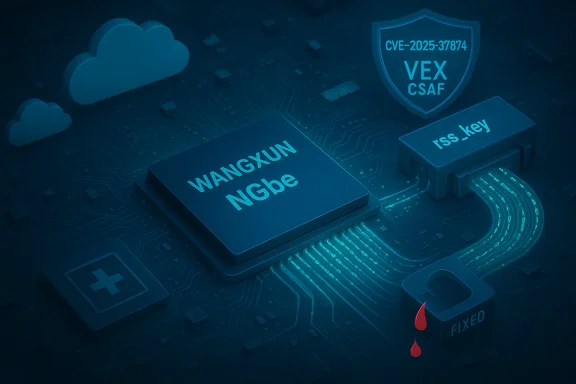
The defect fixed by CVE‑2025‑37874 is a memory‑management bug in the ngbe driver’s probe path. When ngbe_sw_init() invokes wx_init_rss_key(), a block of memory is allocated for wx->rss_key; certain error paths in ngbe_probe() failed to free that allocation, and the fix ensures the rss_key is freed on error and adjusts the error‑label flow to avoid a potential double‑free in subsequent cleanup. This is an upstream kernel correctness/robustness fix—not a remote code execution vulnerability—and its practical impact is principally resource exhaustion or stability degradation when the driver’s probe error paths are triggered.
Multiple tracking and vendor advisories reflect the upstream description and show coordinated distribution updates. The NVD and distribution advisories list the change and, where available, assign a moderate severity score (for example, Amazon’s advisory records a CVSS v3 base score of 5.5 and vendors such as Ubuntu and Red Hat have published notes mapping the kernel commits into their release trees). This CVE was published in May 2025 and appears in the usual Linux stable kernel update changelogs and vendor‑security notices.
Imporcrosoft’s wording:
In short: patch Azure Linux urgently if you run it; audit other Microsoft‑supplied kernels and images under your control; and use Microsoft’s VEX/CSAF output (or vendor advisories) to reduce uncertainty.
Source: MSRC Security Update Guide - Microsoft Security Response Center
 Background / Overview
The defect fixed by CVE‑2025‑37874 is a memory‑management bug in the ngbe driver’s probe path. When ngbe_sw_init() invokes wx_init_rss_key(), a block of memory is allocated for wx->rss_key; certain error paths in ngbe_probe() failed to free that allocation, and the fix ensures the rss_key is freed on error and adjusts the error‑label flow to avoid a potential double‑free in subsequent cleanup. This is an upstream kernel correctness/robustness fix—not a remote code execution vulnerability—and its practical impact is principally resource exhaustion or stability degradation when the driver’s probe error paths are triggered.Multiple tracking and vendor advisories reflect the upstream description and show coordinated distribution updates. The NVD and distribution advisories list the change and, where available, assign a moderate severity score (for example, Amazon’s advisory records a CVSS v3 base score of 5.5 and vendors such as Ubuntu and Red Hat have published notes mapping the kernel commits into their release trees). This CVE was published in May 2025 and appears in the usual Linux stable kernel update changelogs and vendor‑security notices.
What Microsoft actually said — and what that wording means
Microsoft’s public FAQ language for several Linux CVEs (including the pattern used in the MSRC update pages) reads in effect: “Azure Linux includes this open‑source library and is therefore potentially affected… If impact to additional products is identified, we will update the CVE to reflect this.” That phrasing is a deliberate product‑scoped attestation tied to Microsoft’s phased roll‑out of machine‑readable CSAF/VEX attestations that began in October 2025. The announcement about VEX/CSAF explains Microsoft’s intent to publish per‑product attestations so customers can quickly determine which Microsoft artifacts include specific upstream components.Imporcrosoft’s wording:
- The statement is authoritative for the Azure Linux product family: Microsoft has inventory‑checked that distribution and found the implicated upstream code in it. Treat Azure Linux images/kernels as in‑scope for remediation immediately.
- The statement is not an exclusivity guarantee. Microsoft explicitly commits to updating the CVE/VEX record if additional Microsoft products are later found to ship the same upstream component. In plain terms: absence of an attestation today is not proof of absence forever.
Short answer to the user question
No—Azure Linux is not necessarily the only Microsoft product that could include the vulnerable ngbe code, but it is the only Microsoft product Microsoft has publicly attested to include the affected upstream library for this CVE at the time of the advisory. That attestation directs Azuremediate, but it does not technically eliminate the possibility that other Microsoft‑shipped kernels or artifacts might also include the same driver. Security operators must treat other Microsoft artifacts as potentially affected until Microsoft’s VEX/CSAF inventory either declares them Not Affected or confirms discovery.Why that distinction matters (technical and operational explanation)
How the same upstream code can appear in multiple Microsoft artifacts
The Linux kernel is upstream source code. Whether a particular Microsoft product includes a given upstream file (like drivers/net/ethernet/wangxun/ngbe/*) depends on multiple artifact‑specific choices:- Kernel version and upstream commit range used to build the kernel.
- Build configuration (CONFIG_* flags) which determine whether a particular driver is compiled in or built as a module.
- Packaging and image composition choices: kernels in Azure VM images, in WSL2, in Azure Marketplace appliances, or in specialized node images can differ.
- Backporting and downstream patching: Microsoft may cherry‑pick or backport upstream fixes into different kerntimes.
Practical examples where the ngbe code might show up
- Azure Linux images (the product Microsoft explicitly mapped) — attested as potentially affected.
- Azure VM images based on other Linux distributions (for example, Ubuntu, Oracle Linux, or vendor kernels): those are vendor creations and may include the driver depending on kernel version; the vendor advisories (Ubuntu, Oracle, Amazon Linux) list the CVE and patch status.
- The Microsoft‑packaged WSL2 kernel: WSL2 uses a Microsoft‑maintained Linux kernel binary; if that binary was built from an upstream tree that included ngbe and the driver was enabled, it could carry the same code unless Microsoft’s WSL team excluded the driver or published a VEX attestation declaring Not Affected. Microsoft’s phased VEX program is precisely intended to make this mapping explicit over time.
- Specialized Azure services or appliances that ship their own kernel: their inclusion depends on the specific kernel variant and configuration chosen by the service team.
How defenders should interpret Microsoft’s atteststatement as an immediate, actionable item for Azure Linux customers: apply the updated kernel or the distro patch that remediates CVE‑2025‑37874. For other Microsoft artifacts, adopt a conservative, evidence‑based approach:
- Assume other Microsoft kernel artifacts are potentially affected unless a Microsoft VEX/CSAF file explicitly states Not Affected or an updated CVE mapping confirms inclusion.
- Where possible, verify by inspecting the artifact: query the kernel version, search for the driver source in the packaged kernel build, or test whether the kernel was built with the ngbe driver enabled (CONFIG_WX_NGBE/CONFIG_NGBE or similar kernel config flags). If you manage WSL2 or Azure VM images under your control, verify the kernel binary contents or module list.
Verified technical facts and cross‑references
- Technical description of the fix and the upstream commit traces are published in kernel stable trees and NVD/OSV entries. The NVD entry and OSV summary match the upstream change description: freeing wx->rss_key in error paths and adjusting error labels to avoid double‑free.
- Distribution advisories (Ubuntu, Amazon/ALAS, SUSE or vendor advisories) track the CVE and indicate affected kernel series and remediation status; Amazon and Ubuntu published severity and CVSS‑style metrics (Amazon's ALAS entry reports CVSS 5.5). These vendor pages are authoritative for their respective images.
- Microsoft’s transparency program and the October 2025 VEX/CSAF rollout are documented in the MSRC blog that announced machine‑readable VEX for Azure Linux and the broader plan to expand it. That blog post explains why Microsoft is publishing product‑scoped attestations and why the company will update records when more products are mapped.
- Independent security trackers and research summaries (CISA weekly bulletins, PT Security trackers, vendor security advisories) list CVE‑2025‑37874 with the same upstream description and provide additional context about affected kernel versions and mitigation timelines.
Risk assessment — exploitability and operational impact
- Attack vector: local. The ngbe driver bug is triggered by code paths during device probe and similar internal operations. It is not documented as remotely exploitable without local code execution or local privileged access to trigger the driver way.
- Impact: availability. The primary security impact is memory leak leading to resource exhaustion or stability issues (denial of service) when driver probe or other affected code paths are repeatedly exercised. A secondary, low‑probability risk could be a double‑free leading to memory corruption, but upstream fixes focus on correctness and safe cleanup.
- Likelihood: low to moderate in practice. Exploitation requires local access or a scenario where the driver is repeatedly pushed through the vulnerable probe error path. For cloud images or servers, the threat model depends heavily on tenant isolation, exposure of the driver path, and whether untrusted workloads can trigger the condition.
Practical mitigation steps (what to do right now)
- For Azure Linux customers (attested carrier)
- Install the vendor‑published kernel update as soon as it is available for your Azure Linux image. Microsoft’s attestation places Azure Linux images in scope and they should be patched promptly.
- If you run long‑lived instances, plan a kernel update and reboot window; document which VM families are affected and schedule remediation accordingly.
- For customers running other Linux distributions on Azure VMs or on premises
- Check your distribution vendor’s advisory (Ubuntu, Red Hat, SUSE, Oracle, Amazon Linux, etc.) for the CVE mapping and packages. Most mainstream distro vendors have already published CVE pages and fixes for affected kernel branches.
- If your distribution vendor lists the CVE as affecting a kernel branch you use, install the vendor kernel update; otherwise verify whether your specific kernel image includes the ngbe driver and whether the build includes the fixed commit.
- For operators of WSL2, Azure Marketplace appliances, and other Microsoft‑shipped kernels
- Consult Microsoft’s VEX/CSAF feed to confirm whether the artifact you run is attested as Not Affected, Known Affected, or Under Investigation. If the artifact is not yet in VEX, assume potential exposure until inventory confirms otherwise.
- For WSL2 users that rely on the Microsoft‑packaged kernel, check WSL release notes and updates; apply WSL kernel updates when published.
- Detection and compensating controls
- Monitor system logs for repeated ngbe probe failures, OOPS reports, or any kernel oops/panic events related to the ngbe driver or the wangxun driver family.
- Use kernel livepatching where available (for supported distributions) to reduce reboot windows, but verify the livepatch provider’s coverage for this specific fix.
- Harden local access controls to reduce chances that unprivileged users can repeatedly exercise device probe paths.
How to verify whether a specific Microsoft artifact contains the ngbe code
- Inspect the kernel config: look for the driver-related CONFIG_* entries (for example, CONFIG_NET_VENDOR_WANGXUN, CONFIG_NGBE, or driver-specific symbols). If the driver is built into a kernel or available as a module, it is a candidate carrier.
- Query module list on running systems: lsmod/modinfo can reveal whether ngbe is present as a module.
- Check the kernel package contents or the kernel build tree in the artifact SBOM: VEX/CSAF and SBOMs are the tools of record Microsoft is publishing to make these checks machine‑readable.
- Search the kernel binary for module symbols or source‑file name strings when an SBOM is not available; this is more advanced but can produce reasonable evidence in the absence of vendor attestations.
Why Microsoft’s CSAF/VEX rollout matters for supply‑chain hygiene
Microsoft’s October 2025 VEX initiative represents an industry‑useful step: instead of customers guessing which upstream components appear in which artifacts, VEX provides a machine‑readable per‑product attestation of whether a vulnerability is Known Affected, Fixed, Not Affected, or Under Investigation for that product. That clarity reduces time to remediation and lowers false positives in vulnerability-management pipelines. For this specific CVE, Microsoft used the VEX workflow to declare Azure Linux a confirmed carrier and committed to updating the mapping for additional Microsoft products if they are later discovered to include the same upstream component.Policy and procurement implications for enterprise security teams
- Require Vacts: When negotiating with cloud and software vendors, insist on machine‑readable attestations (CSAF/VEX) or SBOM exports for critical artifacts. Microsoft’s public VEX program shows this is feasible and beneficial.
- Treat vendor attestation as a baseline, not the final word: For highly sensitive systems, maintain the capability to independently verify kernel contents or to request targeted attestations from the vendor.
- Automate: Ingest vendor VEX files into your vulnerability‑management platform so that product‑scoped attestations automatically triage which of your assets are in scope for a given CVE.
Conclusion — clear guidance and a cautionary note
CVE‑2025‑37874 is a correctness/robustness fix in the Linux ngbe driver that can cause memory leakage and stability problems; vendor and upstream fixes are available and should be applied. Microsoft’s advisory that “Azure Linux includes this open‑source library and is therefore potentially affected” is authoritative for Azure Linux images and should prompt immediate remediation for Azure Linux customers. However, that statement is a product‑level inventory attestation — not a statement that no other Microsoft product can or does include the same vulnerable upstream code. Until Microsoft completes its broader VEX inventory or explicitly updates the CVE mapping to include other Microsoft artifacts, operators should assume other Microsoft kernel‑bearing artifacts might be potentially affected and verify accordingly via vendor advisories, kernel inspections, or Microsoft VEX/CSAF attestations.In short: patch Azure Linux urgently if you run it; audit other Microsoft‑supplied kernels and images under your control; and use Microsoft’s VEX/CSAF output (or vendor advisories) to reduce uncertainty.
Source: MSRC Security Update Guide - Microsoft Security Response Center
