

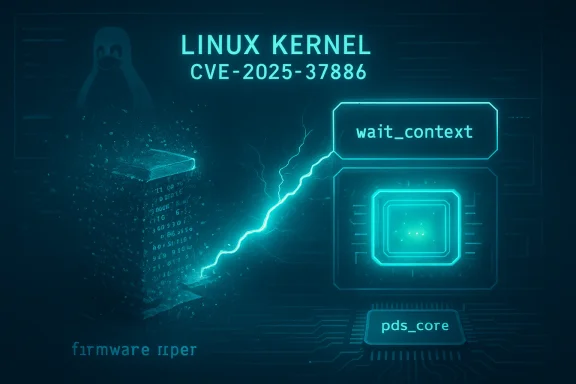
The Linux kernel fix tracked as CVE-2025-37886 addresses a memory-safety and lifetime bug in the pds_core driver by making the previously stack‑allocated wait_context a permanent member of the driver’s q_info structure. At face value the change is small and surgical — move a completion context out of a temporary stack frame and into the queue-level state — but the implication is important: under certain firmware timing scenarios an interrupt could race against a timed‑out admin queue wait and attempt to use a completion object that no longer existed, causing kernel crashes and system instability. The vulnerability has been assigned a medium severity rating (CVSS v3.1 5.5) and has been fixed upstream in the stable kernel trees; Microsoft’s security advisory for this CVE explicitly names the Azure Linux distribution as a known carrier of the affected open‑source component and notes Microsoft will update the CVE entry if additional Microsoft products are found to be impacted.
The bug fixed in CVE-2025-37886 sits inside the Linux kernel’s pds_core driver. The short technical narrative is straightforward: a completion/wait object — used to coordinate a synchronous admin queue request to device firmware — was being created on the stack inside pdsc_adminq_post(). If the driver’s wait loop timed out, the stack object would disappear. If the firmware later completed the request and generated an interrupt, the interrupt handler could try to complete that stack-based completion. That produced use-after-free / bad pointer usage and could lead to kernel oopses or crashes on affected systems. Upstream kernel maintainers remedied the problem by making the wait_context a persistent member of the q_info structure, ensuring its lifetime extends until the queue is torn down and the context is safely available when an interrupt arrives. This description and the fix are reflected across multiple vulnerability databases and the kernel’s stable patch links.
Why this matters in practice: device drivers that talk to firmware via administrative queues are inherently dependent on firmware timing. A driver that assumes a prompt firmware reply can be brittle if the firmware is slow or delayed; that brittleness is precisely what created the unsafe lifetime for the completion context in pds_core. While not typically exploitable for arbitrary code execution, the symptom — kernel instability and crashes — is a real operational risk for hosts running afflicted kernels, particularly in multi-tenant cloud or edge environments where hardware and firmware configurations vary.
Several independent analyses and community writeups have hig soft’s language is helpful because it tells customers which Microsoft offering to prioritize for immediate updates, but it should not be taken as proof that Microsoft’s entire product set is unaffected. In previous CVE postings where MSRC used the same phrasing, follow-up investigations sometimes found the same vulnerable upstream component in other Microsoft-managed artifacts (for example, WSL kernel sources or cloud VM kernel images) even though MSRC initially listed only Azure Linux. That history is why MSRC also committed to updating the CVE entry should further Microsoft products be identified as carriers.
Source: MSRC Security Update Guide - Microsoft Security Response Center
 Background / Overview
The bug fixed in CVE-2025-37886 sits inside the Linux kernel’s pds_core driver. The short technical narrative is straightforward: a completion/wait object — used to coordinate a synchronous admin queue request to device firmware — was being created on the stack inside pdsc_adminq_post(). If the driver’s wait loop timed out, the stack object would disappear. If the firmware later completed the request and generated an interrupt, the interrupt handler could try to complete that stack-based completion. That produced use-after-free / bad pointer usage and could lead to kernel oopses or crashes on affected systems. Upstream kernel maintainers remedied the problem by making the wait_context a persistent member of the q_info structure, ensuring its lifetime extends until the queue is torn down and the context is safely available when an interrupt arrives. This description and the fix are reflected across multiple vulnerability databases and the kernel’s stable patch links.Why this matters in practice: device drivers that talk to firmware via administrative queues are inherently dependent on firmware timing. A driver that assumes a prompt firmware reply can be brittle if the firmware is slow or delayed; that brittleness is precisely what created the unsafe lifetime for the completion context in pds_core. While not typically exploitable for arbitrary code execution, the symptom — kernel instability and crashes — is a real operational risk for hosts running afflicted kernels, particularly in multi-tenant cloud or edge environments where hardware and firmware configurations vary.
The technical anatomy of CVE-2025-37886
What went wrong: stack lifetime vs. asynchronous completion
At a conceptual level the bug is a classic concurrency / lifetime mismatch: a synchronization object (the completion context) was allocated on the stack inside a function that initiates a firmware request and then waits. If the wait loop exits early (for example, timeout or abort), the function returns and the stack frame is popped. A delayed firmware interrupt that tries to complete that now-absent object results in a pointer to reclaimed stack memory being dereferenced. The result is undefined behavior — in practice, kernel warnings, oopses, or full panics. Upstream maintainers resolved the issue by turning the completion context into part of the per‑queue persistent structure so its lifetime is controlled by the queue lifecycle rather than a single call’s stack frame. Evidence for the exact change and the rationale is present in the kernel patch notes and the stable‑tree commit references for the CVE.Why making wait_context part of q_info fixes the race
By embedding the completion object inside q_info, the driver guarantees that the object lives as long as the queue exists. Interrupt handlers reference the queue and its persistent q_info data, so when an adminq completion arrives the referenced completion context is still valid. This is a common pattern in kernel code that needs to coordinate long-lived asynchronous activity: any state referenced by interrupt handlers must have a lifetime that strictly outlasts the possible interrupt window. The upstream patch is minimal code‑wise, but it eliminates the fragile window that allowed an interrupt handler to touch reclaimed stack memory.Exploitability and impact assessment
Multiple vulnerability trackers and vendor advisories rate this issue as medium (CVSS v3.1 5.5) and describe the impact as stability/availability-oriented (NULL or bad pointer dereference leading to kernel crash). There is no public evidence of privileged escalation or remote code execution tied to this specific flaw; the risk is mainly denial-of-service / instability for systems that exercise the vulnerable code path under unfortunate timing conditions. As with many kernel bugs, the practicality of triggering the failure depends on the hardware/firmware interplay and the target’s workload profile.Which products are affected — what Microsoft actually said
Microsoft’s attestation: Azure Linux named, not necessarily exclusive
Microsoft’s Security Response Center (MSRC) advisory language for this CVE follows a precise template: it confirms that Azure Linux includes the open‑source library and is therefore potentially affected, and it states Microsoft will updag if additional Microsoft products are found to include the vulnerable component. That wording is important — it is a product‑scoped inventory attestation, not a categorical guarantee that no other Microsoft product includes the same code. Azure Linux is the only Microsoft product MSRC has publicly declared as a carrier for this particular library at the time of the advisory, but the statement does not exclude the possibility that other Microsoft artifacts, builds, or distributions may also ship the same driver.Several independent analyses and community writeups have hig soft’s language is helpful because it tells customers which Microsoft offering to prioritize for immediate updates, but it should not be taken as proof that Microsoft’s entire product set is unaffected. In previous CVE postings where MSRC used the same phrasing, follow-up investigations sometimes found the same vulnerable upstream component in other Microsoft-managed artifacts (for example, WSL kernel sources or cloud VM kernel images) even though MSRC initially listed only Azure Linux. That history is why MSRC also committed to updating the CVE entry should further Microsoft products be identified as carriers.
Short answer to the reader’s question
- Is Azure Linux the only Microsoft product that includes the open‑source library and is therefore potentially affected?
- As of the advisory, Azure Linux is the only Microsoft product MSRC has publicly attested as including the vulnerable pds_core component. That is a factual statement based on Microsoft’s published advisory language.
- However, that attestation is scoped and not exclusive. Other Microsoft products (for example, any Microsoft kernel artifacts, internal builds, WSL kernels, or appliance images that are built from the upstream kernel) could carry the same driver depending on build configuration and kernel tree version; MSRC has committed to updating the CVE if additional Microsoft products are later identified as carriers. In short: Azure Linux is the only confirmed Microsoft product so far, but it is not logically the only possible carrier.
How to determine whether your Microsoft product is affected
1. Check vendor attestations and CSAF/VEX artifacts
Microsoft now publishes machine-readable per‑artifact attestations (CSAF / VEX) for many of its Linux-related advisories. When an MSRC advisory names a product (for example, Azure Linux), that is an authoritative, product‑level inventory statement; it should be the first stop for administrators. Microsoft also stated publicly that it began publishing CSAF/VEX attestations in October 2025 to improve transparency about which Microsoft assets ship specific open‑source components. Administrators should retrieve the CSAF/VEX attestation for the CVE to see per‑artifact impact details where available.2. Inspect the kernel build and driver presence
On a running system, use the kernel config and module listing to confirm whether pds_core (or the relevant pds driver) is present:- Check whether the kernel was built with the pds_core driver: examine kernel config files (for Azure Linux and other Linux artifacts the admin manages).
- Check loaded modules and built‑in drivers with lsmod, dmesg, and /proc/modules.
- If the driver is compiled in the kernel (not as a module), search the kernel config (zcat /proc/config.gz or /boot/config-*) for CONFIG_PDS or equivalent symbol names. If the module is present, check the module version and source (modinfo pds_core).
3. Track vendor kernel updates and apply patches
Because the upstream fix has been merged into the stable kernel series, vendor distributions are expected to backport the fix into their kernel packages and publish updates. Linux distro vendors and cloud image providers (including Microsoft’s Azure Linux) typically release a kernel package with the patches applied; administrators must install the vendor-supplied kernel update and reboot hosts where the kernel is updated. Consult your distribution’s security advisory for the specific package and update instructions. Advisories from SUSE, Debian, and other vendors list the CVE and provide package-level guidance for their products.Patching, mitigation, and operational guidance
Patching: follow vendor updates and test
- Prioritize installing the vendor-supplied kernel update that includes the pds_core fix. The upstream patch is small, but kernel updates require thorough testing in production-like environments because they affect low-level system behavior.
- In cloud environments, update and redeploy images or apply kernel package updates via your normal orchestration tooling, and plan for reboots when kernel packages change.
- If you operate custom kernels, pull the upstream stable commit(s) referenced in the CVE and recompile your kernel with the patch applied; test comprehensively to catch regressions.
Workarounds and temporary mitigations
- If a vendor update is not immediately available and you must reduce exposure, consider isolating or avoiding hardware that depends on pds_core functionality, where feasible.
- Limit untrusted user access to systems that must continue running an unpatched kernel; the immediate risk is availability, but a DoS on kernel crash can have operational impact.
- Ensure kernel crash dump collection and monitoring are enabled so you can detect and triage kernel oopses rapidly while you wait for a vendor patch.
Validate the fix after patching
After applying the patch, validate that the vulnerable code path is no longer present or has been patched:- Compare module versions and kernel changelogs.
- Reproduce any previously observed crash under controlled test conditions (if safe and permitted).
- Use vendor-provided CSAF/VEX or security advisories to confirm the product-level remediation status.
What administrators should watch out for — risk analysis
Operational risk vs. security risk
This CVE is primarily an availability/stability issue (kernel crash) rather than a privilege‑escalation or remote code‑execution vulnerability. For many production environments, especially multi‑tenant or hypervisor hosts, a kernel panic that causes guest or host instability is high impact. The medium CVSS score reflects the limited scope of confidentiality/integrity impact but appreciable availability consequences.Cloud and edge implications
Cloud providers and vendors typically backport fixes into their kernel packages, but the pace at which updates reach every image or appliance can vary. Microsoft’s MSRC attestation that Azure Linux includes the affected component is an operational signal: Azure Linux images should be patched as a priority. That said, any Microsoft product that includes its own Linux kernel — for example, WSL2 kernel images or specialized appliance images — might also be carriers depending on the exact kernel tree and configuration. Administrators must therefore treat MSRC’s Azure Linux attestation as a starting point for investigation, not a guarantee of exclusivity.Supply-chain and downstream risk
Because this is an upstream kernel fix, the vulnerability may appear in many distributions and products that include the affected kernel code. Vendors sometimes backport fixes into older kernel versions; others may rebuild images with newer kernels. To reduce supply-chain exposure:- Maintain an inventory of kernel versions across your fleet and map them to upstream commit timelines.
- Use machine-readable advisories (CSAF/VEX) where available to automate artifact impact checks.
- Coordinate with your cloud provider or third‑party appliance vendors to learn when fixes will land in their images. Microsoft’s pledge to update CVE mapping if other products are identified is precisely the kind of supply‑chain transparency that agencies and security teams should expect and automate against.
Practical checklist for administrators (quick reference)
- Identify hosts running kernels potentially compiled with pds_core:
- Search kernel configs and module lists for pds/pdsc/pds_core symbols.
- Use inventory tools to map kernel rubrics against the CVE.
- Prioritize patching for Azure Linux images and any Microsoft‑provided Linux kernels.
- Monitor vendor advisories and subscribe to distro security feeds (SUSE, Debian, Ubuntu).
- If using WSL2 or other Microsoft-distributed kernels, verify whether those artifacts have been updated or attested as fixed by Microsoft.
- Validate remediation post‑patch by checking kernel changelogs and ensuring no repeat crashes.
- Enable kernel crash collection and alerting to speed triage if crashes occur.
Why Microsoft’s wording matters — interpreting “potentially affected”
Microsoft’s phrasing — “Azure Linux includes this open‑source library and is therefore potentially affected” — is intentionally conservative and scoped. It tells customers:- Microsoft has performed a product‑level inventory check for Azure Linux and found the open‑source component in question.
- Microsoft will publish remediation guidance and will update the CVE/CVE mapping if additional products are discovered to carry the same code.
- The statement is not a universal guarantee that no other Microsoft product includes the vulnerable component.
Conclusion — balancing transparency and due diligence
CVE-2025-37886 is a well‑scoped Linux kernel fix that eliminates a lifetime/race issue in the pds_core driver by moving a completion context into persistent queue state. The technical fix is straightforward and has been merged into the kernel stable trees and backported by distribution vendors. Microsoft’s public advisory naming Azure Linux as “including” the open‑source library is accurate as a product-level attestation and is a helpful signal for administrators using Azure Linux images. At the same time, administrators must not interpret that single attestation as proof that other Microsoft artifacts (or other vendors’ distributions) are definitely unaffected; the upstream nature of the vulnerability means the same code can appear in many kernels and images depending on build practice and kernel versions. The defensible path is simple: confirm presence of the driver in your artifacts, apply vendor-provided kernel updates as soon as they’re available, and use machine‑readable advisories (CSAF/VEX) and inventory tooling to automate detection and remediation across your estate.Source: MSRC Security Update Guide - Microsoft Security Response Center
