

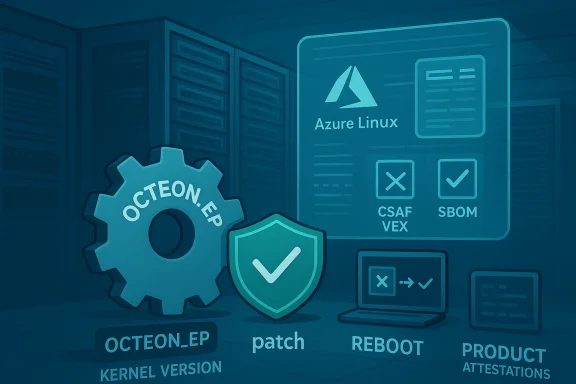
The Linux kernel vulnerability tracked as CVE‑2025‑37933 — a correctness fix in the octeon_ep network driver that prevents a host hang during device reboot — is real, narrow, and already patched upstream. But Microsoft’s brief advisory that “Azure Linux includes this open‑source library and is therefore potentially affected” should be read exactly as written: it is an authoritative, product‑level attestation for a named Microsoft distribution, not a categorical statement that no other Microsoft product could ship the same vulnerable code.
CVE‑2025‑37933 is a Linux kernel defect confined to the Marvell/Octeon PCI endpoint network driver — the octeon_ep module — where an incorrect cleanup path can lead to a host hang if the driver calls the device‑specific ndo_stop function twice during certain reboot/unload sequences. The upstream fix replaces the direct ndo_stop invocation with a safer dev_close call during driver unload, which prevents the double cleanup and the resulting hang. The issue is an availability/DoS risk, not a remote code execution or data‑exfiltration vulnerability.
However, some limitations and risks remain:
At the same time, defenders must not conflate a product‑scoped attestation with a comprehensive inventory of all Microsoft artifacts. The technical truth is simple: the vulnerability exists in upstream kernel source; any Microsoft product that ships a Linux kernel built from a commit range that predates the patch — and that enables or ships the octeon_ep driver — is a plausible carrier until proven otherwise. The only way to be certain is to combine vendor attestations with local artifact verification (kernel config, module presence, package versions) or to wait for Microsoft’s expanded VEX coverage.
If you run Azure Linux, act now and apply Microsoft’s updates. If you run other Microsoft‑supplied images, follow the triage steps in this article and treat the MSRC statement as a prompt to verify, not as a blanket safety guarantee. The vendor has done its part to publish partial inventory; now defensive teams must finish the job by validating the artifacts they operate and patching where necessary.
Conclusion: Azure Linux is the only Microsoft product Microsoft has publicly declared to include the vulnerable octeon_ep component for CVE‑2025‑37933 so far, and that admission is useful and actionable for Azure Linux customers. But it is not proof that other Microsoft products are unaffected — other Microsoft kernel builds and images may still carry the upstream code depending on kernel versions and configurations. Verify locally, prioritize patching where the driver is present, and monitor Microsoft’s VEX/CSAF updates for expanded attestations.
Source: MSRC Security Update Guide - Microsoft Security Response Center
 Background / Overview
CVE‑2025‑37933 is a Linux kernel defect confined to the Marvell/Octeon PCI endpoint network driver — the octeon_ep module — where an incorrect cleanup path can lead to a host hang if the driver calls the device‑specific ndo_stop function twice during certain reboot/unload sequences. The upstream fix replaces the direct ndo_stop invocation with a safer dev_close call during driver unload, which prevents the double cleanup and the resulting hang. The issue is an availability/DoS risk, not a remote code execution or data‑exfiltration vulnerability.- What the bug does: when heartbeat messages from the Octeon device are lost, the driver may free resources via ndo_stop; if the module is subsequently unloaded while the device is already down, a second ndo_stop call attempts to free already freed resources, potentially hanging the host. The upstream remedy uses dev_close to centralize safe teardown.
- Where the code lives: octeon_ep is the Marvell Octeon PCI EndPoint NIC driver, maintained in the kernel’s drivers/net/ethernet/marvell path and documented in the kernel docs. It targets Cavium/Marvell Octeon devices used in certain DPU and NIC designs.
- Severity and exploitability: the flaw is operational (host hang) rather than remotely exploitable in typical configurations; it is assigned moderate/medium scores by multiple trackers and has been merged upstream in the stable kernel trees. Operators should treat it as an availability risk for hosts that run or can load the affected driver.
Microsoft’s advisory: what it actually says — and what it doesn’t
Microsoft’s Security Response Center (MSRC) messaging for multiple recent Linux CVEs follows the same pattern: the company explicitly lists Azure Linux (the distribution formerly known as CBL‑Mariner) as a product that “includes this open‑source library and is therefore potentially affected,” and it explains that the company began publishing machine‑readable CSAF/VEX attestations in October 2025 and will update the CVE entry if additional Microsoft products are later identified as carriers. That wording is precise and important.- Authoritative yes for Azure Linux: Microsoft is saying it has inventory‑checked the Azure Linux artifact and found the vulnerable upstream component; for Azure Linux customers, that is actionable intelligence.
- Not an exclusivity guarantee: Microsoft’s attestation does not logically prove that no other Microsoft product contains the same upstream file or commit range; it only states the scope that Microsoft has completed to date. Multiple independent explainers and vendor responses echo this interpretation: a product‑scoped VEX/CSAF mapping is an inventory statement, not a technical proof of absence across an entire vendor portfolio.
Why “Azure Linux only” is a tempting but dangerous shorthand
Many readers will take a vendor’s CVE page at face value and assume the named product is the only thing to worry about. That is understandable, and it is why Microsoft’s attestation is useful — it tells Azure Linux customers they need to patch or update. But there are several reasons the “only” reading can be misleading:- Microsoft ships multiple, distinct Linux‑based artifacts. Beyond Azure Linux itself, Microsoft maintains other kernel images and distributions — notably the WSL2 kernel project, kernel builds for Azure VM families, curated Marketplace images, and historically the CBL‑Mariner artifacts that were rebranded as Azure Linux. Any of these artifacts could, in theory, include the same upstream driver code depending on source and build configuration.
- Presence in source control does not equal exposure. The vulnerable file may be present in a source tree but not compiled into a particular kernel build (driver built as module vs built‑in; compile‑time CONFIG flags). Whether an image is actually vulnerable depends on the kernel version, configuration, and whether the module is available and loaded on that host.
- Inventory and SBOM work is incremental. Microsoft’s CSAF/VEX rollout started with Azure Linux because it is Microsoft’s publicly maintained Linux distribution and an obvious first target for SBOM/VEX publication; expanding that inventory across dozens of Microsoft artifacts is a multi‑phase effort and may lag individual CVE disclosures. The company has pledged to update records when it identifies additional product carriers.
Practical guidance: how to determine whether your systems are affected
If you operate systems that might carry the octeon_ep driver (for example, appliances or VMs on hardware with Octeon devices, or distributions that enable the module), follow a simple triage checklist to answer the “am I affected?” question quickly.- Inventory first — find the host(s)
- On Linux hosts: run uname -a and note kernel release and distro. Check whether your image is an Azure Linux build or another Microsoft‑supplied image. Use your asset inventory to list machines with Microsoft‑distributed images. (Azure Linux customers are confirmed carriers per Microsoft’s attestation.)
- Confirm the module/configuration
- Check whether the module exists and is loaded:
- lsmod | grep octeon_ep
- modinfo octeon_ep
- Check kernel config for the driver:
- zcat /proc/config.gz | grep CONFIG_OCTEON_EP
- grep CONFIG_OCTEON_EP /boot/config-$(uname -r)
If the module is not present or the kernel was built without the driver, your host is unlikely to be vulnerable in practice. - Map kernel version → vulnerable commit
- Compare your kernel release against the upstream commit that fixed CVE‑2025‑37933. Use the NVD / OSV entries and the upstream commit list to identify which stable kernel releases include the patch. If your running kernel is older than the patched stable release or lacks the backported fix, plan an update.
- Apply a remediation path
- For confirmed carriers: update the kernel to the vendor‑supplied patched build as soon as practical. For Azure Linux customers, apply Microsoft’s Azure Linux updates when they are published. For other distros, apply the vendor patch or upgrade to an upstream stable kernel that contains the fix.
- Mitigation if patching is delayed
- If immediate patching is impossible, unload the module (rmmod octeon_ep) where safe, or, for systems that do not use the device, blacklist the module to prevent accidental loading. That reduces exposure to the driver’s unload/reboot path. Note: unloading modules on production systems can disrupt live networking and must be tested.
- Verify post‑fix
- After patching, confirm the offending code path is no longer present (modinfo shows updated version, kernel release includes the patched stable release, or vendor advisory shows remediation applied). For Azure Linux, watch MSRC / VEX updates that confirm the distribution’s patched status.
Who else should be watching — beyond Azure Linux customers
Which Microsoft artifacts deserve scrutiny? The short list to inspect includes:- WSL2 kernel builds — Microsoft publishes the WSL2 kernel source and builds it for Windows; WSL kernels are maintained in a Microsoft repository and follow their own release cadence. If the WSL kernel tree or builds include the vulnerable upstream commit and enable the driver, WSL hosts could carry exposure. For defenders, the WSL kernel source and binaries are public and should be checked when a kernel CVE hits relevant subsystems.
- Azure kernel images and Marketplace images — Azure exposes several kernel flavors and curated VM images; Microsoft’s kernel packages for Azure VMs (linux‑azure, linux‑azure‑6.*) may include the same upstream fixes at different times depending on the image lifecycle. Operators using Azure Marketplace images or custom images should verify kernel contents.
- Appliance and specialized artifacts — any Microsoft‑built appliance images, container hosts, or managed node OS images that carry a Linux kernel should be inventoried and verified. Microsoft’s phased VEX mapping will expand to cover more artifacts over time; do not assume absence of evidence is evidence of absence.
Strengths in Microsoft’s approach — and the remaining gaps
Microsoft’s recent transparency work is a real positive: publishing CSAF/VEX attestations for Azure Linux gives enterprise defenders machine‑readable signals to automate triage and patch prioritization. That improves response times for customers running the attested product and is a sensible first step toward broader SBOM coverage.However, some limitations and risks remain:
- Attestation scope vs. exhaustiveness: a product‑level VEX entry helps the named product’s users but leaves other Microsoft artifacts effectively unattested until Microsoft inventories them. This delay creates short‑term uncertainty for customers who run other Microsoft‑supplied kernels or images.
- Supply‑chain complexity: Microsoft both consumes and ships upstream open‑source components across many internal teams. Identifying every carrier of a particular upstream file is nontrivial and can leave windows where artifacts are vulnerable but not yet publicly mapped.
- Operational friction for defenders: defenders must combine vendor attestations with their own artifact inspection (kernel configs, module lists, SBOMs) to be certain about exposure. Microsoft’s attestation accelerates that process for Azure Linux but does not obviate local verification for other artifacts.
Recommendation: what Microsoft should do next — and what customers should do now
For Microsoft- Expand VEX coverage to other Microsoft‑built kernel artifacts (WSL kernels, linux‑azure builds, Marketplace images, managed node images) as quickly as operationally possible.
- Publish artifact‑level SBOMs and clear mappings from CVE → specific binary/package versions shipped in each Microsoft SKU.
- Clarify expected timelines for updates to VEX/CSAF when a new CVE is discovered, so enterprise consumers know when to re‑check attestations.
- Treat Microsoft’s Azure Linux attestation as a confirmed hit for that product. Patch Azure Linux images per Microsoft guidance.
- Do not assume other Microsoft artifacts are safe. Inventory any Microsoft‑supplied or Microsoft‑curated images you run (WSL kernels, Azure VM images, Marketplace appliances), and follow the practical triage checklist above.
- Automate detection where possible. Pull kernel configs, scan for module names and verify kernel versions against upstream commit mapping from NVD/OSV.
- Apply compensating controls (module blacklists, unload where safe) if patching cannot be immediate.
- Watch vendor attestations: Microsoft has pledged to update CVE entries and VEX records when it finds additional carriers; re‑check the MSRC CVE page and vendor advisories for changes.
Final analysis: measured transparency is progress, but vigilance remains essential
Microsoft’s explicit attestation that Azure Linux includes the open‑source component at the heart of CVE‑2025‑37933 is a welcome step toward vendor transparency. Publishing machine‑readable CSAF/VEX attestations makes automated triage practical and helps Azure Linux customers prioritize remediation. That operational benefit is real and materially reduces time‑to‑patch for the named product.At the same time, defenders must not conflate a product‑scoped attestation with a comprehensive inventory of all Microsoft artifacts. The technical truth is simple: the vulnerability exists in upstream kernel source; any Microsoft product that ships a Linux kernel built from a commit range that predates the patch — and that enables or ships the octeon_ep driver — is a plausible carrier until proven otherwise. The only way to be certain is to combine vendor attestations with local artifact verification (kernel config, module presence, package versions) or to wait for Microsoft’s expanded VEX coverage.
If you run Azure Linux, act now and apply Microsoft’s updates. If you run other Microsoft‑supplied images, follow the triage steps in this article and treat the MSRC statement as a prompt to verify, not as a blanket safety guarantee. The vendor has done its part to publish partial inventory; now defensive teams must finish the job by validating the artifacts they operate and patching where necessary.
Conclusion: Azure Linux is the only Microsoft product Microsoft has publicly declared to include the vulnerable octeon_ep component for CVE‑2025‑37933 so far, and that admission is useful and actionable for Azure Linux customers. But it is not proof that other Microsoft products are unaffected — other Microsoft kernel builds and images may still carry the upstream code depending on kernel versions and configurations. Verify locally, prioritize patching where the driver is present, and monitor Microsoft’s VEX/CSAF updates for expanded attestations.
Source: MSRC Security Update Guide - Microsoft Security Response Center
