

A small, surgical change to the Linux kernel this spring closed a latent robustness hole in MediaTek’s PMIC input driver, but the bug and its patch underscore a repeated theme for embedded and mobile Linux users: tiny null-pointer mistakes in low-level drivers can produce outsized availability problems on devices that rarely get the attention of traditional desktop or server patch cycles.
On May 20, 2025, the Linux community assigned CVE-2025-37972 to a defect described as "Input: mtk-pmic-keys - fix possible null pointer dereference." The flaw sits in the MediaTek PMIC keys driver — the kernel component that handles power/button inputs provided by some MediaTek power-management integrated circuits (PMICs). The bug arises when a code path expects a parameter (the local variable commonly named
That scope — availability impact only — is important. The defect permits a local actor or a component that can drive the affected input code path to cause a denial-of-service (DoS) condition (kernel oops or panic). It is not a remote code-execution vulnerability in itself, and it does not, by the details published with the patch, directly permit privilege escalation or arbitrary code execution. Nonetheless, a kernel-level crash is a potent outcome for embedded, mobile and IoT devices where uptime and remote management are critical.
Quick checklist:
The operational lesson for administrators and vendors is stable: when low-level drivers interact with optional hardware bindings, defense-in-depth means not only shipping the code that works under ideal conditions, but also preparing for the many variations present in fielded hardware. For IT teams running device fleets with MediaTek platforms, the practical next steps are clear and time-sensitive: inventory, patch, monitor, and — where updating is impossible — consider carefully measured mitigations that trade functionality for increased stability.
This CVE is a reminder that security and reliability converge at the level of defensive programming. A single NULL check avoided at design time can become a far larger continuity and operational headache later. The fix is small, the risk is real for certain device classes, and the mitigation is straightforward: get the updated kernel into your devices and make sure your monitoring will catch any similar failures early.
Source: MSRC Security Update Guide - Microsoft Security Response Center
 Background / Overview
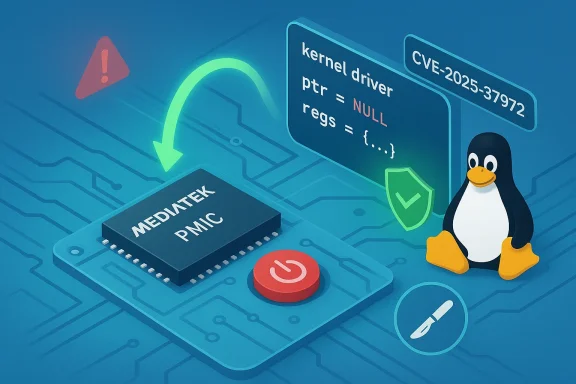
On May 20, 2025, the Linux community assigned CVE-2025-37972 to a defect described as "Input: mtk-pmic-keys - fix possible null pointer dereference." The flaw sits in the MediaTek PMIC keys driver — the kernel component that handles power/button inputs provided by some MediaTek power-management integrated circuits (PMICs). The bug arises when a code path expects a parameter (the local variable commonly named regs) to be initialized only when a device-tree button node is present; on boards where that node is omitted (for example, because the button is floating or intentionally disabled), a subsequent dereference of the un-initialized pointer can cause a kernel fault. In short: under specific hardware or configuration conditions, the kernel could dereference a NULL pointer and crash or otherwise become unavailable until reboot or remediation.That scope — availability impact only — is important. The defect permits a local actor or a component that can drive the affected input code path to cause a denial-of-service (DoS) condition (kernel oops or panic). It is not a remote code-execution vulnerability in itself, and it does not, by the details published with the patch, directly permit privilege escalation or arbitrary code execution. Nonetheless, a kernel-level crash is a potent outcome for embedded, mobile and IoT devices where uptime and remote management are critical.
What went wrong: technical root cause explained
At a technical level, the problem is a classic null-pointer dereference in a kernel probe routine:- The affected function is the probe handler for the MTK PMIC keys driver. Probe handlers run when the kernel binds a device driver to hardware described in the device tree (DT).
- The driver expects to find a button node in the DT and only initializes or assigns a local pointer (the function parameter
regs) when that node is present and parsed. - On boards where the button is intentionally omitted, the device-tree node is commonly removed; the code path that used
regsdid not check for its absence and proceeded to dereference it. - The upstream fix replaces use of the fragile per-probe
regspointer with the driver's module-levelregsstructure that is valid across supported platforms, or otherwise ensures a defined, always-present reference is used. The change is small in lines of code but closes the dereference window entirely.
Affected systems and scale of risk
- The defect is a Linux kernel-level robustness issue that affects kernels containing the vulnerable MTK PMIC keys code prior to the upstream commits that landed the fix. The CVE was documented in May 2025 and merged into stable kernel trees as part of the normal maintenance flow.
- Impacted systems are those whose kernels include the MediaTek PMIC keys driver (mtk-pmic-keys) and which either run hardware where the button node is omitted, or otherwise trigger the probe logic that leads to the NULL dereference.
- Common targets in practice:
- Embedded Linux devices and SoC boards that use MediaTek PMICs.
- Consumer devices (phones, tablets, set-top boxes) built on MTK platforms where upstream or vendor kernels include the affected driver.
- Specialized appliances or industrial controllers that use MTK hardware and do not receive frequent platform updates.
- The vulnerability is primarily a local or on-device issue. Exploitation requires a way to execute the affected code path locally (for example, by plugging/unplugging or otherwise manipulating hardware, or by supplying crafted platform configuration), not remote network access alone. On many devices, local access is easier for an attacker who already has some foothold, which means the defect can be used as an availability weapon to knock devices offline.
Why this matters beyond a single line of code
There are three overlapping reasons this kind of kernel robustness bug matters in 2025:- Devices with MTK PMICs are everywhere. MediaTek supplies PMICs to a wide range of consumer and embedded OEMs. A robustness bug in the PMIC input path can therefore affect many product lines, but not always simultaneously visible to enterprise patch management tooling.
- Embedded and device kernels are frequently forked. Vendors often backport, patch, or selectively cherry-pick kernel changes, creating a heterogeneous landscape where some devices remain vulnerable long after upstream fixes are published.
- Availability is an underrated security axis. Modern security discussions often prioritize RCE or privilege escalation, but repeated or targeted DoS of sensors, gateways, telematics controllers or handset fleets can have direct business and safety consequences — especially in industrial, medical, or telecom contexts.
What the patch does — reasoning and safety
The upstream remedy is intentionally small and narrowly scoped: it avoids changing semantics and instead guarantees the code always references a validregs structure. Practical outcomes of the patch:- Prevents code paths from dereferencing uninitialized pointers by relying on a driver-level structure that is present across supported platforms.
- Keeps behavior intact when keys are disabled: it is safe to set a key register even if the corresponding key is disabled, because interrupt enablement is gated elsewhere; the register write itself is benign.
- Minimizes regression risk: maintainers favored a minimal, correctness-focused change rather than a larger rewrite, which reduces the chance of introducing functional regressions on diverse MTK boards.
Verified timeline and vendor responses
- The CVE was published and recorded in May 2025. Upstream kernel maintainers merged a stable commit that performs the safe reference change in the keys driver.
- Major Linux distributors and downstream maintainers have since mapped the upstream fix into their kernel packages and issued advisories or updates. Some distributions reported fixed kernel package versions in May–July 2025 as they incorporated the upstream stable releases.
- Because the nature of the bug is availability-only and requires on-device interaction to trigger, there were no widespread exploit reports at time of disclosure; nonetheless, maintainers and distributions issued patches to reduce the attack surface for devices that rely on vendor kernels.
Practical detection: how to tell whether your systems are exposed
Detecting exposure is a two-part exercise: (A) does your kernel include the vulnerable driver code, and (B) does your hardware configuration leave it possible to reach the problematic code path?Quick checklist:
- Check kernel package and version:
- On most Linux systems run: uname -r
- Compare the running kernel version against vendor advisories or distribution security notes that list fixed kernel package versions. If your vendor has shipped an updated kernel package, you should be on or past that package to be considered patched.
- Inspect loaded modules and device tree bindings:
- Look for the presence of the MTK PMIC keys driver module or for its device-tree entries. On systems using modules: lsmod | grep mtk or grep -i pmic /proc/modules.
- For DT-based systems (common on embedded boards), review /proc/device-tree (or your DTS sources) for mtk PMIC key node presence/absence.
- Check dmesg and kernel logs:
- Search for probe errors or input-driver warnings that mention mtk, pmic, keys, or related IRQ/key messages. Repeated oopses or WARN_ON messages during early boot or when manipulating power keys could indicate exposure.
- Understand your device architecture:
- If you run devices built on MediaTek SoCs where the vendor kernel is a known carrier for the mtk-pmic-keys driver (for example in many mid-range consumer devices or certain IoT boards), assume potential exposure until you confirm patched kernels.
Mitigation and remediation guidance (practical steps)
The single safest action is to install a kernel that contains the upstream fix. Beyond that, here are pragmatic steps and workarounds ranked by priority.- Apply vendor or distribution kernel updates immediately (recommended)
- Install the distribution-provided kernel package that includes the upstream stable commit. For managed fleets, push the updated kernel through your normal patching channel.
- Reboot devices after the kernel update to ensure the patched code is in use.
- If vendor kernels are not available, consider backporting the upstream commit
- For in-house kernels or OEM-supplied images, extract the upstream fix (it is small) and apply it to your maintained kernel tree, then recompile and test.
- Prefer backporting into the running kernel branch rather than arbitrary version jumps.
- Temporary operational controls
- If immediate patching is impossible and the device can tolerate loss of the PMIC key functionality, temporarily disable or blacklist the mtk-pmic-keys driver. This will remove the attack surface but will also disable hardware key inputs:
- Add the driver to a blacklist (for module-based deployments) and rebuild initramfs/boot images as needed.
- Risk: you may lose power-button behavior, which is often unacceptable in consumer devices.
- Device-tree workarounds (board-level)
- If you maintain the device-tree source (DTS) for your board, ensure that the key node is correctly defined or that any optional key nodes are guarded so that the driver never sees a partially initialized state.
- This is fiddly and brittle; prefer kernel fixes over DT adjustments.
- Hardening and monitoring
- Add kernel oops/warn alerts into your device logging and health-check pipelines. If the vulnerable path is triggered, automatic telemetry should alert operators quickly.
- For remote appliances, combine watchdog mechanisms with kernel crash reporting so that persistent crashes trigger failover or quarantine.
- Test before deployment
- For large fleets, roll the updated kernel to a test cohort first. Validate that power-key behaviors and PMIC interactions continue to function across hardware variants.
Incident scenarios and real-world implications
- IoT gateway: An attacker with local access (or a malicious peripheral) repeatedly triggers the input path causing kernel panics. Gateways become unavailable and remote management is interrupted until physical intervention or a safe reboot sequence occurs.
- Industrial controller: A production controller suffering repeated crashes can halt an assembly line. Even if the device automatically reboots, repeated instability undermines operational continuity and can produce safety incidents.
- Consumer device fleet: Out-of-box kernel faults lead to customer service escalations. Large vendors typically push OTA kernel updates, but smaller OEMs that ship fixed kernels without a robust update mechanism could leave devices vulnerable for months.
Developer/maintainer perspective: why small fixes matter
From a kernel-maintainer standpoint, CVE-2025-37972 illustrates several recurring maintenance imperatives:- Prefer simple, correctness-first fixes for driver robustness issues. Small patches that remove the possibility of NULL dereferences are low-risk and high-value.
- Device-tree variability must be accounted for in drivers that interact with optional hardware. Optional DT nodes require defensive checks throughout the code path.
- Backports matter: because many devices run downstream kernels or vendor-maintained trees, maintainers should provide clear commits and tests to make backports straightforward for vendors.
Risk assessment: strengths of the remediation and remaining concerns
Strengths- The patch is minimal and safe, lowering the chance of regressions and making vendor backports easier.
- Distribution and vendor kernels incorporated the fix relatively quickly; many mainstream distributions mapped the upstream commit into their kernel packages shortly after disclosure.
- The vulnerability is limited to availability (NULL dereference) and does not, as reported in the upstream change, permit direct privilege escalation or code execution.
- The affected population includes embedded devices that are notoriously slow to receive kernel updates or are effectively unpatchable in the field.
- Detection is non-trivial for organizations that lack hardware inventory tied to kernel-level components; standard package management may not capture the presence of MTK PMIC hardware in device manifests.
- Blacklisting or disabling the driver as a workaround may not be acceptable for devices that rely on power-key functionality for normal operations.
Practical checklist for administrators (concise action list)
- Identify affected devices in your estate:
- Query hardware inventory for MediaTek SoCs or PMICs.
- Check running kernel versions and vendor advisories.
- Patch:
- Install vendor/distribution kernel updates that include the upstream fix.
- For nonstandard kernels, backport the upstream commit and rebuild.
- Monitor:
- Add kernel-oops and input-driver warnings to logging, alerting and telemetry.
- Watch for increased reboot counts or watchdog resets.
- Workarounds (only if absolutely necessary):
- Blacklist the driver to prevent load (accepting loss of key functionality), or
- Adjust DTS only when you control board-level configuration and understand implications.
- Validate:
- After patching, exercise power-button and PMIC-related functions across device models to confirm normal behavior.
Final analysis and takeaways
CVE-2025-37972 is not a headline-grabbing remote exploit; it’s an archetypal availability defect that highlights the interplay between small code mistakes and real-world device reliability. The upstream fix is compact, safe, and easy to validate — which checks the right boxes for maintainers tasked with keeping a sprawling set of device trees and board variants functioning.The operational lesson for administrators and vendors is stable: when low-level drivers interact with optional hardware bindings, defense-in-depth means not only shipping the code that works under ideal conditions, but also preparing for the many variations present in fielded hardware. For IT teams running device fleets with MediaTek platforms, the practical next steps are clear and time-sensitive: inventory, patch, monitor, and — where updating is impossible — consider carefully measured mitigations that trade functionality for increased stability.
This CVE is a reminder that security and reliability converge at the level of defensive programming. A single NULL check avoided at design time can become a far larger continuity and operational headache later. The fix is small, the risk is real for certain device classes, and the mitigation is straightforward: get the updated kernel into your devices and make sure your monitoring will catch any similar failures early.
Source: MSRC Security Update Guide - Microsoft Security Response Center
