

The short answer is: Microsoft has publicly confirmed Azure Linux as a carrier of the upstream code path implicated by CVE‑2025‑38115, but that attestation is product‑scoped — it is not a technical guarantee that no other Microsoft product could include the same vulnerable kernel code. Treat Azure Linux as a confirmed remediation priority, and treat other Microsoft‑distributed Linux artifacts (notably the WSL2 kernel and any Microsoft‑published kernel images or Marketplace images) as unverified unless Microsoft publishes a corresponding attestation or you verify the artifact yourself. / Overview
CVE‑2025‑38115 is a Linux kernel bug in the network scheduler’s Stochastic Fairness Queueing (SFQ) implementation (the file net/sched/sch_sfq.c). The defect relates to handling of generalized segmentation offload (GSO) sk_buffs: under certain conditions sch->q.len can be inflated by packets in sch->gso_skb, and an enqueue() on an empty SFQ qdisc can be followed by an immediate drop; the fix adjusts sfq_drop() to properly clear q->tail to avoid a crash. The upstream announcement and the canonical mitigation guidance encourage updating to a fixed kernel or applying the stable backports.
Why this matters operationally: the bug can cause kernel instability or a local crash (availability impact) when the affected qdisc path is exercised. The condition is not purely theoretical — multiple distributors and trackers (Debian, SUSE, Red Hat and others) mapped the upstream fix into distribution kernels and issued advisories and package updates.
Microsoft’s Security Response Center (MSRC) entry for the CVE uses a concise inventory-style sentence: “Azure Linux includes this open‑source library and is therefore potentially affected.” That sentence is a direct product‑level attestation — Microsoft has checked Azure Linux artifacts and found the implicated upstream code there. Microsoft has also said it is publishing machine‑readable CSAF/VEX attestations (initial rollout began in October 2025) and will update CVE mappings if additional Microsoft products are identified as carriers.
Important nuance: that MSRC phrasing is deliberately scoped. It tells Azure Linux customers what they need to know: Microsoft has authoritative inventory coverage for that product and has mapped the upstream component to the product. It does not by itself assert that Azure Linux is the only Microsofever ship the code. Absence of an MSRC attestation for other Microsoft artifacts is absence of attestation, not proof of absence.
Key technical points to confirm in your environment:
Why that is true (technical reasoning):
This is why the correct operational posture is twofold:
Distributors published (netns + ethtool + tc flows) and the kernel CVE announcement links stable commits that fix the issue — use these references to validate whether an observed kernel oops matches this CVE’s symptom pattern.
End of article.
Source: MSRC Security Update Guide - Microsoft Security Response Center
CVE‑2025‑38115 is a Linux kernel bug in the network scheduler’s Stochastic Fairness Queueing (SFQ) implementation (the file net/sched/sch_sfq.c). The defect relates to handling of generalized segmentation offload (GSO) sk_buffs: under certain conditions sch->q.len can be inflated by packets in sch->gso_skb, and an enqueue() on an empty SFQ qdisc can be followed by an immediate drop; the fix adjusts sfq_drop() to properly clear q->tail to avoid a crash. The upstream announcement and the canonical mitigation guidance encourage updating to a fixed kernel or applying the stable backports.
Why this matters operationally: the bug can cause kernel instability or a local crash (availability impact) when the affected qdisc path is exercised. The condition is not purely theoretical — multiple distributors and trackers (Debian, SUSE, Red Hat and others) mapped the upstream fix into distribution kernels and issued advisories and package updates.
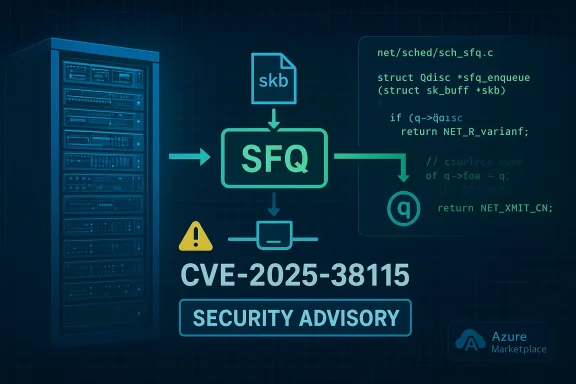 What Microsoft actually said (and how to read it)
Microsoft’s Security Response Center (MSRC) entry for the CVE uses a concise inventory-style sentence: “Azure Linux includes this open‑source library and is therefore potentially affected.” That sentence is a direct product‑level attestation — Microsoft has checked Azure Linux artifacts and found the implicated upstream code there. Microsoft has also said it is publishing machine‑readable CSAF/VEX attestations (initial rollout began in October 2025) and will update CVE mappings if additional Microsoft products are identified as carriers.Important nuance: that MSRC phrasing is deliberately scoped. It tells Azure Linux customers what they need to know: Microsoft has authoritative inventory coverage for that product and has mapped the upstream component to the product. It does not by itself assert that Azure Linux is the only Microsofever ship the code. Absence of an MSRC attestation for other Microsoft artifacts is absence of attestation, not proof of absence.
Technical verification and how the industry mapped the fix
Upstream kernel maintainers published the fix and a CVE announcement via the kernel CVE mailing process; stable branch commits are available for operators and packagers to apply. The Linux CVE announcement lists the affected source file (net/sched/sch_sfq.c) and points to the stable commits that resolve the issue. Distributions subsequently packaged or backported the change into specific kernel package versions, and distribution trackers (Debian, SUSE, Ubuntu, Red Hat) show which releases are fixed or need updates.Key technical points to confirm in your environment:
- Is the host kernel a Linux kernel that includes the SFQ qdisc (most kernels do unless deliberately configured without qdisc support)?
- Is the kernel version (or the vendor backport) earlier than the fixed upstream stable commits? Distribution advisories list the fixed package versions and are the authoritative mapping for package-managed systems.
Is Azure Linux the only Microsoft product affected?
Short, practical answer: No — not necessarily. Microsoft has publicly attested that Azure Linux is affected (it is the product Microsoft has inspected and flagged), but other Microsoft artifacts that ship Linux kernels or kernel modules could also include the same upstream code — and therefore could also be affected — until they are verified or patched.Why that is true (technical reasoning):
- The vulnerable code lives in the upstream Linux kernel tree. Any Microsoft product that ships a compiled Linux kernel (or kernel modules) built from a tree that predates the fix and includes net/sched/sch_sfq.c can carry the vulnerability.
- Microsoft ships multiple kernel‑based artifacts beyond Azure Linux: notably the WSL2 kernel binary distributed as part of Windows/WSL, kernel images used for some Azure VM offerings, Azure Marketplace images, and various management/agent images. The WSL2 kernel is explicitly a Microsoft‑built Linux kernel binary (Microsoft rebases and ships a kernel for WSL2), so it is a plausible carrier if that kernel binary falls within the vulnerable commit range and was configured to include the SFQ code.y by configuration and vendor backports. A kernel can include or exclude a subsystem at build time (CONFIG_* flags), and vendors often backport fixes into older-release packages. That means two kernels with the same upstream version number might differ in whether they are vulnerable depending on build-time choices and vendor backports.
Which Microsoft products and artifacts should you check now
Prioritize the following artifact families when you evaluate exposure in environments that run Microsoft-supplied or Microsoft-managed software:- Azure Linux (confirmed): treat as in‑scope and apply Microsoft/ distro updates immediately.
- WSL2 kernels on Windows hosts: Microsoft publishes and ships a Linux kernel binary for WSL2. If you rely on WSL2 in development or production workflows, verify the kernel version inside WSL (uname -r from within the WSL instance) and confirm whether the kernel image shipped to your Windows build includes the fixed commits. Microsoft’s published WSL kernel source tree and release notes are the place to cross-check build provenance.
- Azure Marketplace VM images and Microsoft‑published VM images: images that include a Linux kernel provided or curated by Microsoft or by the image publisher can be carriers if the kernel used to build the image contains the pre‑fix commits.
- Managed node images (AKS node images, curated container hosts): any Microsoft‑maintained base images used as the foundation for hosted or managed Kubernetes nodes and container hosts.
- Microsoft-published container images, developer base images, or appliance images (where Microsoft is the publisher): scan these kernel modules or userland components; even when the kernel is not in the container, Microsoft-published appliances and VM images may include kernels in their supporting artifacts.
- Third‑party Microsoft channels (GitHub Actions runner images run by Microsoft, Azure Cloud Shell, etc.) — these artifacts often inherit base images and packages; validate the kernels/packages they include.
- Inventory: list all places in your estate where Microsoft‑supplied Linux kernels or Microsoft‑published images are used (Azure Linux VMs, WSL2 on developer laptops, Azure Marketplace images, AKS nodes, GitHub/Microsoft runner images, Cloud Shell usage). This is the single most important immediate action.
- Identify the kernel binary or package version:
- On a Linux VM or container host: run uname -r and check the distribution package version (e.g., dpkg -l linux-image-*, rpm -q kernel). Then map that package to the distribution advisory that lists the fixed version. Distribution trackers (Debian/SUSE/Ubuntu/Red Hat) publish the package versions that include the backport.
- In WSL2: open a WSL shell and run uname -r to see the kernel version used by that WSL instance. Then compare to Microsoft’s WSL kernel source tree or the stable commit bug. Microsoft’s WSL kernel is maintained and occasionally rebased by Microsoft; if your WSL kernel is old and predates the fix, it warrants attention. (devblogs.microsoft.com)
- Cross‑check vendor attestations:
- If the artifact is Azure Linux, Microsoft has already attested it and will publish VEX/CSAF status for that product. Follow Microsoft’s update and apply the vendor‑supplied kernel package updates.
- For other artifacts, check whether Microsoft has published a VEX/CSAF attestation for that specific product or artifact. Absence of an attestation means you must verify the artifact yourself or wait for Microsoft to expand VEX coverage.
- If you cannot update immediately: apply compensating controls and reduce exposure:
- Limit untrusted users’ ability to manipulate network qdiscs (restrict access to tc and ethtool utilities).
- Harden multi-tenant surfaces where local/guest triggers are possible.
- Monitor for kernel oopses and report anomalous network stack crashes — a sudden rise in kernel oops logs originating in net/sched is a signal to triage. (Upstream advisories include repro steps that can also help triage.)
- Remediation: apply the fixed kernel package from your distribution or vendor. Do not rely on informal cherry-picks unless you are able to test and validate them; upstream guidance recommends updating to the latest stable kernel or using vendor backports.
Why vendors publish product‑scoped attestations — the operational reality
Large vendors (including Microsoft) produce thousands of artifacts: kernels, images, appliance binaries, container base images, developer tooling, and more. Mapping an upstream component to every single published artifact is operationally heavy; a phased VEX/CSAF rollout (start with the product families you can inventory end‑to‑end) is the practical approach. Microsoft’s MSRC stated approach — begin with Azure Linux and expand attestations — is consistent with that reality. The attestation for Azure Linux is valuable and authoritative for Azure Linux customers; it simply does not guarantee a negative for other Microsoft artifacts that haven’t yet been inventoried.This is why the correct operational posture is twofold:
- Prioritize remediation of the Microsoft product that Microsoft attested (Azure Linux).
- At the same time, perform artifact‑level verification for other Microsoft-supplied binaries and images in your environment (WSL kernels, Marketplace images, AKS node images, GitHub runner images, Cloud Shell, etc.).
Threat and exploitability context
CVE‑2025‑38115 is an availability‑focused kernel bug (crash). The attack vector requires the vulnerable qdisc path to be exercised and, depending on environment, local access or guest‑level access to trigger the condition. Public trackers assessed the issue as medium / moderate in CVSS terms for typical distributions; the immediate operational risk is kernel stability and denial‑of‑service rather than a remote RCE. That said, kernel painfrastructure are high‑impact even when exploit complexity is non‑trivial.Distributors published (netns + ethtool + tc flows) and the kernel CVE announcement links stable commits that fix the issue — use these references to validate whether an observed kernel oops matches this CVE’s symptom pattern.
Recommended immediate actions (checklist)
- Treat Azure Linux hosts as “Known Affected” and apply the vendor’s kernel updates or mitigations immediately.
- Inventory all Microsoft‑supplied Linux artifacts in your estate: Azure images, Marketplace images, AKS/ node images, WSL2 instances, Cloud Shell usage, GitHub runner images.
- On each artifact, check kernel package or binary versions (uname -r, package manager queries) and map to distribution/vendor advisories to confirm fixed status.
- If you manage Windows clients with WSL2, query the WSL instan-r and compare to Microsoft’s WSL kernel releases or the upstream fixed commits. Patch or update WSL kernels if Microsoft delivers a fixed WSL kernel update.
- For images you cannot immediately update, restrict access to utilities that can manipulate qdiscs (tc, ethtool) and monitor kernel logs for net/sched or sch_sfq oopses.
Strengths in Microsoft’s approach — and remaining gaps
Strengths- Microsoft published a clear product‑level attestation for Azure Linux and committed to machine‑readable VEX/CSAF attestations — that improves automation and reduces uncertainty for customers who run Azure Linux. This is a positive transparency step.
- The attestation gives e signal (Known Affected) for a product family Microsoft directly maintains, helping defenders prioritize remediation.
- The attestation is product‑scoped and phased. Customers who run other Microsoft‑distributed artifacts (especially WSL2 kernels, Marketplace images, and managed node images) cannot rely on the absence of mention to mean absence of vulnerability — those artifacts require independent verification.
- The pace of VEX/CSAF expansion matters: until Microsoft publishes attestations for more arttors must perform their own artifact inventories — a nontrivial operational burden in large estates.
Bottom line for IT teams and security operators
- Azure Linux: treat as confirmed in‑scope. Patch Azure Linux kernel packages immediately using Microsoft/distro guidance.
- WSL2 and other Microsoft‑distributed kernels/images: do not assume safety. Verify kernel versions and apply updates where necessary; if Microsoft later issues VEX/CSAF attestations that name additional products as Known Affected, follow those updates.
- If you rely on vendor attestations for vulnerability triage, make sure you understand the scope of those attestations (product‑by‑product) and run artifact‑level verification where your estate includes many Microsoft‑published artifacts.
End of article.
Source: MSRC Security Update Guide - Microsoft Security Response Center
