

Microsoft’s brief advisory that “Azure Linux includes this open‑source library and is therefore potentially affected” is accurate — but it is a product‑scoped attestation, not proof that Azure Linux is the only Microsoft product that could possibly include the vulnerable code tied to CVE-2025-38166.
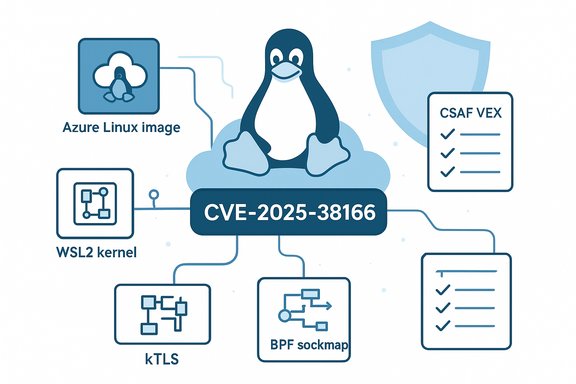
CVE-2025-38166 is a Linux kernel issue described as “bpf: fix ktls panic with sockmap,” a bug that can produce a kernel panic (OOPS) when certain BPF sockmap interactions meet kTLS (kernel TLS) socket paths. The vulnerability was disclosed in July 2025 and has been recorded in the normal vulnerability trackers and vendor advisories; upstream kernel fixes were merged into the stable kernel trees and distributions have been mapping and backporting those fixes into their kernel packages. At the same time Microsoft’s Security Response Center (MSRC) published an advisory that explicitly states Azure Linux (the Microsoft‑maintained Linux distribution descended from CBL‑Mariner) “includes this open‑source library and is therefore potentially affected.” Microsoft also said it began publishing machine‑readable CSAF/VEX attestations in October 2025 and committed to update the CVE entry if additional Microsoft products are identified as carriers of the same upstream component. That phrasing is deliberate: it is a statement about what Microsoft’s inventory work has verified so far, not a categorical exclusion of all other Microsoft artifacts.
Why that nuance matters:
However, there are two important supply‑chain caveats:
Source: MSRC Security Update Guide - Microsoft Security Response Center
 Background
CVE-2025-38166 is a Linux kernel issue described as “bpf: fix ktls panic with sockmap,” a bug that can produce a kernel panic (OOPS) when certain BPF sockmap interactions meet kTLS (kernel TLS) socket paths. The vulnerability was disclosed in July 2025 and has been recorded in the normal vulnerability trackers and vendor advisories; upstream kernel fixes were merged into the stable kernel trees and distributions have been mapping and backporting those fixes into their kernel packages. At the same time Microsoft’s Security Response Center (MSRC) published an advisory that explicitly states Azure Linux (the Microsoft‑maintained Linux distribution descended from CBL‑Mariner) “includes this open‑source library and is therefore potentially affected.” Microsoft also said it began publishing machine‑readable CSAF/VEX attestations in October 2025 and committed to update the CVE entry if additional Microsoft products are identified as carriers of the same upstream component. That phrasing is deliberate: it is a statement about what Microsoft’s inventory work has verified so far, not a categorical exclusion of all other Microsoft artifacts.What CVE‑2025‑38166 actually is
Technical summary
- The defect manifests in the Linux kernel BPF subsystem in interactions that cross into kTLS socket paths when using sockmap facilities.
- The symptom observed in the public kernel traces is a kernel BUG/OOPS at lib/iov_iter.c (a crash triggered when iteration over IO vectors goes out of bounds after a rollback), producing a hard panic on affected kernels.
- Upstream patches make the code defensively correct by ensuring the BPF sockmap path and kTLS rollback logic keep message iterators and scatter/gather sizes consistent so a later revert does not leave an inconsistent internal state that can be dereferenced. The kernel stable commits implementing the fix are publicly available in the kernel tree and have been referenced by multiple CVE trackers.
Practical impact and attack surface
- Primary impact: availability — kernel panic and crash; not a straightforward remote code execution by itself.
- Attack vector: typically local or local‑adjacent — an attacker or untrusted code able to load particular BPF programs (or influence BPF maps/sockmap behavior) can trigger the crash conditions. Whether that requires privileges depends on the host policy for unprivileged BPF loads (for example, sysctl kernel.unprivileged_bpf_disabled and capability gating for CAP_BPF / CAP_SYS_ADMIN).
- Exploitability: low for remote attackers on default hardened kernels, but higher for environments where unprivileged BPF or permissive sockmap usage is allowed (developer hosts, permissive container images, multi‑tenant CI runners). The real upside for defenders is that a non‑patched environment will show reproducible kernel OOPS traces that map to the CVE.
How Microsoft described product impact — what “Azure Linux includes this open‑source library” means
Microsoft’s MSRC entry and the machine‑readable CSAF/VEX attestations represent a product‑level inventory mapping: Microsoft looked at (some) of its artifacts, found the upstream component in the Azure Linux product family, and published that result so customers can automate triage for that product. The exact language — “Azure Linux includes this open‑source library and is therefore potentially affected… If impact to additional products is identified, we will update the CVE to reflect this” — encodes three clear operational points:- Microsoft has completed inventory checks for the Azure Linux family and found the implicated component there; treat those images as confirmed carriers and remediate accordingly.
- Microsoft’s CSAF/VEX output is machine‑readable, intentionally designed to be ingested into enterprise triage pipelines so security teams can automate actions against the specific product artifacts Microsoft has attested.
- Microsoft committed to expand the attestation set if further internal inventories identify other Microsoft products that ship the same component — in other words, the attestation rollout is phased and product‑by‑product.
Is Azure Linux the only Microsoft product that includes the library and is therefore potentially affected?
Short, direct answer (operationally meaningful): No — Azure Linux is the only Microsoft product that Microsoft has publicly attested to include the implicated upstream component for CVE‑2025‑38166 so far, but that does not guarantee it is the only Microsoft artifact that could contain the same vulnerable code.Why that nuance matters:
- Large vendors ship many independently built and packaged artifacts: Azure Linux images, WSL2 kernels, linux‑azure kernels bundled with specific VM SKUs, curated Marketplace images, container base images published by Microsoft, and partner appliances. Each of those is a distinct build artifact; the same upstream source code can appear in some artifacts and not others depending on build choices, kernel configuration flags, enabled modules, and selective backports.
- Microsoft’s attestation for Azure Linux is a positive confirmation for that product family; it is not yet an exhaustive inventory across all Microsoft SKUs. Microsoft explicitly promised to update the CVE/VEX records if additional products are identified.
- For defenders, the implication is: treat Azure Linux images as confirmed in‑scope and remediate; for other Microsoft artifacts, perform artifact inspection (SBOMs, kernel config checks, package inventories) rather than assume they are safe because they are not listed.
Which Microsoft artifacts should you verify beyond Azure Linux?
The following Microsoft‑distributed artifacts are plausible carriers depending on build choices:- WSL2 Linux kernel images shipped with Windows — Microsoft publishes WSL kernel builds and the kernel config is published for consumer inspection; whether a specific WSL kernel contains the vulnerable code depends on the kernel version and config used in that build. Public sample configs for WSL kernels typically omit many developer‑only KASAN options, but you must verify your exact WSL kernel build and config rather than assume.
- linux‑azure kernels that Microsoft may ship for certain VM SKUs — these are distinct artifacts from Azure Linux images and must be inventoried separately.
- Azure Marketplace VM images or partner appliances published under Microsoft’s marketplace — some are curated by Microsoft, others by third parties; each image may have independent package sets and kernels.
- Container base images and curated runtime environments published or maintained by Microsoft in Azure Container Registry or related services — these can include older base layers that carry vulnerable system packages.
- Any custom snapshots, VM images, or installers produced by Microsoft build pipelines for internal services or appliances — these frequently escape broad inventory checks and must be inspected on a per‑artifact basis.
What defenders should do now — practical triage and remediation playbook
The operational checklist below is prioritized for speed and realism.1. Treat Azure Linux as in‑scope and apply vendor updates immediately
- If you run Azure Linux, follow Microsoft’s published guidance and update kernel packages and images as Microsoft publishes them. The VEX/CSAF attestation is authoritative for Azure Linux images.
2. Inventory other Microsoft Linux artifacts you run
- Identify WSL2 usage, linux‑azure kernels, Marketplace images, curated container images, and any custom Azure VM images that your org runs.
- For each artifact, collect:
- Kernel version: uname -r
- Kernel config: /boot/config-$(uname -r) or publicly published kernel configs for WSL images
- Package lists and SBOMs for container/VM images
- Do not assume absence of a VEX entry equals safety. Microsoft’s attestation is phased.
3. Verify presence or absence of the implicated code
- Map the upstream commit IDs referenced by the CVE to the changelogs or kernel package release notes for your artifacts.
- If you build kernels internally, verify the upstream commit(s) that fix the issue are present in your git history. The kernel commits referenced in public trackers (and mirrored by tools like cvefeed) are the canonical fix points.
4. Apply mitigations where immediate patching is infeasible
- If unprivileged BPF is allowed and you cannot patch quickly, consider restricting BPF usage: set kernel.unprivileged_bpf_disabled = 1 where appropriate and remove CAP_BPF/CAP_SYS_ADMIN from untrusted processes. This reduces the local attack surface for many BPF‑related issues.
- Monitor kernel logs (dmesg / journalctl -k) for BPF or sockmap‑related OOPS traces; if you see the lib/iov_iter.c:629 backtraces, treat those systems as high priority for patching.
5. Automate and consume VEX/CSAF feeds
- Ingest Microsoft’s machine‑readable attestations into your vulnerability management pipeline so that when Microsoft updates the CVE mapping to include additional Microsoft products, your automation will mark affected artifacts for remediation. Microsoft explicitly designed the VEX feed to help with this automated triage.
Why vendor attestation language matters for supply‑chain risk
Vendor attestations like Microsoft’s CSAF/VEX entries solve a real operational problem: they tell customers which vendor products ship the exact upstream components that a CVE references. That is useful and actionable — particularly for customers running the named product (Azure Linux in this case) because it allows deterministic, automated triage.However, there are two important supply‑chain caveats:
- A vendor attestation is a snapshot of what the vendor has inventory‑checked; it is not a proof that other artifacts are clean. A vendor’s phased rollout typically starts with a clearly scoped product family and expands over time; customers operating outside that family must treat other artifacts as unverified until the vendor attests them or until they perform their own artifact inspection.
- Binary artifacts are build‑time objects — the same upstream source code can appear in multiple, independently produced binaries depending on configuration, backports and packaging. That means two Microsoft kernels can differ in subtle ways; an attestation for one product does not automatically apply to another unless the vendor explicitly states so.
Strengths and risks of Microsoft’s approach
Strengths
- Transparency and automation: Microsoft’s move to publish machine‑readable CSAF/VEX attestations for third‑party CVEs is an important step; it helps customers automate triage and prioritize remediation where Microsoft has completed inventory checks.
- Conservative wording: By explicitly promising to update the CVE if other products are found to be impacted, Microsoft avoids overclaiming and sets realistic expectations about a phased inventory rollout.
- Actionable guidance for Azure Linux: Customers running Azure Linux get a clear, high‑confidence signal and should apply updates promptly.
Risks and limitations
- False sense of exclusivity: Non‑expert readers may misinterpret a product attestation as proof that other Microsoft products are safe; operational teams could defer checks for other artifacts and leave blind spots. The MSRC wording must be read carefully — “attested for Azure Linux” is not “only Azure Linux could be affected.”
- Inventory gaps: Microsoft ships many independently built artifacts; inventories for WSL kernels, linux‑azure kernels, Marketplace images and others may lag and therefore remain unverified until Microsoft or customers perform artifact inspection.
- Operational complexity for mixed estates: Organizations that run a mix of Windows‑hosted WSL, Azure VMs, marketplace appliances and containerized workloads must perform multiple types of checks (kernel configs, SBOMs, package changelogs) — a more complex triage task than “apply one vendor patch.”
Final assessment and guidance
- Microsoft’s statement about Azure Linux and CVE‑2025‑38166 is accurate and actionable for Azure Linux operators: treat the attestation as definitive for that product and apply Microsoft’s updates promptly.
- However, Azure Linux is not guaranteed to be the only Microsoft product that could include the vulnerable BPF/kTLS/sockmap code. Any Microsoft‑distributed or Microsoft‑built kernel image (WSL2 kernels, linux‑azure, marketplace images, container bases) could be a carrier depending on build/version/config choices. Absence of attestation ≠ proof of absence.
- Defenders should combine three actions immediately:
- Patch and update Azure Linux artifacts per Microsoft guidance.
- Inventory and verify other Microsoft artifacts you run by checking kernel versions, configs, package manifests and SBOMs.
- Ingest Microsoft’s CSAF/VEX feeds and vendor advisories so that newly attested products are automatically flagged in your vulnerability management system.
Source: MSRC Security Update Guide - Microsoft Security Response Center
