

Microsoft’s terse MSRC note that “Azure Linux includes this open‑source library and is therefore potentially affected” is accurate for the product it names — but it is a product‑scoped inventory attestation, not a technical guarantee that no other Microsoft artifact can carry the same vulnerable ALSA code.
The vulnerability CVE‑2025‑38249 is a kernel ALSA (usb‑audio) bug that allows an out‑of‑bounds read in snd_usb_get_audioformat_uac3 when the driver trusts a length value returned by a USB device without sufficient validation. Upstream kernel maintainers added a length check to validate the returned size before casting and accessing the buffer, closing the window for a device‑supplied short length to cause an out‑of‑range read. Independent vulnerability trackers and distribution advisories (Debian, Ubuntu, Oracle, NVD) document the defect and list the upstream patch and fixed package versions. This is fundamentally an input‑validation bug triggered by a USB device returning a smaller length than the driver expects; it is classed as a robustness/availability defect rather than a canonical remote code‑execution primitive. The practical impact is an out‑of‑bounds read that can produce kernel oopses or other reliability failures when the ALSA usb‑audio code is exercised by hardware or emulated devices. Major distributions have already mapped the upstream fix into stable kernels and security updates; operators must apply a patched kernel and reboot to remediate fully.
Two facts follow from that wording:
This is not academic: operational exposure depends on whether the driver is present and reachable. For example, a Windows host with WSL2 uses a Microsoft‑maintained WSL kernel; if that WSL kernel contains the vulnerable ALSA code at the vulnerable revision and accepts USB device pass‑through, then a machine using WSL could be exposed — even though Microsoft’s MSRC entry named only Azure Linux. The safe operational stance is to treat the Azure Linux attestation as a confirmed hit and to verify other Microsoft artifacts you run until they are attested or proven clean.
Why that longer answer is correct:
At the same time, the phased rollout necessarily leaves a verification gap for other Microsoft artifacts until those are inventoried and attested. The correct operational interpretation is:
Applying patched kernels, hardening USB device handling on high‑risk hosts, and maintaining a firm image provenance practice are the reliable, defensible steps that close the operational gap left by phased vendor attestations.
Source: MSRC Security Update Guide - Microsoft Security Response Center
 Background / Overview
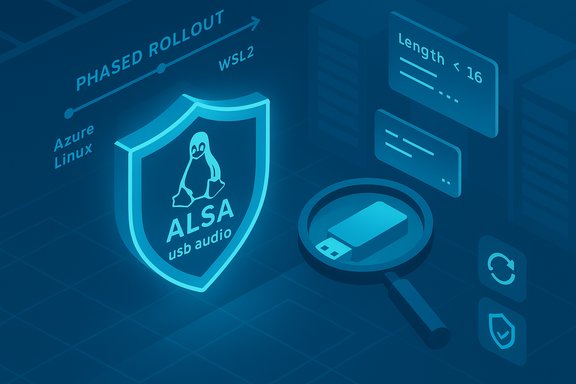
The vulnerability CVE‑2025‑38249 is a kernel ALSA (usb‑audio) bug that allows an out‑of‑bounds read in snd_usb_get_audioformat_uac3 when the driver trusts a length value returned by a USB device without sufficient validation. Upstream kernel maintainers added a length check to validate the returned size before casting and accessing the buffer, closing the window for a device‑supplied short length to cause an out‑of‑range read. Independent vulnerability trackers and distribution advisories (Debian, Ubuntu, Oracle, NVD) document the defect and list the upstream patch and fixed package versions. This is fundamentally an input‑validation bug triggered by a USB device returning a smaller length than the driver expects; it is classed as a robustness/availability defect rather than a canonical remote code‑execution primitive. The practical impact is an out‑of‑bounds read that can produce kernel oopses or other reliability failures when the ALSA usb‑audio code is exercised by hardware or emulated devices. Major distributions have already mapped the upstream fix into stable kernels and security updates; operators must apply a patched kernel and reboot to remediate fully. What Microsoft actually published — parsing the MSRC wording
Microsoft’s Security Response Center (MSRC) entry for this CVE includes a short, machine‑readable product attestation saying that “Azure Linux includes this open‑source library and is therefore potentially affected,” and it simultaneously notes Microsoft began publishing CSAF/VEX attestations in October 2025 and will update the CVE entry if additional Microsoft products are identified as carriers of the same code. That phrasing is deliberate: it confirms an inventory result for Azure Linux and signals Microsoft’s phased, product‑by‑product approach to VEX/CSAF publishing.Two facts follow from that wording:
- It is an authoritative yes for Azure Linux. Microsoft inspected the Azure Linux artifacts it ships and determined the implicated ALSA usb‑audio code appears in those images; the Azure Linux family is therefore in‑scope and must be remediated per Microsoft guidance.
- It is not an assertion of exclusivity. The statement does not and cannot logically prove that other Microsoft‑distributed kernel artifacts are free of the same upstream code until those artifacts have themselves been inventoried and attested. Microsoft explicitly said it would update the CVE/VEX mapping if its further inventories discover additional products that ship the component.
Why that distinction matters for defenders
Large vendors ship many binary artifacts, kernels and images. Whether a particular Microsoft product contains the vulnerable code is an artifact‑level property determined by:- Which upstream kernel version / commits were used when building the kernel;
- Which kernel configuration options (CONFIG_*) were enabled or disabled at build time;
- Whether the ALSA usb‑audio driver was compiled in or omitted (or available only as a module);
- Whether the image actually exposes USB passthrough or device nodes in a way that allows the code path to be exercised.
This is not academic: operational exposure depends on whether the driver is present and reachable. For example, a Windows host with WSL2 uses a Microsoft‑maintained WSL kernel; if that WSL kernel contains the vulnerable ALSA code at the vulnerable revision and accepts USB device pass‑through, then a machine using WSL could be exposed — even though Microsoft’s MSRC entry named only Azure Linux. The safe operational stance is to treat the Azure Linux attestation as a confirmed hit and to verify other Microsoft artifacts you run until they are attested or proven clean.
Independent verification of the technical claim
Multiple independent vulnerability trackers confirm the technical details of CVE‑2025‑38249 and the upstream fix:- Debian’s security tracker lists vulnerable and fixed kernel package versions and documents the patch that adds a length check to ensure the buffer is large enough for the expected descriptor.
- Ubuntu’s security notice documents the same description and lists affected kernel packages and status.
- The NVD entry reproduces the technical summary and links to upstream fixes.
Is Azure Linux the only Microsoft product that includes the library and is therefore potentially affected?
Short answer (precise): No — not necessarily. Azure Linux is the only Microsoft product Microsoft has publicly attested to include the implicated ALSA usb‑audio component for CVE‑2025‑38249 at the time of the MSRC advisory; but Microsoft’s attestation is product‑scoped and phased, and other Microsoft artifacts could still include the same upstream code until they are inventoried and attested. Treat the Azure Linux attestation as authoritative for Azure Linux and perform artifact‑level checks for every other Microsoft‑supplied kernel or image you run.Why that longer answer is correct:
- Microsoft’s statement is an inventory attestation, not a claim of global exclusivity. The company explicitly committed to updating the CVE/VEX entries if additional products are discovered to ship the component.
- Microsoft builds and publishes multiple Linux‑adjacent artifacts (for example, the WSL2 kernel, linux‑azure kernels for some VM families, Marketplace images, AKS node images, and other curated images). Whether each artifact is affected depends on the kernel revision and configuration used to produce that artifact. Absence of a published Microsoft attestation for those artifacts is simply “not yet attested,” not proof they’re clean.
Practical detection and verification steps (artifact‑level checks)
Operators need concrete checks to determine whether a host or image is vulnerable. Follow these steps to triage quickly:- Confirm whether the ALSA usb‑audio driver exists in the kernel image:
- Check whether the module is present or built in: lsmod | grep snd_usb_audio
- Inspect the kernel config: grep CONFIG_SND_USB_AUDIO /boot/config-$(uname -r)
- Check running kernel version and package metadata:
- Run uname -r and compare the version and package changelog against the distribution’s security advisory for CVE‑2025‑38249.
- Inspect kernel logs for symptomatic traces:
- Use dmesg or journalctl -k to look for audio‑driver oopses referencing snd_usb_audio or unexpected memory access in ALSA stack frames.
- For images and VM appliances, verify the packaged kernel:
- Mount the image or inspect its manifest; check packages or kernel RPM/DEB changelogs for the upstream commit or the CVE mapping.
- For WSL2 and Windows hosts:
- Inspect the WSL2 kernel binary or the WSL kernel source tree used by the host to determine whether the vulnerable code was included and whether a patched WSL kernel is available.
- For cloud environments:
- Use vendor attestations where available (the Azure Linux VEX/CSAF feed is authoritative for Azure Linux images) and replace vulnerable images with patched vendor images where possible.
- If you run Azure Linux images: treat them as confirmed in‑scope and apply Microsoft’s published remediation immediately.
- If you run other Microsoft images (WSL2, Marketplace, AKS nodes): inspect each artifact’s kernel version and config; do not assume they’re unaffected because Azure Linux was the only attested product.
Remediation and mitigation playbook
The only complete remediation for this class of kernel defect is to install a kernel that contains the upstream fix and reboot into it. Use the following prioritized checklist:- Patch Azure Linux images immediately
- If you use Azure Linux images supplied by Microsoft, consume the vendor update and reboot instances. Microsoft’s attestation for Azure Linux makes this the highest‑priority remediation for that product family.
- Patch other Linux distributions and appliances
- For Ubuntu, Debian, Oracle Linux and other distros, apply the fixed kernel packages listed in their advisories (these are already mapped and available).
- Verify WSL2 kernels and Microsoft‑built kernel artifacts
- If you rely on WSL2, examine the WSL kernel binary shipped with your Windows build or check for patched WSL kernel releases from Microsoft; update Windows/WSL accordingly where Microsoft issues a patched WSL kernel. Treat WSL kernels as separate artifacts that require explicit verification.
- For cloud and multi‑tenant hosts
- Restrict USB passthrough and block untrusted USB attachments, especially on multi‑tenant and CI systems where untrusted code might be able to access device nodes.
- Where possible, migrate critical tenants to patched hosts while you schedule rolling reboots of vulnerable hosts.
- Short‑term mitigations (when patching cannot be immediate)
- Tighten permissions on /dev/snd/* (reduce access to audio device nodes).
- Disable USB device attach or disable USB passthrough for untrusted VMs.
- Add SIEM/EDR rules to alert on kernel oops/panic logs referencing ALSA or snd_usb_audio stack traces.
- After applying updates, confirm the kernel changelog or package changelog lists the upstream stable commit or explicitly references the CVE fix.
- Reboot into the patched kernel and monitor kernel logs for absence of earlier oops patterns.
- For images, replace or rebuild VM images with the patched kernel and validate through a staging ring before broad rollout.
Operational guidance for mixed Windows + Linux estates
Many WindowsForum readers run heterogeneous environments: Windows hosts with WSL2 instances, Azure VMs using Microsoft images, Marketplace appliances, and on‑prem Linux servers. The Azure Linux VEX attestation is a useful automation signal for Azure Linux images specifically, but defenders should:- Use Microsoft’s VEX/CSAF outputs to automate triage for Azure Linux images immediately. The attestation will feed automation tools and reduce manual triage for that product family.
- Maintain an artifact inventory pipeline that maps each deployed image to a kernel provenance record (which commits and kernel config were used to build it). This is the only reliable way to prove whether a particular Microsoft–supplied artifact includes a vulnerable upstream revision.
- Treat absence of a Microsoft attestation for WSL2, Marketplace images, or other kernels as “not yet attested,” and take conservative remediation or verification actions for assets in high‑risk contexts (multi‑tenant hosts, CI runners, developer test farms that process USB devices).
Why Microsoft’s phased VEX/CSAF rollout is practically helpful — and where it leaves gaps
Microsoft’s decision to publish machine‑readable CSAF/VEX attestations (starting with Azure Linux in October 2025) is a measurable improvement in vendor transparency. For Azure Linux customers, the attestation provides a deterministic “known affected” signal that can be consumed by automation to triage and prioritize patching quickly. That is a real operational win.At the same time, the phased rollout necessarily leaves a verification gap for other Microsoft artifacts until those are inventoried and attested. The correct operational interpretation is:
- Use VEX/CSAF outputs to automate triage where attestations exist (Azure Linux).
- Continue artifact discovery, provenance checks and per‑artifact verification for all other Microsoft or third‑party images you run until a formal attestation is published. Microsoft has stated it will update CVE records as inventory work proceeds, but the timing will vary by product family.
Risks and caveats worth emphasizing
- Absence of attestation ≠ absence of vulnerable code. Treat un‑attested Microsoft artifacts as unverified until you can confirm kernel provenance.
- Vendor backport variability. Vendors backport patches to stable kernels differently; the presence of a CVE‑fix commit in a distribution’s changelog or package description is the definitive proof a kernel has been patched — not merely the kernel version number. Always inspect changelogs or package metadata for the upstream commit ID or CVE mapping.
- Long‑tail devices remain risky. Embedded appliances, vendor kernel forks and OEM images often lag upstream and can retain vulnerable revisions long after mainstream distributions have patched, so include them in your inventory and mitigation planning.
- Operational complexity in cloud contexts. Cloud images, Marketplace appliances and managed node images may be patched by different parties; verify the image publisher and its patch timetable and, where necessary, rebuild images with patched kernels for your tenant.
Recommended immediate actions (concise)
- For Azure Linux customers: apply Microsoft’s patch for the image and reboot affected instances as the top priority.
- For all Linux hosts: check for snd_usb_audio presence and map running kernels to the distribution fix for CVE‑2025‑38249; update and reboot where needed.
- For Windows + WSL2 users: confirm the WSL2 kernel binary your host uses and apply any Microsoft‑issued WSL kernel updates; treat WSL kernels as separate artifacts requiring verification.
- Harden high‑risk hosts: disable untrusted USB passthrough, restrict /dev/snd/* permissions, and increase monitoring for kernel oops traces tied to audio subsystems.
Conclusion
Microsoft’s statement that “Azure Linux includes this open‑source library and is therefore potentially affected” is a correct and useful product‑level attestation: if you run Azure Linux images you must treat them as in‑scope and apply the vendor’s updates. However, that wording is not a universal guarantee that no other Microsoft product includes the same ALSA usb‑audio code or is therefore safe. The attestation reflects a phased VEX/CSAF rollout — a pragmatic transparency improvement — and not an assertion of exclusivity. Defenders should act on the Azure Linux attestation immediately, while simultaneously performing artifact‑level inventory and verification for any other Microsoft‑supplied kernel binaries, images, or appliances they run until those are attested or proven patched.Applying patched kernels, hardening USB device handling on high‑risk hosts, and maintaining a firm image provenance practice are the reliable, defensible steps that close the operational gap left by phased vendor attestations.
Source: MSRC Security Update Guide - Microsoft Security Response Center
