

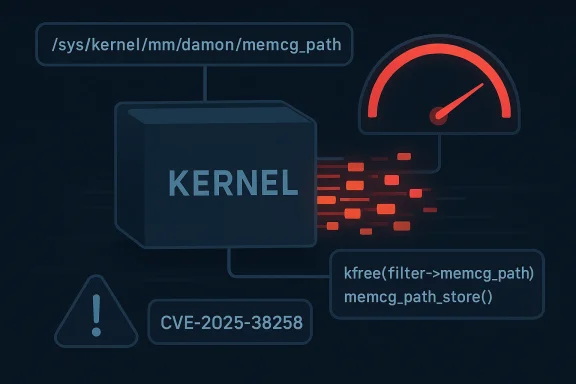
A newly disclosed kernel flaw, tracked as CVE-2025-38258, allows an attacker with local write access to a DAMON sysfs control to repeatedly leak kernel memory by overwriting a filter’s cgroup path without freeing the previous buffer — a straightforward memory‑leak bug that has been fixed upstream with a one‑line defensive change but still requires operators to patch broadly to avoid sustained availability problems.
DAMON (Data Access MONitor) is a kernel subsystem used to monitor memory access patterns and to build policies for memory management and data placement. Its sysfs interface exposes configurable schemes and filters, including per‑filter files such as memcg_path, which allows monitoring to be scoped to a particular memory cgroup. The vulnerable code path sits in mm/damon/sysfs‑schemes.c inside the implementation of memcg_path_store(), the sysfs write handler that updates a filter’s memcg path from user input.
The public disclosure timeline is concise: the CVE was published on July 9, 2025, and the upstream patch merged into the stable kernel trees shortly thereafter. Vendor trackers and distribution advisories assigned the issue a medium base score (CVSSv3 ≈ 5.5) reflecting a local attack vector and Availability as the primary impact.
The upstream fix is minimal and explicit: the code now frees the old buffer before replacing the pointer. The stable‑queue commit showing the change inserts a single call to free the previously stored pointer (kfree(filter->memcg_path) immediately before assigning the new allocated buffer to filter->memcg_path. That one small insertion closed the leak.
Why this matters in practice
Immediate steps (ordered)
Operational takeaways
CVE‑2025‑38258 is a plain but consequential example of how a simple resource management oversight in kernel code can become an operational outage if left unpatched. The fix is small and available; the operational work remains: find the exposed hosts, apply the fixes from your vendor or stable backports, and harden access to kernel sysfs controls so a single writable file cannot become a vehicle for a sustained denial‑of‑service.
Source: MSRC Security Update Guide - Microsoft Security Response Center
 Background / Overview
DAMON (Data Access MONitor) is a kernel subsystem used to monitor memory access patterns and to build policies for memory management and data placement. Its sysfs interface exposes configurable schemes and filters, including per‑filter files such as memcg_path, which allows monitoring to be scoped to a particular memory cgroup. The vulnerable code path sits in mm/damon/sysfs‑schemes.c inside the implementation of memcg_path_store(), the sysfs write handler that updates a filter’s memcg path from user input.The public disclosure timeline is concise: the CVE was published on July 9, 2025, and the upstream patch merged into the stable kernel trees shortly thereafter. Vendor trackers and distribution advisories assigned the issue a medium base score (CVSSv3 ≈ 5.5) reflecting a local attack vector and Availability as the primary impact.
What exactly was wrong (technical analysis)
At a high level the bug is simple and classical: when the sysfs write handler accepts a new memcg path string it allocates a new kernel buffer and stores a pointer to it in the filter structure. It did not free the previously assigned buffer before overwriting that pointer. Repeating writes therefore accumulate unreachable allocations in kernel memory — a textbook memory leak (CWE‑401). Over time this can consume kernel memory pools, disturb slab caches, or otherwise degrade host stability and availability.The upstream fix is minimal and explicit: the code now frees the old buffer before replacing the pointer. The stable‑queue commit showing the change inserts a single call to free the previously stored pointer (kfree(filter->memcg_path)
immediately before assigning the new allocated buffer to filter->memcg_path. That one small insertion closed the leak.Why this matters in practice
- Sysfs files are commonly writable by local users or processes that have access to specific control nodes. On multi‑user or multi‑tenant systems, that can be a broad attack surface.
- A leak in kernel space differs from a userland leak: hardware resources and kernel memory allocations are more constrained and affect system‑level services. If a locally repeated write loop can be executed by an attacker (or by runaway automation), it can force kernel resource exhaustion and produce availability loss — hung services, kernel OOMs, or panics.
- The flaw does not provide remote execution on its own; exploitation requires the ability to write the DAMON memcg_path sysfs node. Still, in environments where containerization, privileged helpers, or misconfigurations grant access to sysfs nodes to untrusted workloads, the effective attack surface broadens beyond classic local users.
Verified specifics (what I checked and where)
I verified the most important facts against multiple independent sources and the upstream commit record:- The vulnerability summary and CVSS rating (CVSSv3 ≈ 5.5) reported by vendor trackers and distribution advisories. Amazon’s ALAS entry and several CVE indices list the CVSS vector AV:L/AC:L/PR:L/UI:N/S:U/C:N/I:N/A:H.
- The technical description of the bug — that memcg_path_store() overwrites filter->memcg_path without freeing the previous memory — appears consistently in Red Hat, vulnerability databases, and patch notes.
- The upstream change added a call to free the old memcg_path before assigning the new allocation; the stable‑queue patch listing shows the exact one‑line insertion and the commit metadata. That insertion is the canonical fix and has been backported into stable trees.
- DAMON’s sysfs structure and the role of the memcg_path file are documented in kernel admin docs, which clarify why writable filter attributes exist and who can interact with them. This helps explain how an attacker might reach the vulnerable handler.
- Some secondary writeups speculate about exact affected kernel ranges or distribution package names; while patches have been merged into several stable branches, exact package identifiers vary by vendor and release. Operators must consult their distribution advisories for the precise fixed package mapping. Several trackers list affected kernel CPE ranges but those ranges differ slightly across feeds; the authoritative mapping is the distributor’s security advisory.
Impact assessment — operational risk and exploitability
Risk profile- Primary impact: Availability (denial of service via kernel memory exhaustion). The vulnerability does not, by itself, disclose data or elevate privileges; it steadily consumes kernel memory.
- Attack vector: Local (writes to a specific sysfs node). The attacker must be able to write the DAMON memcg_path sysfs file. In many deployments that means local user accounts, containers with excessive privileges, or management agents with access to sysfs.
- Complexity: Low to moderate for causing denial of service — repeated writes are trivial. High for turning the leak into a privilege escalation or remote compromise, because additional exploitation primitives would be required.
- A malicious tenant on a shared build/CI host that can write sysfs nodes could cause a host‑wide degradation over minutes or hours, depending on the leak rate and host memory configuration. This is especially risky for long‑running hosts or appliances that cannot be reloaded quickly.
- Untrusted automation or a misbehaving management script that loops sysfs writes could unintentionally create the same outcome — an operational outage framed as a reliability incident, not purely a security incursion.
- Embedded devices or appliances often run long‑lived kernels and receive updates slowly; the “long tail” effect makes such devices prime candidates for persistent exposure. File systems and services that rely on host stability (networking, storage) can be affected even if the kernel does not immediately panic.
- Vendors and trackers categorized the CVE as Medium overall, but that umbrella classification masks a practical reality: availability issues at the kernel level often cause outsized operational pain because they can disable networking, storage, or management services for entire hosts. Treat this one as a patch‑priority availability issue for exposed systems.
Detection, hunting, and validation guidance
Indicators to look for- Unexpected growth in kernel memory usage or slab caches that are not reclaimed over time after repeated sysfs writes.
- Repeated writes or commands targeting DAMON sysfs nodes, especially scripts that iterate over schemes//filters//memcg_path.
- Kernel logs showing OOM killer activity, slab allocation failures, or other memory‑pressure diagnostics that correlate with sysfs activity timestamps.
- Use of dynamic diagnostics: slabtop, /proc/slabinfo, kmemleak (in test environments), and system monitoring alerts for abnormal growth in kernel memory pools.
- Inventory sysfs nodes under /sys/kernel/mm/damon/* and identify which hosts expose writable memcg_path* entries. Use
find /sys/kernel/mm/damon -type f -writable -lsor equivalent to enumerate writeable control files. - Correlate any suspicious sysfs write activity with memory metrics: compare timestamps in audit logs or process accounting to kernel memory stats (/proc/meminfo, slabtop) when memcg_path writes occur.
- If you have kernel tracing in place, capture the memcg_path_store() call traces during a controlled test; look for repeated allocations and absence of frees in heap profiling traces.
- In staging only, reproduce the patch test by writing repeatedly to memcg_path and observing whether memory is reclaimed after successive writes — but never reproduce such tests on production hosts. (Danger: reproducing in production can cause real outages.)
Mitigation and remediation — what to do now
Short answer: apply vendor kernel updates that include the stable patch. The upstream fix is tiny and low risk; vendors have included it in stable branches and backported it into distribution kernels where applicable.Immediate steps (ordered)
- Inventory: Identify hosts that expose DAMON sysfs nodes and note which users/containers/processes have write permission. Prioritize multi‑tenant and management hosts.
- Patch: Apply vendor kernel updates or backports that include the stable commit which frees the old memcg_path before reassigning it. Use your distribution’s security advisory as the authoritative mapping to package names and versions.
- If you cannot patch immediately:
- Restrict access: Remove or reduce untrusted write access to /sys/kernel/mm/damon/**. This may mean changing permissions, using kernel parameters, or adjusting access control lists in your orchestration platform.
- Isolate: Move untrusted workloads to patched hosts or to hosts that do not expose DAMON sysfs nodes.
- Monitor: Set alerts for abnormal kernel memory growth or repeated sysfs writes to memcg_path.
- Test: After patching, validate the fix in staging by exercising the memcg_path write path in a controlled test and confirming that repeated writes no longer produce accumulating unreferenced allocations.
- Long term: Harden system images and enforce least‑privilege for sysfs writes (capabilities, namespaces, SELinux/AppArmor policies). Consider whether DAMON needs to be enabled on production hosts at all; if not, disable it at build time or via configuration.
- Temporarily disallow non‑root write access to the DAMON sysfs tree by changing permissions; for container platforms, limit the containers’ capabilities so they cannot reach /sys/kernel/mm/damon.
- If DAMON is a module in your kernel build, consider removing the module or blacklisting it until you can apply an upstream-stable backport (note: this may reduce functionality for legitimate monitoring workflows).
- Apply a vendor-provided livepatch if offered for your kernel tree — many vendors provide livepatch channels for small, non‑disruptive fixes to avoid reboots. Confirm that the vendor livepatch includes this specific stable commit.
Why the upstream fix is low‑risk — and why that matters
The kernel community’s response pattern for this class of bug is instructive. This particular defect is a classic resource lifetime error and the upstream remedy is a small, surgical change that restores proper deallocation semantics. That makes the patch low surface area and straightforward to backport into stable trees and distribution kernels. Small, focused fixes like this minimize regression risk compared with sweeping architectural changes.Operational takeaways
- Quick, small fixes are a positive signal: maintainers understood the root cause and applied a minimal, correct change rather than reworking the subsystem.
- The operational risk is not the fix, but the deployment lag: appliances, embedded systems, and older vendor kernels form the long tail that stays vulnerable the longest. That tail is the true risk vector for persistent availability incidents.
Practical checklist for administrators (step‑by‑step)
- Run a rapid inventory for DAMON sysfs exposure across your fleet.
- Feed inventory results into your patch management process; tag hosts that require an immediate kernel update.
- Test the vendor’s patched kernel in a staging environment:
- Confirm the presence of the upstream stable commit (or vendor advisory that references it).
- Validate that repeated writes to memcg_path no longer produce monotonic kernel memory growth in controlled tests.
- Deploy the patch according to your rollout plan, prioritizing shared or multi‑tenant hosts first.
- For hosts that cannot be patched immediately: restrict access to the DAMON sysfs nodes and monitor memory metrics closely.
- Post‑deployment: add an audit rule for sysfs writes to DAMON and re‑run your detection checks after a week of normal traffic.
- Long term: review whether DAMON needs to be enabled by default; consider embedding stricter access controls in golden images.
Broader context and lessons learned
CVE‑2025‑38258 is one of a string of small, correctness‑focused kernel fixes the community has fixed in recent cycles: many of them are lifetime and resource‑management issues that produce availability concerns rather than direct remote takeover vectors. The pattern — a tiny, obvious fix that nonetheless requires coordinated distribution updates and an operational patch rollout — repeats across kernels and vendors. This highlights two enduring truths:- Small code errors in kernel components can yield outsized operational impact.
- The operational hard part is not writing the fix; it is finding every device, appliance, and image that needs it and pushing the fix to each one in a timely, tested manner.
Final analysis — strengths, residual risks, and recommendations
Strengths- The patch is surgical and low‑risk: freeing the old pointer before assignment is the proper fix and should not introduce regressions.
- Upstream maintainers and stable‑queue channels moved the change into distribution trees quickly; major distributions and trackers have listed the change.
- Distribution and vendor package mapping differences: administrators must use their vendor advisory as the authoritative source for the exact package that contains the fix.
- The long tail of embedded and appliance devices: systems that do not receive timely kernel updates remain vulnerable and can present persistent availability risks.
- Environments where sysfs is exposed to less‑trusted user contexts (containers, CI runners, management agents) need immediate attention because the vulnerability is trivially exercisable to cause resource exhaustion.
- Treat CVE‑2025‑38258 as a targeted availability risk and prioritize patching for hosts that expose the DAMON sysfs interface to untrusted contexts.
- Use the vendor’s security advisory to map to fixed package identifiers and apply the update.
- If patching is delayed, restrict write access to /sys/kernel/mm/damon/** and enable monitoring for kernel memory growth and repeated sysfs writes.
- Add audit and detection rules for sysfs writes to protect future operations.
CVE‑2025‑38258 is a plain but consequential example of how a simple resource management oversight in kernel code can become an operational outage if left unpatched. The fix is small and available; the operational work remains: find the exposed hosts, apply the fixes from your vendor or stable backports, and harden access to kernel sysfs controls so a single writable file cannot become a vehicle for a sustained denial‑of‑service.
Source: MSRC Security Update Guide - Microsoft Security Response Center
