

Microsoft’s terse advisory that “Azure Linux includes this open‑source library and is therefore potentially affected” is accurate but incomplete as an operational statement — it is a product‑level attestation, not proof that every other Microsoft product is free of the same vulnerable component.
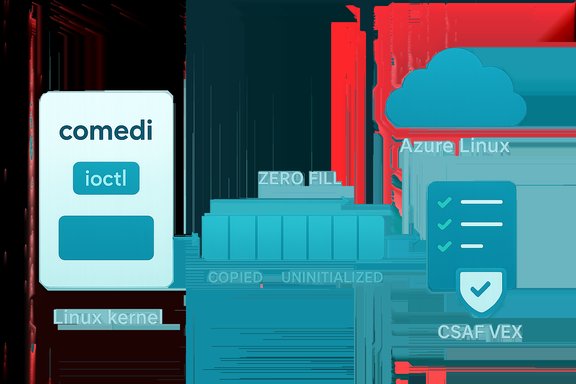
The vulnerability tracked as CVE‑2025‑38478 affects the Linux kernel’s comedi subsystem. At its core the bug is a failure to fully initialize a temporary buffer: the kernel allocates at least MIN_SAMPLES (16) elements for instruction data used by comedi ioctl handlers, but for certain instruction codes that write to the subdevice the code copies only the first insn->n elements from user space and leaves the remainder uninitialized. Certain subdevice handlers may read beyond the copied elements and therefore could observe uninitialized kernel memory. Upstream maintainers fixed this by ensuring the extra elements are zeroed before calling the handler. This is a correctness / information‑leak class of kernel bug rather than a clean, unauthenticated remote code execution. Depending on the driver and platform involved, it can lead to leakage of kernel memory to user space or other undefined behavior when an instruction handler consumes uninitialized data. Several distributors and tracking databases (Ubuntu, Rapid7, CISA, NVD) have recorded the issue and mapped the upstream fix into their advisories. Microsoft’s public note about this CVE takes a distinct form from a traditional patch bulletin. Instead of listing a long product matrix, Microsoft published a machine‑readable CSAF/VEX attestation and included the short, plain‑language statement that Azure Linux “includes this open‑source library and is therefore potentially affected.” Microsoft also announced in October 2025 that it has begun publishing VEX attestations as a phased program, starting with Azure Linux, and committed to update CVE entries and VEX records if additional Microsoft products are discovered to ship the affected component. That transparency move is a material improvement for customers, but it also introduces important operational nuance about what the phrase “includes … and is therefore potentially affected” does — and equally what it does not do.
This distinction matters operationally. Large vendors ship many Linux artifacts — separate kernel builds for Azure VM images, the WSL2 kernel that ships with Windows, linux‑azure kernels, Marketplace images, partner appliances, and IoT/base images. Each of these artifacts is built independently and may include or omit a given driver based on CONFIG_ choices, distribution packaging, or backports. Microsoft’s attestation is authoritative for Azure Linux*; it does not logically exclude other Microsoft artifacts from carrying the same upstream code until those artifacts are individually inventory‑checked and attested.
Source: MSRC Security Update Guide - Microsoft Security Response Center
 Background / Overview
The vulnerability tracked as CVE‑2025‑38478 affects the Linux kernel’s comedi subsystem. At its core the bug is a failure to fully initialize a temporary buffer: the kernel allocates at least MIN_SAMPLES (16) elements for instruction data used by comedi ioctl handlers, but for certain instruction codes that write to the subdevice the code copies only the first insn->n elements from user space and leaves the remainder uninitialized. Certain subdevice handlers may read beyond the copied elements and therefore could observe uninitialized kernel memory. Upstream maintainers fixed this by ensuring the extra elements are zeroed before calling the handler. This is a correctness / information‑leak class of kernel bug rather than a clean, unauthenticated remote code execution. Depending on the driver and platform involved, it can lead to leakage of kernel memory to user space or other undefined behavior when an instruction handler consumes uninitialized data. Several distributors and tracking databases (Ubuntu, Rapid7, CISA, NVD) have recorded the issue and mapped the upstream fix into their advisories. Microsoft’s public note about this CVE takes a distinct form from a traditional patch bulletin. Instead of listing a long product matrix, Microsoft published a machine‑readable CSAF/VEX attestation and included the short, plain‑language statement that Azure Linux “includes this open‑source library and is therefore potentially affected.” Microsoft also announced in October 2025 that it has begun publishing VEX attestations as a phased program, starting with Azure Linux, and committed to update CVE entries and VEX records if additional Microsoft products are discovered to ship the affected component. That transparency move is a material improvement for customers, but it also introduces important operational nuance about what the phrase “includes … and is therefore potentially affected” does — and equally what it does not do. What the comedi bug actually means for operators
Technical anatomy
- The vulnerable code lives in the comedi data‑acquisition subsystem of the Linux kernel. comedi exposes device nodes used by data‑acquisition hardware; its ioctl interfaces accept instruction lists and per‑instruction sample arrays.
- The vulnerability arises because helper functions do_insn_ioctl and do_insnlist_ioctl allocate a buffer sized at least MIN_SAMPLES but do not fully initialize it before handing it to instruction handlers that may read more elements than were copied from user space.
- The fix is straightforward and low risk: explicitly zero the full MIN_SAMPLES region (or otherwise initialize uncopied elements) before invoking the handler, preventing exposure of uninitialized kernel memory to user space.
Practical impact profile
- The typical risk is information exposure (uninitialized kernel memory leaking to user space) or undefined behavior in device drivers that consume those elements. In practice, exploitability depends on whether a given driver reads the extra elements and whether adversary‑controlled userland can exercise the ioctl paths.
- This vulnerability is more relevant to systems that expose comedi device nodes to untrusted processes — common in industrial control systems, embedded data‑acquisition equipment, lab workstations, or build/test infrastructure where drivers are present.
- For cloud and server images that do not enable comedi drivers (or where those drivers are compiled out), the practical exposure is minimal. But because kernel build configuration varies across artifacts, presence or absence is an artifact‑level property: one Microsoft kernel build can include comedi while another may not.
Microsoft’s wording: attestation versus exclusivity
Microsoft’s short sentence that Azure Linux includes the open‑source library and is therefore potentially affected is a product attestation. It says Microsoft performed an inventory for Azure Linux images and found the comedi component in those builds; it does not say Microsoft scanned every product and verified the component is absent elsewhere. Absence of a VEX/CSAF attestation for another Microsoft product is absence of attestation, not proof of absence. Microsoft explicitly committed to update the VEX/CSAF records if further Microsoft products are found to ship the component.This distinction matters operationally. Large vendors ship many Linux artifacts — separate kernel builds for Azure VM images, the WSL2 kernel that ships with Windows, linux‑azure kernels, Marketplace images, partner appliances, and IoT/base images. Each of these artifacts is built independently and may include or omit a given driver based on CONFIG_ choices, distribution packaging, or backports. Microsoft’s attestation is authoritative for Azure Linux*; it does not logically exclude other Microsoft artifacts from carrying the same upstream code until those artifacts are individually inventory‑checked and attested.
Is Azure Linux the only Microsoft product that includes comedi?
Short answer: No — not necessarily. Azure Linux is currently the only Microsoft product that Microsoft has publicly attested to include the comedi component for CVE‑2025‑38478. That makes Azure Linux the single confirmed Microsoft product to prioritize. However, the wording is not a blanket exclusivity guarantee: other Microsoft artifacts could include the comedi subsystem depending on kernel configuration, target platform, or backports. Treat Microsoft’s Azure Linux attestation as authoritative for that product family and as a prompt to verify other Microsoft‑provided artifacts you run.Why this answer is the correct operational reading
- Inventory is per artifact. Whether a kernel includes comedi depends on the kernel source, version, and CONFIG flags used to build it. Two kernels from the same vendor can differ widely in which subsystems are compiled in or available as modules.
- Microsoft is rolling out VEX/CSAF in phases. The company started with Azure Linux in October 2025. A phased rollout is practical — mapping every build and image across a large company’s portfolio is labor‑intensive. Microsoft’s statement that it will update CVE entries if additional products are discovered reiterates that the inventory is ongoing.
- Other Microsoft kernel artifacts are plausible carriers. Examples include the WSL2 kernel image, linux‑azure kernels for VM SKUs, Marketplace images, AKS node images, appliance images, and embedded IoT images — any of these could include comedi or be built with configurations enabling it. Customers running those artifacts should verify them explicitly.
How to verify whether your Microsoft‑provided artifact is affected
Operators should not rely solely on VEX/CSAF absence for other Microsoft products. Instead, follow a simple, prioritized verification checklist:- Inventory Microsoft artifacts in your estate:
- Identify Azure VM images, Marketplace images, AKS node images, and any WSL2 deployments in use.
- Treat Marketplace/customer images as separate artifacts that require individual checking.
- On any Linux system, check whether comedi support is present:
- Check the running kernel: uname -r
- Inspect kernel config: grep -i COMEDI /boot/config-$(uname -r) or cat /proc/config.gz (if available)
- Check loaded modules: lsmod | grep comedi
- Look for comedi device nodes: ls -l /dev/comedi*
These artifact‑level checks show whether comedi is present and whether the device nodes are exposed to user processes. - Map kernel package releases to upstream fixes:
- Use your distribution’s security advisories (Ubuntu, Debian, Red Hat, etc. to determine whether the kernel package version you run incorporates the upstream comedi fix. Ubuntu, Rapid7, and CISA have advisories that map the upstream commit to distro package updates.
- Examine SBOMs or CSAF/VEX artifacts:
- If you consume Microsoft CSAF/VEX feeds in your vulnerability automation, confirm whether the specific Microsoft image SKU you run is listed as Known Affected, Fixed or Not Affected. For Azure Linux customers, Microsoft’s VEX file for the CVE is the authoritative attestation.
- If you cannot confidently verify, ask the vendor:
- Raise a support ticket with Microsoft or the image vendor asking whether a specific SKU or kernel build has been inventory‑checked for CVE‑2025‑38478 and whether a fix/backport will be provided. Microsoft has stated it will update CVE/VEX entries if more products are discovered to ship the component.
Remediation and mitigation guidance
- Apply vendor patches: The correct fix is upstreamed; for most distributions and kernel packages the remedy is a small backport. Update kernels via your vendor’s normal patch channel (Ubuntu packages, vendor kernels in Azure, Windows updates for WSL2 where Microsoft ships the kernel image). Confirm the package changelog includes the comedi fix.
- Limit exposure of device nodes: On general‑purpose servers, ensure comedi device nodes are not accessible by untrusted users or containers. If a kernel includes comedi but you do not use it, consider blacklisting the module (modprobe.blacklist=comedi) or removing the module from images intended for multi‑tenant or untrusted workloads.
- For embedded and appliance vendors: If you ship a product with a custom kernel, backport the minimal upstream fix and rebuild the kernel. For appliances that bundle a static kernel or drivers, coordinate with your supply chain to push updated images to customers.
- Container hardening: If your workloads run in containers, ensure container runtimes do not expose host device nodes to untrusted containers. Use device allowances carefully; avoid mounting /dev entries that are not required.
- WSL2 users: If you operate Windows hosts with WSL2, check whether your WSL kernel image contains comedi and whether Microsoft’s WSL kernel update includes the fix; if in doubt, consult Microsoft’s kernel source or the WSL update notes. Microsoft’s VEX program is expanding but WSL kernels are a separate artifact and must be verified independently.
Critical analysis: strengths and risks of Microsoft’s VEX/CSAF approach
Notable strengths
- Machine‑readable attestations are a major win. Microsoft’s adoption of CSAF and VEX reduces ambiguity and helps security teams automate triage: a clear “Known Affected / Not Affected / Fixed / Under Investigation” for a named product is immensely useful when consumed by patch orchestration tools. Microsoft’s October 2025 VEX rollout, starting with Azure Linux, formalizes this approach and will reduce false positives for customers who consume vendor attestations.
- Transparent procedural commitment. Microsoft openly states it will update CVE entries if additional products are discovered to ship the same library. That promises accountability and an evolving inventory rather than silence.
Practical risks and gaps
- Phased rollouts create a perception gap. A one‑sentence attestation naming only Azure Linux can be read (incorrectly) by some as an exclusive denial that other Microsoft products are impacted. In practice, non‑security teams or downstream customers may misread the attestation as clearance for all Microsoft artifacts, potentially leaving vulnerable kernels unpatched. The distinction between “attested” and “exhaustively scanned” is subtle and needs explicit operational education.
- Artifact fragmentation complicates coverage. Microsoft (like other large vendors) ships multiple kernel artifacts. The presence of comedi in Azure Linux does not automatically tell you whether linux‑azure kernels, WSL2 kernels, Marketplace images, or partner appliances include the same code. Each of those remains a separate verification task. Customers who do not inventory artifacts may assume false safety.
- Static and vendor‑embedded binaries are hard to fix. Marketplace appliances, static images, or embedded device firmware that bundle kernels and drivers can be difficult to update in place; they often require vendor coordination or rebuilds. Microsoft’s VEX attestation helps only after the vendor’s inventory identifies these artifact types. Until inventory completes, these remain blind spots.
- Operational lag time matters. The time between upstream disclosure, distribution mapping, and vendor attestation is when defenders are most exposed. While Microsoft’s VEX makes it faster to know when Azure Linux is affected, it does not eliminate the lag for other artifacts. Security teams must adopt a defense‑in‑depth posture: patch quickly, limit device exposure, and verify artifacts.
Actionable checklist (what readers should do right now)
- If you run Azure Linux, treat this VEX attestation as a priority signal: apply Microsoft/ubuntu/your vendor kernel updates that include the comedi fix, and verify remediation via kernel package changelogs.
- If you run other Microsoft‑published artifacts (WSL2, linux‑azure, Marketplace images, AKS node images), do not assume you’re safe: perform the artifact checks described above (kernel config, lsmod, device nodes), consult vendor advisories, or open a support ticket to request inventory confirmation.
- For embedded appliances and vendor‑supplied images, contact the vendor to confirm whether the image includes the comedi subsystem and whether an updated image or backport is available. If you manage the image, rebuild with the upstream fix applied.
- Use defense in depth: restrict access to device nodes, remove unnecessary modules, harden container runtimes to avoid exposing host devices, and monitor for anomalous ioctl usage patterns in logs or via host IDS.
Conclusion
CVE‑2025‑38478 is a classic kernel correctness bug in the comedi subsystem that has a simple upstream fix: zero the extra MIN_SAMPLES buffer elements before passing them to instruction handlers. Microsoft’s statement that Azure Linux includes the open‑source library and is therefore potentially affected is both accurate and useful — it gives Azure Linux customers a direct, machine‑readable remediation signal — but it should not be interpreted as an exclusive claim that only Azure Linux could carry the vulnerable code. The VEX/CSAF rollout is a substantive improvement in vendor transparency and automation, yet its phased nature means operators must continue to verify other Microsoft artifacts they run rather than relying on omission from the VEX feed as proof of safety. Practical security requires both vendor attestations and artifact‑level validation: treat Microsoft’s Azure Linux attestation as authoritative for Azure Linux, use CSAF/VEX feeds to automate triage, and run the inventory checks, kernel config inspections, and vendor queries described above for every other Microsoft image or kernel you operate. That combined approach will ensure the comedi fix is not just published, but actually applied across the diverse kernels and images that power today’s mixed cloud, edge, and endpoint environments.Source: MSRC Security Update Guide - Microsoft Security Response Center
