

Microsoft’s brief public attestation that “Azure Linux includes this open‑source library and is therefore potentially affected” is correct — but it is a scoped, product‑level inventory statement, not a categorical guarantee that no other Microsoft product or image could include the same vulnerable F2FS code. In short: Azure Linux is the only Microsoft product Microsoft has publicly confirmed so far, and that confirmation is meaningful — but absence of confirmation for other Microsoft artifacts should not be read as proof of absence. Operators must verify their own inventories and treat any Microsoft image or kernel that ships the F2FS subsystem as potentially affected until proven otherwise.
CVE‑2025‑39731 is a Linux‑kernel vulnerability in the F2FS (Flash‑Friendly File System) implementation that can cause the kernel to call vm_unmap_ram() from an invalid execution context. The condition surfaces when pages are unmapped while interrupts are disabled or when the call occurs from an interrupt/atomic context; the result is a “sleeping function called from invalid context” kernel bug which can cause warnings, kernel oopses, or instability under certain workloads (notably when F2FS is exercised on UFS‑backed virtual disks in test scenarios).
The fix upstream adjusts the context checks in the F2FS read/end‑io path so that unmapping is not performed from an atomic or interrupt‑disabled context. The Linux kernel community released patches and maintainers have been backporting the changes into stable series and downstream distributions.
Microsoft’s public security note names Azure Linux as a shipper of the affected upstream component and states the company will update the CVE/VEX/CSAF mapping if additional Microsoft products are discovered to include the same code. That wording — common across many vendor advisories for upstream open‑source CVEs — is precise but often misunderstood by defenders. It tells you two things: (1) Microsoft has inventory‑checked Azure Linux and confirmed the presence of the upstream F2FS component, and (2) Microsoft will expand its published product mapping if and when further Microsoft artifacts are found to ship the vulnerable code.
That said, defenders should expect the following from vendors in responsible disclosures:
However, that statement does not mean Azure Linux is the exclusive Microsoft carrier of the vulnerable F2FS code. Defenders must assume that any Microsoft‑supplied kernel build — including WSL2 kernels, CBL‑Mariner variants, marketplace images, and appliance images — could contain the vulnerable code until their own triage and vendor attestations confirm otherwise.
Action plan for defenders (summary):
Source: MSRC Security Update Guide - Microsoft Security Response Center
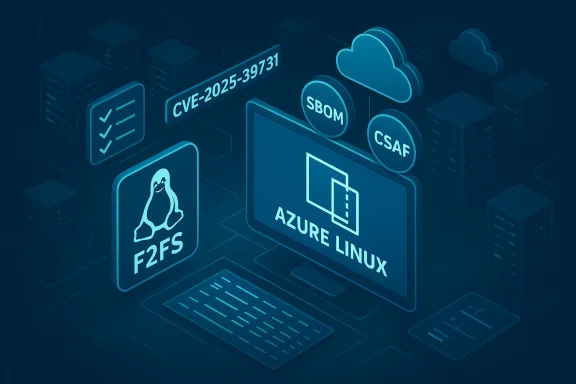 Background / Overview
CVE‑2025‑39731 is a Linux‑kernel vulnerability in the F2FS (Flash‑Friendly File System) implementation that can cause the kernel to call vm_unmap_ram() from an invalid execution context. The condition surfaces when pages are unmapped while interrupts are disabled or when the call occurs from an interrupt/atomic context; the result is a “sleeping function called from invalid context” kernel bug which can cause warnings, kernel oopses, or instability under certain workloads (notably when F2FS is exercised on UFS‑backed virtual disks in test scenarios).The fix upstream adjusts the context checks in the F2FS read/end‑io path so that unmapping is not performed from an atomic or interrupt‑disabled context. The Linux kernel community released patches and maintainers have been backporting the changes into stable series and downstream distributions.
Microsoft’s public security note names Azure Linux as a shipper of the affected upstream component and states the company will update the CVE/VEX/CSAF mapping if additional Microsoft products are discovered to include the same code. That wording — common across many vendor advisories for upstream open‑source CVEs — is precise but often misunderstood by defenders. It tells you two things: (1) Microsoft has inventory‑checked Azure Linux and confirmed the presence of the upstream F2FS component, and (2) Microsoft will expand its published product mapping if and when further Microsoft artifacts are found to ship the vulnerable code.
What the F2FS defect actually is — technical recap
How the bug arises
- The F2FS kernel code can unmap memory pages used for decompression buffers when read I/O completes.
- Under some asynchronous I/O or error paths, that unmap routine can be invoked while interrupts are disabled or from an atomic context.
- vm_unmap_ram() — like other vmalloc/vmalloc‑backed memory operations — may sleep. Calling it while in an atomic context or with interrupts disabled triggers the kernel’s “BUG: sleeping function called from invalid context” diagnostic.
- The practical outcome is system instability (kernel warnings, oopses, or crashes) in workloads that exercise these code paths.
The fix
- Upstream patches alter the context test (the in_task/in_atomic checks) so the code avoids performing sleepable unmap operations when in an invalid context, and instead defers or avoids the operation.
- The change was landed in the stable kernel series and has been propagated to downstream distribution kernels.
Scope and exploitability
- This is a local kernel integrity/stability bug rather than a remote code‑execution vulnerability. It is not a network‑accessible exploit in general.
- The vulnerability requires the F2FS filesystem to be present and the vulnerable code path to be exercised. Systems that do not mount F2FS or do not use the affected code paths will not see the bug.
- Attackers with local access (or guests in certain VM configurations where the guest can influence host behavior) could attempt to trigger the condition, but exploitation is constrained by environment and workload.
Why Microsoft’s statement does not mean “only Azure Linux is affected”
Microsoft’s public statement — “Azure Linux includes this open‑source library and is therefore potentially affected” — has two common misinterpretations:- Some readers take it to mean Microsoft has fully scanned every Microsoft product and found only Azure Linux to be carrying the code. That is not what the wording says. It says Microsoft has validated Azure Linux and lists it as a confirmed shipper; it does not assert that no other Microsoft product contains F2FS, only that Microsoft will update the advisory if it identifies further carriers.
- Others assume this reduces their burden — that they can stop searching other Microsoft images or kernels for the vulnerable code. That would be unsafe. Microsoft’s product inventory and artifact landscape is large and varied: images, container base layers, virtualization kernels, appliance images, managed service components, and specialist distributions can each contain independent kernel builds.
Where else the vulnerable kernel code could appear inside Microsoft’s product surface
Any Microsoft product or artifact that ships a Linux kernel build with the F2FS subsystem enabled — either built in or as a module — could include the vulnerable code until proven otherwise. Relevant Microsoft artifacts include but are not limited to:- Azure Marketplace images and VM images (beyond Azure Linux official images).
- CBL‑Mariner or other Microsoft Linux derivatives used for cloud infrastructure and appliances.
- Windows Subsystem for Linux (WSL2) kernel builds that Microsoft publishes for Windows clients.
- IoT and embedded Linux images that Microsoft builds or distributes for specific hardware.
- Security and endpoint agents for Linux that bundle or depend on kernel modules (in some architectures vendors ship custom kernels).
- Third‑party appliance or marketplace images published under Microsoft’s accounts that might include kernels compiled with F2FS enabled.
How to verify exposure across your Microsoft images and assets — practical checklist
If you are responsible for Linux hosts, Azure workloads, or Windows devices that consume Microsoft‑supplied Linux kernels, follow this prioritized set of checks:- Inventory first (high‑value, high‑exposure systems)
- Enumerate all Microsoft‑supplied images in your environment: Azure VM images, Marketplace images, WSL2 kernels, and appliance images.
- Prioritize internet‑facing, multi‑tenant, and critical VMs.
- Identify whether the kernel has F2FS present
- On a running system, run:
- uname -a (to identify kernel version and build)
- lsmod | grep f2fs (to see if f2fs is loaded)
- grep -i f2fs /proc/filesystems (to see if the filesystem is supported)
- zcat /proc/config.gz | grep CONFIG_F2FS (if config is available) to see if F2FS is built-in or modular.
- If you cannot log in directly, check the image manifest or SBOM (if available).
- Compare kernel version / patch level
- The defect was introduced in a given upstream commit and fixed in later kernel releases. Identify whether the kernel build includes the fix (look for the specific commit IDs or the presence of later stable releases that include the patch).
- If the vendor provides CSAF/VEX or SBOM metadata, review it for kernel versions, commits, or backport statements.
- If F2FS is present and kernel is in the affected range
- Schedule patching of the kernel or apply vendor‑provided updates.
- If patching is impossible in the short term, consider mitigation controls such as removing F2FS usage (unmounting or avoiding F2FS mountpoints) or isolating affected workloads.
- For Windows hosts with WSL2
- Check the WSL2 kernel version shipped with your Windows build. WSL2 uses a Microsoft‑distributed Linux kernel; if F2FS is enabled in that build and it predates the fix, it could be a vector — especially for developers who create F2FS images or mount F2FS volumes inside WSL.
- Use vendor attestations and CSAF/VEX output
- Microsoft has committed to publishing CSAF/VEX attestations for affected products. Use those machine‑readable artifacts where available to speed triage for confirmed carriers.
- If in doubt, contact vendor support
- For managed Microsoft images or appliances you cannot inspect, open a support case asking the vendor to confirm whether a particular image/kernel build includes the fixed code or not.
Step‑by‑step triage for Azure customers (condensed)
- Identify all Azure subscriptions and their VM images.
- Query image SKU manifests for kernel versions or request SBOM/CSAF for the image.
- For running VMs, check for F2FS support using the commands above.
- If vulnerable, schedule a kernel update or redeploy to updated images that include the fix.
- Use image scanning tools and configuration management policies to prevent redeployment of known vulnerable kernel images.
Risk analysis: who should worry most?
- Systems that mount F2FS volumes: highest priority. If you run F2FS as a production filesystem (common in some embedded or flash-optimized setups), the vulnerability is directly relevant.
- Systems that inadvertently include F2FS code in the kernel: moderate priority. Many generic kernels compile in a wide range of filesystem drivers by default; even if you don’t use F2FS now, code presence increases attack surface.
- Multi‑tenant or shared infrastructure: higher risk. The local nature of the bug means a malicious tenant or a compromised guest in some VM configurations could attempt to stress kernel paths.
- WSL2 clients and developer laptops: lower operational impact for most users, but a concern for devs who mount/inspect F2FS images inside WSL or run untrusted workloads.
Recommended mitigations for IT teams
- Apply patches: prioritize deploying the kernel updates from Microsoft (for Microsoft‑shipped kernels) and your Linux distribution vendors for non‑Microsoft kernels.
- Replace/upgrade images: use updated Azure images that include patched kernels. Rebuild or redeploy Marketplace or appliance images if necessary.
- Take defensive measures if patching is delayed:
- Avoid mounting F2FS filesystems on systems that cannot be patched quickly.
- Restrict local access and sandbox execution of untrusted workloads on hosts that ship the vulnerable kernel.
- For critical hosts, consider emergency kernel rollouts with livepatching where supported.
- Harden monitoring:
- Add kernel oops/watchdog alerting to detect any “sleeping function called from invalid context” messages in logs.
- Increase observation of VM guest I/O patterns that might exercise F2FS decompression/unmap paths.
- For WSL2 users:
- Verify the WSL2 kernel version and apply Windows updates that include patched WSL kernels.
- Avoid using F2FS images inside WSL2 until you confirm the kernel contains the fix.
How vendors should communicate (and what to expect from Microsoft)
Vendor attestation — naming a single product as “includes the open‑source component” — is a pragmatic approach: vendors cannot instantly audit every artifact and SKU across a vast ecosystem. Publicly confirming one product is useful because it gives customers a verified starting point and the knowledge that the vendor is actively triaging their inventory.That said, defenders should expect the following from vendors in responsible disclosures:
- A clear product mapping for confirmed affected products (as Microsoft has done for Azure Linux).
- A promise to update the CVE/CSAF/VEX record as additional artifacts are identified (Microsoft has stated this explicitly).
- Machine‑readable attestations (CSAF/VEX/SBOM) for each confirmed product image to speed automated triage.
- Guidance for customers about how to verify exposure and where to find patched images or kernel packages.
Practical examples: plausible Microsoft artifacts to double‑check
- Azure VM images (beyond the official Azure Linux image): custom Marketplace images often use vendor kernels.
- WSL2 kernel builds distributed through Windows Update: verify WSL2 kernel build and release notes.
- CBL‑Mariner variants or other Microsoft internal distributions used to build cloud appliances or managed services.
- Containers or appliances published through Microsoft accounts in the Marketplace: these sometimes embed kernels or provide kernel‑adjacent components for specialized use.
Caveats and unverifiable claims
- Vendor attestations change. Microsoft’s statement that Azure Linux is a confirmed carrier is a point‑in‑time attestation; Microsoft has committed to updating the CVE record/VEX as new information becomes available. Customers should always check their own environment and vendor updates rather than rely on a single statement.
- The exact exploitability and impact of CVE‑2025‑39731 depend on workload specifics (e.g., F2FS usage, VM backing, I/O patterns). We have summarized the typical behavior based on upstream technical descriptions, but individual environments will vary.
- Some downstream distributions may have backported fixes into older kernel versions without changing the kernel version identifier; verifying presence of the fix sometimes requires checking vendor changelogs, patchsets, or commit IDs, not just the version string.
Closing assessment and final recommendations
CVE‑2025‑39731 is an important kernel robustness bug that can destabilize systems that ship the vulnerable F2FS code and exercise the specific unmap path. Microsoft’s public statement correctly identifies Azure Linux as a product that includes the affected upstream component and pledges to update the CVE mapping if further Microsoft artifacts are discovered to include the same code.However, that statement does not mean Azure Linux is the exclusive Microsoft carrier of the vulnerable F2FS code. Defenders must assume that any Microsoft‑supplied kernel build — including WSL2 kernels, CBL‑Mariner variants, marketplace images, and appliance images — could contain the vulnerable code until their own triage and vendor attestations confirm otherwise.
Action plan for defenders (summary):
- Treat Azure Linux as confirmed affected and patch accordingly.
- Rapidly inventory and verify all Microsoft images and kernels in your environment.
- Prioritize hosts that mount F2FS and multi‑tenant infrastructure.
- Apply vendor patches and redeploy updated images; use livepatching or isolation where patching is temporarily infeasible.
- Request CSAF/VEX/SBOM artifacts from vendors for any unverified Microsoft images.
Source: MSRC Security Update Guide - Microsoft Security Response Center
