

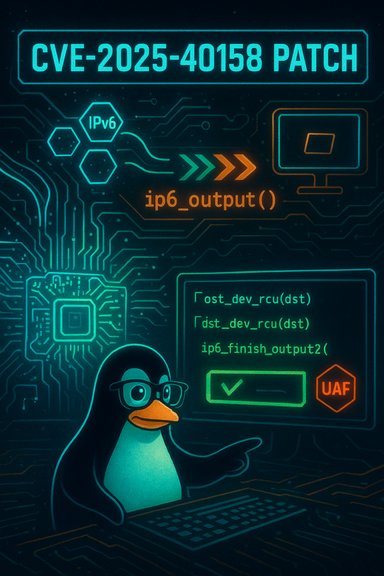
A recently disclosed Linux kernel vulnerability, tracked as CVE-2025-40158, affects the IPv6 transmit path: a race-condition/RCU misuse in the ip6_output / ip6_finish_output2 code that can lead to a possible use‑after‑free (UAF) when the kernel reads the destination device pointer; the upstream fix changes the code to use RCU-safe accessors (dst_dev_rcu and removes explicit rcu_read_lock/rcu_read_unlock pairs, and distributions are publishing patches and kernel updates in response.
IPv6 packet transmit in the Linux kernel is handled by a collection of functions that prepare an sk_buff and hand it off into the network stack and drivers. Two symbols are central to this CVE: ip6_output, the outward-facing IPv6 transmit function, and ip6_finish_output2/ip6_finish_output, which continue packet processing through netfilter hooks and the lower networking stacks. A subtle timing window existed around how the code accessed the destination device pointer (dst->dev) and how RCU (Read-Copy-Update) protection was applied. Read‑Copy‑Update (RCU) is a critical low‑overhead synchronization primitive used extensively in the kernel to allow readers to access pointers without heavy locks while writers update or delete structures. Because RCU allows concurrent readers and deferred reclamation, code that fetches a pointer under RCU but then later dereferences it must ensure the pointer remains valid for the readers’ critical section. Mistakes—missing RCU-safe accessors, mismatched lock/unlock pairing, or failing to use the proper RCU-protected accessor—can result in stale pointers and possible UAF conditions. The kernel community has repeatedly hardened networking code over the last years to follow consistent RCU patterns; this CVE is part of that continuing hardening effort.
In short: CVE‑2025‑40158 is a kernel IPv6 RCU‑lifetime fix that was identified and patched in upstream trees; the practical risk is local UAF leading to crashes or worse in multi‑tenant or attacker‑exposed environments. The correct operational response is prompt assessment, staged testing, and application of vendor kernel updates as they become available.
Source: MSRC Security Update Guide - Microsoft Security Response Center
 Background / Overview
IPv6 packet transmit in the Linux kernel is handled by a collection of functions that prepare an sk_buff and hand it off into the network stack and drivers. Two symbols are central to this CVE: ip6_output, the outward-facing IPv6 transmit function, and ip6_finish_output2/ip6_finish_output, which continue packet processing through netfilter hooks and the lower networking stacks. A subtle timing window existed around how the code accessed the destination device pointer (dst->dev) and how RCU (Read-Copy-Update) protection was applied. Read‑Copy‑Update (RCU) is a critical low‑overhead synchronization primitive used extensively in the kernel to allow readers to access pointers without heavy locks while writers update or delete structures. Because RCU allows concurrent readers and deferred reclamation, code that fetches a pointer under RCU but then later dereferences it must ensure the pointer remains valid for the readers’ critical section. Mistakes—missing RCU-safe accessors, mismatched lock/unlock pairing, or failing to use the proper RCU-protected accessor—can result in stale pointers and possible UAF conditions. The kernel community has repeatedly hardened networking code over the last years to follow consistent RCU patterns; this CVE is part of that continuing hardening effort. What exactly was wrong: the technical root cause
RCU vs direct device pointer access
The vulnerable pattern centered on how the code read and used the device pointer associated with a route/destination object (dst). Historically, networking code sometimes used direct reads of dst->dev with rcu_read_lock surrounding the read, then later accessed fields of the pointed-to device without using the kernel’s RCU-safe accessor family. The safer pattern—now adopted—uses dst_dev_rcu, a small helper that reads dst->dev while ensuring the access is done in an RCU-compatible way so subsequent operations can safely assume the RCU-protected lifetime semantics. The upstream commits change ip6_output to call dst_dev_rcu and to pair the reader region correctly.The upstream patch: what changed in the code
The upstream change replaces the sequence where the code obtained a device pointer and later relied on rcu pairs in ip6_finish_output2. The patch explicitly:- Calls dst_dev_rcu(dst) in ip6_output and holds the RCU-critical section until NF_HOOK_COND returns (or until the function returns), ensuring the device pointer is RCU-stable while the packet is dispatched.
- Removes redundant or mispaired rcu_read_lock/rcu_read_unlock usages in ip6_finish_output2, simplifying the control flow and avoiding nested/mismatched RCU regions that could leave a dereference unprotected.
- Adjusts the return path so the rcu_read_unlock happens after post‑routing hook invocation returns. This prevents a freed device/route from being observed by later code in the transmit path.
Impact and severity: what attackers can (and cannot) do
What the vulnerability enables
- Use‑After‑Free (UAF): The primary technical risk is that a reader in the transmit path could dereference a device pointer after it has been freed or replaced, producing undefined behavior including kernel crashes (OOPS), memory corruption, or in a worst-case exploitation chain, arbitrary kernel memory writes that could lead to privilege escalation. The upstream description explicitly calls this a potential UAF and the fix is to make the path RCU-safe.
- Local attack vector: All vendor assessments and tracker entries indicate the attack vector is local. That means an attacker needs either local code execution (unprivileged process executing on the box) or some mechanism to influence the local network transmit path (e.g., via crafted packet processing performed by a local process, containers, or some exposed IPC that can trigger IPv6 traffic). The exploitability via remote network access alone is not supported by the public descriptions.
- Primary impacts: Most assessors list integrity and availability impacts (kernel crash, potential tampering with network data path). Confidentiality impact is typically marked as none in the vendor summaries. A number of scoring sources provide high/medium scores depending on the vector and assumptions; vendor CVSS and internal trackers vary while upstream NVD had not fully enriched the record at the time of disclosure.
Exploitability and real‑world risk
- Exploit reports: As of current public information there are no widely reported proof‑of‑concept exploits or active exploitation campaigns specifically targeting CVE‑2025‑40158. Most public databases give a low EPSS (exploit prediction) score, indicating low short-term exploitation likelihood. That said, kernel UAFs are commonly targeted in local privilege‑escalation exploit chains, so the issue is treated seriously by maintainers and distro vendors.
- Attack complexity: Vendors and trackers rate attack complexity as high in some CVSS interpretations, mainly because attackers must orchestrate the timing to trigger the race, and often need local access to create the race window. That makes commodity remote exploitation less likely but does not eliminate risk in multi-tenant or shared-host environments (containers, VMs) where local triggers may be available.
Who is affected and where patches are available
Kernel versions and affected trees
Upstream commit metadata and open-sourced vulnerability trackers indicate the issue was introduced at a specific commit range and fixed by commits referenced in the Linux stable and net-next trees; two canonical stable commits are associated with the fix. The upstream project included the change in the net-next/ipv6 series and merged it into the stable trees as part of the regular stable update flow. Distributors that pick up a kernel including the fix will mark their packages as fixed.Distribution status — what vendors report
- Debian: The Debian security tracker lists multiple releases and kernel package versions affected and indicates fixed versions are available in the unstable branch (git-based fixed versions such as 6.17.6‑1 for the upstream kernel) and that stable releases are being assigned updates per Debian’s release security workflow. Administrators running Debian kernels should consult the Debian tracker entry for their release and upgrade to the vendor-supplied fixed kernel when available.
- SUSE: SUSE’s tracker lists the issue as pending with a moderate severity rating in their internal scale, and notes vendor decisions on what to patch in kernel-default. SUSE has historically been conservative about which kernel CVEs they backport; administrators should check SUSE’s security advisories for product-specific status.
- Commercial scanners and advisories: Tenable, Wiz, and other security vendors include CVE‑2025‑40158 in their databases and offer detection plugins or alerts; some larger vendors have flagged it as high severity for the kernel category and indicate that in some environment configurations a patch may not be available immediately and extra mitigation steps may be needed.
Practical guidance for administrators
- Apply kernel updates from your distribution as soon as they become available. Kernel fixes that address RCU/UAF issues typically require pulling a patched kernel package or applying a backported patch to your distro kernel packaging; inertly updating userland does not mitigate the kernel bug.
- For systems where immediate kernel rollout is difficult (production datacenters, appliances), consider:
- Isolating untrusted local users/processes and minimizing local code execution privileges.
- Limiting which services can generate IPv6 traffic from untrusted contexts.
- Applying host‑based exploit mitigation layers and monitoring for kernel OOPS/panic logs that could indicate attempts to trigger the bug.
- Container and multi‑tenant hosts should prioritize vendor kernel updates because local exploitability is more likely in shared environments.
Why this class of bug matters: RCU, complexity, and hardening
RCU is powerful because of its scalability and low read‑path cost, which is why it’s everywhere in kernel networking. But its semantics are subtle: readers must not take locks that will block in contexts that RCU does not expect, and writers must ensure proper grace periods before freeing memory. Over the past several years, kernel maintainers have run coordinated efforts to tighten RCU usage in networking code (dst->dev accessors, sk and dst lifetime handling, etc.. CVE‑2025‑40158 is one piece of that hardening work—fixes are defensive and reduce the number of distinct RCU patterns developers must remember when touching the network stack. The resulting code is not only safer from security exploitation but generally more robust against races and crashes.Attack scenarios (realistic and worst‑case)
- Local user triggers IPv6 transmit path repeatedly while racing a device removal or reconfiguration operation to coax an UAF that causes kernel memory corruption.
- Malicious container tenant repeatedly issues crafted IPv6 packets to stress the host’s transmit path, attempting to cause a kernel OOPS that couldbe chained to escape the container if other vulnerabilities exist.
- In worst-case theoretical chains (not publicly reported for this CVE), an attacker uses the UAF to overwrite function pointers or structures that could allow privilege escalation; such chains typically require additional vulnerabilities and carefully controlled kernel layouts.
Patching, testing, and operational notes
- Patching: Install your distribution’s kernel update once it is published. For Debian-based systems, the security tracker shows fixed versions in unstable and security updates will follow for stable series; follow your distro’s guidance for staged rollout. For SUSE and other enterprise vendors check their advisories for fixed kernel packages or recommended backports.
- Testing: Kernel updates touching RCU and network code should be smoke‑tested for:
- IPv6 connectivity, including tunnels and any applications that rely heavily on IPv6 extension headers.
- Netfilter/iptables/nftables rule behavior in the transmit/post‑routing chain.
- Performance regressions under representative traffic loads — RCU changes can alter micro‑timings and rare corner cases.
- Rollout strategy:
- Apply the fix in a staging environment first.
- Run IPv6-heavy traffic tests and monitoring for OOPS or WARN messages.
- Schedule broad production deployment with maintenance windows.
- Emergency mitigations: If vendor kernel updates are not available and you have high exposure, consider disabling non‑essential IPv6 services or reducing the ability of untrusted local users/processes to send IPv6 packets; this is a blunt instrument and impacts functionality. Monitor for kernel oops patterns that might indicate attempts to trigger the issue.
Strengths of the response and remaining risks
Notable strengths
- Upstream patch is targeted and small: The changes use established helpers (dst_dev_rcu and reduce complex locking patterns, which reduces human error in future edits.
- Rapid identification and tracking: The CVE was assigned, tracked by multiple national and vendor trackers, and included in the kernel stable patch streams, demonstrating a functioning vulnerability response pipeline for low-level kernel issues.
- Vendor awareness: Major trackers and security vendors have added the CVE to their databases and are producing detection plugins and advisories, enabling administrators to find and remediate affected hosts.
Residual and systemic risks
- Local‑only vector but high impact: Because the vector is local, Internet‑facing attack risk is limited in classic single‑tenant systems; however in multi‑tenant/cloud/container contexts the risk is materially higher.
- Backporting lag and vendor decisions: Not all distributors backport every kernel fix to all supported kernel flavors; some vendors may prioritize stable‑tree backports differently. Administrators of long‑lived kernel trees (e.g., older LTS kernels on appliances) must validate vendor statements and apply custom backports if needed.
- Exploit chain uncertainty: There is no public proof-of-concept exploit known at disclosure time; however kernel UAFs are attractive to attackers and can be chainable with other bugs. The lack of public exploit does not eliminate risk for high-target environments.
Recommended action checklist (concise, actionable)
- Inventory: Identify hosts running affected kernel versions or distributions. Use vendor security tracker references and scanner plugins that include CVE‑2025‑40158.
- Patch: Apply vendor-supplied kernel updates as soon as they are available and tested in your environment. Where vendors provide backports, prefer those packages for minimal regression risk.
- Isolate: For hosts that cannot be patched immediately, reduce the local attack surface by restricting unprivileged local execution and limiting the ability for untrusted tenants to generate IPv6 traffic. Consider host‑level hardening and container confinement.
- Monitor: Watch for kernel OOPS, WARN, or panic messages in logs that might indicate attempted exploitation; use anomaly detection on rapid repeated IPv6 transmit operations from unexpected processes.
- Plan: Update patching and test plans to account for future RCU/networking hardening patches—the kernel network stack has undergone several RCU safety changes recently and similar follow‑ups are possible.
Final analysis and takeaways
CVE‑2025‑40158 is a local kernel hardening fix: it addresses an RCU lifetime handling issue in IPv6 transmit code that could produce a use‑after‑free. The upstream change is precise—switching to dst_dev_rcu and consolidating RCU critical sections—and follows the kernel project’s broader move to normalize dst->dev access patterns to be RCU-safe. This is not an exotic remote exploit; it’s a classic kernel race/UAF whose risk is concentrated where local attackability exists (multi‑tenant hosts, compromised local users, or environments that run untrusted workloads). Administrators should treat this as a high‑priority kernel update for hosts with meaningful local‑user exposure, and as a medium‑priority fix for isolated single‑user desktops — but all production and shared‑host environments should prioritize vendor kernels containing the patch. Given the long history of RCU-related kernel bugs turning into local privilege escalations when combined with other issues, the decision to apply the fix promptly is prudent defensive hygiene. Caveat: public trackers and vendor pages differ in CVSS assignment and patch cadence; the NVD record was still in enrichment at initial publication and some vendors’ pages use different scoring lenses. Where precise CVSS numbers or vendor‑specific impact statements are critical to your compliance or risk posture, consult your distribution’s official security advisory and test vendor-supplied kernel packages in a controlled preproduction environment before broad rollout.In short: CVE‑2025‑40158 is a kernel IPv6 RCU‑lifetime fix that was identified and patched in upstream trees; the practical risk is local UAF leading to crashes or worse in multi‑tenant or attacker‑exposed environments. The correct operational response is prompt assessment, staged testing, and application of vendor kernel updates as they become available.
Source: MSRC Security Update Guide - Microsoft Security Response Center
