

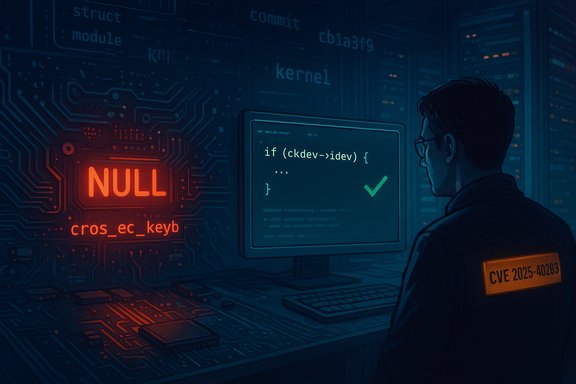
A subtle but dangerous correctness bug in the Linux kernel’s ChromeOS EC keyboard driver has been assigned CVE‑2025‑40263: a defensive‑coding oversight allows the driver to dereference a NULL input device pointer when it receives a particular EC event while the driver intentionally omitted matrix initialization, producing an invalid memory access and kernel fault. This article dissects the bug, explains how and why it occurs, examines patch and distribution coverage, and offers a practical remediation and mitigation playbook for system administrators, OEMs and embedded vendors who must keep devices stable and secure.
The vulnerability affects the ChromeOS Embedded Controller keyboard driver — commonly referenced in the kernel as cros_ec_keyb — which implements communication between the AP (application processor) and the EC for keyboard events. The problem arises when the driver’s probe path chooses not to register a matrix input device (for example, when the device is configured as buttons/switches only). In that configuration the driver intentionally leaves certain input device pointers uninitialized (NULL). Later, if the kernel receives an EC MKBP (Matrix Keyboard Protocol) event of type KEY_MATRIX, the work handler processes the event and — because of a missing defensive check — proceeds to use the NULL pointer, causing an invalid read and a kernel oops. The NVD summary and public trackers document this behavior and the kernel call trace observed when the fault occurs. This is a classical robustness issue in privileged kernel code: the driver’s internal state allows for a mode where no matrix input device exists, but an out‑of‑band or malformed event can still arrive and reach code paths that assume the matrix device is present. Rather than being an arbitrary memory‑corruption exploit, the immediate and realistic impact is kernel instability — oopses, panics, or driver crashes — that translate to availability problems on affected systems. Public records note that the root cause of why such malformed EC events are delivered remains unclear; regardless, kernel code must not dereference NULL pointers in any control path.
The EC reports events through the MKBP event queue; the kernel registers a notifier and a work handler to process those events asynchronously. A KEY_MATRIX event indicates matrix updates and is normally handled by code that assumes a valid
Verification steps operators should perform:
Source: MSRC Security Update Guide - Microsoft Security Response Center
 Background / Overview
The vulnerability affects the ChromeOS Embedded Controller keyboard driver — commonly referenced in the kernel as cros_ec_keyb — which implements communication between the AP (application processor) and the EC for keyboard events. The problem arises when the driver’s probe path chooses not to register a matrix input device (for example, when the device is configured as buttons/switches only). In that configuration the driver intentionally leaves certain input device pointers uninitialized (NULL). Later, if the kernel receives an EC MKBP (Matrix Keyboard Protocol) event of type KEY_MATRIX, the work handler processes the event and — because of a missing defensive check — proceeds to use the NULL pointer, causing an invalid read and a kernel oops. The NVD summary and public trackers document this behavior and the kernel call trace observed when the fault occurs. This is a classical robustness issue in privileged kernel code: the driver’s internal state allows for a mode where no matrix input device exists, but an out‑of‑band or malformed event can still arrive and reach code paths that assume the matrix device is present. Rather than being an arbitrary memory‑corruption exploit, the immediate and realistic impact is kernel instability — oopses, panics, or driver crashes — that translate to availability problems on affected systems. Public records note that the root cause of why such malformed EC events are delivered remains unclear; regardless, kernel code must not dereference NULL pointers in any control path. Technical anatomy — how the bug arises
Driver responsibilities and the EC MKBP event model
The ChromeOS EC keyboard driver handles two complementary classes of inputs:- Matrix keyboard scanning and the associated matrix input device (the main keyboard matrix).
- Non‑matrix items such as buttons and switches that the EC reports independently.
buttons_switches_only path), the matrix registration routine is skipped and the driver intentionally leaves the matrix input device pointer (commonly ckdev->idev) as NULL.The EC reports events through the MKBP event queue; the kernel registers a notifier and a work handler to process those events asynchronously. A KEY_MATRIX event indicates matrix updates and is normally handled by code that assumes a valid
idev to report key presses.The missing guard: race of state and event handling
The bug appears when:- The driver’s probe path sets up the driver in a buttons/switches only mode and does not call the function that registers and initializes the matrix input device.
- Despite that configuration, the kernel receives an EC MKBP event of type KEY_MATRIX.
- The registered work handler (cros_ec_keyb_work → cros_ec_keyb_process) receives the event and proceeds to access
ckdev->idev(and associated fields) without checking whether the pointer is non‑NULL. - The resulting dereference of
NULLcauses an invalid memory access and a kernel oops; the observed call trace in public write‑ups shows input_event → cros_ec_keyb_work → blocking_notifier_call_chain → ec_irq_thread. The kernel log shows zeroed registers and an attempted read at a low virtual address consistent with a NULL‑based dereference.
ckdev->idev (or the matrix registration status) is non‑NULL before using it in cros_ec_keyb_process — eliminates the invalid access while preserving intended behavior in buttons_switches_only mode.Why this is a “defensive correctness” fix
This is the same class of problem seen repeatedly in kernel maintenance: driver code assumes a resource or object exists because it is usually created, but probe permutations or platform differences can leave the object absent. The correct pattern is defensive: check returned pointers or driver state and take a safe early exit when an expectation is not met. Public vulnerability write‑ups of similar kernel fixes highlight this exact pattern and recommend small, surgical fixes that add a NULL check or rework the control flow to avoid dereferencing optional resources.Patch details and verification
Upstream kernel maintainers merged fixes in the stable trees to ensure the work handler does not useckdev->idev unless it has been initialized. The NVD and public trackers list the kernel commits associated with the remediation; multiple stable commit IDs were referenced in tracker entries indicating the patch was applied to several active stable branches. Those tracker records and vendor advisories provide commit identifiers and reference the same behavior description: a missing matrix registration leaves ckdev->idev NULL and the work handler must not dereference it. Because several stable branches were updated, distributors typically map those upstream commits into their kernel package changelogs. Operators should not rely on kernel version numbers alone; rather, they must confirm their package changelog or vendor advisory references the upstream commit (or the CVE).Verification steps operators should perform:
- Confirm the kernel package changelog or distribution advisory cites the CVE or the upstream commit hashes associated with the fix. Public trackers list multiple stable commit references to help map distribution backports.
- If you maintain custom kernel forks (OEM, embedded), inspect your local cros_ec_keyb.c to ensure
cros_ec_keyb_processvalidatesckdev->idevand any related pointers before use. - Reproduce the fix in a test device if feasible by exercising EC event paths in a controlled environment and ensuring no oops occurs for Key Matrix events when the matrix device has not been registered.
Impact and exploitability — realistic threat model
Attack vector and privileges
- Attack vector: local / hardware event. Triggering the problem requires that the kernel receive an EC MKBP KEY_MATRIX event while the driver intentionally left the matrix device unregistered.
- Privileges required: local/low — the event originates from the EC; it may be the result of actual keyboard hardware behavior, a buggy EC firmware, or crafted inputs over a bus (I2C, LPC, SPI) that the EC does not validate.
- Remote network exploitation: unlikely, unless some remote channel can coerce the EC into emitting the event (rare and highly platform‑specific). For most systems, this is a local hardware/firmware reliability and availability problem, not a network threat.
Practical effects
The most immediate and probable impact is availability: kernel oopses and crashes, potentially requiring a reboot and disrupting services. Public summaries emphasize the invalid read and the kernel call trace showing an attempted read from a near‑NULL address; these symptoms are typical of a NULL‑pointer dereference and result in a kernel oops. There is no public evidence that this specific bug can be trivially converted into remote code execution — it is best characterized as a stability/denial‑of‑service issue — but defenders should not dismiss the possibility that local instability can be chained in targeted attack scenarios.Why supply‑chain devices and OEM images matter
Embedded devices, laptop firmwares and OEM kernels often lag upstream patches and may carry vendor‑specific backports. Because the ChromeOS EC keyboard driver is used on many laptop designs (especially ChromeOS devices and some consumer laptops that re‑use the EC interface), vendors that ship custom kernels must ensure the fix is included in their images. Distribution propagation varies and embedded images may never be updated without vendor action. Multiple public advisories emphasize that the fix is small and low‑risk to backport, but the long patch tail lies with vendors and OEM firmware teams.Affected systems — what to check
- Linux kernels built from upstream trees before the stable commits that implement the patch should be considered potentially affected. Public aggregators list multiple commit IDs for different stable series; distribution advisories map those fixes into packaged kernels. Confirm by looking for the cros_ec_keyb.c changes in your kernel source or package changelog.
- Embedded boards (Chromebook vendor kernels, OEM forks) that include ChromeOS EC keyboard support and that use the buttons/switches only code path are the highest priority.
- Systems with ECs that can emit MKBP KEY_MATRIX events — laptops, small form‑factor PCs and some embedded boards — should be inventoried and validated.
- uname -r (identify running kernel)
- rpm -qi kernel (or apt-cache policy linux-image-... , dkms/kernel package checks) to map to distro advisories
- Inspect /sys or kernel config for EC and cros_ec support: check for modules or drivers such as cros_ec and cros_ec_keyb in drivers/input/keyboard
- For integrated device builds: search kernel source for cros_ec_keyb.c and review whether the upstream patch is present
Detection, logging and incident hunting
Detection relies on three complementary channels:- Kernel logs: watch for oops or panic traces mentioning cros_ec_keyb_work, cros_ec_keyb_process or input_event. The canonical fault trace recorded in records shows the work handler path and register state indicative of a NULL dereference. Add log alerts for any repeated oopses referencing the EC or keyboard driver.
- Crash telemetry: collect and analyze kernel crash dumps and report on patterns where input subsystem faults cluster on
ec_irq_threador input_event frames. - Hardware/firmware telemetry: if you can collect EC firmware logs or MKBP event traces (on supported hardware), validate whether KEY_MATRIX events are being emitted while the kernel has not registered a matrix device.
- grep -R "cros_ec_keyb_work" /var/log/* and journalctl for oops traces.
- Monitor for repetitive crashes during boot or resume that coincide with EC enumeration.
- For cloud or fleet environments, correlate crashes with hardware model and kernel package versions to prioritize vendors with many vulnerable endpoints.
Remediation and mitigation playbook
- Patch: Install a kernel package that includes the upstream stable commit(s) that implement the fix, then reboot into the patched kernel. This is the definitive remediation. Public trackers list the stable commit IDs and indicate the fix has been merged into multiple branches; confirm your distro’s kernel package changelog mentions either CVE‑2025‑40263 or the specific commit hashes before deployment.
- Verify: After patching, reproduce prior triggers in a safe test environment (if you can generate MKBP KEY_MATRIX events) and validate there is no kernel oops. Also monitor kernel logs for 7–14 days for reoccurrence.
- Temporary mitigations (if immediate patching is impossible):
- Restrict access to any interfaces that could cause EC events (for example, limit access to debug interfaces or bus controllers) where practical.
- For virtualized or managed images, quarantine vulnerable hosts from critical multi‑tenant workloads until patched.
- Use device firmware updates if the vendor supplies EC firmware that mitigates malformed MKBP events (rare, but validate vendor advisories).
- Vendor coordination: For OEM or embedded images, coordinate with device vendors to obtain updated kernels or firmware images that include the upstream patch. Insist vendors provide a verified firmware/kernel image or a changelog referencing the upstream commit.
- Long‑term code hygiene: Developers and integrators should treat any pointer returned from an optional registration routine as potentially NULL and add explicit checks. This is consistent with prior kernel corrective patterns where small defensive edits (NULL checks or bounded input checks) eliminated common classes of oops‑causing bugs.
- Inventory affected hardware models and map to kernel package versions.
- Identify pilot hosts and apply the patched kernel there first.
- Run hardware‑centric smoke tests (keyboard input, resume, EC event handling).
- Roll out phased updates and maintain rollback images in case of regressions.
- Schedule a maintenance window since kernel updates require reboots.
Verification notes and caveats
- Multiple independent vulnerability trackers and the NVD list the issue with consistent technical descriptions and reference the upstream commit IDs that implement the fix, providing cross‑verification of the underlying facts.
- The public descriptions note that the root cause of why the kernel receives a malformed event remains unknown. That claim is important: it means defenders should not assume the EC cannot be coaxed into emitting illegal events by firmware bugs or glitchy hardware. Until the origin of the event is known, the right defensive posture is to harden kernel code and ensure the handler never dereferences pointers that may be NULL.
- While the bug was fixed upstream with a small edit, distribution and OEM backport status can lag. Do not treat the absence of CVE scanning alerts as proof of patching; instead confirm package changelogs and vendor advisories map the upstream commits to your shipped kernel packages.
Critical analysis — strengths, residual risks and recommendations
Strengths- The upstream fix is small and surgical — adding a defensive check or early return — which means low risk of regression and straightforward backporting into stable kernel branches.
- Multiple reputable trackers and vendor advisories rapidly indexed the CVE and pointed to the canonical upstream commits, making verification by administrators practical.
- Supply‑chain lag is the dominant risk: embedded vendors and OEMs often maintain their own kernel forks and may delay backports for months. Devices in the field (laptops, kiosks, appliances) may remain exposed for long periods without vendor action.
- The origin of malformed MKBP events is not documented publicly; if a class of EC firmware or bus interactions can consistently deliver such events, attackers with local access could weaponize the stability issue to cause targeted denials of service on fleets of devices.
- Detection is intrinsically local: many organizations do not gather high‑fidelity kernel trace telemetry centrally, so early signs of wider exploitation might go unnoticed. Strengthen crash reporting and telemetry collection where possible.
- Treat multi‑tenant and fleet‑scale deployments as highest priority for patching. An unpatched host can be trivially taken down by repeated kernel faults, creating operational consequences beyond a single workstation.
- Verify and demand vendor timelines for any OEMs that ship devices with bespoke kernels.
- Include a simple WinRE‑style or post‑update hardware validation step in your update rollout to catch device‑specific regressions early.
Conclusion
CVE‑2025‑40263 is an instructive reminder that defensive coding and strict state checks in kernel drivers are not optional: hardware event handlers must never assume the presence of optional resources. The fix is straightforward and low risk, but its practical security value depends entirely on timely propagation into vendor and distribution kernels. Administrators should treat this as an availability/stability risk requiring routine patching discipline: inventory, apply the upstream‑mapped kernel updates, reboot into patched kernels, and validate device behavior. Maintain robust crash telemetry, insist on vendor backports for embedded devices, and ensure that driver code never dereferences optional objects without explicit checks — a small change upstream can prevent a disruptive failure in production.Source: MSRC Security Update Guide - Microsoft Security Response Center
