

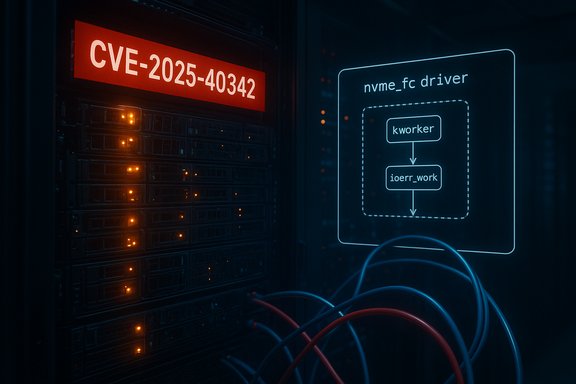
CVE‑2025‑40342 is a kernel-level race and lifecycle bug in the Linux nvme‑fc (NVMe over Fibre Channel) driver that can let an asynchronous workqueue handler run against freed state during controller/association teardown, producing kernel list corruption and an immediate host crash (kernel oops/panic). The defect arises from incorrect ordering and insufficient synchronization when cancelling or synchronizing work that may still be queued by the association‑deletion path, and the upstream fix reorders the cancellation so the deletion completes before cancel_work_sync is invoked. Practical consequences range from unpredictable host reboots and service disruption to prolonged downtime for storage and hypervisor hosts that rely on NVMe‑FC I/O.
Background
NVMe over Fibre Channel (nvme‑fc) is the kernel driver that enables NVMe transports across Fibre Channel fabrics — a common deployment in datacenter storage arrays, SAN-attached storage systems, and virtualization hosts. Because nvme‑fc lives in kernel space and interacts directly with block I/O and controller lifecycles, any memory-safety or lifecycle bug can have outsized operational impact: a single kernel oops on a storage host can cascade into VM failures, failovers, or data‑path outages.The vulnerability identified as CVE‑2025‑40342 was reported to upstream maintainers and patched in the stable kernel trees; the corrective change addresses an ordering/race between association teardown and workqueue cancellation that allowed an ioerr work handler to execute while its data structures were being freed. The public record and internal vendor analyses describe the primary impact as availability (denial of service) rather than a straightforward remote code execution vector.
What went wrong: technical anatomy
The actors: ioerr_work, nvme_fc_delete_association, and cancel_work_sync
At the heart of the bug are three interacting pieces in the nvme‑fc driver:- A per‑controller work item (commonly referenced as
->ioerr_work) that handles I/O error reporting and cleanup on worker threads (kworker). - The controller/association teardown routine
nvme_fc_delete_association, which synchronously deletes an NVMe‑FC controller association and waits for pending I/O to complete. - A cancellation call
cancel_work_syncintended to ensure outstanding work items have finished before freeing the controller object.
cancel_work_sync is executed before the association deletion completes, allowing nvme_fc_delete_association (or one of its code paths) to queue ->ioerr_work after cancellation has returned. If the object that ->ioerr_work references is freed while the work is queued or while it runs, the work handler will dereference freed memory, corrupt linked lists and kernel bookkeeping (list_del corruption), and trigger kernel BUG checks — an immediate crash.Root cause in plain language
The fundamental mistake is an ordering and synchronization error: the code assumed cancel_work_sync would globally prevent new instances of that work from being queued after it returns. In fact, cancel_work_sync only guarantees that previously queued work is completed and that the workqueue won't execute already queued entries; it does not prevent other paths from queuing the same work after cancellation returns. If some other teardown action can queue the work after cancel_work_sync completes, the object can still be accessed by that work while being freed. The correct discipline here is to ensure that any path that can queue the work (the association deletion) has completed and cannot future-queue the work before cancelling and freeing the work’s owner object. Upstream maintainers fixed this by moving the cancel_work_sync call to execute after association deletion finishes.Who is affected and how severe is it?
This is primarily an operational risk for systems that:- Use the Linux kernel nvme‑fc driver (NVMe over Fibre Channel).
- Run active NVMe‑FC I/O workloads that can experience transport errors or controller association teardown under load (for example, host‑initiated controller removal, SAN failover, or firmware resets).
- Are configured with the nvme‑fc module loaded (either built in or as a loadable module).
How the bug appears in the wild: detection indicators
Operators and SREs can detect hits or near‑misses by scanning kernel logs for the following telltale patterns:- Kernel messages indicating list corruption or list_del failures, often flagged by lib/list_debug.c with a “kernel BUG” trace.
- Oops or stack traces originating in kworker contexts that mention NVMe or NVMe‑FC code paths.
- Preceding NVMe‑FC log messages indicating I/O timeouts, transport association events, or controller resets, e.g. “io timeout” or “transport association event: io timeout abort failed”.
- Repeated panics or reboots coinciding with heavy storage I/O or observed SAN events.
- dmesg | grep -iE "kernel BUG|list_del corruption|lib/list_debug.c"
- dmesg | grep -iE "NVME-FC|nvme.*io timeout|transport association"
- journalctl -k | grep -i nvme‑fc
- lsmod | grep nvme; modinfo nvme‑fc
The upstream patch: what changed and why it works
The upstream corrective change is deliberately small and surgical:- Reorder the synchronization calls so that
nvme_fc_delete_association— the routine that can itself queue->ioerr_work— completes beforecancel_work_syncis invoked on the->ioerr_workitem. - This reordering ensures no execution path remains that can queue the work after cancellation returns, preserving the runtime invariant that the work will not run against freed objects.
Immediate mitigations and operational playbook
If you operate NVMe‑FC hosts and cannot immediately apply an updated kernel, follow these interim mitigations that reduce the trigger surface:- Inventory and prioritize:
- Identify hosts that load the nvme‑fc module and rank them by criticality (storage servers, hypervisor hosts first). Use uname -r and distribution package metadata to map kernels to vendor advisories.
- Avoid association/controller teardown under load:
- Do not perform controller removal or module unloads during high I/O windows. Quiesce I/O and drain queues before teardown operations.
- Blacklist the module if NVMe‑FC is not used:
- On systems that do not require NVMe‑FC, prevent the driver from loading by creating a modprobe blacklist: echo "blacklist nvme‑fc" > /etc/modprobe.d/blacklist-nvme-fc.conf. Note: unloading the module from a live system in use can itself trigger races — prefer blacklisting for unused hosts.
- Schedule controlled maintenance:
- Patch and reboot during a maintenance window after validating the vendor kernel or distribution backport in a test cohort.
How to validate the fix safely
Testing in an isolated lab is essential before broad rollout. Recommended validation steps:- Recreate the environment: use the same kernel tree, HBA driver, and SAN configuration as production.
- Reproduce pre‑fix behavior under controlled conditions: run sustained I/O to NVMe‑FC devices while triggering controller association teardown or simulating transport errors to exercise the deletion path.
- Capture kernel logs: preserve dmesg and enable kdump/vmcore collection to retain oops traces for analysis.
- Confirm no list_del corruption or kernel BUG traces appear after applying the patched kernel under equivalent stress.
- Execute a soak test (multi‑hour or multi‑day) to exercise rare races that may not surface in short runs.
Strengths of the fix — why this is low‑risk to backport
- Minimal surface area: the patch moves a single call rather than adding heavy global locks, reducing regression risk.
- Addresses root cause: it removes the ordering window rather than masking symptoms.
- Backportable: small and local changes are straightforward for distributions to backport into multiple stable kernel branches, which vendors commonly do for critical storage bugs.
- Measurable verification: test harnesses and kernel logs provide clear pass/fail indicators (absence of list_del corruption or kernel BUG traces).
Residual risks and caveats
- Kernel concurrency is subtle: even with the ordering fix, other, unrelated race windows in the driver or transport stacks could exist; the fix does not guarantee the entire nvme‑fc subsystem is free of concurrency defects. Continuous vigilance and kernel monitoring remain necessary.
- Vendor lag and backports: appliances, vendor kernels, and vendor‑forked OS images can lag upstream. Operators of vendor images must confirm vendor advisories and obtain vendor-provided fixed kernels rather than assuming the upstream fix is present. Discrepancies between branches can leave some hosts vulnerable even after parts of the estate are patched.
- Unsafe manual remediation: administrators tempted to forcibly unload modules or perform ad‑hoc fixes may inadvertently cause the very condition they seek to avoid. Follow documented maintenance procedures and vendor guidance.
- Detection gaps: kernel oops traces vanish on reboot unless logs or vmcore are preserved. If a host reboots automatically, forensic evidence may be lost; ensure persistent logging and crash dump capture are enabled.
Action checklist for Windows‑focused operations teams managing mixed estates
Many Windows datacenters also run Linux components (storage servers, SAN managers, cloud images, build agents). For teams that manage both Windows and Linux assets, an integrated response helps limit blast radius:- Inventory: find hosts running the nvme‑fc module in your estate (virtual appliances, Linux storage servers, VMs). Use configuration management or orchestration tool queries to build a prioritized list.
- Communicate with storage teams: coordinate kernel updates with SAN administrators and HBA firmware testing to ensure interoperability.
- Patch policy: apply vendor OS kernel updates that explicitly reference the CVE or upstream commit; do not substitute unverified kernels.
- HA and failover: ensure high‑availability clusters and automatic failover behave predictably during kernel rollouts; prepare rollback plans.
- Monitoring: add kworker, NVMe‑FC and kernel oops signatures to your alerting rules; preserve vmcore and centralize kernel logs for rapid diagnosis.
Final assessment
CVE‑2025‑40342 is a classic, high‑impact kernel ordering bug affecting a narrow but critical subsystem: NVMe over Fibre Channel. It is not an immediately trivial remote exploit; the main danger is unplanned host crashes during storage I/O under teardown conditions. The upstream remedy is succinct, correct, and low risk: reorder cancellation semantics so the association deletion cannot queue work after cancellation returns. Distributors and vendors should and are expected to backport this change; operators must treat NVMe‑FC hosts as high priority for kernel updates and validation. Short‑term mitigations (blacklisting unused modules, avoiding live controller removals, quiescing I/O) help reduce exposure, but the definitive remediation is a kernel package containing the upstream fix and a follow‑up validation cycle in test and staging before production rollout.Operators who manage storage servers, hypervisors, or cloud compute nodes with NVMe‑FC should schedule patching and verification promptly and enforce persistent kernel logging and vmcore capture so that any residual or unexpected failures can be diagnosed with evidence. The community response and upstream patching behavior show the bug was addressed deliberately and responsibly; the remaining challenge is operational: mapping vendor packages, scheduling reboots, and validating the fix across complex storage stacks.
(If any specific kernel package version mappings, vendor advisories, or distribution‑level KB numbers are required for your environment, include the kernel/package details and platform names and a follow‑up will provide targeted package mappings and rollout advice.
Source: MSRC Security Update Guide - Microsoft Security Response Center
