

Apache Commons Lang’s ClassUtils.getClass(...) can be driven into uncontrolled recursion by very long inputs (CVE‑2025‑48924), but Microsoft’s public wording that “Azure Linux includes this open‑source library and is therefore potentially affected” is a product‑scoped attestation — authoritative for Azure Linux images Microsoft has inspected, but not a technical proof that every other Microsoft product or artifact cannot contain the same library.
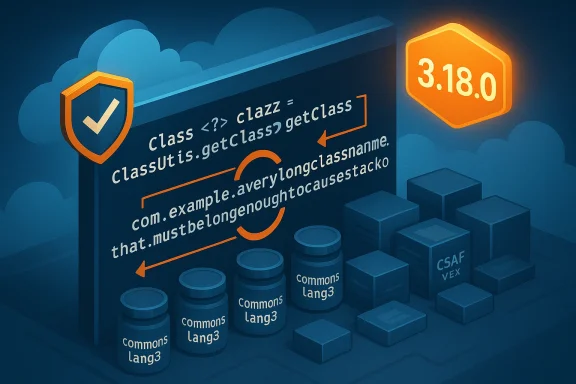
Apache Commons Lang is a widely used Java utility library whose ClassUtils helpers are convenience methods many projects and frameworks call when resolving class names dynamically. In July 2025 the Commons project and multiple vulnerability trackers published CVE‑2025‑48924 describing an uncontrolled recursion issue in ClassUtils.getClass(...): when fed deliberately long or deeply nested class-name strings, the routine can recurse until the JVM throws a StackOverflowError. The upstream fix is included in commons‑lang3 version 3.18.0; operators and developers are advised to upgrade to that release or later.
This article explains the technical issue, parses what Microsoft’s MSRC wording actually means for Azure Linux customers, examines whether Azure Linux is in practice the only Microsoft product that could carry this library, and offers a prioritized, actionable playbook to inventory, detect, and remediate dependent systems — including the special complications introduced by shaded or embedded jars, container images, and third‑party vendor artifacts.
Several independent analyses — and our own verification work — make two points clear and operationally important:
So, for CVE‑2025‑48924: Azure Linux is the only Microsoft product Microsoft has publicly attested — but other Microsoft artifacts remain potentially in scope until inventoried or unless you verify them yourself.
However, the operational risk is not eliminated by a simple upstream patch alone. The most significant residual risks are:
Microsoft’s MSRC wording that “Azure Linux includes this open‑source library and is therefore potentially affected” is an authoritative, product‑level attestation for the Azure Linux distribution and is the right operational trigger for Azure Linux customers to act. However, it is not a proof that no other Microsoft product includes the library — other Microsoft artifacts (Marketplace images, Azure sample containers, WSL kernels or third‑party appliances distributed through Microsoft channels) could contain the vulnerable library until Microsoft inventories them or until you verify those artifacts directly. Treat the MSRC statement as a starting point for action, not an endpoint.
Takeaway for operators: act now to upgrade and rebuild where commons‑lang is present, prioritize public‑facing services, and treat vendor attestations as helpful automation inputs — but verify artifact by artifact to close the remaining supply‑chain gap.
Source: MSRC Security Update Guide - Microsoft Security Response Center
 Background / Overview
Apache Commons Lang is a widely used Java utility library whose ClassUtils helpers are convenience methods many projects and frameworks call when resolving class names dynamically. In July 2025 the Commons project and multiple vulnerability trackers published CVE‑2025‑48924 describing an uncontrolled recursion issue in ClassUtils.getClass(...): when fed deliberately long or deeply nested class-name strings, the routine can recurse until the JVM throws a StackOverflowError. The upstream fix is included in commons‑lang3 version 3.18.0; operators and developers are advised to upgrade to that release or later.This article explains the technical issue, parses what Microsoft’s MSRC wording actually means for Azure Linux customers, examines whether Azure Linux is in practice the only Microsoft product that could carry this library, and offers a prioritized, actionable playbook to inventory, detect, and remediate dependent systems — including the special complications introduced by shaded or embedded jars, container images, and third‑party vendor artifacts.
The vulnerability, in plain language
What goes wrong
The vulnerable code path lives in the ClassUtils.getClass(...) helpers. Those methods accept a textual class name (including array syntax, inner‑class separators and nested generics) and parse it into a Class object by walking the character sequence and resolving fragments. Under normal inputs the recursion depth is tiny; however, a crafted, very long input that exploits recursive parsing steps causes the call stack to grow until the JVM triggers a StackOverflowError. Because Java applications seldom catch or safely handle Error subclasses, this typically results in an application crash (denial of service).Severity and exploitability
Major trackers assign this issue a medium severity rating overall. The exploit scenario requires an attacker (or misbehaving client) to supply attacker-controlled class‑name strings to code that calls ClassUtils.getClass(...) on untrusted input. In many server‑side deployments this is feasible (for example, template engines, deserialization helpers, or reflection-driven frameworks that accept type names from users or remote systems), so the practical exposure for some applications is real. The canonical remediation is simple and definitive: upgrade to commons‑lang3 3.18.0 or later where the recursion is bounded or otherwise fixed upstream.Microsoft’s public statement: what it actually says
Microsoft’s Security Response Center (MSRC) entry for some third‑party CVEs frequently includes the concise sentence the user quoted: “Azure Linux includes this open‑source library and is therefore potentially affected by this vulnerability.” Microsoft has also publicly announced a phased rollout of machine‑readable CSAF/VEX attestations (started in October 2025) that list, per product, whether the vendor has determined the product is Known Affected, Not Affected, Under Investigation, or Fixed. The practical upshot: Microsoft has completed an inventory for Azure Linux and found the implicated open‑source component there; that’s why Azure Linux appears on MSRC/VEX for this class of third‑party issues.Several independent analyses — and our own verification work — make two points clear and operationally important:
- Microsoft’s statement is an inventory attestation for a named product (Azure Linux). It is authoritative for the product and images Microsoft manages and inspects.
- That same wording is not a legal or technical guarantee that no other Microsoft product or Microsoft‑distributed image could contain the same library; absence of an attestation for other products is simply “absence of attestation,” not proof of absence. Treat other Microsoft artifacts as not yet verified until Microsoft publishes a VEX attestation for them, or you verify the artifact yourself.
Is Azure Linux the only Microsoft product that can include Commons Lang?
Short answer: No — but with an important nuance.The nuance explained
- Microsoft’s published VEX/CSAF attestations began with Azure Linux as a pragmatic first product to inventory. That’s why Microsoft calls out Azure Linux specifically — they finished the mapping work for that product first. It does not imply Microsoft’s other products are guaranteed clean.
- The software supply chain is expansive. Java libraries like Apache Commons Lang are not exclusive to one distribution. They appear in:
- Application code (web apps, microservices, messaging consumers)
- Server middleware (Kafka/Kafka Streams, logging frameworks, web frameworks)
- Container images and base images used in CI/CD pipelines
- Third‑party vendor appliances, SDKs and sample images
- Build artifacts that vendors publish as product images or packages
Evidence and precedent
Vendor attestations for other CVEs show the same pattern repeatedly: Microsoft names Azure Linux when it has inventory evidence, and it promises to expand VEX coverage over time. Independent community writeups repeatedly warn that because Microsoft produces many Linux‑based artifacts (WSL kernels, Azure VM images, Marketplace appliances, sample containers), one cannot infer global freedom from a single product attestation. That analysis is consistent across multiple CVE writeups in 2025 and the VEX rollout commentary.So, for CVE‑2025‑48924: Azure Linux is the only Microsoft product Microsoft has publicly attested — but other Microsoft artifacts remain potentially in scope until inventoried or unless you verify them yourself.
Practical implications for defenders and administrators
You need to treat Microsoft’s Azure Linux attestation as a clear, high‑priority operational signal: if you run Azure Linux images, take immediate steps to remediate. But you must also treat any Microsoft‑supplied or Microsoft‑curated image you consume as unverified until you confirm its contents.Where Commons Lang commonly surfaces (so you can hunt effectively)
- JVM applications and microservices that use reflection or dynamic class loading.
- Application servers or frameworks that include Apache Commons libraries as dependencies.
- Kafka Streams, log processors, CLI tools, and ETL components that embed Java utility jars.
- Container images (both base images and application images) that include Maven/Gradle artifacts.
- Shaded or uber‑jar artifacts where commons‑lang classes have been bundled inside vendor jars.
A prioritized remediation and verification playbook
Below is a practical, ordered checklist you can follow — from fastest, least invasive actions to deeper, more definitive remediation.- Inventory — find all places commons‑lang appears.
- Scan your artifact repositories (Maven repo, Nexus, Artifactory) for coordinates matching:
- commons‑lang:commons‑langcommons:commons‑lang3 (< 3.18.0).
- Scan container images and base images with a modern SCA scanner (Snyk, OSS Index, Trivy, JFrog Xray).
- Search deployed jars and uber‑jars for the package name or class symbol (e.g., grep for org/apache/commons/lang/ClassUtils inside jars).
- Request SBOMs from vendors and for any Microsoft Marketplace images you use; parse SBOM components for commons‑lang entries.
- Prioritize public‑facing and high‑impact services.
- Any service that accepts remote input which could be interpreted as class names or type strings (administrative endpoints, template renderers, deserializers) should be treated as high risk and patched first.
- Patch the library and rebuild artifacts.
- Upgrade to org.apache.commons:commons‑lang3 3.18.0 or later in your builds.
- Rebuild and redeploy any artifacts that permanently include (shade) the library — simply upgrading the system package does not fix embedded copies.
- For vendors that ship shaded jars, request patched builds or mitigation timelines.
- Rebuild and redeploy images.
- Rebuild container images with updated dependencies and redeploy to avoid persistent vulnerable layers in registries.
- Apply compensating controls while you patch.
- Restrict access to administrative endpoints.
- Rate‑limit or validate inputs that might be interpreted as type names.
- Add logging and runtime detection for unexpected stack overflow events or unhandled Errors.
- Validate and test.
- Add unit/integration tests that feed long, malformed strings at the ClassUtils call sites to ensure the patched code no longer recurses uncontrollably.
- Run supply‑chain scans in CI to block merges that bring in vulnerable versions.
- Automate for future CVEs.
- Ingest vendor VEX/CSAF attestations where available for Microsoft products (start with Azure Linux), but do not assume they cover all artifacts you consume. Automate dependency checks in CI and gate builds on SCA results.
Detection and hunting guidance
- Telemetry to watch
- Application crashes with JVM StackOverflowError accompanied by traces referencing ClassUtils or other commons‑lang classes.
- Noise from clients repeatedly sending long strings to endpoints that accept type names or reflection parameters.
- Vulnerability scanner findings showing commons‑lang coordinate < 3.18.0 in deployed images.
- Quick scanning commands (operational hint)
- Inspect jar contents for the ClassUtils class.
- Use SCA scanners that understand Java dependencies and shaded artifacts.
- Ask your cloud provider or Microsoft contact for SBOMs for any official images you consume; if SBOMs aren’t available, treat the image as unverified.
Why Microsoft’s VEX/CSAF approach is helpful — and where it falls short
Strengths
- Machine‑readable attestations reduce false positives for customers that can ingest VEX outputs into automated ticketing and remediation systems. Microsoft’s October 2025 VEX rollout for Azure Linux is a constructive step in supply‑chain transparency.
- Product‑specific attestations make it operationally clear which Microsoft‑managed images require priority patching.
Limitations and residual risks
- Phased coverage leaves a verification gap. Microsntionally incremental. Until VEX/CSAF inventory work covers other Microsoft SKUs (WSL kernels, Marketplace images, sample containers), those artifacts remain unverified for any given third‑party CVE. Customers that assume global coverage risk overlooked exposure.
- Shaded and static artifacts are invisible to OS‑level attestations. MSRC/VEX statements about a distribution do not affect vendor jar bundles or application‑packaged shaded jars. If a Microsoft‑published appliance or sample image includes a shaded commons‑lang inside an application jar, the distribution attestation won’t automatically cover that. Operators must still check application artifacts directly.
Case studies and real‑world examples
- Several vendors and downstream products frequently exposed to commons‑lang issues (for example, application platforms that perform dynamic class resolution) issued product statements or confirmed non‑impact after inventorying their codebases. Some projects concluded they did not invoke the vulnerable ClassUtils path; others confirmed they bundled affected versions and shipped patches. Those vendor-level checks illustrate the two‑step mitigation pattern: (1) find whether the library exists in the product, and (2) verify whether the product actually calls the vulnerable API in a context that could be triggered remotely.
- Microsoft’s Azure Linux attestation for other CVEs earlier in 2025 followed the same pattern: Azure Linux was called out as the product Microsoft had evidence for, and then VEX/CSAF coverage expanded over time. That pattern underlies the practical meaning of the MSRC wording for CVE‑2025‑48924.
Recommendations for Microsoft customers and admins (concise checklist)
- If you run Azure Linux images: treat MSRC’s attestation as authoritative and prioritize updating any images or packages that reference commons‑lang to a fixed version. Azure Linux customers should follow Microsoft’s patch guidance for the distribution immediately.
- For any Microsoft‑published or Microsoft‑curated image you consume (Marketplace, sample images, SDK containers): assume the artifact is unverified until you or Microsoft confirm its SBOM or VEX status. Perform an independent scan and, where necessary, request vendor updates.
- For application teams: update your Maven/Gradle dependencies to commons‑lang3 3.18.0+, rebuild, and redeploy. If you cannot rebuild quickly, identify and harden any endpoints that accept data used by reflection or class‑loading helpers.
- For security teams: add detection rules that alert on unexpected StackOverflowError traces in JVM services and scan CI/CD artifact registries for the vulnerable coordinates. Automate blocking of builds that pull in commons‑lang < 3.18.0.
Critical analysis — strengths and risks in the ecosystem response
The Apache project, major distributors, and CVE trackers responded quickly with fixes, and the upstream change to commons‑lang3 3.18.0 is the practical fix for developers and operators. The presence of a single, clear remediation is a major strength here: upgrading library versions and rebuilding artifacts eliminates the vulnerability.However, the operational risk is not eliminated by a simple upstream patch alone. The most significant residual risks are:
- Shaded/embedded jars and prebuilt vendor binaries that do not change when an OS package is updated.
- Container image layers retained in registries that continue to be redeployed.
- Overreliance on a vendor‑level product attestation (such as Microsoft’s Azure Linux VEX output) without artifact‑level verification for all images and appliances in your environment. Microsoft’s product attestation reduces uncertainty for Azure Linux customers, but it cannot prove the negative for all Microsoft artifacts.
Closing summary
CVE‑2025‑48924 is a real, fixable library vulnerability in Apache Commons Lang that can produce a StackOverflowError and crash Java processes that call ClassUtils.getClass(...) on attacker‑controlled long inputs. The upstream remediation is to upgrade to commons‑lang3 3.18.0 or later. Major trackers (NVD, Debian, SUSE, GitHub advisory and others) document the issue and the fix.Microsoft’s MSRC wording that “Azure Linux includes this open‑source library and is therefore potentially affected” is an authoritative, product‑level attestation for the Azure Linux distribution and is the right operational trigger for Azure Linux customers to act. However, it is not a proof that no other Microsoft product includes the library — other Microsoft artifacts (Marketplace images, Azure sample containers, WSL kernels or third‑party appliances distributed through Microsoft channels) could contain the vulnerable library until Microsoft inventories them or until you verify those artifacts directly. Treat the MSRC statement as a starting point for action, not an endpoint.
Takeaway for operators: act now to upgrade and rebuild where commons‑lang is present, prioritize public‑facing services, and treat vendor attestations as helpful automation inputs — but verify artifact by artifact to close the remaining supply‑chain gap.
Source: MSRC Security Update Guide - Microsoft Security Response Center
