

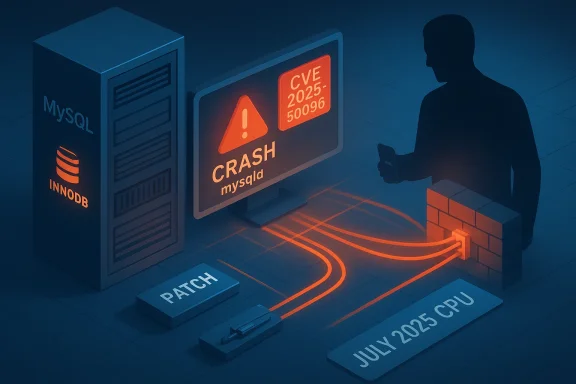
Oracle’s July 15, 2025 advisory that introduced CVE-2025-50096 describes a denial‑of‑service weakness in MySQL Server’s InnoDB component that can be triggered by a high‑privilege actor with network access, and — when exploited — can hang or repeatedly crash mysqld, producing sustained or persistent loss of availability for affected instances until patched or otherwise recovered.
MySQL remains one of the world’s most widely deployed relational database engines, and InnoDB is its default transactional storage engine. A stability or resource‑management defect in InnoDB therefore has wide operational impact: crashed servers, failed transactions, and complicated crash recovery sequences can cascade into front‑end outages and SLA failures.
CVE-2025-50096 was published as part of Oracle’s July 2025 Critical Patch Update (CPU). Vendors and independent aggregators list the affected upstream version ranges as MySQL Server 8.0.0 through 8.0.42, 8.4.0 through 8.4.5, and 9.0.0 through 9.3.0. Oracle’s advisory and third‑party trackers consistently describe the flaw as enabling an attacker with high privileges and network access to cause the server to hang or crash repeatedly (a complet
Numerical severity across trackers places CVE-2025-50096 in the medium range by CVSS v3.1 (around 4.4–4.9), but that score masks crucial operational realities: the primary impact is availability, and the requirement for high privileges makes this a classic post‑compromise availability weapon — trivial to weaponlready controls an administrative account.
Administrators should not be lulled by the numeric score: treat the advisory as high operational priority for production systems, and use the remediation window to fix both the software and the underlying privileged‑access practices that make such post‑compromise attacks possible. Patch quickly, restrict administrative access, rotate and vault credentials, rebuild embedded artifacts, and harden detection for the operational signals that actually capture this class of exploitation. ([oracle.com](https://www.oracle.com/security-alerts/cpujul2025verbose.html?utm_source=sion: CVE-2025-50096 converts elevated database access into a highly reliable availability weapon against MySQL. The vendor patch is the authoritative fix; treat it as required operational work for any production fleet running the affected branches, and use the incident to tighten privileged‑account governance so that a single compromised credential cannot bring your services to a halt.
Source: MSRC Security Update Guide - Microsoft Security Response Center
 Background / Overview
MySQL remains one of the world’s most widely deployed relational database engines, and InnoDB is its default transactional storage engine. A stability or resource‑management defect in InnoDB therefore has wide operational impact: crashed servers, failed transactions, and complicated crash recovery sequences can cascade into front‑end outages and SLA failures.CVE-2025-50096 was published as part of Oracle’s July 2025 Critical Patch Update (CPU). Vendors and independent aggregators list the affected upstream version ranges as MySQL Server 8.0.0 through 8.0.42, 8.4.0 through 8.4.5, and 9.0.0 through 9.3.0. Oracle’s advisory and third‑party trackers consistently describe the flaw as enabling an attacker with high privileges and network access to cause the server to hang or crash repeatedly (a complet
Numerical severity across trackers places CVE-2025-50096 in the medium range by CVSS v3.1 (around 4.4–4.9), but that score masks crucial operational realities: the primary impact is availability, and the requirement for high privileges makes this a classic post‑compromise availability weapon — trivial to weaponlready controls an administrative account.
What the public records actually say
Affected component and versions
- Component: InnoDB (MySQL Server storage engine).
- Affected versions: 8.0.0–8.0.42, 8.4.0–8.4.5, 9.0.0–9.3.0 (inclusive).
- Fixes published as 2025 CPU; upstream patched releases for the 8.0 family begin at 8.0.43 (and equivalent 8.4/9.x updates followed). Downstream distributions mapped those fixes into their package trees soon after.
Attack vector and impact
- Attack vector: Network‑reachable MySQL protocol endpoints can reach the vulnerable codepaths.
- Privileges required: High — attacker must already hold elevated MySQL privileges (DBA, SUPER, or equivalent).
- Primary impact: Availability loss — repeated crash or hang of the mysqld process, causing a complete DoS effect against the database. No reliable public evidence indicates confidentiality or integrity loss tied directly to this CVE at disclosure.
- CVSS v3.1 vector: Commonly reported as AV:N/AC:L/PR:H/UI:N/S:U/C:N/I:N/A:H with a base score around 4.4–4.9. Note that small numeric differences appear between trackers due to interpretation of secondary impacts.
Clay root cause
Multiple trackers categorize the flaw as CWE‑400 (Uncontrolled Resource Consumption) or an incorrect authorization/logic issue in code paths reachable via DDL/stored‑procedure handling. The practical effect is that crafted, privileged operations cause the server to consume or mismanage resources until it hangs or crashes. Oracle’s CPU text deliberately omits code‑level details — standard practice for vendor advisories — so public records are high level by design.Technical analysis
How an exploit would look in practice
Because the vulnerability requires high privileges, feasible exploit chains follow this pattern:- Attacker obtains or already controls an administrative MySQL account (compromise via phishing, credential theft, vulnerable app, insider).
- Using that account, the attacker issues crafted DDL/stored-procedure or other privileged operations that trigger uncontrolled resource consumption in InnoDB.
- mysqld hangs or repeatedly crashes; if the attacker continues issuing the input, the DoS is sustained. In some deployments, the crash may persist until manual intervention or patching.
Exploitability and proof‑of‑concept status
At public disclosure there were no widely validated public PoCs demonstrating remote, unauthenticated weaponization beyond crash triggers. Trackers and EPSS metrics indicated low probability of mass exploitation, chiefly because of the high‑privilege requirement. That said, once credentials are available, DoS is easy to script and will likely be used by opportunistic actors or malicious insiders. Administratplacent because the lack of PoC does not mean lack of risk.Why CVSS can be misleading here
A CVSS numeric score in the mid‑range may underplay business impact. Availability‑only issues that can be triggered repeatedly against a critical database engine can cause large‑scale outages, SLA violations, and incident costs far beyond the numeric rating. Thus, operational prioritization should treat this CVE with urgency where privileges are broadly available or where HA/failover is limited.Detection and hunting guidance
Because the vulnerability’s exploitation path depends on privileged actions, strong detection focuses on operational telemetry and account misuse rather than a narrow signature.- Monitor MySQL error logs and system logs for repeated mysqld crashes, core dumps, or abnormal process restarts tied to database activity. Set alerts for process restart frequency thresholds.
- Audit DDL and stored‑procedure invocation patterns. Flag rapid or repetitive DDL from accounts that don’t normally perform schema changes. Correlate with source IP and operating hours.
- In containerized or orchestrated environments, watch for pod/container restarts and liveness probe failures. These signals scale well across fleets and serve as an ea impact.
- Hunt for evidence of credential misuse: anomalous connections, unusual host origins for administrative sessions, and changes to automation/CI credentials that could expose elevated access. Because the bug requires high privileges, credential compromise is the key precondition.
Mitigation and remediation: practical playbook
Patch is the primary mitigation. Oracle relea2025 CPU; downstream distributions and vendors built packages and mapped upstream versions into their own package versions. Use vendor‑provided packages where possible and follow controlled rollout procedures.Immediate steps (first 24–72 hours)
- Inventory: Identify every MySQL instance and record exact version strings, packaging, and whether the instance is embedded in containers or appliances. Include ephemeral/test instances and images in registries.
- Prioritize: Prioritize internet‑facing, master/primary, and admin‑accessible instances for patching. If you have replica setups, plan a replica‑first upgrade to minimize impact.
- Temporary access controls: Restrict who can connect with elevated privileges. Apply network ACLs/firewall rules to limit administrative access to trusted management subnets. Rotate credentials for accounts with DDL/SUPER privileges if compromise is suspected.
Short term (7–14 days)
- Test vendor patches in staging with production‑like workloads.
- Apply vendor package updates or upgrade to patched upstream releases:
- Upstream 8.*8.0.43** (or later) to receive the CPU fixes.
- Equivalent 8.4/9.x branches: upgrade to the patched releases published in the CPU (check vendor mapping for exact package names).
- For containerized environments, rebuild images using patched MySQL binaries and redeploy via canary or blue/green r host package updates fix embedded server binaries.
Longer term (30–90 days)
- Harden privileged access: reduce number of accounts with DDL/SUPER rights, enforce role separatiorative credentials in vaults with MFA and rotation.
- Integrate SBOM generation in CI/CD so that future advisories can be mapped to deployed artifacts automatically and container images can be tracked and rebuilt quickly.
- Improve automated monitoring and alerting for crash loops, process restarts, and unusual DDL activity. Treat repeated crashes as an immediate incidengation.
If you cannot patch immediately — temporary mitigations
- Network segmentative MySQL access from untrusted subnets or public internet.
- Apply OS‑level resource caps (cgroups, systemd, ulimit) to limit the damage of uncontrolled resource consumption as a stopgap. Note: these mitigations can change system behaviour; test before applying broadly.
- Increase monitoring and shorten detection thresholds for restarts and InnoDB errors.
Patching across packaging models and cloud services
Downstream distributions
Distribution maintainers patched packages on their own cadences; for example, Debian/Ubuntu tracked fixes and rebased package trees to upstream patched versions (Debian moved mysql-8.0 packaging to a fixed 8.0.43 build in unstable). Check your distribution’s security tracker and install the vendor-supplied security package rather than building ad‑hoc upstream tarballs unless you have a tested pipeline. (an.org]Containers and images
Containers often embed mysqld binaries. Upgrading the host does not change container images. Rebuild container images from patched upstream bases, validate, and redeploy via your normal orchestration strategy. Also purge vulnerable images from registries and update CI policies to block unpatched tags.Managed/Cloud services
For managed MySQL Database for MySQL, Cloud SQL, Oracle Cloud MySQL), vendors may apply security updates on a maintenance cadence or offer minor version upgrades. Do not assume the provider patched your instance; verify the provider’s advisory and maintenance logs and request explicit confirmation if necessary. If the provider handles patching, confirm the maintenance window and service impact ahead of time. risk assessment: who should worry most- High risk: Multi‑tenant hosting, shared‑control panels, managed database services with exposed admin planes, and environments where an credentials (CI/CD runners, backup scripts). These contexts often expose privileged accounts indirectly and therefore increase the surface for a post‑compromise DoS.
- Moderate risk: Single‑tenant prod strong least‑privilege and robust HA. If credentials are properly restricted and failover works, risk is lower but not zero.
- Lower immediate risk: Instances strictly isolated from management networks and with no accounts having DDL/SUPER rights. However, credential theft or pipeline misconfiguration can rapidly elevate risk.
Critical assessment of vendor and ecosystem response
Strengths- Oracle published the fix within its scheduled July 2025 CPU, enabling coordinated downstream responses and providing a canonical upstream patch target. Independent trackers and distro maintainers quickly mapped fixes into packages, which produced clear remediation paths.
- The explicit statement thatquires high privileges helps defenders prioritize — this is not a wormable unauthenticated remote takeover vulnerability.ning risks
- The advisory omits code‑level details (a deliberate, defensible choice) which leaves defenders without a precise PoC to craft targeted detection rules; this slows understanding of exact triggers.
- High privileges boundary in modern estates: credentials travel widely via automation, container images, and CI systems. Where credential hygiene is lax, the vulnerability becomes trivial to weaponize.
- Long‑lived images, vendor appliances, and unmanaged containers can remain vulnerable even after host or package updates. This supply‑chain vector is the most likely cause of latent vulnerab CPU release.
Actionable checklist for administrators (priority ordering)
- Inventory all MySQL instances and rd exact version strings and packaging.
- If running affected versions (8.0.0–8.0.42, 8.4.0–8.4.5, 9.0.0–9.3.0), schedulefor upstream or vendor packages (target 8.0.43+, 8.4.6+, 9.4.0+ as applicable).
- Patch replicas first where possible; promote a patched replica ormer primary to reduce downtime.
- Rotate and vault administrative credentials used by CI/CD, backup, and monitoring tooling. Enforce MFA where possibleiner images and vendor appliances that embed mysqld binaries; purge vulnerable images from registries.
- Harden network access to admin ports and restrict management plane access to trusted subnets.
- Increase monitoring sensitivity for process restarts, core dumps, and repeated DDL activity; create on‑call runbooks for a mysqld crash loop incident.
Final assessment and cautionary notes
CVE-2025-50096 is not a catastrophic, unauthenticated remote code execution vulnerability — but in the right context it is a powerful and low‑complexity tool for an adversary who already controls administrative credentials. The combination of a widely deployed engine (MySQL), a core component (InnoDB), and the potential for repeated, sustained DoS means the practical business impact can be severe even if the CVSS number reads “medium.”Administrators should not be lulled by the numeric score: treat the advisory as high operational priority for production systems, and use the remediation window to fix both the software and the underlying privileged‑access practices that make such post‑compromise attacks possible. Patch quickly, restrict administrative access, rotate and vault credentials, rebuild embedded artifacts, and harden detection for the operational signals that actually capture this class of exploitation. ([oracle.com](https://www.oracle.com/security-alerts/cpujul2025verbose.html?utm_source=sion: CVE-2025-50096 converts elevated database access into a highly reliable availability weapon against MySQL. The vendor patch is the authoritative fix; treat it as required operational work for any production fleet running the affected branches, and use the incident to tighten privileged‑account governance so that a single compromised credential cannot bring your services to a halt.
Source: MSRC Security Update Guide - Microsoft Security Response Center
