

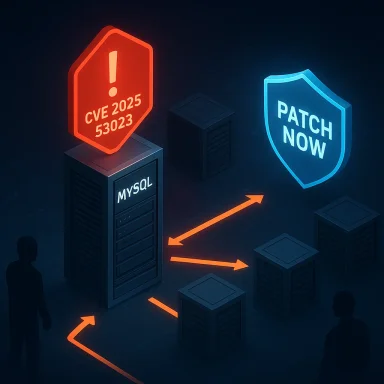
A newly disclosed flaw in Oracle MySQL’s replication component — tracked as CVE-2025-53023 — can be leveraged by a high‑privilege actor with network access to cause repeated hangs or crashes of the MySQL server, producing a sustained or persistent denial‑of‑service (DoS) condition for affected installations. This vulnerability affects a wide swath of commonly deployed MySQL releases and was included in Oracle’s July 2025 Critical Patch Update; operators must treat it as an operational emergency where privileged credentials are not tightly controlled.
MySQL sits at the core of countless web and internal applications, and its replication machinery is a foundational building block for high availability, backups, and read scaling. A defect in replication code therefore places a privileged lever into an attacker’s hands: cause one node to crash or hang, and you force failovers, stalled replication streams, or cascading application outages. The publicly posted CVSS v3.1 vector for CVE‑2025‑53023 is CVSS:3.1/AV:N/AC:L/PR:H/UI:N/S:U/C:N/I:N/A:H with a base score commonly recorded as 4.9 (Medium), reflecting network reachability but the requirement for high privileges and an availability‑first impact.
This vulnerability was published on July 15, 2025 and mapped into vendor advisories and downstream distribution errata shortly thereafter. Oracle’s July 2025 CPU lists the MySQL fixes that remediate replication and related server issues, and major distributors (Ubuntu, Oracle Linux, and others) produced security notices aligning with Oracle’s guidance.
Why this matters: even a single crashed primary in a replication topology can force application traffic to stall, trigger emergency failovers, or create replication resync workstreams that extend outages far beyond the initial crash window. For multi‑node deployments, an attacker who can repeatedly crash multiple nodes (or crash a primary and then a promoted replica) can escalate an availability incident into a multi‑hour outage.
Operators need to internalize two crucial constraints simultaneously:
CVE‑2025‑53023 is a timely reminder that not all high‑impact database vulnerabilities look like data theft or remote takeover — some are highly practical availability weapons for attackers who already control privileged credentials or for insiders. The definitive fix is to apply the patched MySQL builds provided via Oracle’s July 2025 CPU and downstream vendor errata, but operational resilience depends equally on credential hygiene, least‑privilege enforcement, network segmentation, and rebuilding long‑lived images. If you run MySQL in production, start with an immediate inventory and harden your administrative plane now; then schedule a staged patch rollout that preserves replication health and minimizes application downtime.
Source: MSRC Security Update Guide - Microsoft Security Response Center
 Background
MySQL sits at the core of countless web and internal applications, and its replication machinery is a foundational building block for high availability, backups, and read scaling. A defect in replication code therefore places a privileged lever into an attacker’s hands: cause one node to crash or hang, and you force failovers, stalled replication streams, or cascading application outages. The publicly posted CVSS v3.1 vector for CVE‑2025‑53023 is CVSS:3.1/AV:N/AC:L/PR:H/UI:N/S:U/C:N/I:N/A:H with a base score commonly recorded as 4.9 (Medium), reflecting network reachability but the requirement for high privileges and an availability‑first impact.This vulnerability was published on July 15, 2025 and mapped into vendor advisories and downstream distribution errata shortly thereafter. Oracle’s July 2025 CPU lists the MySQL fixes that remediate replication and related server issues, and major distributors (Ubuntu, Oracle Linux, and others) produced security notices aligning with Oracle’s guidance.
Affected products and versions — what to look for
At disclosure the authoritative affected ranges were recorded as:- MySQL Server (8.0.0 through 8.0.42), and
- MySQL Cluster lines identified in some advisories (for example, 7.6.0–7.6.34 and cluster variants tied to the 8.0 line).
Why this matters: even a single crashed primary in a replication topology can force application traffic to stall, trigger emergency failovers, or create replication resync workstreams that extend outages far beyond the initial crash window. For multi‑node deployments, an attacker who can repeatedly crash multiple nodes (or crash a primary and then a promoted replica) can escalate an availability incident into a multi‑hour outage.
High‑level technical summary
At a high level CVE‑2025‑53023 is an availability‑class bug in the Server: Replication component. Public trackers and vendor advisories describe the root cause as an uncontrolled resource consumption or logic/authorization weakness in replication-related code paths that privileged actors can trigger remotely, causing mysqld to enter an unhandled internal state and either hang or crash. The attack is network‑accessible and — importantly — requires high database privileges (for example, replication privileges or DBA/SUPER‑like rights). Once the attacker has those privileges, the exploit complexity is low and the condition is repeatable.Operators need to internalize two crucial constraints simultaneously:
- The vulnerability is not reported as an unauthenticated remote code execution or direct data‑exfiltration vector; it is primarily an availability weapon.
- However, privileged credentials are commonly stored and reused across environments (CI/CD secrets, management tooling, shared service accounts), making privilege compromise an achievable attacker path in many estates. Treat this as a post‑compromise escalation tool.
Exploitability and real‑world risk
Exploitability profile- Attack vector: Network (any protocol the MySQL server exposes).
- Privileges required: High (DBA, replication privileges, or equivalent).
- Complexity: Low once privileges are attained — repeated triggers are straightforward.
- Impact: High availability loss (hang/crash, repeatable DoS).
- At the time of disclosure there were no widely circulated proof‑of‑concept exploits that enable unauthenticated mass exploitation; most coverage notes the absence of a public PoC and a relatively low EPSS value. That reduces short‑term internet‑scale risk but does not remove the immediate danger of insider misuse or post‑compromise weaponization.
- The numeric CVSS value (4.9) downplays operational severity when read without context. CVSS scores are designed to capture a narrow set of properties; they do not account for credential exposure, blast radius across clustered topologies, or human‑operational fragility during an incident. In practice, repeatable DoS of a core database often escalates into major incidents with financial and reputational impact far larger than the raw CVSS suggests.
Detection, indicators, and forensics
What to monitor immediately- Repeated mysqld crashes, aborted runs, and core dumps — watch systemd/journald, MySQL error logs, and any central logging for multiple restarts in a short window. Alert on “N restarts in M minutes.”
- Correlate crash times with privileged SQL activity — general and audit logs often show the SQL sequences that preceded a crash (stored procedure invocations, DDL/DDL‑like replication commands).
- Unexpected administrative connections — new source IPs, sessions bypassing bastion hosts, or connections outside normal maintenance windows.
- Preserve mysqld error logs, binary logs (mysqlbinlog dumps), and any core dumps. Capture host diagnostics (top, vmstat, dmesg) and an image snapshot of the instance for offline analysis. Do not reboot or clear logs before collection.
- Confirm version on each server (mysql --version or SELECT VERSION()
 .
. - Query MySQL user grants for accounts with replication, SUPER, or SYSTEM_VARIABLES_ADMIN rights.
- Search for recent administrative SQL patterns (stored procedure creation/invocation, unusual DDL).
- Correlate with host restart/crash telemetry and alert if correlation suggests an intentional trigger.
Mitigation and remediation — immediate to medium term
Priority principles- Patch where possible — applying the vendor fix is the definitive mitigation. Oracle’s July 2025 CPU contains fixes addressing this family of MySQL issues; vendors and distributions have since produced patched packages that rebase to upstream remedial releases. Confirm the exact patched build from your OS vendor before deploying.
- Reduce the blast radius — enforce least‑privilege, limit network exposure, and harden administrative access paths. These compensating controls materially reduce the likelihood the vulnerability can be weaponized while patches are rolled out.
- Inventory: identify every MySQL instance — hosts, containers, cloud DB instances, appliance images, and CI artifacts that may carry vulnerable binaries. Use both package manager queries and in‑server SELECT VERSION(); checks.
- Lock down access: restrict MySQL listeners to trusted subnets via firewall/security groups and route administrative access through bastion hosts requiring MFA and session logging.
- Audit and rotate credentials: disable or rotate any shared high‑privilege credentials and vault all admin secrets. If compromise is suspected, revoke immediately.
- Test in staging: run the vendor patch in a staging environment that mirrors production topology, including replication and failover behavior. Run schema and workload tests.
- Patch replicas first: upgrade secondaries/replicas and validate startup and replication health. Promote a patched replica and then patch the former primary. This minimizes service interruption for master‑follower deployments.
- For single‑node deployments: schedule a maintenance window, ensure backups and tested restores are available, then apply the patch.
- Upstream corrective releases commonly referenced as fixes for the July 2025 CPU include MySQL 8.0.43 (8.0 line); downstream distributors provided their own mapped package versions. Always prefer your OS vendor’s erratum package when available.
- Rebuilding containers is essential: host package updates do not change embedded binaries inside images; rebuild and redeploy any images that contain mysqld.
- Managed DBaaS/custom images: cloud providers and appliance vendors may patch on different cadences — verify patch status via your provider’s advisory and request expedited maintenance if needed. Do not assume auto‑patch.
- Enforce least‑privilege by removing DDL/replication privileges from accounts that do not strictly require them.
- Restrict replication access to private networks and enforce network ACLs that limit which hosts can connect for replication.
- Convert multi‑purpose admin accounts into access‑controlled roles that require bastion/VPN+MFA and that are audited.
Operational playbook: step‑by‑step (practical checklist)
- Inventory and confirm versions across every asset (on‑prem, VM, container, DBaaS). Use automated asset scanners and SBOMs to find embedded MySQL binaries.
- If vulnerable: schedule a phased patch rollout, starting with replicas and non‑critical instances. Document rollback plans and ensure tested backups exist.
- While patching is scheduled: immediately restrict network access, rotate admin credentials, and enable detailed audit logging for privileged accounts.
- Rebuild and redeploy container images and appliance images containing mysqld. Validate downstream services against patched images.
- After patching: run smoke tests, replication checks, and failover drills; monitor for abnormal restarts or increased replication lag for at least 72 hours.
- Conduct a post‑mortem to identify how privileged credentials are used and smoked out any opportunities to reduce privilege and improve vaulting.
Why administrators should act now (and how to prioritize)
Risk triage rubric- Highest priority: internet‑facing MySQL endpoints, multi‑tenant hosting, DB instances with widely used administrative credentials, and primary/coordinate nodes in HA topologies. These environments expose the largest blast radius and should be patched first.
- Medium priority: internal production databases where privileged access is limited but not strictly bastioned. Patch after high‑exposure systems but tighten credential governance immediately.
- Lower priority: isolated development or test instances behind strict segmentation — patch these as part of your normal cadence but ensure container images and CI artifacts are also rebuilt.
- A repeatable DoS against a database tier can cost much more than a standard patch window: emergency engineering time, SLA credits, customer churn, and operational abrasion during recovery. Treat the problem as availability-first and respond with urgency proportionate to exposure.
Remaining questions and cautionary notes
- No public unauthenticated PoC: while this lowers the probability of random internet mass exploitation, it is not a reason to delay remediation. Attackers frequently chain credential compromises with availability exploits.
- Vendor mapping matters: do not assume the upstream numeric version alone proves patching; downstream distributors may repackage or backport fixes under different package names. Always validate the installed binary and the vendor erratum statement.
- If you discover repeated crashes that correlate with privileged commands, treat the incident as possible misuse and perform full containment (isolate the host, collect logs, rotate credentials). Patching alone is necessary but not sufficient if credentials were compromised.
Final assessment — strengths in the ecosystem, lingering risks
Strengths- Oracle published fixes within a scheduled CPU that downstream vendors promptly mapped into errata, giving administrators a clear remediation path. Distributors and security vendors have provided guidance and packages to support staged rollouts.
- The public descriptions emphasize availability rather than data exfiltration; this narrows the immediate technical response to ensuring uptime and credential hygiene rather than complex data‑integrity triage.
- Credential exposure remains the weak link: privileged accounts are often widely accessible in modern operations, and once compromised the vulnerability becomes a trivial and reliable availability weapon. Until credential surface area is reduced and administrative access is strictly bastioned, similar post‑compromise exploits will remain a high operational threat.
- Long‑lived artifacts: container images, VM snapshots, and vendor appliances that aren’t rebuilt pose a significant risk of silent reintroduction of vulnerable code after an otherwise successful patching campaign. Sound CI/CD hygiene and SBOM‑driven inventories are essential to prevent recurrence.
CVE‑2025‑53023 is a timely reminder that not all high‑impact database vulnerabilities look like data theft or remote takeover — some are highly practical availability weapons for attackers who already control privileged credentials or for insiders. The definitive fix is to apply the patched MySQL builds provided via Oracle’s July 2025 CPU and downstream vendor errata, but operational resilience depends equally on credential hygiene, least‑privilege enforcement, network segmentation, and rebuilding long‑lived images. If you run MySQL in production, start with an immediate inventory and harden your administrative plane now; then schedule a staged patch rollout that preserves replication health and minimizes application downtime.
Source: MSRC Security Update Guide - Microsoft Security Response Center
