

Microsoft has published an advisory for CVE‑2025‑60721, a high‑severity elevation‑of‑privilege flaw that targets the new Windows Administrator Protection elevation flow and can let a local, authenticated attacker obtain administrative‑equivalent privileges by abusing a privilege context switching error; Microsoft has released security updates for affected Windows 11 builds and administrators should treat this as an urgent, high‑priority patching and detection task.
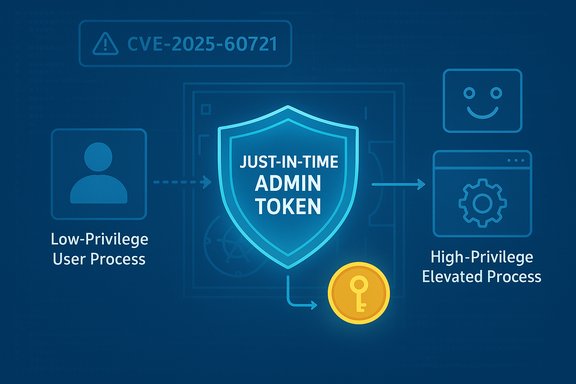
Administrator Protection is Microsoft’s newer elevation model for Windows 11 that shifts the platform away from long‑lived ambient administrative tokens toward just‑in‑time, process‑scoped admin tokens that are minted only when an operation explicitly requests elevation and are typically bound to Windows Hello authentication. The goal is to reduce the “blast radius” of elevated tokens, prevent automatic or silent elevation bypasses, and require stronger local authorization for privileged operations. Early vendor and community explanations of the design and operational tradeoffs are available in Microsoft documentation and developer communications. CVE‑2025‑60721 was publicly recorded on November 11, 2025. The vendor summary describes the vulnerability as a privilege context switching error in the Administrator Protection flow that permits a low‑privileged, authenticated actor to escalate to administrative privileges without interactive user consent. Public trackers and Microsoft’s advisory list a CVSS v3.1 base score of 7.8 (High) with vector elements indicating a local attack requiring low complexity and no user interaction. Why this matters: because Administrator Protection centralizes elevation handling into a single, high‑value gate, any defect inside that gate can be especially attractive to attackers. If an adversary can cause malicious code to execute inside the short‑lived admin token’s process, the protective model is defeated — the attacker gains the same privileged capabilities the token was intended to grant. Community analysis has repeatedly highlighted that vulnerabilities in Administrator Protection are high‑value targets for post‑compromise escalation chains.
Source: MSRC Security Update Guide - Microsoft Security Response Center
 Background / Overview
Administrator Protection is Microsoft’s newer elevation model for Windows 11 that shifts the platform away from long‑lived ambient administrative tokens toward just‑in‑time, process‑scoped admin tokens that are minted only when an operation explicitly requests elevation and are typically bound to Windows Hello authentication. The goal is to reduce the “blast radius” of elevated tokens, prevent automatic or silent elevation bypasses, and require stronger local authorization for privileged operations. Early vendor and community explanations of the design and operational tradeoffs are available in Microsoft documentation and developer communications. CVE‑2025‑60721 was publicly recorded on November 11, 2025. The vendor summary describes the vulnerability as a privilege context switching error in the Administrator Protection flow that permits a low‑privileged, authenticated actor to escalate to administrative privileges without interactive user consent. Public trackers and Microsoft’s advisory list a CVSS v3.1 base score of 7.8 (High) with vector elements indicating a local attack requiring low complexity and no user interaction. Why this matters: because Administrator Protection centralizes elevation handling into a single, high‑value gate, any defect inside that gate can be especially attractive to attackers. If an adversary can cause malicious code to execute inside the short‑lived admin token’s process, the protective model is defeated — the attacker gains the same privileged capabilities the token was intended to grant. Community analysis has repeatedly highlighted that vulnerabilities in Administrator Protection are high‑value targets for post‑compromise escalation chains.What the advisory says (technical summary)
- Vulnerability class: Privilege context switching error within the Windows Administrator Protection elevation flow.
- Impact: Local Elevation of Privilege (EoP) — an authenticated user with low privileges may gain administrative‑equivalent control on a vulnerable host.
- CVSS v3.1: 7.8 (High), vector elements indicating Local (AV:L), Low Attack Complexity (AC:L), Low Privileges Required (PR:L), No User Interaction (UI:N), and high impact to confidentiality/integrity/availability.
- Affected products: Microsoft’s advisory maps this CVE to specific Windows 11 builds (for example, the 24H2, 25H2 and related servicing channels as reported in community mirrors); administrators must consult the Microsoft Security Update Guide to extract the exact KB→build mapping for their estate.
- Remediation: Microsoft has published security updates that mitigate the issue; the vendor page is the authoritative source for KB identifiers and servicing details.
Technical analysis — how attackers can (likely) turn this into an EoP
Public advisories and independent community write‑ups describe the flaw at an architectural level: the Administrator Protection flow performs context switching and token creation for privileged operations; a context switching error implies that the logic which mediates identity binding, token transfer between process contexts, or the creation/activation of the temporary admin token could be induced to perform actions under the wrong (elevated) context. In practice, this means an attacker who can 1) place code or crafted inputs in the right local context and 2) trigger an Administrator Protection elevation flow may cause the elevated process to execute attacker‑controlled code or inherit attacker state with elevated rights. Common exploitation primitives for Administrator Protection‑class defects include:- Improper validation of the origin or binding of a request that results in the Administrator Protection logic granting an elevated token to an attacker‑controlled process. This can be an authentication‑logic or state‑machine manipulation bug.
- Path/confusion or untrusted search path issues where a privileged helper loads resources (DLLs, configuration) using a search order that includes writable locations or network shares; placing an attacker module earlier in that search order results in loading malicious code into an elevated process. This pattern has been the root cause of many historical Windows EoP issues.
- Token impersonation and improper token handoff: an attacker causes or fakes the conditions under which an elevated token is issued or transferred, enabling creation of a privileged process or direct token duplication.
Exploitability, attacker model, and practical risk
Practical attacker prerequisites for CVE‑2025‑60721 (based on public reporting and historical analogues):- Local, authenticated access to the target machine (the attacker must be able to run code or place files under the victim’s namespace). This can be a standard user account or code execution from an unprivileged process.
- The ability to trigger an Administrator Protection elevation flow that will reach the vulnerable code path — for instance, by initiating an elevated operation that the OS will service via the Administrator Protection gate.
- Write/placement capability in a directory or resource that the elevation flow consults (if the vulnerability is exploited via module load/search path manipulation). If the root cause is a logic/state bug, then crafted inputs or sequence of calls may suffice.
- Short‑term: High for already‑compromised endpoints. If an attacker already has a local foothold (phishing, malicious installer, or lateral move), this CVE provides a practical escalation vector to admin‑equivalent control.
- Breadth: Not wormable — the vector is local. That reduces chances of wide, automated mass compromise but increases importance for targeted intrusions and follow‑on activity (credential theft, lateral movement, ransomware deployment).
- Attack complexity: Low–Moderate once local placement and trigger conditions are available; Administrator Protection is a known, centralized target and similar EoP patterns have short exploit cycles. Expect Proof‑of‑Concepts relatively quickly for this class of bug.
What administrators must do now — prioritized checklist
- Map affected systems → confirm vendor KBs. Use the Microsoft Security Update Guide (MSRC) entry for CVE‑2025‑60721 and extract the exact KB→build mapping for every Windows 11 SKU you run before creating automated deployment rules. The MSRC advisory is the authoritative mapping; third‑party CVE lists are useful for triage but can mislabel KB mappings.
- Patch high‑value hosts first. Prioritize: administrative workstations, jump boxes, image/build servers, domain‑joined servers that accept local user sessions (RDS/VDI), and any system that mounts or executes content from network shares.
- Pilot before wide rollout. Test updates in a small pilot ring to catch potential compatibility regressions introduced by changes in the elevation paths. Administrator Protection changes elevation UX and behavior; some legacy installers or scripts may need updates.
- Reboot coordination. Expect reboots for updates that touch elevation or kernel/service components; plan maintenance windows and rollouts accordingly.
- Hunt and detection. Implement EDR/SIEM hunts for:
- unexpected module loads from user‑writable directories into processes running under elevated tokens;
- unusual process ancestry where a low‑privilege parent results in elevated flows;
- writes/creation of new DLLs or executables in directories that are part of process search orders (current directories, TEMP, mapped network shares).
- Enforce strict least privilege and remove unnecessary local admin rights; require separate administrative accounts and reduce standing admin counts.
- Restrict execution from user temporary folders and network shares via application control (WDAC, AppLocker) where feasible.
- Harden hosts that accept user‑supplied content by reducing writable locations in places that might appear in process search orders.
Detection guidance and forensic triage
Because exploitation of this class of bug usually requires placement of files or execution under privileged contexts, the following telemetry and forensic artifacts are practical to collect and monitor:- Module load traces (Event Tracing for Windows / EDR module load events) showing elevated processes loading modules from non‑system paths.
- Process creation trees — correlate child elevated processes to parent processes that ran under low privileges.
- File writes in directories that are commonly part of a search path (current working directories, TEMP, mapped network shares) around the time of elevation requests.
- Windows Security event logs for token creation and assignment anomalies; capture and retain relevant artifacts for incident response (memory images, module files, timeline).
Strengths of Microsoft’s response and remaining limitations
Notable strengths:- Centralized patching: because Administrator Protection centralizes elevation handling, a correct fix in that component reduces the chance of many different bypasses — a single update can remove a broad class of attack paths.
- Vendor guidance: Microsoft’s Security Update Guide maps CVEs to KBs and provides remediation guidance; the advisory is the authoritative source for deployment planning.
- Local prerequisite means the flaw is not wormable, but very valuable in post‑compromise escalation chains. If adversaries already have footholds, this CVE materially increases the risk of full system compromise.
- Compatibility and operational gaps: Administrator Protection changes how elevation flows behave and may break legacy installers or automation; rushed deployments can introduce operational disruption or blind defenders if logging is not centralized.
- Rapid PoC emergence risk: untrusted search path and token manipulation classes historically attract fast PoC development; assume that public exploit code may appear soon and plan detection accordingly.
Long‑term hardening: beyond the immediate patch
- Continue the principle of least privilege: reduce standing administrative accounts, use Privileged Access Workstations (PAWs) and dedicated admin endpoints, deploy Just‑In‑Time (JIT) privilege models and PAM solutions.
- Enforce signed‑load policies: use Windows Defender Application Control (WDAC) / driver signing policies to reduce risk of attacker modules being accepted by privileged processes.
- Reduce writable locations in process search orders: ensure that services and elevated helpers never rely on unqualified search paths that include user‑writable folders or network mounts. Use absolute, signed paths wherever possible.
- Centralize telemetry: instrument Administrator Protection flows and elevation events so anomalies can be detected and correlated across the estate (EDR + SIEM).
What we verified and what remains uncertain
Verified facts:- CVE‑2025‑60721 exists and is listed in Microsoft’s Security Update Guide; Microsoft has published updates to remediate it.
- Public trackers assign a CVSS v3.1 base score of 7.8 (High) and describe the weakness generically as a context switching/privilege elevation issue in Administrator Protection.
- No widely validated public proof‑of‑concept or confirmed in‑the‑wild exploitation had been broadly verified at the time of the advisory; absence of a PoC does not mean the risk is low. Expect PoCs and toolkits for local EoP primitives to appear rapidly. Flag any third‑party PoC claims as requiring corroboration.
- The vendor advisory omits low‑level implementation details (function names, internal APIs) on purpose; if your detection relies on exact internals, wait for trusted technical writeups from Microsoft or reliable researchers before encoding brittle rules.
Conclusion — an operational framing
CVE‑2025‑60721 is a high‑priority local elevation‑of‑privilege vulnerability that targets the heart of Microsoft’s new Administrator Protection model. While it is not remotely wormable, its operational impact is profound when chained after an initial local foothold: an attacker who can run code locally or place files where elevation flows will consult them may escalate to administrative control and pivot across an estate. Microsoft has released updates; administrators must map the CVE to the correct KBs using the Microsoft Security Update Guide and push tested updates with priority for administrative and management hosts. Complement patches with layered compensations — least privilege, application allow‑listing, monitoring for suspicious module loads, and focused EDR hunts — because the centralization of elevation logic makes this flaw both highly valuable to attackers and tractable for defenders to detect if telemetry is good. Immediate action summary (one‑page checklist):- Confirm KB mapping for CVE‑2025‑60721 in Microsoft Security Update Guide and schedule updates.
- Patch admin workstations, jump hosts, imaging/build servers first.
- Pilot patches, coordinate reboots, and validate compatibility.
- Deploy EDR hunts for elevated processes loading modules from non‑system paths and unexpected token creation events.
- Reduce writable search‑path locations and enforce signed‑load/app control policies.
Source: MSRC Security Update Guide - Microsoft Security Response Center
