

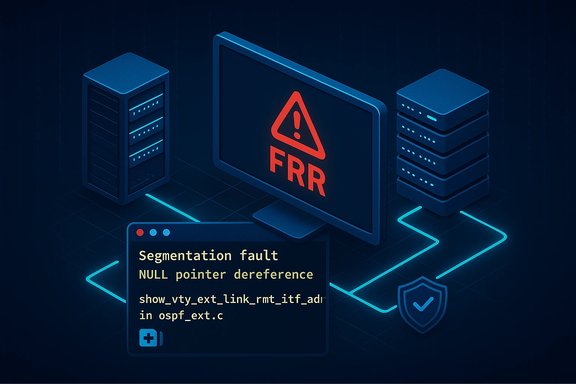
A newly assigned CVE, CVE-2025-61101, identifies a NULL-pointer dereference in the FRRouting (FRR) OSPF code that can be triggered by a crafted OSPF packet and may crash the ospfd process, producing a network-impacting Denial of Service (DoS) for affected routing hosts and appliances.
FRRouting (FRR) is an open‑source routing suite used widely in Linux and BSD routers, network appliances, virtual network functions, and many cloud/edge environments. The 2025 October disclosure covers a family of related OSPF parsing bugs reported against FRR versions from 4.0 through 10.4.1; CVE‑2025‑61101 specifically points at a NULL pointer dereference in the function show_vty_ext_link_rmt_itf_addr inside ospf_ext.c. The practical effect is straightforward: a specially crafted OSPF packet can drive the vulnerable code path and cause ospfd to crash, taking routing services offline on the host until the daemon (or host) is recovered. Multiple public trackers and vendor advisories have registered the CVE and assigned a high availability impact (CVSS v3.1 = 7.5 is commonly reported), with vendor scoring and distribution triage varying by assessor. Several vendors and vulnerability databases point to the same upstream patch PR containing fixes for a set of OSPF opaque/extended-LSA display functions; the public patch discussion is tracked in FRR’s issue/pull request queue.
Operators should treat the absence of public exploitation reports as a temporary assurance, not a reason for complacency: the availability impact of a simple crash can be severe in production networks, and scanning or opportunistic attackers may add weaponized PoCs to public repositories quickly once fixes and technical details are public. Cross‑check vendor package changelogs to confirm that the fix you install contains the upstream commit(s) associated with PR #19480 before considering any host remediated. In short: inventory, isolate, patch, and validate—those steps will contain the risk and restore routing-plane stability for affected environments.
Source: MSRC Security Update Guide - Microsoft Security Response Center
 Background / Overview
FRRouting (FRR) is an open‑source routing suite used widely in Linux and BSD routers, network appliances, virtual network functions, and many cloud/edge environments. The 2025 October disclosure covers a family of related OSPF parsing bugs reported against FRR versions from 4.0 through 10.4.1; CVE‑2025‑61101 specifically points at a NULL pointer dereference in the function show_vty_ext_link_rmt_itf_addr inside ospf_ext.c. The practical effect is straightforward: a specially crafted OSPF packet can drive the vulnerable code path and cause ospfd to crash, taking routing services offline on the host until the daemon (or host) is recovered. Multiple public trackers and vendor advisories have registered the CVE and assigned a high availability impact (CVSS v3.1 = 7.5 is commonly reported), with vendor scoring and distribution triage varying by assessor. Several vendors and vulnerability databases point to the same upstream patch PR containing fixes for a set of OSPF opaque/extended-LSA display functions; the public patch discussion is tracked in FRR’s issue/pull request queue. What the vulnerability is, in plain terms
- The vulnerability is a NULL pointer dereference (CWE‑476) inside FRR’s OSPF extended LSA diagnostic/VTY display code (ospf_ext.c).
- The vulnerable functions are used when FRR’s OSPF code attempts to format or display extended information (for example, when dumping opaque LSA/extended link attributes or when debug output is enabled).
- When FRR processes a specially crafted OSPF packet that contains malformed or unexpected TLVs/LSA contents, code paths that assume non‑NULL context pointers can dereference a NULL and crash the ospfd daemon.
- The observable result is denial of OSPF routing on the host (daemon crash, potentially repeated crash loops) — an availability failure rather than a confidentiality or integrity compromise.
Why this matters (threat model and impact)
OSPF is a core interior gateway protocol in many datacenter, campus and carrier networks. When ospfd on a router, virtual router, or service node crashes, OSPF adjacency and route propagation stop on that host. For network‑critical appliances, the fallout can be immediate:- BGP peers or forwarding tables may be affected by loss of OSPF routes, creating traffic blackholes or path changes.
- Multi‑tenant or cloud hosts that run FRR to provide tenant routing can stop routing tenant networks, causing widespread service outages.
- Embedded or vendor appliances using FRR as the control plane can trigger device instability, and vendor firmware update cycles may delay fixes.
Technical verification — what public records show
Multiple independent sources corroborate the core technical details:- The NVD entry and OSV import list CVE‑2025‑61101 and describe a NULL pointer dereference in show_vty_ext_link_rmt_itf_addr within ospf_ext.c.
- Distribution trackers (Debian, Ubuntu, SUSE) and major vulnerability databases (Tenable, Snyk, Cvedetails) list the same affected version range and cite a common upstream PR addressing a group of related OSPF display/parsing issues.
- The public FRR pull request referenced by trackers (PR #19480) contains the patch commits that add extra null checks and safer handling of VTY context and opaque-LSA display routines; commit identifiers from those PRs are visible in the advisories and tracker imports.
Immediate risk assessment and exploitation status
- Exploitability: Public trackers list the attack vector as network (no credentials required) and rate attack complexity as low in the common vector strings, but practical exploitation depends on whether the receiver will process the crafted OSPF payload and on local configuration (e.g., whether debug output or certain display functions are enabled).
- In‑the‑wild reports: As of the aggregated public records and vendor advisories at disclosure time, there is no authoritative public proof‑of‑concept or confirmed active exploitation campaign reported. EPSS/scan data indicate low short‑term exploitation probability, but the availability impact is material for exposed networks.
- Attack surface notes: Many trackers flag that the issue is triggered by OSPF packet processing and by certain diagnostic/display code paths; some advisories and vendor notes highlight that enabling deep OSPF debug output increases exposure. If a host receives OSPF from untrusted or unfiltered neighbors (for example, a poorly segmented management plane), the practical risk is higher.
What to do now — step‑by‑step remediation and mitigations
Operators should treat CVE‑2025‑61101 as an operational priority for any host running affected FRR versions (4.0 → 10.4.1). The following prioritized actions are practical, non‑destructive, and platform-agnostic:- Inventory and prioritize
- Identify every host, container image, appliance, or VM that runs FRR/frr or vendor images that embed FRR. Use package and binary scanning (dpkg/rpm, container image scans, SCA tools).
- Map the instances to business impact—edge routers and control‑plane routers rank highest.
- Immediate mitigations (while you patch)
- Restrict OSPF peer sources: apply ACLs or interface filters so only trusted OSPF neighbors can deliver OSPF PDUs to the routing instance.
- Disable or avoid enabling verbose OSPF debug/dump commands (for example, “debug ospf packet all send/recv detail”) on production systems; vendor and security tracker notes call out debug modes as increasing exposure for related OSPF display bugs.
- If FRR runs inside containers or VMs, consider isolating control-plane ports further (use host firewall rules, management VRFs, or separate control networks).
- Add process‑supervision and automated restart policies, but treat restarts as temporary; repeated crashes are a symptom that must be resolved by patching.
- Apply the upstream or vendor patch
- Track FRR’s upstream pull request (PR #19480) and the corresponding commit series that addresses the OSPF extended/opaque LSA display handling. If your environment builds FRR from source, apply the upstream patch commit (the PR/commit identifiers are present in public CVE imports).
- If you rely on distribution packages, monitor your distribution’s security tracker and install the vendor‑supplied packages that explicitly reference CVE‑2025‑61101 or the upstream commit. Debian and Ubuntu trackers list affected packages and update status; consult them for exact package numbers.
- Hardening and compensating controls
- Limit adjacency formation: require OSPF authentication where supported and feasible.
- Constrain management and control-plane network reachability with network ACLs and zero‑trust segmentation.
- Monitor and alert on ospfd restarts, core dumps, and log messages indicating NULL dereferences or crashes.
- Post‑patch validation
- After applying the patch, verify ospfd stability under representative OSPF adjacency and LSA traffic. Exercise any debug/display paths that the patch targets in a lab before deploying to production.
- Rotate out of any temporary guardrails (for example, re-enable selective logging) only after validating the patch.
Detection, logging, and forensic cues
Hunting for exploitation or attempted exploitation should focus on process‑level and routing control‑plane telemetry rather than packet signatures:- Host indicators:
- Repeated ospfd crashes or daemon restarts in system logs.
- Core dumps referencing ospfd or stack traces with functions in ospf_ext.c / show_vty*ext** frames.
- Unexpected route flaps or sudden disappearance of OSPF-learned prefixes.
- Network indicators:
- Spikes in OSPF LSA/LSU traffic from a single neighbor or untrusted source.
- Unusual OSPF packets with malformed TLVs; packet captures (pcap) of control-plane traffic may reveal anomalous payloads.
- SIEM queries and example searches (high‑signal):
- Search for ospfd process exit codes, "segfault", or "NULL pointer dereference" in syslog/journalctl.
- Alert on OSPF adjacency flaps or core dumps from FRR packages.
Patch and vendor status — what the public record shows
- Upstream: The FRR issue and PR tracker entries referenced by NVD and OSV point to PR #19480 as the corrective work that introduces defensive checks and safer handling of VTY context and opaque/extended LSA display code. Use the upstream PR/commit IDs to validate the patch content if you plan to cherry‑pick changes.
- Distributions: Debian, Ubuntu and SUSE trackers list CVE‑2025‑61101; their pages indicate the vulnerability and show distribution‑specific state (vulnerable or fixed/backported). Ubuntu’s public tracker at disclosure flagged the issue and, in some releases, shows “fix deferred” or pending backporting depending on the release. Always map the vendor package version and changelog to the upstream commit rather than relying solely on upstream version numbers.
- Advisory rollouts: Some vendors and vulnerability aggregators published guidance and detection notes; however, at the time public trackers were assembled there was no consistent “fixed release number” across all distributions because the upstream fix was moving through PR/merge and vendor backport cycles. Where vendors have released fixed FRR packages, they will include the CVE or the upstream commit in the package changelog.
Critical analysis — strengths, weaknesses, and residual risks
Strengths- The vulnerability class (NULL pointer dereference) is well understood and the remediation (add defensive null checks and safer VTY handling) is small and surgical; upstream PRs reflect targeted fixes rather than heavy rewrites, which typically makes safe backporting feasible. The public record shows a clean, reviewable patch path.
- Multiple independent trackers and vendors converged quickly on the technical details and published mitigation recommendations, which helps operators apply consistent remediation at scale.
- Distribution and vendor lag: Many operators rely on distribution or appliance vendor images; those vendors may take time to absorb upstream fixes and produce signed packages or firmware images. The potential window of exposure for appliances can be long.
- Network exposure assumptions: While the CVSS vector assumes network access, practical exploitation depends on whether the vulnerable code path is reached in normal packet processing. Some advisories indicate debug/display settings (or specific LSA handling) increase exploitation ease; however, those assumptions vary across trackers. When such assumptions are ambiguous, treat the worst case (network‑reachable, no auth) as the organizing principle for remediation.
- Detection difficulty: Attackers who craft malicious OSPF PDUs may blend them into control‑plane traffic; detection depends on control‑plane packet capture and inspection, which many operations teams do not routinely retain. This complicates retrospective detection.
- Public sources do not (at disclosure) include a reliable, reproducible public PoC exploit that is tuned for production routers. Several vendors report no evidence of in‑the‑wild exploitation; this remains an assurance rather than proof. Any claim that this CVE is currently being used widely should be flagged and verified against multiple independent telemetry sources before accepting.
- Some secondary writeups combine multiple related FRR CVEs into aggregate narratives; while that’s useful for trend analysis, individual CVEs should be assessed against their own patch and exploitability notes to avoid conflating disparate issues.
Recommended operational checklist (quick reference)
- Immediate (first 24 hours)
- Inventory FRR deployments and mark critical routers/appliances.
- If possible, apply temporary ACLs to limit OSPF PDUs to trusted neighbors.
- Disable verbose OSPF debug/dump modes in production control planes.
- Short term (24–72 hours)
- Apply vendor or upstream patches where available; if not available, consider applying the upstream PR commit in a controlled, tested build.
- Harden OSPF adjacency formation (authentication, VRFs, interface locks).
- Medium term (1–4 weeks)
- Validate patch behavior under load, confirm no regression in OSPF adjacency and LSA handling.
- Add OSPF LSA anomaly detection into telemetry and SIEM playbooks.
- Long term
- Reduce attack surface: centralize control-plane traffic on management networks, isolate routing daemons from general user networks, and require strong neighbor authentication where supported.
- Add FRR/OSPF testcases to CI that reproduce malformed-LSA processing to avoid regressions in future releases.
Closing analysis and final recommendations
CVE‑2025‑61101 is a high‑impact availability bug in a widely used open‑source routing daemon. The technical fix is narrow and reviewable, and upstream work is already referenced in public PRs and tracker imports. The urgent operational task is twofold: reduce exposure (limit who can send OSPF PDUs, disable unnecessary debug that increases code‑path reachability) and patch quickly once a vendor or upstream package containing the fix is available. For organizations that run FRR on critical routers or multi‑tenant hosts, prioritize those instances for rapid patching and control‑plane isolation.Operators should treat the absence of public exploitation reports as a temporary assurance, not a reason for complacency: the availability impact of a simple crash can be severe in production networks, and scanning or opportunistic attackers may add weaponized PoCs to public repositories quickly once fixes and technical details are public. Cross‑check vendor package changelogs to confirm that the fix you install contains the upstream commit(s) associated with PR #19480 before considering any host remediated. In short: inventory, isolate, patch, and validate—those steps will contain the risk and restore routing-plane stability for affected environments.
Source: MSRC Security Update Guide - Microsoft Security Response Center
