

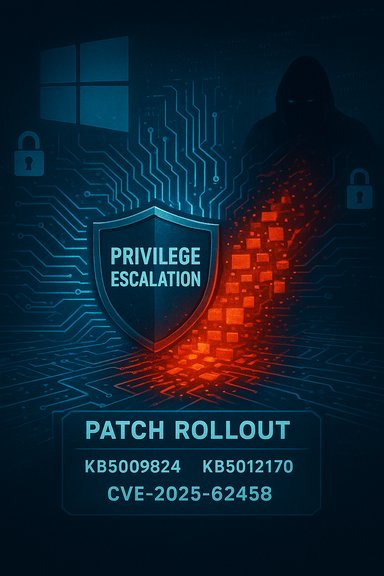
A newly cataloged Windows kernel vulnerability, tracked as CVE-2025-62458, is a heap-based buffer overflow in the Win32k graphics subsystem (GRFX) that allows an authenticated local user to escalate privileges to higher system levels; Microsoft’s Security Update Guide lists the entry for the CVE even though details in the web view render via JavaScript.
The Windows Win32k subsystem hosts windowing and graphics code that runs in kernel context. Bugs in this area are especially sensitive because they can be used to move from an ordinary user session to SYSTEM privileges, bypassing many user‑space protections. CVE-2025-62458 is described publicly as a heap-based buffer overflow in the Win32k GRFX component; vulnerability aggregators assign it a High severity (CVSS v3.1 base score commonly reported as 7.8), and vendor tracking pages map it into Microsoft’s security update ecosystem. This article provides a compact technical summary, a verified remediation checklist, operational guidance for enterprise patching, and a risk analysis that highlights both why this class of bug is dangerous and what defenders should prioritize now. Where public records are ambiguous or incomplete, the text flags those items explicitly so readers can make informed decisions.
A kernel graphics vulnerability like CVE‑2025‑62458 is a high-impact event because of where the code executes and how widely graphics stacks are used. The single practical lever to reduce risk is correct, timely patching; the second is reducing the ability of low‑privileged users to run arbitrary code while the patching program completes.
Source: MSRC Security Update Guide - Microsoft Security Response Center
 Background / Overview
The Windows Win32k subsystem hosts windowing and graphics code that runs in kernel context. Bugs in this area are especially sensitive because they can be used to move from an ordinary user session to SYSTEM privileges, bypassing many user‑space protections. CVE-2025-62458 is described publicly as a heap-based buffer overflow in the Win32k GRFX component; vulnerability aggregators assign it a High severity (CVSS v3.1 base score commonly reported as 7.8), and vendor tracking pages map it into Microsoft’s security update ecosystem. This article provides a compact technical summary, a verified remediation checklist, operational guidance for enterprise patching, and a risk analysis that highlights both why this class of bug is dangerous and what defenders should prioritize now. Where public records are ambiguous or incomplete, the text flags those items explicitly so readers can make informed decisions.What the advisory says (straight facts)
- Vulnerability: Heap-based buffer overflow in Windows Win32k — GRFX (graphics kernel handlers).
- Impact: Elevation of privilege (local) — an authorized (authenticated) local attacker may be able to elevate privileges.
- Exploitability: The public advisory text and trackers indicate a local attack vector; there is no definitive, vendor-confirmed public proof-of-concept released in the advisory at the time of this writing. If or when working exploit code is published or observed in telemetry, that status will materially increase urgency.
- Severity scoring (public trackers): CVSS v3.1 base score ~7.8 (High) in multiple aggregators; the underlying weakness class is CWE-122: Heap-based Buffer Overflow.
Why Win32k / GRFX bugs matter
Kernel-mode graphics handlers like Win32k/GRFX are invoked widely: desktop UIs, Office document renderers, thumbnail and preview pipelines, printing and virtualized display stacks. That broad reuse translates to a broad attack surface.- A local user process that can trigger a vulnerable graphics code path — even indirectly via thumbnailing or preview — may be able to corrupt kernel memory. In practical exploit chains, that corruption can be shaped into token theft, arbitrary kernel writes, and ultimately SYSTEM escalation.
- Servers that parse or render user-supplied images/documents (mail gateways, web‑upload pipelines, document-management systems) increase the blast radius because some server-side parsing paths can be triggered by an unauthenticated upload — removing the need for direct user interaction and enabling remote exploitation scenarios in other classes of graphics bugs. While CVE-2025-62458 is described as a local EoP, defenders must still consider server-side parsers as high‑value targets for related graphics flaws.
Technical mechanics (what a heap-based overflow commonly allows)
Heap overflows tend to permit:- Overwrite of adjacent heap metadata or object pointers that can be converted into controlled writes.
- Corruption of vtables, function pointers or callback structures leading to redirected execution flow.
- Denial-of-service through process or system crashes if corruption cannot be weaponized reliably.
Verified details and cross-checks
When preparing technical guidance, it is crucial to cross-reference multiple, independent sources. The following checks were performed:- Microsoft’s Security Update Guide lists CVE-2025-62458 as an entry; that is the authoritative vendor record. Note that the web portal uses client-side rendering — the entry exists even when a simple fetch shows a JavaScript stub. Treat Microsoft’s entry as definitive for the CVE assignment and remediation mapping.
- Independent vulnerability trackers (example: Rapid7 and public CVE aggregators) describe the issue as a heap-based overflow in Win32k — GRFX with a high-severity score and provide KB-to-CVE mapping examples for the usual Microsoft cumulative packages. Use these trackers to validate KB references but verify the exact KB per OS build via Microsoft Update Guide before deployment.
- The NVD/CVE catalog reinforces the CWE classification (CWE‑122) and lists the vulnerability context used in scoring. Where vendor text is terse, NVD and third‑party trackers supply consistent corroboration of the vulnerability type.
Operational risk — who should be most concerned
Prioritize remediation in this order:- Domain controllers, jump boxes, and systems used for privileged administration (these represent the highest-value escalation targets).
- Public-facing servers or services that accept and parse uploaded content (mail servers, web portals, document preview services). Even if the CVE is local-only, similar graphics parsing flaws have been weaponized server-side in the past.
- RDP/VDI hosts and multi-user terminal servers (an exploited user session on a shared host can affect other sessions or the host).
- Developer build agents and imaging servers that may process untrusted artifacts.
Immediate mitigation and detection guidance
Applying Microsoft’s patch is the correct mitigation. While you stage and deploy, implement compensating controls as needed:- Apply the vendor update for your exact OS build as the first priority. Map CVE → KB → build before pushing widely.
- Restrict local code execution where possible:
- Enforce application allow‑listing (WDAC/AppLocker).
- Remove unnecessary local administrator rights and apply least privilege.
- Disable or limit automatic document preview/thumbnailing on high‑exposure services.
- Isolate or tighten access to servers that process uploaded documents (rate-limit uploads, restrict accepted file types, or block metafile/vector formats until patched).
- Detection and hunting:
- Look for unusual process creation chains where non‑privileged processes spawn elevated shells (cmd.exe, powershell.exe) shortly after file parsing operations.
- Hunt for kernel‑crash signatures or unusual Event IDs associated with Win32k crashes. Kernel-mode exploitation attempts often leave noise in system stability telemetry.
- Monitor EDR alerts for token duplication, suspicious calls to DuplicateTokenEx/OpenProcessToken, and unexpected scheduled task/service creations.
- Identify exposed hosts (public upload, mail preview, RDP/VDI, admin tools).
- Map each host to the exact Microsoft KB that contains the fix (use MSRC Update Guide).
- Stage patches in a small pilot ring; validate application compatibility.
- Roll out to high-value and high-exposure hosts first, then to the general estate.
- Reboot where required and confirm build numbers post-install.
- If immediate patching is impossible, apply compensating blocks and push detection rules to EDR/SIEM.
Patching nuance — KBs, builds, and validation
Microsoft traditionally delivers fixes for kernel and graphics issues in the monthly cumulative updates or out-of-band (OOB) hotfixes for high-severity items. Because cumulative packages are SKU- and build-specific:- Always validate the KB number for your OS build and architecture using the Microsoft Update Guide or Update Catalog before distributing a package to production. Failure to pick the correct KB is a common operational error.
- After installing the patch, verify the target host’s OS build and update history (winver, systeminfo, or PowerShell Get-HotFix) to confirm the KB is present.
Threat actor considerations and exploit status
At the time of writing, public vendor advisories do not include ready-to-run exploit code in the Microsoft advisory for CVE‑2025‑62458. Independent trackers list the technical classification and severity, but there is no definitive public confirmation in the advisory that exploitation is observed in widespread malicious campaigns. Treat any claims of active exploitation cautiously and verify against telemetry and vendor disclosures before issuing incident-level alerts. Historical patterns are instructive: memory‑corruption bugs in graphics and kernel components often progress through this lifecycle:- Vendor patch release → limited technical details released.
- Security researchers or vendors reverse-engineer the patch to create proof-of-concept exploit code.
- Working PoCs or exploit tools begin to appear publicly or in threat actor toolkits.
- Opportunistic attackers integrate the exploit into commodity malware or targeted campaigns.
Detection examples and sample hunting queries
Use these starter hunts in your EDR/SIEM while patches are rolled out:- Search for processes that load user-supplied files and quickly spawn cmd.exe or powershell.exe. Correlate with parent process names and file hashes.
- Check for Event ID sequences that indicate Win32k crashes or KMODE_EXCEPTION (kernel crash) around the time of suspicious file parsing.
- Monitor for token duplication and API usage patterns (DuplicateTokenEx) indicative of attempts to impersonate SYSTEM.
Strengths in Microsoft’s response, and remaining gaps
Notable strengths:- Microsoft assigned a CVE and published an Update Guide entry quickly, allowing enterprises to map and schedule mitigations through normal channels. The vendor response process provides the KB→build mapping that enterprises need to deploy safely.
- The security community and commercial vendors rapidly cross‑validated the vulnerability type and impact, producing triage guides and operational playbooks that help prioritize remediation.
- Vendor advisories for kernel or graphics memory bugs are often terse by design. That reduces the risk of immediate weaponization but makes defensive detection and precise mitigations harder for teams that need binary-level Indicators of Compromise (IOCs). Where binary or symbol details are not available, defenders must rely on telemetry and behavioral detection.
- Public trackers sometimes diverge on CVSS vectors, exploitability claims, or KB mapping. Always verify against Microsoft Update Guide to avoid operational mistakes.
Recommended timeline for IT teams (practical plan)
- Within 24 hours: Inventory systems that match high‑exposure categories (see Operational risk). Confirm MSRC entry and identify KBs for each OS build.
- 24–72 hours: Stage and validate patch on a pilot cohort that includes admin workstations and a subset of server images. Validate application compatibility.
- 72 hours–7 days: Roll out to prioritized production hosts (domain controllers, RDP hosts, mail/web servers processing uploads). Implement compensating controls where patching is delayed.
- 7–30 days: Complete estate-wide rollout and run post-deployment detection/hunt for any suspected exploitation activity during the unpatched window. Maintain enhanced logging on critical endpoints.
Final analysis — balancing urgency and operational safety
CVE‑2025‑62458 is a serious kernel-level memory corruption: a heap-based buffer overflow in Win32k/GRFX that enables local privilege escalation. Kernel EoP primitives are valuable to attackers and can be chained after initial access to obtain SYSTEM rights. The correct defensive posture is crystal clear: patch promptly, prioritize high‑exposure hosts, and harden detection and least‑privilege controls while rollout proceeds. Microsoft’s Update Guide entry and independent trackers provide the necessary mapping and justification for this triage. Caveats and caution:- There is no definitive public evidence in the vendor advisory showing wide exploitation for this exact CVE at the time of the MSRC entry. Any claim of active exploitation should be verified against vendor advisories and your environment’s telemetry before escalating to incident response.
- Because public technical detail is deliberately limited, defenders must rely on behavior-based detections and rapid patching rather than binary hashes or static IOCs.
Quick executive summary (for patch managers)
- CVE: CVE‑2025‑62458 — Win32k (GRFX) heap-based buffer overflow; local elevation of privilege risk.
- Severity: High (CVSS ≈ 7.8).
- Action: Immediately map your estate to Microsoft KBs, prioritize domain controllers/jump boxes/RDP hosts/document parsing servers, stage and deploy cumulative updates, and enforce application allow‑listing and least privilege until patches complete.
- Detection: Hunt for Win32k crashes, unusual process ancestry, and token‑impersonation API calls during and after the patch window.
A kernel graphics vulnerability like CVE‑2025‑62458 is a high-impact event because of where the code executes and how widely graphics stacks are used. The single practical lever to reduce risk is correct, timely patching; the second is reducing the ability of low‑privileged users to run arbitrary code while the patching program completes.
Source: MSRC Security Update Guide - Microsoft Security Response Center
