

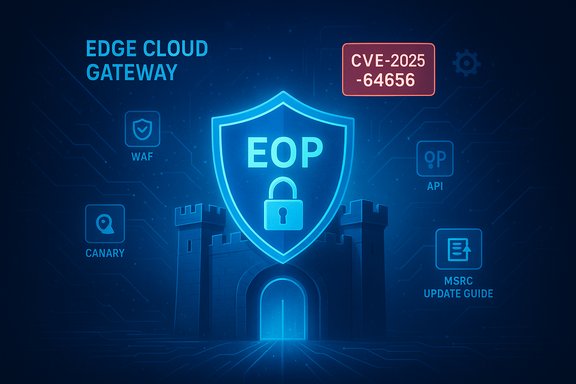
Microsoft’s Security Update Guide lists CVE-2025-64656 as an Elevation of Privilege affecting Application Gateway, but public technical detail is currently limited and the vendor’s confidence metric indicates uncertainty about how much of the exploit chain has been independently validated; defenders should treat this as an urgent operational item while verifying KB mappings and applying vendor fixes as soon as they are confirmed.
Background / Overview
Azure Application Gateway is Microsoft’s Layer‑7 load balancer and web application delivery platform, commonly deployed to terminate TLS, offload WAF protection, and route traffic into application back ends. It bridges edge exposure with internal services and often sits in front of web apps, APIs and containerized workloads, making any meaningful vulnerability in the gateway a high‑value target for attackers. CVE‑2025‑64656 is recorded in Microsoft’s Update Guide as an elevation‑of‑privilege issue tied to Application Gateway. The vendor entry includes a confidence metric — a shorthand Microsoft uses to communicate how certain it is about the vulnerability’s existence and the credibility of the published technical details. That metric is a crucial operational signal: high confidence implies vendor acknowledgement and likely available fixes, reasonable or uncorroborated confidence implies the vulnerability may be real but lacks independent corroboration or full technical disclosure.This story matters because Application Gateway frequently handles TLS termination, WAF inspection, and request routing for internet‑facing workloads. Privilege escalation in that context can go beyond “just the appliance”: misused management tokens, compromised control plane actions, or manipulated WAF policies can amplify local or administrative compromise into broad cloud‑plane effects. Several recent Azure‑adjacent advisories have shown exactly this cross‑plane amplification risk, so teams should not treat a local EoP in a network or management component as limited to a single host.
What Microsoft’s entry actually says (and what it deliberately doesn’t)
The MSRC “confidence” metric — what it means in practice
Microsoft’s Security Update Guide adds a small but important metadata field to some advisories called the confidence metric. It communicates whether Microsoft has vendor‑acknowledged reproducible technical details, has supporting third‑party research, or is still in an early, provisional stage. In a nutshell:- Confirmed / High confidence — vendor acknowledgement and a patch are present; treat as authoritative and urgent.
- Reasonable / Medium confidence — multiple researchers or vendors have corroborated the issue; treat as actionable and prioritize.
- Uncorroborated / Low confidence — rumor or a single report exists without vendor confirmation; monitor and research further before mass action.
What Microsoft’s Application Gateway entry does and does not disclose
The MSRC record for CVE‑2025‑64656 identifies the affected product (Application Gateway) and the vulnerability class (elevation of privilege). The vendor entry does not publish a detailed exploit chain, PoC code, or low‑level function names when the confidence level or operational risk argues for limited disclosure. This is an intentional practice designed to reduce the chance of immediate mass weaponization while administrators apply vendor fixes. The net effect: the advisory is authoritative about what is affected, but not always rich enough to support custom detection rules without additional public research.Why Application Gateway EoP matters: attack surface and consequences
Application Gateway acts as a choke point for web traffic and often integrates with other Azure services:- TLS termination and certificate management — compromises can reveal private material if keys are exposed.
- Web Application Firewall (WAF) policy handling — privileged control over WAF rules could allow persistent bypass or redirection of protection logic.
- Management plane interfaces — the gateway’s management APIs, configuration model, and integrations can be leveraged to change routing, expose back‑end services, or modify logging.
- Modify WAF rules to whitelist malicious traffic or suppress detection.
- Change routing to capture or exfiltrate traffic.
- Abuse machine identities or management tokens to call Azure APIs on behalf of the compromised instance.
- Deploy or pivot to back‑end workloads using modified configuration.
Technical analysis: likely root causes, exploitability and attack vectors
Public vendor detail for CVE‑2025‑64656 is intentionally sparse. Based on Microsoft’s classification (EoP) and the recurring patterns for gateway/management‑plane advisories, the most plausible technical root causes include:- Improper access control in management APIs or configuration endpoints (missing authorization checks).
- Unsafe deserialization or parsing of management or telemetry payloads that run in privileged contexts.
- Race conditions or memory‑safety bugs in long‑running gateway processes that operate with elevated privileges.
- Token or credential handling flaws that let lower‑privileged processes obtain elevated tokens or impersonate the gateway instance.
- If the flaw requires local code execution (common for many EoP bugs), an attacker must already have a foothold on the gateway host or a path to execute code in the gateway process context. In that case, the vulnerability is a post‑compromise force multiplier.
- If the flaw is network reachable (for example exposed management endpoints or unauthenticated deserialization), exploitability is higher and the urgency rises accordingly. Microsoft’s advisory—if it does not explicitly say “unauthenticated network vector”—should be treated conservatively: assume reachable management APIs could be leveraged until you confirm otherwise.
Operational impact and realistic exploitation scenarios
Below are pragmatic attacker playbooks reflecting how CVE‑class EoP issues in gateways have been used elsewhere; apply them as threat models for your environment.- Local foothold → SYSTEM escalation → cloud token theft: An attacker compromises a back‑end app or VM, executes code locally, triggers the gateway EoP to obtain elevated privileges, queries local metadata or management endpoints to harvest machine identities, then calls Azure APIs to enumerate or control cloud resources. This is the classic cross‑plane amplification scenario.
- Management API abuse → configuration tampering: If the gateway’s management endpoints accept mis‑authorized requests, an attacker could change WAF rules, add routing entries to siphon traffic, or export certificate material for offline decryption. This could be achieved remotely if sufficient access to management APIs is available.
- Persistent backdoor via misconfiguration: Post‑exploit the attacker could create persistent automation (scripts, modified templates) so that reboots or redeployments recreate a compromised configuration state. Because gateways often integrate with IaC and automation, the blast radius can be high.
Detection, mitigation and remediation: a prioritized playbook
Below is a practical, prioritized checklist to mitigate CVE‑2025‑64656 and similar Application Gateway EoP threats. Use the vendor KB mapping for your exact SKU as the authoritative patch identifier before broad automation.- Inventory and scope (minutes → hours)
- Identify all Application Gateway instances (public, private, and those used for internal routing). Map versions, SKU types, and whether WAF / management APIs are enabled.
- Confirm whether any management endpoints are internet‑exposed or reachable from less‑trusted segments.
- Confirm vendor mapping and patch (hours → days)
- Use Microsoft’s Security Update Guide and Microsoft Update Catalog to map CVE → KB → build. Do not rely solely on third‑party CVE strings — recent Azure advisories have shown CVE fragmentation that can mislead automated patching.
- If a patch exists, schedule a staged rollout: pilot → canary → enterprise. Validate post‑patch build numbers and service behavior.
- If patching is delayed, apply compensating controls (immediate)
- Restrict management plane access via IP allowlists, just‑in‑time administration, and conditional access.
- Disable or restrict non‑essential WAF management APIs and automation hooks until patches are applied.
- Rotate certificates and keys only if compromise is suspected.
- Hardening & least privilege (short term → medium term)
- Enforce least privilege for management accounts and service principals used to configure Application Gateway.
- Use Privileged Identity Management (PIM) and MFA for administrative operations.
- Review automation pipelines that deploy or modify gateway config; require signed templates and approvals.
- Detection & telemetry (ongoing)
- Hunt for anomalous configuration changes, sudden WAF rule edits, or unusual management API calls.
- Instrument control‑plane telemetry and diagnostic logs for unusual actor behavior (creation of new routes, new certificate uploads, or deleted audit records).
- On hosts, monitor for unusual process elevation, impersonation API usage, or token requests to metadata endpoints.
- Incident containment (if compromise suspected)
- Isolate the gateway or affected host, preserve forensic artifacts (audit logs, config snapshots), and rotate credentials for service principals or managed identities.
- Examine IaC repositories and deployment pipelines to ensure no malicious templates were checked in.
- Consider emergency re‑provisioning from known‑good templates if integrity can’t be validated.
Critical appraisal: strengths, gaps and operational risks in the vendor response
Microsoft’s approach to publishing CVE entries with a confidence metric and targeted advisories has clear virtues: it reduces the chance of immediate mass weaponization and gives defenders a triage signal beyond the raw CVE label. However, the approach also creates practical friction for operations teams.Strengths:
- Vendor acknowledgement + patch availability (when present) is authoritative and lets defenders act decisively.
- Confidence metadata helps prioritize scarce patching resources when many advisories land at once.
- CVE fragmentation: Community feeds sometimes map different CVE numbers to related Azure admiralty issues; automated patch systems can miss the correct KB if they rely solely on CVE strings. The pragmatic remedy is to always cross‑check the MSRC KB mapping and the Microsoft Update Catalog before automated deployments.
- Sparse technical detail: When vendor advisories omit low‑level indicators, defenders find it hard to write precise detection signatures and may be forced to rely on broader, noisier heuristics. This can delay detection in the narrow window before weaponized PoCs appear.
- Cross‑plane amplification: EoP in a gateway can enable cloud resource access if machine identities or tokens are available locally. This makes host patching necessary but not sufficient; cloud identity hygiene must be included in remediation.
What we verified and what remains unverified
Verified:- Microsoft lists CVE‑2025‑64656 in its Security Update Guide as an Application Gateway elevation‑of‑privilege vulnerability. The advisory includes the vendor’s confidence rubric.
- The operational risks tied to gateway EoP — cross‑plane amplification, WAF manipulation, routing tampering — are documented patterns in contemporary Azure advisories and security analyses.
- Public, detailed exploit mechanics for CVE‑2025‑64656 (stack traces, PoC code or exploit primitives) were not available in vendor text accessible without a full MSRC render and in public trackers at the time of this article. Until Microsoft or multiple reputable researchers publish detailed technical analysis, any claims about the exact attack code or weaponization timeline should be treated as provisional.
Practical checklist for WindowsForum readers (executive to hands‑on)
- Immediately: Query your inventory for Application Gateway instances and check MSRC for the CVE→KB mapping before any automation.
- If a vendor patch is available: schedule a staged rollout (pilot → canary → broad), coordinate reboots where required, and validate final build numbers.
- If patching must wait: restrict management API access, tighten IP allowlists, and reduce privileges for the gateway’s service principals.
- Monitoring: add hunts for WAF policy changes, unexpected certificate rotations, and management‑API calls from unusual principals. Instrument IaC pipelines for unauthorized commits.
- Post‑incident: rotate keys and service principals if compromise is suspected and rebuild affected infrastructure from known‑good images and signed templates.
Conclusion
CVE‑2025‑64656 — an Application Gateway elevation‑of‑privilege entry in Microsoft’s Update Guide — is a reminder that modern cloud‑edge components are high‑value security targets. Microsoft’s confidence metric is a useful triage signal, but it is not a substitute for confirming the official KB mapping and following vendor patch guidance. Defenders must treat gateway‑level EoP as a cross‑plane problem: patch quickly when fixes are available, harden management and identity controls, and hunt for indicators that a gateway configuration or token has been abused. The operational priority is clear: inventory, confirm the MSRC KB mapping, stage and validate patches, and harden management plane access — in that order. (If you manage Application Gateway instances, treat MSRC’s Update Guide as the source of truth for KB→patch mapping and follow your organization’s change controls to validate updates before a broad rollout.Source: MSRC Security Update Guide - Microsoft Security Response Center
