

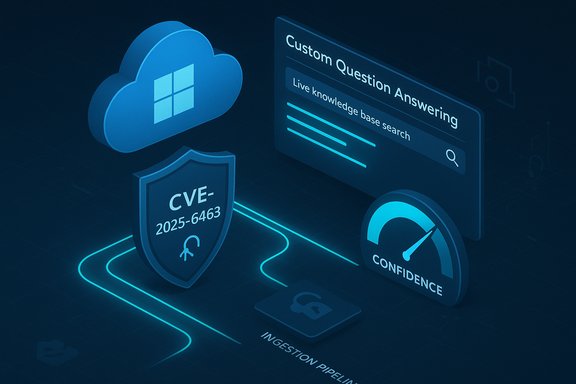
Microsoft has recorded CVE‑2025‑64663 as an elevation‑of‑privilege issue tied to Custom Question Answering (Microsoft’s knowledge‑base / conversational Q&A service), and the advisory is accompanied by Microsoft’s confidence metric that explicitly signals how much of the technical detail is corroborated. The public record is deliberately terse: vendors and defenders are told the CVE exists and that it can result in privilege escalation, but Microsoft’s published entry does not include a full exploit chain, proof‑of‑concept code, or low‑level root‑cause details — leaving security teams to prioritize by confidence and apply standard mitigation discipline while awaiting full vendor technical notes.
Custom Question Answering (CQA) is Microsoft’s managed service for building searchable, conversational knowledge bases over documents, FAQs and other organizational content. It exposes authoring APIs, project publishing/deployment flows, and runtime REST endpoints that client apps query to receive ranked answers with associated confidence scores. The service pipeline includes content ingestion, indexing (often backed by Azure Search), an NLP reranker, and a published runtime endpoint that returns JSON responses for application consumption. This architecture makes CQA powerful but also increases the attack surface: authoring/import paths, deployed runtime endpoints, and the service’s integration with identity and storage services all present legitimate vectors for abuse. Microsoft’s MSRC (Security Update Guide) entry for CVE‑2025‑64663 lists the vulnerability and classifies it as Elevation of Privilege. Importantly, MSRC attaches a confidence metric to the entry that describes how certain the vendor is that the problem exists and how credible the technical details are. That metric is intended to guide defenders: high confidence means vendor confirmation and actionable technical detail; medium or low confidence means the public facts are incomplete or uncorroborated and defenders should verify and monitor while applying risk‑reducing mitigations. Forum and operational posts that examined MSRC’s guidance emphasize that the confidence metric is an operational triage signal — not a substitute for mapping CVEs to specific KB/package numbers and testing vendor patches.
Security vendors have already begun tracking the broader March 2025 Microsoft disclosures and added IDS/IPS detection coverage (Snort/Talos rule updates referenced 64663 among other Microsoft CVEs), indicating that network security vendors have considered the March advisories worthy of signature coverage even where vendor technical detail is limited. This vendor‑level attention underscores the operational reality: when Microsoft adds a CVE to the Update Guide and security vendors ship detection content, customers must treat the CVE as actionable even if exploit details are sparse.
For defenders, the operational consequence is:
Treat the advisory as actionable: prioritize inventory, RBAC and credential hygiene now; test vendor patches as they become available; and hunt for suspicious publish or ingestion activity. Use vendor‑supplied detection rules (for example the March Talos/Snort updates) as an interim measure, but do not assume a complete detection story until Microsoft or trusted researchers publish the full technical analysis and mitigations. Finally, treat any detailed exploit claims seen in community posts with caution until corroborated by vendor technical notes or respected research teams — the absence of public PoC at disclosure time does not imply low risk, only uncertainty that must be managed through disciplined, layered defenses.
Source: MSRC Security Update Guide - Microsoft Security Response Center
 Background / Overview
Custom Question Answering (CQA) is Microsoft’s managed service for building searchable, conversational knowledge bases over documents, FAQs and other organizational content. It exposes authoring APIs, project publishing/deployment flows, and runtime REST endpoints that client apps query to receive ranked answers with associated confidence scores. The service pipeline includes content ingestion, indexing (often backed by Azure Search), an NLP reranker, and a published runtime endpoint that returns JSON responses for application consumption. This architecture makes CQA powerful but also increases the attack surface: authoring/import paths, deployed runtime endpoints, and the service’s integration with identity and storage services all present legitimate vectors for abuse. Microsoft’s MSRC (Security Update Guide) entry for CVE‑2025‑64663 lists the vulnerability and classifies it as Elevation of Privilege. Importantly, MSRC attaches a confidence metric to the entry that describes how certain the vendor is that the problem exists and how credible the technical details are. That metric is intended to guide defenders: high confidence means vendor confirmation and actionable technical detail; medium or low confidence means the public facts are incomplete or uncorroborated and defenders should verify and monitor while applying risk‑reducing mitigations. Forum and operational posts that examined MSRC’s guidance emphasize that the confidence metric is an operational triage signal — not a substitute for mapping CVEs to specific KB/package numbers and testing vendor patches.Security vendors have already begun tracking the broader March 2025 Microsoft disclosures and added IDS/IPS detection coverage (Snort/Talos rule updates referenced 64663 among other Microsoft CVEs), indicating that network security vendors have considered the March advisories worthy of signature coverage even where vendor technical detail is limited. This vendor‑level attention underscores the operational reality: when Microsoft adds a CVE to the Update Guide and security vendors ship detection content, customers must treat the CVE as actionable even if exploit details are sparse.
What is known (concise, verifiable facts)
- The CVE identifier CVE‑2025‑64663 is recorded by Microsoft and classified as an Elevation of Privilege (EoP) affecting a component described as Custom Question Answering or an associated service surface.
- Microsoft presents a confidence (existence & technical detail) metric for this entry that should be used to guide triage and urgency decisions. The metric measures how corroborated and detailed the public technical information is.
- Security vendors (for example Talos / Snort rule updates) included signatures connected to Microsoft’s March 2025 advisories — 64663 appears in those Snort rule lists, showing vendor attention to the disclosure set.
- Publicly available write‑ups and trackers at the time of initial disclosure are concise; there is no widely published, authoritative PoC or deep technical breakdown available in the public domain that maps the exact exploit steps for CVE‑2025‑64663. Treat any detailed exploit claims you see in community posts as unverified until corroborated by vendor technical notes or trusted researchers.
What remains uncertain (and why that matters)
Microsoft’s confidence metric exists precisely because many advisories are published before a full technical narrative or exploit details are released. When a vendor marks an entry with limited confidence or deliberately withholds low‑level details, it’s typically to avoid rapid weaponization while fixes are staged and distributed.For defenders, the operational consequence is:
- You cannot reliably create high‑fidelity detection signatures or exploit indicators without vendor technical details or PoC.
- You must map the CVE to Microsoft KB(s) and confirm which builds and packages the vendor has released for your environment before deploying patches widely.
- If MSRC confidence is not “high”, anticipate follow‑on clarifications and update your detection and patching plans as vendor details emerge.
- Unsafe deserialization or parser bugs in authoring or ingestion pipelines (file upload / document parsing) that run with elevated service privileges.
- Insufficient access control on management/authoring APIs that allow users to register or publish crafted content which in turn impacts runtime behavior.
- Token/credential leakage between the CQA runtime and backend resources (storage, search index) that could let an attacker escalate access from a tenant‑scoped user to a higher privilege service operation.
- Prompt injection or context poisoning where attacker‑controlled content in a knowledge base or a fetched external document causes the reasoning pipeline or an agent to take privileged actions or leak secrets. Research on question‑answering and web‑use agent threats shows such indirect attacks are feasible and can be leveraged to break model‑imposed constraints.
Technical analysis — attack surfaces and plausible exploitation chains
1) Authoring / ingestion pipeline
Authoring endpoints accept documents, URLs and uploads that are parsed, transformed and indexed. If the ingestion pipeline contains unsafe parsers or deserializers, a crafted input could trigger remote code execution or create privileged state changes in the service process.- Why it’s dangerous: ingestion runs with elevated service trust (indexing jobs may access storage and metadata), so a successful exploit here can yield an EoP primitive.
- Defender actions: lock down upload formats, validate and sandbox parsers, scan content for suspicious structures before indexing, and apply strong IAM boundaries between ingestion jobs and privileged control planes.
2) Management / publishing APIs
CQA solutions typically offer authoring APIs and publish/deploy workflows. If an attacker can publish a project or change a deployment without strict authorization checks, they can introduce malicious Q&A pairs, metadata tags, or JavaScript-like artifacts (depending on the front end) that influence runtime outputs.- Why it’s dangerous: changing published content is a direct vector for poisoning knowledge bases, leading to downstream data leakage or model‑driven actions.
- Defender actions: enforce RBAC, require multi‑party approvals for production publishes, log and alert on publishing events, and restrict authoring to hardened admin roles.
3) Runtime endpoint abuse and token misuse
The runtime endpoint returns answers and may include follow‑up actions, references or links. A compromised runtime path—or stolen service tokens that grant write or administrative capabilities—can be used to escalate privileges or exfiltrate data.- Why it’s dangerous: tokens and service principals often have lateral access to storage, logging and other tenant resources.
- Defender actions: enforce least privilege service principals, reduce token lifetimes, restrict endpoint access by network controls and app‑level auth, and rotate keys proactively.
4) Prompt injection / contextual steering
Although prompt injection is more commonly discussed in the context of generative LLMs, Q&A systems that perform multi‑turn or guided responses can be coaxed to reveal more than intended if an attacker manages to persist malicious content into the knowledge base or manipulates the context the model sees.- Why it’s dangerous: model outputs can be trusted by client apps; if outputs are used to trigger automation, a model‑driven misbehaviour becomes an attack vector.
- Defender actions: sanitize stored content, use model output filters and provenance tags, deny automatic execution of model suggestions, and enforce mandatory human review for any model output that could alter system state.
Verification status and independent corroboration
- Microsoft’s MSRC entry is the canonical record for CVE‑2025‑64663; the Update Guide includes the CVE identifier and the vendor confidence metric, which is the authoritative signal for affected products and the public technical posture. The Update Guide page can require interactive rendering; defenders must use the MSRC page or Microsoft Update Catalog to map a CVE to exact KBs.
- Security vendor telemetry: Cisco Talos / Snort rule updates for March 2025 listed SIDs and rule sets that reference the Microsoft advisory cluster and included item 64663 among the rule identifiers tracked by Talos — demonstrating independent vendor tracking and the availability of network detection content timed to the vendor disclosure. This provides a second, independent confirmation that 64663 was included in the March disclosure set and that network‑security vendors took action.
- Public PoC / exploit code: there is no widely published, authoritative proof‑of‑concept for CVE‑2025‑64663 at the time of this writing. Numerous community notes emphasize that many MSRC entries are concise at disclosure time and that defenders should not assume full, public technical detail exists immediately. Treat exploit claims in social posts as unverified until corroborated.
Immediate mitigation checklist (operational, prioritized)
- Inventory and map
- Identify all Custom Question Answering projects, authoring endpoints, published deployments, and the service principals or managed identities attached to them.
- Confirm the exact product/feature versions in use and map these to Microsoft’s Update Guide / KB IDs before applying any patch.
- Confirm vendor guidance and test patches
- Use MSRC / Microsoft Update Catalog to find any vendor fixes mapped to CVE‑2025‑64663 and test patches in a staging ring prior to wide deployment. Track Microsoft’s confidence updates for the CVE.
- Harden authoring and publishing
- Enforce strict RBAC for authoring/publishing roles; require separate accounts for production publishing with multi‑factor authentication.
- Require human approvals for any content that can trigger automation or that is promoted into production KBs.
- Lock down ingestion and parsing
- Sanitize and sandbox ingestion pipelines; apply strict content type validation and limit accepted file formats.
- Run offline parsing in a hardened environment and scan uploaded files for anomalies before indexing.
- Contain runtime exposure
- Restrict runtime endpoints by network ACLs or API gateway policies and apply application‑level rate limiting and anomaly detection.
- Ensure the service principal used by the runtime has the minimum set of permissions; remove unnecessary write/management rights.
- Rotate and monitor credentials
- Rotate keys and service tokens associated with CQA service principals; implement short token TTLs and conditional access policies.
- Hunt and detect
- Enable detailed logging for authoring/publishing APIs, ingestion flows and deployment actions; feed logs to SIEM/EDR for correlation hunts.
- Create hunts for unusual publish events, sudden spikes in knowledge‑base updates, or atypical model outputs that contain external references or instructions.
- Apply layered AI‑specific controls
- Use output validation filters, provenance markers, and do not automatically execute policies for any model suggestion that can change configuration or access resources.
Detection and incident response guidance
- Hunt for indicators such as:
- Unexpected publish or deployment operations by non‑admin accounts.
- Large or repetitive ingestion events that create or modify KB content.
- Unusual runtime responses that include unexpected links or data patterns (e.g., secrets, references to internal URLs).
- Unexpected service principal activity: create, delete, or permission elevation events tied to CQA identities.
- If you detect suspicious activity:
- Revoke affected credentials / rotate keys.
- Isolate compromised authoring accounts and rollback recent publish commits.
- Pull forensic exports of KB contents and audit change history.
- Engage vendor support and follow vendor patching guidance; apply any emergency updates the vendor issues.
- Rebuild any compromised staging/authoring instances from known‑good images if integrity is in doubt.
Critical evaluation — strengths, weaknesses and practical risks
Strengths — the vendor approach that helps defenders
- Microsoft’s inclusion of a confidence metric is an operationally useful innovation: it helps teams prioritize triage and allocate effort where vendor confirmation is strong and act conservatively where details are incomplete. When used correctly, the metric reduces overreaction to uncorroborated claims while accelerating response when vendor confirmation is high.
- Security vendors (IDS/IPS, EDR) often respond quickly to vendor advisories; Talos/Snort releasing rule updates tied to the March advisory set demonstrates healthy ecosystem coordination that defenders can use while vendor technical notes are pending.
Weaknesses and practical risks
- Brevity of public advisories: terse MSRC entries without root‑cause detail mean defenders must act on limited information, making high‑fidelity detection and automated patching via CVE alone risky. Teams must map CVEs to KBs manually and test patches — an error‑prone process under time pressure.
- Automation friction: MSRC pages that require interactive rendering or JavaScript can hinder programmatic KB extraction and impede automated patch orchestration pipelines. Teams relying on scripts should query MSRC APIs or the Microsoft Update Catalog rather than scraping pages.
- AI‑specific attack vectors: prompt injection, context poisoning, and model‑output‑validation gaps create new classes of risk that traditional vulnerability triage does not fully cover. These risks require both application‑level mitigations and organizational process changes (review gating, RBAC, and manual approval for content). Research shows indirect attacks against question answering systems and web‑use agents are practical and can slip past naive filters.
Recommended short‑term playbook (for SOCs and platform owners)
- Immediately inventory all tenant‑scoped CQA projects and note service principals, authoring accounts and deployment flows.
- Check MSRC / Microsoft Update Catalog for KB mapping to CVE‑2025‑64663; earmark packages for testing. Do not blindly rely on CVE strings in third‑party feeds; confirm vendor KB→SKU mapping.
- Harden publishing and ingestion: require explicit approvals, enforce RBAC, sandbox parsers, and apply content sanitation.
- Rotate tokens and reduce privileged scopes on service principals.
- Enable detailed audit logging and create SIEM rules to detect unusual publishing/ingestion and service principal activity.
- Apply vendor patches to staging ring and validate behavior before rolling to production.
- If you run network IDS/IPS, apply vendor rule updates (for example Talos/Snort updates that track the March advisory set) while you wait for vendor patches.
Conclusion
CVE‑2025‑64663 is a meaningful operational signal: Microsoft recorded an elevation‑of‑privilege issue tied to Custom Question Answering and attached a confidence metric that defenders must read and respond to carefully. The vendor’s approach — announcing the CVE while controlling technical detail and flagging confidence — is designed to balance disclosure and risk; however, it places the practical burden on defenders to rapidly inventory affected assets, map CVEs to KBs, harden critical paths (authoring, ingestion, runtime), and implement pragmatic detection and containment controls.Treat the advisory as actionable: prioritize inventory, RBAC and credential hygiene now; test vendor patches as they become available; and hunt for suspicious publish or ingestion activity. Use vendor‑supplied detection rules (for example the March Talos/Snort updates) as an interim measure, but do not assume a complete detection story until Microsoft or trusted researchers publish the full technical analysis and mitigations. Finally, treat any detailed exploit claims seen in community posts with caution until corroborated by vendor technical notes or respected research teams — the absence of public PoC at disclosure time does not imply low risk, only uncertainty that must be managed through disciplined, layered defenses.
Source: MSRC Security Update Guide - Microsoft Security Response Center
