

A recently disclosed vulnerability in the widely used JavaScript cryptography library node-forge—tracked as CVE-2025-66030—allows specially crafted ASN.1 Object Identifier (OID) values to be mis-parsed due to integer truncation, letting an attacker spoof OIDs and potentially bypass downstream OID-based security checks; the maintainers released a targeted fix in node-forge 1.3.2 that rejects oversized OID components and DER-decoded values to close the gap.
ASN.1 OIDs are compact, hierarchical identifiers used throughout cryptography and PKI to name algorithms, certificate extensions, attributes, and many protocol elements. The DER encoding of OIDs uses a base-128 variable-length integer format for each arc (component) of the OID; parsers must reconstruct potentially very large integer components from a sequence of continuation bytes. Because JavaScript historically models integers as IEEE-754 doubles and implicitly converts values during bitwise operations into 32-bit signed integers, careless use of bitwise shifts can silently truncate or wrap large component values. The vulnerability in node-forge’s ASN.1 parser exploited exactly this mismatch. node-forge’s developers and multiple vulnerability trackers classify CVE-2025-66030 as an Integer Overflow / Truncation issue affecting the library versions prior to 1.3.2. The Common Vulnerability Scoring System (CVSS v4.0) and vendor-provided assessments place the issue in the moderate severity band (example: CVSS 6.3), reflecting a realistic but non-trivial attack surface that may enable integrity bypasses where applications trust OID equality or canonical OID values.
In JavaScript, using bitwise left-shift (
Apply the patch, confirm versions, and treat OID parsing as a policy boundary—defend that boundary in multiple layers.
Source: MSRC Security Update Guide - Microsoft Security Response Center
 Background / Overview
ASN.1 OIDs are compact, hierarchical identifiers used throughout cryptography and PKI to name algorithms, certificate extensions, attributes, and many protocol elements. The DER encoding of OIDs uses a base-128 variable-length integer format for each arc (component) of the OID; parsers must reconstruct potentially very large integer components from a sequence of continuation bytes. Because JavaScript historically models integers as IEEE-754 doubles and implicitly converts values during bitwise operations into 32-bit signed integers, careless use of bitwise shifts can silently truncate or wrap large component values. The vulnerability in node-forge’s ASN.1 parser exploited exactly this mismatch. node-forge’s developers and multiple vulnerability trackers classify CVE-2025-66030 as an Integer Overflow / Truncation issue affecting the library versions prior to 1.3.2. The Common Vulnerability Scoring System (CVSS v4.0) and vendor-provided assessments place the issue in the moderate severity band (example: CVSS 6.3), reflecting a realistic but non-trivial attack surface that may enable integrity bypasses where applications trust OID equality or canonical OID values. What exactly went wrong? Technical anatomy
How node-forge decodes OID arcs
The vulnerable code path is the ASN.1 OID decoder (asn1.derToOid) in forge/lib/asn1.js. DER encodes each OID component as one or more bytes: each byte contributes 7 data bits and a continuation bit. Typical decoders accumulate these 7-bit chunks into a running integer using bitwise shifts and ORs.In JavaScript, using bitwise left-shift (
<<) or right-shift with numbers coerces the operand to a 32-bit signed integer. When an arc’s numeric value exceeds 2^31−1, left-shifting a JavaScript Number will wrap the value into a truncated 32-bit signed integer without throwing an error. That silent truncation allows an attacker to construct a DER-encoded OID whose mathematical value is extremely large and unique, but which the parser reconstructs as a much smaller, different integer—potentially matching a trusted OID. The application that relies on that decoded OID may then accept a malicious object as if it carried legitimate OID semantics. The precise code-level fix
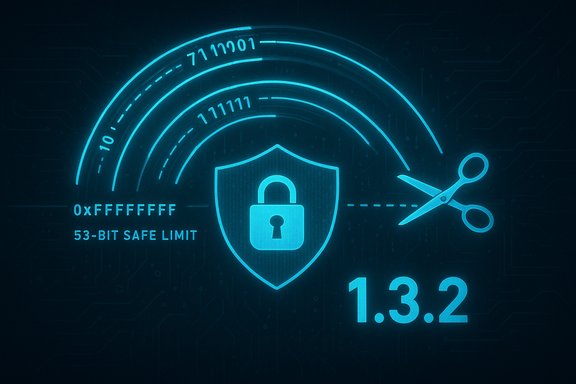
The node-forge maintainers applied a surgical patch that adds explicit validation thresholds:- When converting text OID components into DER, the library now throws an error if a parsed OID numeric arc would exceed 0xFFFFFFFF (32 bits).
- While decoding DER-encoded arcs, the library checks the running accumulator before shifting; if the accumulator would exceed Number.MAX_SAFE_INTEGER territory after a 7-bit shift, the parser throws an error (the fix bounds DER-decoded values to a safe 53-bit limit appropriate for IEEE-754 numbers).
Impact analysis: What can an attacker do?
- Spoofing OIDs — The primary impact is integrity degradation: an attacker who can feed a target application a crafted DER structure (for example, a certificate, a signed attribute, or an ASN.1-encoded object in a protocol message) may make the node-forge parser report a different OID than the one encoded mathematically in the DER. If the application uses OID equality or canonical OID values to make security decisions (e.g., "is this certificate using algorithm X?" or "does this extension match the allowed list?"), those checks can be bypassed.
- Downstream bypass — The real-world consequence depends on how the consuming application uses OIDs. Applications that perform strict algorithm OID matching for signature verification, client certificate acceptance, or attribute whitelisting are at highest risk. In some scenarios, a malformed OID might be interpreted as a standard OID (for example an encryption or signature algorithm OID) and cause the application to treat malicious data as legitimate.
- Remote and unauthenticated vector — In many deployments node-forge runs in server-side or client-side JavaScript contexts. If an attacker can submit or manipulate ASN.1-encoded inputs (certificates, signed metadata, or protocol messages) that are parsed by node-forge, the vector can be remote and require no privileges. Public trackers flag the attack vector as network-accessible and requiring present attack conditions but no privileges.
- The vulnerability does not directly leak private keys or cause memory-corruption primitives (it’s not a classic buffer-overflow leading to remote code execution). Its primary power is semantic spoofing — convincing a trusting piece of code that an OID is the one it expects when it is not.
- Exploitation requires the ability to have the target parse attacker-controlled ASN.1 data. Many hardened stacks validate certificates and OIDs at different layers or use native cryptographic libraries (OpenSSL, platform TLS stacks, or WebCrypto) rather than node-forge, which reduces practical exposure in some contexts.
- There is no widely published proof-of-concept exploit or active in-the-wild weaponization tied to CVE-2025-66030 at the time of public advisories; trackers show a low EPSS / low short-term exploitation probability. That absence reduces immediate urgency for some environments but does not remove the correctness flaw or the potential for targeted abuse.
Verification and cross-checking
Multiple independent sources report and corroborate the vulnerability and the fix:- The node-forge repository advisory and changelog entry documenting the issue and patched release (1.3.2) and the concrete commit that adds upper-bound checks to the ASN.1 OID code.
- Public vulnerability databases (NVD, OSV, Debian security-tracker mirrors) list CVE-2025-66030, summarize the vulnerability as ASN.1 OID integer truncation, and record the fixed release as 1.3.2. These sources align on the CWE classification (CWE‑190) and CVSS characterization.
- There is no authoritative public proof-of-concept demonstrating a practical end-to-end bypass of a specific deployed product using node-forge. Any claim that CVE-2025-66030 has been weaponized in the wild should be treated with caution until telemetry or incident reports confirm exploitation.
Who should worry and why: deployment risk matrix
- High priority (patch immediately)
- Services and daemons that parse externally supplied certificates or signed ASN.1 objects using node-forge (e.g., custom TLS endpoints, some S/MIME or code-signing tooling).
- Client- or server-side code that makes critical trust decisions based solely on OID equality from node-forge-parsed data.
- Gateways and proxies that use node-forge in TLS termination, certificate validation, or policy enforcement.
- Medium priority
- Internal tools that process certificates or ASN.1 entries but are behind trusted network boundaries.
- Developer and CI tooling that uses node-forge for test fixtures; these are lower operational risk but can implicate build artifacts.
- Lower priority
- Applications that use system-native TLS stacks (OpenSSL, SChannel, Secure Transport, WebCrypto) for certificate parsing and validation; node-forge may still be used elsewhere in those apps, but the critical certificate-parsing path may not be affected.
Recommended remediation steps (practical playbook)
Apply the short checklist below to reduce risk quickly and verify remediation.- Immediate action (0–24 hours)
- Upgrade dependency: Update node-forge to version 1.3.2 (or later) in all projects that list it directly. This is the definitive fix released by the maintainers.
- Rebuild and redeploy: For services that bundle node-forge (npm, yarn, pnpm), rebuild artifacts and redeploy. For container images, rebuild the image and redeploy to all environments.
- Scan dependencies: Use SCA tools (npm audit, OSS scanning, or enterprise SCA) to find indirect, transitive usages of node-forge in your supply chain. Many projects include node-forge transitively via other packages—identify and remediate those too.
- Verification (24–72 hours)
- Confirm patched code: Run
npm ls node-forgeor examine lockfiles (package-lock.json / yarn.lock) to confirm every runtime includes node-forge 1.3.2+. Use your CI or artifact repository to assert the version. - Unit tests: Where your code performs OID-based decisions, add or run unit tests that exercise unusual OID lengths and verify that the patched library rejects oversized OID arcs (the library now throws on values above the configured thresholds).
- Runtime checks: If feasible, instrument certificate-parsing paths to log unexpected OID values and rejection events for a short monitoring window after deployment.
- Compensations if immediate patching is impossible
- Restrict input surface: Limit which clients can submit certificates or ASN.1 payloads. Enforce strict ACLs and front the service with a more robust TLS terminator if possible.
- Application-level validation: Add explicit checks in your application to validate OIDs against an allow-list before trusting them, rejecting any OID values that fall outside expected numeric ranges or known canonical strings.
- Use native stacks: Where practical, move PKI validation to platform TLS libraries (OpenSSL, platform crypto) or a hardened service that does not depend on node-forge for critical certificate verification.
- Longer-term hardening
- Dependency hygiene: Adopt SBOMs and continuous SCA monitoring to catch transitive dependencies proactively.
- Defensive coding: Avoid relying solely on library-parsed OIDs for high-value trust decisions; implement canonicalization and allow-lists at the application layer.
- Vendor engagement: For appliances and third-party products that embed node-forge, request vendor firmware updates or mitigation guidance and track those vendor timelines in asset inventories.
Detection and hunting guidance
If you need to hunt for indicators of attempted exploitation or exposure:- Search logs for crashes, parse errors, or exceptions coming from node-forge’s ASN.1 routines; the patched code throws explicit errors for oversized OIDs—applications logging these thrown messages can reveal attempted abuse.
- Use SCA outputs to find images, containers, or hosts that have not been rebuilt since the release of node-forge 1.3.2.
- In environments that accept client certificate uploads, examine incoming certificates for unusually large OID arcs or DER sequences with extremely long OID encoding sequences—these are anomalous and worth preserving for forensic analysis.
- Monitor for unusual certificate chains or signed metadata that rely on non-standard OIDs; an attacker trying to exploit the bug will likely supply OIDs that are mathematically extreme but decode to canonical small OIDs under truncation.
Why this matters to Windows and Node.js operators
Even moderate-severity crypto implementation bugs matter because trust decisions are binary—a single misread OID can change a “deny” into an unexpected “allow.” Many Node.js applications (including API gateways, custom PKI tooling, and certain browser/Electron-based clients) rely on libraries like node-forge for portable, JavaScript-native cryptographic processing. If your application examines OIDs produced by node-forge to permit algorithms, accept certificates, or validate signed attributes, CVE-2025-66030 is material. Apply the recommended updates and use supply-chain controls to ensure transitive use cases are addressed.Rapid playbook (prioritized checklist)
- Update projects: bump node-forge to 1.3.2 and rebuild artifacts across dev, CI, staging, and production.
- Scan the inventory: run
npm ls node-forgeacross repos and container images; prioritize externally facing services and any service that validates certificates or OID-based policy. - Compensate: if you cannot patch immediately, restrict certificate submission endpoints, and add application-level OID allow-lists.
- Verify: deploy and run tests that assert the parser rejects oversized OIDs; monitor logs for the new error messages introduced by the patch.
- Track vendors: request firmware and package updates from appliance vendors and distribution maintainers; maintain a remediation timeline for vendor-supplied images.
Final assessment and risk summary
CVE-2025-66030 is a concrete, correctness weakness in node-forge’s ASN.1 handling that permits semantic spoofing of Object Identifiers via integer truncation. The maintainers released a minimal, well-scoped fix in node-forge 1.3.2 that adds explicit size checks for parsed OID values and DER-decoded accumulators; operators should treat the fix as authoritative and apply it promptly where node-forge is used in trust-sensitive code paths. The immediate operational risk is moderate: the vulnerability can be triggered remotely when an attacker can control ASN.1 inputs, but practical exploitation requires specific application-level conditions to result in a meaningful security bypass. The long tail risk—embedded devices, vendor appliances, and transitive packages—is real and should drive inventory and vendor engagement work. Organizations with certificate-based authentication, custom TLS handling in Node.js, or OID-dependent policy enforcement should prioritize remediation and monitoring.Apply the patch, confirm versions, and treat OID parsing as a policy boundary—defend that boundary in multiple layers.
Source: MSRC Security Update Guide - Microsoft Security Response Center
