

A recently assigned CVE — CVE-2025-68264 — targets the Linux kernel’s ext4 filesystem and documents a race-condition bug that can let stale inline-data size metadata lead to a kernel BUG_ON crash during writes to tiny “inline” files, prompting immediate patching across kernel trees and distribution kernels.
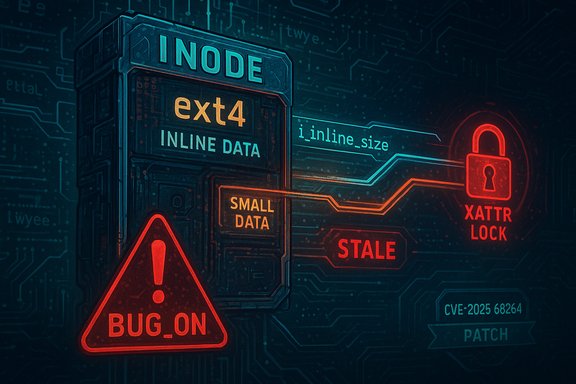
The ext4 filesystem includes an optimization called inline data, where very small files (or small directory entries) are stored directly inside the inode rather than in separate data blocks. That optimization reduces I/O and saves space for tiny files, but it depends on correct metadata values such as i_inline_off and i_inline_size to describe how much inline storage is actually available in the inode. The Linux kernel documentation describes the inline-data feature and its constraints in detail. CVE-2025-68264 is the formal identifier for a subtle race in the ext4 inline-data code: an initial size check reads the current inline capacity, but concurrent extended-attribute (xattr) operations can change the inode’s inline capacity before the write path acquires the xattr lock, causing subsequent functions to operate on stale i_inline_size. When a write proceeds under those stale assumptions, a guard in the code (BUG_ON) can be triggered, crashing the kernel. The kernel community accepted and applied a targeted patch that recalculates the inline size immediately after acquiring the xattr semaphore to ensure the write path validates against the current capacity.
The ext4 inline-data optimization continues to deliver real-world benefits, but as CVE-2025-68264 demonstrates, compact metadata structures combined with concurrent operations create fragile invariants that must be protected by careful synchronization. The Linux community’s rapid, minimal fix and the fast mapping of the patch into distribution and vendor trackers show the ecosystem is functioning: review, patch, reboot. For mixed Windows-Linux environments — especially WSL2 users — this advisory is a timely reminder that kernel-level vulnerabilities in Linux also matter on Windows platforms that ship or use Linux kernels, and that keeping both host and subsystem kernels current is essential to maintaining stability and security.
Source: MSRC Security Update Guide - Microsoft Security Response Center
 Background / Overview
The ext4 filesystem includes an optimization called inline data, where very small files (or small directory entries) are stored directly inside the inode rather than in separate data blocks. That optimization reduces I/O and saves space for tiny files, but it depends on correct metadata values such as i_inline_off and i_inline_size to describe how much inline storage is actually available in the inode. The Linux kernel documentation describes the inline-data feature and its constraints in detail. CVE-2025-68264 is the formal identifier for a subtle race in the ext4 inline-data code: an initial size check reads the current inline capacity, but concurrent extended-attribute (xattr) operations can change the inode’s inline capacity before the write path acquires the xattr lock, causing subsequent functions to operate on stale i_inline_size. When a write proceeds under those stale assumptions, a guard in the code (BUG_ON) can be triggered, crashing the kernel. The kernel community accepted and applied a targeted patch that recalculates the inline size immediately after acquiring the xattr semaphore to ensure the write path validates against the current capacity. What the bug is — technical anatomy
The core problem
- The ext4 code path that decides whether a small write can be handled inside an inode first calls ext4_get_max_inline_size to read the current inline capacity (i_inline_size).
- That check can pass (i.e., the write appears to fit), but before the path acquires ext4_write_lock_xattr a concurrent thread can add or change xattrs, altering i_inline_size downward.
- After acquiring the lock, ext4_update_inline_data or ext4_create_inline_data proceed using the previously cached, now-stale i_inline_size.
- If the actual capacity is now smaller than the original check assumed, the write can exceed the real inline storage, triggering a BUG_ON defensive check and crashing the kernel.
Why this matters in practice
Kernel BUG/BUG_ON paths are not graceful failures — they indicate a state the kernel author considered impossible, and when hit they typically cause an oops/panic. On a production machine this means an immediate system crash or at least a hung kernel thread and potential filesystem instability or data loss. The problem is especially dangerous because it occurs under a realistic concurrency pattern: simultaneous file writes and xattr updates, which are not exotic operations. The issue was flagged by automated kernel fuzzing and testing infrastructure (syzbot) and then addressed by a minimal code change to recompute inline size under the lock.Timeline and disclosure
- The bug and a corrective patch were discussed on the kernel mailing lists and submitted as a small patch that recalculates inline capacity under the xattr semaphore. The patch author and reviewers documented the race window and rationale for the fix.
- The patch was accepted and applied to upstream kernel trees with commit id reported in the mail threads; maintainers marked the fix for stable backports.
- CVE-2025-68264 was assigned and published in vulnerability databases (NVD, OSV, various vendor trackers) on December 16, 2025, with distribution trackers listing affected and fixed package versions.
Scope and affected systems
What code is actually vulnerable
- The flaw appears in the ext4 inline-data write path in the Linux kernel. Any kernel that includes the vulnerable ext4 code path prior to the applied patch is affected. The fix is compact — it recomputes inline size with ext4_find_inline_data_nolock immediately after acquiring the xattr semaphore — but until that fix is present the race persists.
Which distributions and packages are impacted
- Distribution security trackers quickly mapped the commit to distro kernel packages. For example, Debian’s tracker shows that many stable and long-term kernels were initially vulnerable and lists the unstable kernel package 6.17.12-1 (sid) as the first fixed packaging. Administrators should consult their distribution's security advisory for precise package versions and backports.
- SUSE and other vendors have created CVE pages indicating they are analyzing and preparing updates. Expect vendor kernel packages and security advisories to be published in the days following the upstream commit.
Who is at risk
- Any system running a vulnerable Linux kernel with ext4 mounted filesystems that make use of inline data can be impacted. The most obvious risk is local users or processes that can exercise concurrent writes and xattr updates on an inline-data inode.
- Virtualized environments that present ext4 to guests (including WSL2 on Windows, which runs a Linux kernel instance inside a lightweight VM), cloud images, containers using host kernels, and physical Linux machines are all within scope if their kernel lacks the fix. WSL2 uses a real Linux kernel provided by Microsoft/WSL distribution, so WSL2 instances inherit kernel-level vulnerabilities unless Microsoft’s WSL kernel builds are updated.
Practical impact: crash, data integrity, and exploitability
- Primary impact: denial of service / kernel crash. The BUG_ON path is designed to halt or crash when invariants are violated; attackers or buggy applications can trigger crashes by exercising the race. This is a local crash vector and not a remote code-execution primitive by design — it results in instability rather than privilege escalation alone.
- Secondary risk: potential data corruption. While the patch and advisory focus on preventing the BUG_ON, races that lead to out-of-bounds writes or inconsistent inline layout can, in the real world, cause corruption of small files, their xattrs, or neighboring inode contents. Because inline data sits physically inside the inode, a miswrite is particularly unpleasant to recover.
- Exploitability: there are no public reports or reliable indicators that CVE-2025-68264 has been weaponized in the wild. Public trackers currently show no EPSS score or exploitation reports as of the CVE publication snapshot; that status can change and should be monitored. Absence of proof is not proof of absence — administrators should patch promptly because race and crash bugs are often leveraged to create denial-of-service conditions and sometimes chained with other vulnerabilities to escalate impact.
The patch and why it’s a reasonable fix
The fix is narrow and conservative: after acquiring the xattr semaphore that protects inline metadata, the code calls ext4_find_inline_data_nolock to recalculate i_inline_size in the synchronized context. This ensures the write path validates against the current inline capacity rather than an earlier cached value. The Linux ext4 maintainers reviewed and accepted the patch, and it has been merged into the upstream trees and proposed for stable backports. The developers note the change mirrors a previous fix that addressed i_inline_off staleness, which gives confidence that the approach fits ext4’s concurrency model. Strengths of the fix:- Minimal surface area — a deliberate recomputation under lock avoids broader locking changes that would increase complexity or reduce performance.
- Matches prior fixes and patterns in ext4 code, suggesting correctness-by-analogy.
- Enables stable backporting: small, reviewable patches are more likely to land in LTS kernels quickly.
- The recomputation is done under the xattr semaphore; while that is correct for consistency, it slightly tightens the lock window and could marginally affect concurrent xattr-heavy workloads.
- Race bugs are tricky; similar-but-different edge cases may exist elsewhere in inline code paths; additional auditing and fuzzing are prudent. Automated fuzzers (syzbot) already reported related inline-data conditions, pointing to the class of fragility in inline features.
Recommendations for administrators and Windows users
Whether you run Linux natively, host Linux VMs, or use Windows with WSL, the following steps will help mitigate risk and limit exposure.1. Identify kernel versions and affected systems
- On Linux hosts and VMs, run:
- uname -r
- rpm -q kernel (RHEL-like) or apt policy linux-image-* (Debian/Ubuntu) to determine the installed kernel package and whether it matches fixed package versions from your vendor.
- For WSL2 on Windows:
- Use wsl --status and wsl --update --status to see the WSL kernel version. WSL receives kernel updates via the Store or via wsl --update, and Microsoft documents the update commands for WSL. If a shipped WSL kernel is vulnerable, Microsoft is likely to push an updated package; apply it.
2. Patch vendor kernels immediately
- Follow your distribution vendor’s security advisory for kernel package updates — this is the most reliable remediation path.
- If you run vendor-provided kernels in cloud images or appliances, check the vendor’s security feed; many vendors have already placed the commit into their stable kernel packages or are assessing the necessary backports.
3. For Windows + WSL users
- If you use WSL2, run:
- wsl --update
- wsl --shutdown
- Restart WSL or your system to ensure the new kernel is active. Microsoft’s WSL documentation explains the update flow and the wsl --update command. If your environment uses an internally managed WSL kernel (enterprise scenarios), coordinate with IT to push the updated kernel to clients.
4. If immediate patching is not possible — mitigations
- Reduce local-exploit risk by limiting untrusted local access and reducing the number of users/processes that can create concurrent xattr modifications and inline writes on sensitive hosts.
- Implement process isolation and strict access controls for untrusted applications. Because the vector requires performing filesystem operations on inline-data inodes, limiting who can create such files reduces attack surface.
- Monitor system logs for kernel oops, BUG_ON messages referencing fs/ext4/inline.c or ext4_write_inline_data — such logs indicate the bug has been triggered.
Detection and hunting guidance
- Kernel oops/panic: Look in system dmesg, journalctl, and crash dumps for messages like “kernel BUG at fs/ext4/inline.c” or backtraces showing ext4_write_inline_data and BUG_ON at the inline.c guard. These are high-fidelity indicators.
- Fuzzing hits: syzbot and automated fuzzers flagged related inline-data issues in the past; if you operate a kernel-fuzzing or regression-testing pipeline, add targeted tests that exercise concurrent inline writes and xattr updates to validate your kernels.
Wider analysis: filesystem features and risk trade-offs
Inline data is a performance and space optimization that packs small file contents into inode structures. That optimization is attractive but inherently brittle: it compresses multiple roles (data storage and extended attributes) into shared inode fields, and concurrency or layout invariants are subtle. The CVE highlights a broader engineering theme:- Optimizations that increase code complexity require rigorous concurrency reasoning and aggressive fuzz/coverage testing.
- Small, local races that appear benign (a late size check) can manifest as defensive guards and produce crashes or corruption.
- The kernel community’s response — small, surgical fixes and backports — remains the correct model for addressing these problems quickly while minimizing unintended side effects.
Final verdict — what readers should take away
- CVE-2025-68264 is a local ext4 race that can trigger kernel BUGs and potential data issues when inline-data inode capacity becomes stale due to concurrent xattr changes. The issue was identified, a minimal fix was developed, and the patch has been applied upstream and marked for stable backports.
- Administrators should prioritize installing vendor kernel updates and WSL kernel updates where applicable; the correct mitigations are vendor patches rather than workarounds. Distribution trackers and vendor advisories (Debian, SUSE, etc. already map the fix to kernel package versions — consult those advisories for exact package names and fixed-version numbers.
- There are no confirmed reports of exploitation in the wild at the time of publication, but the bug is straightforward to trigger with local access and can cause system crashes. Given the potential for denial-of-service and the non-zero risk of data corruption, apply patches as soon as they become available in your environment.
Quick checklist for administrators (actionable steps)
- Check kernel version:
- uname -r
- Check distribution advisories and security trackers for fixed kernel package names and versions (e.g., Debian’s tracker shows a 6.17.12-1 fix in unstable).
- Patch kernels and reboot systems (reboot required to load new kernel).
- For WSL2 users: run wsl --update; then wsl --shutdown and restart WSL instances.
- Monitor dmesg/journalctl for ext4 BUG_ON crashes and implement forensic capture if any oops occurs.
The ext4 inline-data optimization continues to deliver real-world benefits, but as CVE-2025-68264 demonstrates, compact metadata structures combined with concurrent operations create fragile invariants that must be protected by careful synchronization. The Linux community’s rapid, minimal fix and the fast mapping of the patch into distribution and vendor trackers show the ecosystem is functioning: review, patch, reboot. For mixed Windows-Linux environments — especially WSL2 users — this advisory is a timely reminder that kernel-level vulnerabilities in Linux also matter on Windows platforms that ship or use Linux kernels, and that keeping both host and subsystem kernels current is essential to maintaining stability and security.
Source: MSRC Security Update Guide - Microsoft Security Response Center
