

A targeted NULL‑check omission in the Linux kernel’s AMD display driver has been cataloged as CVE‑2025‑68286 and patched upstream — but the operational impact, exposure model, and the path to mitigation deserve careful attention from desktop users, cloud operators, and embedded vendors alike.
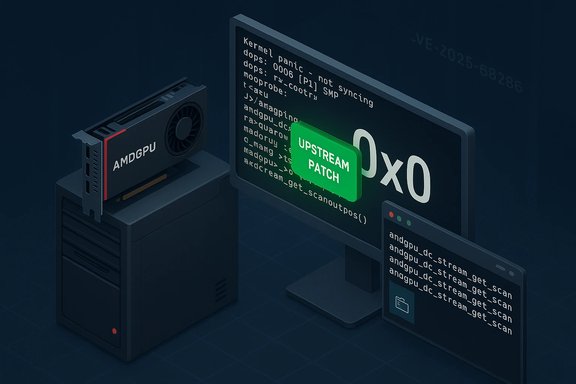
The vulnerability affects the Linux kernel’s Direct Rendering Manager (DRM) AMDGPU display stack — specifically code under drivers/gpu/drm/amd/display — where a pointer used to represent display state or per‑ASIC callbacks can be dereferenced before the code confirms it is non‑NULL. When that happens in kernel context the result is a deterministic kernel NULL‑pointer dereference (an oops) that crashes the graphics driver or the whole kernel, producing a denial‑of‑service for affected systems. This pattern and the fixed behavior are documented across multiple vendor and community trackers and reflected in public advisories. The public description attached to CVE‑2025‑68286 notes a reproducible crash observed while running a DRM test scenario (IGT kms_cursor_legacy long-nonblocking-modeset-vs-cursor-atomic) with eDP and DP displays attached; the stack trace shows a kernel oops in a DRM/AMDGPU function such as dc_stream_get_scanoutpos or related code paths. Upstream kernel maintainers addressed the root cause by adding an early NULL check at the use site so the code returns a safe error path instead of dereferencing 0x0.
Recommended remediation playbook:
Source: MSRC Security Update Guide - Microsoft Security Response Center
 Background / Overview
The vulnerability affects the Linux kernel’s Direct Rendering Manager (DRM) AMDGPU display stack — specifically code under drivers/gpu/drm/amd/display — where a pointer used to represent display state or per‑ASIC callbacks can be dereferenced before the code confirms it is non‑NULL. When that happens in kernel context the result is a deterministic kernel NULL‑pointer dereference (an oops) that crashes the graphics driver or the whole kernel, producing a denial‑of‑service for affected systems. This pattern and the fixed behavior are documented across multiple vendor and community trackers and reflected in public advisories. The public description attached to CVE‑2025‑68286 notes a reproducible crash observed while running a DRM test scenario (IGT kms_cursor_legacy long-nonblocking-modeset-vs-cursor-atomic) with eDP and DP displays attached; the stack trace shows a kernel oops in a DRM/AMDGPU function such as dc_stream_get_scanoutpos or related code paths. Upstream kernel maintainers addressed the root cause by adding an early NULL check at the use site so the code returns a safe error path instead of dereferencing 0x0. Why this matters: kernel NULL dereferences are availability bugs, not mystery exploits
A NULL pointer dereference in userland typically terminates a single process. In kernelland, however, dereferencing a NULL pointer is an availability‑critical failure: it can cause a driver oops, module reset, session loss for desktop users, or even a full kernel panic requiring a reboot. For the AMDGPU driver — which frequently handles compositor calls, video playback, and debugfs reads — that means a trivial local operation can be converted into a reproducible outage on an unpatched host. Public trackers consistently frame CVE‑2025‑68286 as a local (AV:L), low‑complexity issue with an availability impact — often classed as Medium severity in vendor advisories. Operationally, the highest‑risk systems are those that expose GPU device nodes (/dev/dri/*) or debugfs interfaces to untrusted users or untrusted container workloads, and hosts that allow GPU passthrough to tenants (CI runners, VDI, cloud GPU instances). Embedded appliances and vendor kernels also present a long‑tail risk because vendor trees often lag upstream and may not receive timely backports.Technical anatomy — what went wrong and how the patch fixes it
The faulty pattern
The vulnerability follows a common kernel pattern: code reads a pointer from driver state (for example, a per‑pipe or per‑ASIC function table or a stream_status object) and then uses fields or calls through that pointer without performing a fresh validity check at the point of use. In the affected AMD display code the first dereference occurs earlier than the subsequent null check, so if the pointer is legitimately NULL in a particular topology or runtime state the kernel dereferences 0x0 and crashes. Examples cited in the patch metadata include functions such as dc_stream_get_scanoutpos, resource_log_pipe_topology_update, and DTN color/logging paths that touch per‑ASIC callback tables.Real reproduction traces
Public reproductions and advisory snippets include full oops traces showing supervisor read access faults at address 0x0 inside amdgpu symbols, for example a crash in dc_stream_get_scanoutpos when exercising IGT kms_cursor_legacy tests or when reading debugfs entries such as /sys/kernel/debug/dri/0/amdgpu_dm_dtn_log. These reproductions are valuable because they establish the bug’s determinism: once the vulnerable code path is hit with a missing pointer, the crash is reliable.The fix: minimal, surgical defensive checks
Upstream maintainers applied a small, surgical remediation: add an explicit NULL check (or reorder logic) so the code does not access pointer members before verifying the pointer is non‑NULL. That converts an uncontrolled kernel fault into a controlled error return or a skip path. Kernel maintainers prefer this defensive approach because it is low risk, easy to test across hardware topologies, and simple to backport into stable branches. The changes are typically one or two lines at the use site and are designed to preserve behavior on hardware that implements the expected callbacks.Scope, affected systems and exposure model
- Affected component: Linux kernel DRM/AMDGPU display subsystem (drivers/gpu/drm/amd/display), DC/DCN related code paths.
- Typical exposure: Desktop and laptop systems with AMD GPUs where DRM device nodes are accessible to unprivileged users; systems with amdgpu module loaded.
- High‑priority exposure: Multi‑tenant servers, CI runners, VDI hosts, and cloud instances that expose GPUs via passthrough or device bind mounts to untrusted workloads — because these environments can be trivially abused to trigger a local crash primitive.
- Long‑tail risk: Embedded devices, appliances, or OEM kernels that lag upstream and may not receive immediate backports.
Attack prerequisites, complexity and practical exploitability
- Attack vector: local only. An attacker needs to run code on the target host or have a process that can exercise DRM ioctls or compositor-driven code paths.
- Privileges: often low. On many desktop installations unprivileged users can indirectly reach the DRM stack through compositors, media players, and sandboxed runtimes. On hardened servers where /dev/dri is restricted, the attack surface is much smaller.
- Complexity: low. The crash is deterministic once the vulnerable path is executed with the NULL condition present. That makes the vulnerability a reliable denial‑of‑service primitive for local attackers.
Detection: what to look for in logs and monitoring
When this class of bug is triggered it typically leaves highly diagnostic artifacts in kernel logs:- Kernel oops messages in dmesg or journalctl that mention amdgpu symbols and show a NULL pointer dereference (instructions fetching from 0x0).
- Call traces that include functions like dc_stream_get_scanoutpos, dm_crtc_get_scanoutpos, amdgpu_display_get_crtc_scanoutpos, or DTN/dcn log frames.
- Repeated compositor crashes, Wayland/Xwayland session terminations, pageflip timeouts, or amdgpu reset watchdog entries in the kernel log correlated with display operations.
- Alerts for kernel messages containing "amdgpu" AND "NULL pointer" OR "Oops" OR "kernel NULL pointer dereference".
- Correlation rules linking kernel oops traces to users, containers, or VMs that had active GPU workloads around the time of the oops.
Remediation and mitigation — immediate steps
The only definitive fix is to install supplier kernel updates that include the upstream remedial commit and reboot into the patched kernel. Kernel-level changes require a reboot for the new code to take effect.Recommended remediation playbook:
- Inventory:
- Confirm running kernel: uname -r.
- Confirm AMD driver presence: lsmod | grep amdgpu.
- Confirm /dev/dri presence and permissions: ls -l /dev/dri/*.
- Consult vendor/distro security advisories or package changelogs to identify kernel packages that include the fix.
- Patch:
- Install the vendor/distribution kernel package update that incorporates the upstream patch (check changelog for the stable commit ID or the CVE).
- Reboot into the patched kernel.
- Validate:
- Smoke test representative display scenarios (hot‑plug, MST hubs, fullscreen media transitions) in a staging environment and monitor logs for oopses over a representative window (24–72 hours recommended).
- Compensating controls when immediate patching is impossible:
- Restrict access to DRM device nodes: update udev rules or group membership so only trusted users or groups can read/write /dev/dri/*.
- Avoid mounting /dev/dri into untrusted containers and avoid GPU passthrough for untrusted guests.
- Harden container capabilities and drop privileges that could reach DRM ioctls.
- Increase kernel log monitoring for amdgpu oops and pageflip timeouts. These are stopgaps — they reduce exposure but do not remove the underlying vulnerability.
Enterprise and cloud considerations
- Multi‑tenant environments (CI, VDI, GPU cloud): treat this as high priority. An untrusted tenant or CI workload can weaponize the crash primitive to disrupt co‑tenants. Apply kernel updates or restrict GPU exposure before allowing untrusted workloads.
- Embedded fleets and vendor kernels: coordinate with hardware vendors for backports and OTA rollouts. Vendors sometimes lag upstream, so plan long‑tail remediation and maintain compensating controls for devices that cannot be patched quickly.
- Microsoft / Azure context: Microsoft’s Security Update Guide lists CVE‑2025‑68286 and Microsoft has published attestation for some Azure Linux images; however, artifact inventories vary and you must verify each image/offer. Until vendors declare specific artifacts Not Affected or Fixed, assume potential carrier status and confirm package versions on your images. This is especially important for marketplace images and curated Azure images that may bundle specific kernel builds.
Verification checklist — how to ensure your hosts are fixed
- After applying vendor kernel updates, reboot the host and verify the kernel version matches the patched package version in your vendor advisory.
- Reproduce representative display operations and monitor dmesg/journalctl for any amdgpu oops frames for a sustained validation window.
- If you build custom kernels, cherry‑pick the upstream commit that implements the null check into your tree, rebuild, and run the same smoke tests across your hardware matrix.
- For images and appliances, inspect /lib/modules and kernel module lists to confirm the amdgpu driver installed corresponds to the patched kernel build.
Risk analysis — strengths of the fix and residual risks
Notable strengths
- The upstream remediation is small and surgical, minimizing regression risk in a notoriously complex code area (display sequencing and hardware state transitions). That makes the patch well suited to backporting and rapid distribution.
- The fix directly eliminates a deterministic crash primitive — an immediate operational improvement for exposed multi‑tenant systems.
Residual risks and caveats
- The vulnerability class (forward‑null usage across complex control flows) is common in graphics stacks; other, similar patterns may exist elsewhere in the same driver and require separate fixes. Relying on a single CVE closure does not guarantee no other FORWARD_NULL findings remain. Static analysis has historically identified multiple adjacent defects in drm/amd/display that were fixed over several commits.
- Vendor and distribution backporting cadence varies. Embedded and OEM kernels are especially susceptible to long‑tail exposure. Maintain inventories and verify each vendor’s package mapping to the upstream commit.
- Monitoring and SIEM detection are effective but reactive. An attacker with local access can already trigger the crash — therefore, compensating controls are reducing likelihood but not eliminating the risk. Patch deployment remains the only comprehensive remediation.
Practical hardening checklist (quick actions)
- Prioritize patching for:
- Shared CI / build runners that expose GPUs.
- VDI and terminal servers with GPU acceleration.
- Cloud GPU instances used by multiple tenants.
- Short‑term mitigations:
- Restrict /dev/dri device node access with udev rules.
- Avoid mounting /dev/dri into containers unless necessary.
- Disable GPU passthrough for untrusted guests.
- Monitoring:
- Add SIEM rules for kernel oops traces pointing to amdgpu/DCN/DTN functions.
- Capture and preserve dmesg and kdump artifacts for any suspected incidents.
- Dev/Ops:
- For fleets that run GPU workloads, add post‑patch regression tests that exercise display hot‑plug, MST hubs, and media playback transitions.
Conclusion and actionable summary
CVE‑2025‑68286 is a defensively patched NULL‑check omission in the Linux DRM/AMDGPU display stack that produced deterministic kernel NULL dereferences when specific display code paths were exercised. The upstream fix is intentionally minimal — an early null check at the point of use — and is suitable for stable backports. Operators should treat this as an availability‑focused risk: patch and reboot affected kernels as the primary remediation, prioritize multi‑tenant and cloud GPU hosts, and apply compensating controls (restrict /dev/dri, limit GPU passthrough) for systems that cannot be immediately updated. Confirm vendor package changelogs or artifact attestations when mapping the upstream commit to your deployed kernels; do not rely on generic dates or assumptions about distribution patching cadence. Immediate takeaways:- Inventory hosts with amdgpu loaded and /dev/dri accessible.
- Install vendor kernel updates that include the fix and reboot.
- If you cannot patch immediately, restrict device access and tighten container policies.
Source: MSRC Security Update Guide - Microsoft Security Response Center
