A kernel-level bug in the Linux BPF helper bpf_skb_check_mtu recently received a formal CVE (CVE-2025-68363) after maintainers landed a targeted fix: the helper assumed skb->transport_header was always valid when the BPF_MTU_CHK_SEGS flag was used, but that field can be unset in some paths — causing WARNs and potential failures when GSO skbs are validated. The issue was patched by explicitly checking whether the transport header was set (using skb_transport_header_was_set before using skb->transport_header; testcases were added and the CVE was assigned and published by vulnerability databases in late December 2025.
The Linux kernel’s BPF subsystem exposes helpers that allow in-kernel programs to inspect and manipulate sk_buffs (skbs) during packet processing. One such helper, bpf_skb_check_mtu, is used to determine whether a (possibly GSO) skb would fit a given MTU when segmented — a check that’s essential for correct offload handling and for BPF programs that make MTU-aware decisions.
When called with the BPF_MTU_CHK_SEGS flag, the helper must examine network/transport header lengths to validate that segments produced by offload splitting will be within limits. In certain code paths the skb’s transport header pointer is not initialized or is intentionally left unset; if the helper assumes it is valid, downstream validation (notably skb_gso_validate_network_len) can trigger kernel WARNs or unexpected return paths. The kernel patch that closed CVE-2025-68363 added an explicit test for whether the transport header was set and returns -EINVAL when it is not, avoiding an unsafe dereference.
The kernel maintainers addressed the bug with a focused guard and added tests to ensure the helper behaves predictably even as the kernel networking receive paths evolve; administrators should treat this as a routine but necessary kernel update and apply vendor fixes promptly to avoid avoidable availability incidents.
Source: MSRC Security Update Guide - Microsoft Security Response Center
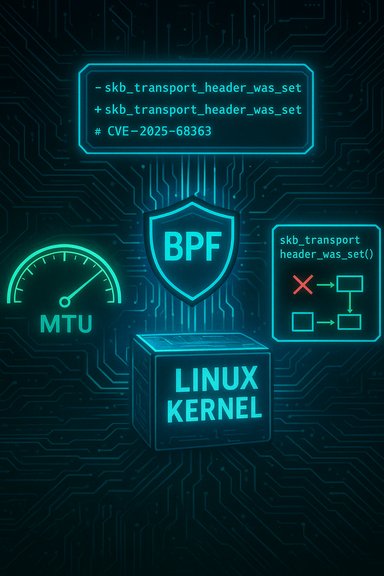 Background / Overview
The Linux kernel’s BPF subsystem exposes helpers that allow in-kernel programs to inspect and manipulate sk_buffs (skbs) during packet processing. One such helper, bpf_skb_check_mtu, is used to determine whether a (possibly GSO) skb would fit a given MTU when segmented — a check that’s essential for correct offload handling and for BPF programs that make MTU-aware decisions.When called with the BPF_MTU_CHK_SEGS flag, the helper must examine network/transport header lengths to validate that segments produced by offload splitting will be within limits. In certain code paths the skb’s transport header pointer is not initialized or is intentionally left unset; if the helper assumes it is valid, downstream validation (notably skb_gso_validate_network_len) can trigger kernel WARNs or unexpected return paths. The kernel patch that closed CVE-2025-68363 added an explicit test for whether the transport header was set and returns -EINVAL when it is not, avoiding an unsafe dereference.
What happened: the flaw in plain language
- The helper bpf_skb_check_mtu(skb, ifindex, &mtu_len, 0, BPF_MTU_CHK_SEGS) is intended to check whether a GSO skb will split into segments that each fit within an MTU.
- The check requires knowledge of transport-layer lengths; that implies relying on skb->transport_header.
- Some skb creation/handling code paths (including test harnesses used by bpf_prog_test_run) do not guarantee skb->transport_header is set.
- When the helper proceeded to validate using skb_gso_validate_network_len while transport_header was unset, a WARN_ON_ONCE was observed under CONFIG_DEBUG_NET and GSO-enabled test conditions, and the helper could behave incorrectly.
- The patch adds a guard that checks skb_transport_header_was_set(skb) immediately before using skb->transport_header and fails fast (-EINVAL) if not set; a selftest was added to ensure the behavior is enforced.
Technical analysis: why this is important for kernel and BPF users
The role of transport_header and GSO validation
Packets in the kernel are represented by struct sk_buff, which stores multiple header pointers (mac_header, network_header, transport_header). Helpers that validate how a GSO (Generic Segmentation Offload) skb will be split must know where the network and transport headers start, because segment sizes depend on L3/L4 header lengths as well as payload. The function skb_gso_validate_network_len(const struct sk_buff *skb, unsigned int mtu) performs that check and expects skb transport information to be valid. If transport_header is not set, validation is meaningless and may lead to out-of-bounds reads or WARNs in debug builds.The specific failure mode here
The hazardous path was not a classic remote code execution primitive; rather, it produced kernel WARNs (and returned unexpected errors to the caller) under a combination of conditions: GSO present (skb->gso_size non-zero), use of BPF_MTU_CHK_SEGS, and invocation by bpf_prog_test_run test scaffolding where the transport header was not initialized. The upstream discussion notes that for normal ingress SKBs the kernel performs skb_reset_transport_header, but planned or implemented changes in reception code (e.g., commit 2170a1f09148 described in the patch discussion) aim to avoid resetting transport_header in some receive paths — which makes this helper’s unchecked usage of transport_header brittle.The fix
The minimal and safe fix inserted by the maintainer is straightforward: check skb_transport_header_was_set(skb) immediately before using skb->transport_header and return -EINVAL if it is not set. This keeps existing BPF programs working for SKBs that do have the transport header set while avoiding an unsafe dereference in the cases that caused the WARN. The patch diff and the selftest addition were posted to the netdev mailing list and then merged toward bpf-next/stable. The exact patch snippet shows the new guard and the retained call to skb_gso_validate_network_len only after the guard passes.Severity, exploitability, and real-world impact
CVE score and classification
Vendor and distribution trackers list the issue as moderate/medium with a CVSSv3 base score of 5.5 (vector: AV:L/AC:L/PR:L/UI:N/S:U/C:N/I:N/A:H) — that is, local attack vector, low complexity, low privileges required (non-root BPF program execution can be relevant), and an availability impact (kernel WARNs/crashes) rather than confidentiality or integrity loss. The score and vector appear in multiple vendor advisories and distribution trackers.What an attacker (or misbehaving program) could do
- Trigger kernel WARNs or cause BPF programs to observe unexpected return codes when assuming successful MTU checks.
- In degenerate cases (depending on surrounding code paths), an unchecked assumption could lead to kernel messages or devices misbehaving, creating denial-of-service-style symptoms (availability impact), but not necessarily privilege escalation or remote code execution in the absence of additional bugs.
- The most obvious trigger vectors are local: crafted eBPF programs executed by users with BPF-load rights (privileged or unprivileged depending on sysctl/kernel config), selftests invoked by developers, or tools that call bpf_prog_test_run. There is no public evidence of remote exploitation in the wild at publication time. This should be treated as a reliability/availability bug rather than a high-value compromise avenue — but availability bugs in kernels running routers, gateways, or critical infrastructure can have significant practical impact.
How likely is exploitation?
- The attack is local in nature (CVSS AV:L). Many distributions default to unprivileged eBPF disabled, or otherwise restrict BPF loading to root/admins. Where unprivileged BPF is enabled, a local attacker could potentially exercise the problematic helper using a crafted program or a BPF test harness.
- Practical exploitation beyond causing WARNs or dropping BPF programs requires additional conditions and thus is less likely as a high-severity RCE chain on its own. Still, when the kernel acts up (WARNs, oops) in production network stacks, even a non-RCE issue may force reboots or degraded throughput — justify prompt patching in critical environments. Vendor trackers reflect a conservative medium/availability-focused severity for this reason.
Who is affected
- Any Linux kernel build that includes the BPF helper code path and ships with versions lacking the transport-header check is potentially affected. The upstream patch was introduced on the netdev/BPF side and targeted bpf-next/stable; NVD and downstream trackers consolidated the CVE and linked to the upstream change.
- Vendors and distributions that package kernels without the fix must release updates. At time of public CVE publication, several downstream trackers (Amazon Linux, SUSE, Debian) listed the CVE and indicated varying status for fixes or pending updates. Administrators running vendor kernels should check their vendor advisories and apply available kernel updates.
- Systems that allow unprivileged users to load and run eBPF programs (kernel.unprivileged_bpf_disabled set to 0) have a larger attack surface than systems that restrict BPF loading to administrators. Many enterprise distributions default to disabling unprivileged eBPF or provide sysctl knobs to control it.
Mitigation and hardening — practical, prioritized steps
The most robust mitigation is to apply the upstream patch (or the vendor-supplied kernel update) that implements the transport-header check. For administrators who cannot patch immediately, or who want to reduce risk while testing updates, the following layered measures reduce exposure.1) Install vendor kernel updates (primary, recommended)
- Check your distribution’s security advisories for CVE-2025-68363 and install available kernel updates as soon as vendors release them.
- After patching, reboot to ensure the running kernel includes the fixed helper code.
This is the correct fix because it addresses the root cause in the helper itself and is what upstream applied.
2) Restrict unprivileged BPF / reduce local attack surface (short- to medium-term)
- On systems where you do not require unprivileged users to load BPF programs, set:
- sysctl: sudo sysctl -w kernel.unprivileged_bpf_disabled=1
- or make it persistent by adding kernel.unprivileged_bpf_disabled = 1 to /etc/sysctl.d/99-disable-unprivileged-bpf.conf and running sudo sysctl --system.
- Distributions and kernel configs often provide a default to disable unprivileged BPF or a boot-time knob to tighten the default; consult your distro guidance. This reduces the number of local actors who can load test or crafted BPF programs.
3) Limit who can load BPF and audit BPF program loading
- Limit group membership and sudo capability for tools that load BPF.
- Monitor kernel logs and run-time BPF loading events; enforce code-review or signed-binary policies for BPF programs in production.
- Use tools such as bpftool and auditing frameworks to log and, when possible, restrict BPF program types and maps.
4) For developers and testers: avoid using bpf_prog_test_run on untrusted code with CONFIG_DEBUG_NET enabled
- The reproduction path described upstream involved the test-run helper and CONFIG_DEBUG_NET: if you are fuzzing or running test harnesses that exercise bpf_prog_test_run in debug kernels, be aware that an uninitialized transport header can produce WARNs. Prefer running webreliable kernel builds (non-debug) or add transport-header initialization in test scaffolding until you can apply the patch.
5) Apply network-level defenses for critical infrastructure
- Since the practical effect is availability degradation, ensure kernel-based network functions (routers, load balancers) run with vendor-patched kernels and monitor for kernel WARN/OOPS messages in logs. Prepare failover/restart procedures for devices that might require immediate remediation if they trigger WARNs. Vendor advisories often include recommended remediation windows.
The patch in context: small, surgical, and upstream-aware
The upstream patch is intentionally minimal: it adds a one-shot check (skb_transport_header_was_set and returns -EINVAL if the transport header is not present, deferring to existing logic for the happy path where transport_header exists. That surgical approach is appropriate in kernel networking — it fixes behavior without changing ABI or BPF helper semantics for correctly-initialized SKBs, and it adds a selftest to prevent regressions. The change was proposed with a clear rationale and test coverage on the netdev mailing list; the patch references the original helper addition (Fixes: 34b2021cc616) and documents the reporters and reviewers involved. This minimal-change approach reduces the chance of regressions in heavily used BPF code paths and avoids breaking existing in-production BPF programs that expect prior semantics when SKBs have already valid transport headers.Practical checklist for sysadmins and devops (step-by-step)
- Inventory: Identify Linux hosts running kernel versions on which your vendor has not applied the upstream fix.
- Patch: Apply vendor-supplied kernel updates that reference CVE-2025-68363; reboot as required.
- Hardening: If immediate patching is not feasible:
- Disable unprivileged BPF: sudo sysctl -w kernel.unprivileged_bpf_disabled=1 (persist via /etc/sysctl.d).
- Audit and restrict who can load BPF programs.
- Avoid running debugging kernels with CONFIG_DEBUG_NET enabled on production traffic-facing hosts.
- Test: For in-house BPF tooling, run the updated BPF selftests (new test checks were added upstream) to validate behavior.
- Monitor: Watch kernel logs for unexpected WARN_ON_ONCE messages referencing skb_gso_validate_network_len or bpf_skb_check_mtu; create alerts for such messages.
Limitations, unanswered questions, and cautions
- There is no public evidence of exploit code that leverages this CVE for privilege escalation or remote code execution. The highest documented impact is availability (kernel WARN), and the upstream fix centers on correctness and validation. Nevertheless, local untrusted code execution of BPF (where allowed) remains a general attack surface that security teams should treat seriously.
- The CVE writeups and vendor pages list affected kernels and patches differently — administrators must consult their distribution’s security advisories for the exact package and version numbers relevant to their systems rather than relying solely on upstream commit IDs. Several distributions listed the CVE in their trackers with varying statuses (pending fix, fixed); check distro advisories for the final patched package.
- Kernel internals can change rapidly; the behaviour of skb_reset_transport_header and related receive-path changes were explicitly mentioned in the upstream discussion. If you operate environments where kernel trees are heavily patched or backported, test carefully before broad deployment. The upstream patch intentionally avoids changing BPF helper semantics for standard traffic but adds a guard that will return -EINVAL for SKBs without transport headers — so programs that previously relied on the helper to succeed for such SKBs (if any existed) may now see an error and should handle it gracefully.
Bottom line and recommended action
CVE-2025-68363 addresses a correctness and stability issue in the Linux BPF helper bpf_skb_check_mtu related to use of skb->transport_header when the BPF_MTU_CHK_SEGS flag is set. The upstream fix is minimal, safe, and already recorded in CVE trackers; the practical risk is local and primarily impacts availability (kernel WARNs / potential instability) rather than confidentiality or integrity. Systems running kernels that permit BPF loading (especially where unprivileged BPF is enabled) should prioritize vendor kernel updates. Where immediate updates are not possible, restricting unprivileged BPF and auditing program loads are pragmatic mitigations until patches are applied.Appendix — Quick reference (commands and checks)
- Check for kernel.warns and related messages:
- sudo journalctl -k | grep -iE 'skb_gso_validate_network_len|bpf_skb_check_mtu|transport_header'
- Temporarily disable unprivileged eBPF (reduces local attack surface):
- sudo sysctl -w kernel.unprivileged_bpf_disabled=1
- To make persistent, add a file /etc/sysctl.d/99-disable-unprivileged-bpf.conf with:
- kernel.unprivileged_bpf_disabled = 1
- Reload sysctl: sudo sysctl --system
- After vendor patch, reboot machines to apply kernel update and verify with uname -r.
The kernel maintainers addressed the bug with a focused guard and added tests to ensure the helper behaves predictably even as the kernel networking receive paths evolve; administrators should treat this as a routine but necessary kernel update and apply vendor fixes promptly to avoid avoidable availability incidents.
Source: MSRC Security Update Guide - Microsoft Security Response Center