
A logic ordering bug in the Smack Linux Security Module (LSM) has been assigned CVE-2025-68733 after maintainers corrected a code path that allowed unprivileged processes — under specific Smack configurations — to create new Smack labels by writing names into their own process attribute files. The fix reorders checks in the attribute-setting routine so that label validation against the configured relabel-self whitelist happens before the kernel imports the provided label, closing an elevation-of-capability window that could be abused on systems where Smack’s relabeling facility is enabled for unprivileged tasks.
Smack (Simplified Mandatory Access Control Kernel) is a lightweight LSM used in embedded, IoT, and some hardened Linux distributions to enforce mandatory access control policies with a simple label and rule model. Unlike SELinux, Smack targets simplicity: processes and objects carry string labels, and a compact set of access rules govern interactions. Several Smack interfaces expose runtime configuration and per-task attributes through virtual filesystems, most notably the process label at /proc/<pid>/attr/current and a control file called relabel-self that can permit constrained, one-time self-relabeling for non-privileged processes.
The Smack model includes administrative controls: only processes with CAP_MAC_ADMIN (or equivalent) can freely change labels. The relabel-self mechanism is intentionally narrow — system administrators can populate /sys/fs/smackfs/relabel-self (or platform-equivalent) with specific labels that an otherwise unprivileged process may adopt once. This is useful in constrained scenarios where a controlled relabeling is needed without granting full MAC administrative capabilities.
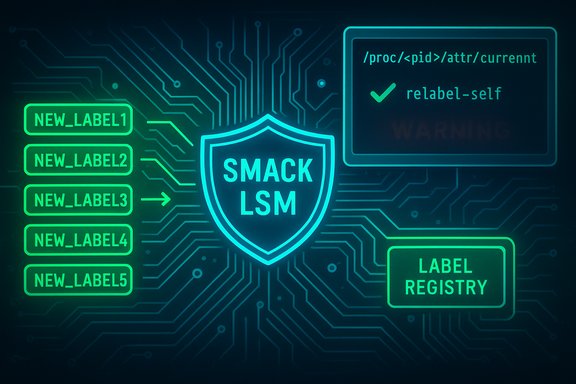
CVE-2025-68733 stems from an ordering mistake in the kernel’s Smack attribute-setting path: the implementation imported (allocated/registered) the label string before verifying that the process requesting the relabel was allowed to perform that transition according to the relabel-self list. That premature import allowed a task that already had permission to write to its own label file to cause the kernel to register previously unknown labels — effectively creating labels — by writing arbitrary label names. The corrected behavior ensures the kernel first checks whether the requested label is permitted by the relabel-self list and only then proceeds to import or register that label name.
Why this matters: labels are the fundamental atoms of Smack’s policy. Allowing untrusted processes to create labels undermines the authority model and can complicate or weaken access rules. A crafted set of labels can be used by a malicious local actor to attempt policy confusion, escalate indirect access paths when labels later get referenced in rules, or simply clutter the label namespace to complicate administration and forensic analysis.
The patch is a classic example of mitigating a side-effect by moving a potentially visible state change (label import) until after permission checks succeed. The fix restores the intended invariant: unprivileged tasks may only adopt one of the preapproved labels, and unprivileged actions cannot expand the global Smack label namespace.
Design lessons reinforced by this case:
Organizations running Smack-enabled systems should treat this as a timely policy-integrity vulnerability: patch promptly, monitor label namespaces for anomalies, and review Smack configuration defaults to avoid exposing unprivileged relabeling in production. The underlying theme is the perennial one: small ordering mistakes in security code can yield outsized consequences, and disciplined change-control plus prompt patching remain the best defenses.
Source: MSRC Security Update Guide - Microsoft Security Response Center
 Background
Smack (Simplified Mandatory Access Control Kernel) is a lightweight LSM used in embedded, IoT, and some hardened Linux distributions to enforce mandatory access control policies with a simple label and rule model. Unlike SELinux, Smack targets simplicity: processes and objects carry string labels, and a compact set of access rules govern interactions. Several Smack interfaces expose runtime configuration and per-task attributes through virtual filesystems, most notably the process label at /proc/<pid>/attr/current and a control file called relabel-self that can permit constrained, one-time self-relabeling for non-privileged processes.The Smack model includes administrative controls: only processes with CAP_MAC_ADMIN (or equivalent) can freely change labels. The relabel-self mechanism is intentionally narrow — system administrators can populate /sys/fs/smackfs/relabel-self (or platform-equivalent) with specific labels that an otherwise unprivileged process may adopt once. This is useful in constrained scenarios where a controlled relabeling is needed without granting full MAC administrative capabilities.
CVE-2025-68733 stems from an ordering mistake in the kernel’s Smack attribute-setting path: the implementation imported (allocated/registered) the label string before verifying that the process requesting the relabel was allowed to perform that transition according to the relabel-self list. That premature import allowed a task that already had permission to write to its own label file to cause the kernel to register previously unknown labels — effectively creating labels — by writing arbitrary label names. The corrected behavior ensures the kernel first checks whether the requested label is permitted by the relabel-self list and only then proceeds to import or register that label name.
What the vulnerability actually is
- Vulnerability class: Logic bug in LSM label handling (access control ordering).
- Component: Smack Linux Security Module, attribute-setting routine.
- Trigger: Writing a label name into /proc/<pid>/attr/smack/current (a process’s Smack label) when the system configures one or more labels in relabel-self and the task is allowed to relabel itself.
- Root cause: The kernel imported (registered) the provided label before checking whether the requesting process was permitted to adopt that label based on the relabel-self whitelist.
- Effect: An unprivileged process with write access to its own Smack attribute file could cause the kernel to create/register new Smack label names by supplying arbitrary names — bypassing the intended restriction that only labels listed in relabel-self can be adopted.
Who and what is affected
Not all Linux systems use Smack. The vulnerability only affects systems that:- Include Smack as the active LSM (built into the kernel and enabled), and
- Have the relabel-self mechanism populated (the list is not empty) so that unprivileged tasks are permitted to relabel themselves to one or more allowed labels, and
- Allow unprivileged processes to write to their own /proc/<pid>/attr/smack/current (which is typical if relabel-self entries exist).
Technical analysis: how the bug works
Smack maintains a global label namespace and per-task current labels. When a process requests a label change via the procfs interface, the kernel code path:- Receives the label string from userspace.
- Imports or resolves the label within the kernel’s Smack label management subsystem (this can allocate or register a new label name if it doesn’t already exist).
- Validates whether the transition is permitted (for unprivileged tasks, checks whether the requested label is present in the relabel-self list).
- Applies the label change if checks succeed.
Why this matters: labels are the fundamental atoms of Smack’s policy. Allowing untrusted processes to create labels undermines the authority model and can complicate or weaken access rules. A crafted set of labels can be used by a malicious local actor to attempt policy confusion, escalate indirect access paths when labels later get referenced in rules, or simply clutter the label namespace to complicate administration and forensic analysis.
Exploitability and likely impact
- Exploitability: Local, low-complexity. An attacker with the ability to execute code as an unprivileged process and that is permitted to relabel itself (because the relabel-self list is populated) can trigger the behavior. The vulnerability does not appear to be remotely exploitable by itself.
- Privileges required: The attack is available to non-privileged tasks — specifically those already allowed to self-relabel via Smack’s configured list.
- Attack vector: Local process writes a chosen string into its /proc/<pid>/attr/smack/current; the kernel’s import-before-check ordering causes registration of a new label name.
- Impact categories:
- Policy integrity compromise: Untrusted label creation dilutes the integrity of label space and can, in complex or misconfigured systems, open the door to unintended privilege relationships.
- Operational risk: Unexpected labels in the namespace may alter how administrator-defined rules apply, or create confusion during incident response or audits.
- Not direct code execution: The flaw does not directly provide code execution or kernel memory corruption; its impact is primarily on MAC policy integrity.
How maintainers fixed it
Maintainers adjusted the Smack attribute-setting code so that the kernel checks the relabel-self list (and related permission checks) before importing or registering the provided label string. Reordering this logic ensures the kernel does not create a new label entry until it has confirmed the requesting task is allowed to adopt that label.The patch is a classic example of mitigating a side-effect by moving a potentially visible state change (label import) until after permission checks succeed. The fix restores the intended invariant: unprivileged tasks may only adopt one of the preapproved labels, and unprivileged actions cannot expand the global Smack label namespace.
Detection: how to tell if a system is vulnerable
- Verify whether Smack is enabled in the running kernel. If Smack isn’t present or active, the system is not affected. Kernel configuration and boot-time LSM selection determine presence.
- Check whether any relabel-self list is non-empty. An empty relabel-self indicates the mechanism isn’t enabled for unprivileged tasks.
- Inspect the Smack label namespace for unexpected labels. If new label names appear that were neither deployed by administrators nor part of controlled initialization, that may indicate the issue was observed prior to patching.
- Review kernel logs or auditing channels around times when /proc/<pid>/attr/current writes occurred. Administrative logging around Smack attribute writes may reveal suspicious label-write activity.
Recommended remediation and mitigation
- Apply patched kernels: The primary remediation is to update to a kernel version that includes the Smack fix. Distributors and kernel maintainers have backported the fix to supported stable trees; install the vendor-supplied kernel update as soon as it is available for your distro or platform.
- Temporarily restrict relabel-self usage: If you cannot immediately apply an update, remove entries from the relabel-self list or restrict write access to the relabel control files to prevent unprivileged self-relabels. This may reduce functionality but mitigates the root cause.
- Harden local process controls: Limit the set of unprivileged processes that can modify their own labels. Use additional sandboxing or containerization to prevent arbitrary process writes to /proc/<pid>/attr/current.
- Monitor label namespace changes: Maintain a whitelist of legitimate labels and detect unexpected entries. Employ operational monitoring to alert on newly created Smack labels or abnormal writes to Smack procfs/sysfs attributes.
- Auditing: Enable and review audit logs for attr/current writes by unprivileged users if possible. Correlate with other indicators of compromise or anomalous activity.
- Vendor coordination: For embedded devices and appliances, contact the vendor for firmware updates or vendor-recommended mitigations if you cannot apply upstream kernel updates.
- Confirm Smack is enabled on the running kernel.
- Inspect /sys/fs/smackfs (or distribution-specific path) for the relabel-self list.
- Remove any unneeded entries from relabel-self as a stop-gap.
- Schedule and deploy an updated kernel image from your distribution or vendor.
- After updating, verify label namespace stability and audit for unexpected changes.
Operational considerations and risk assessment
- Embedded and appliance risk: Devices that rely on Smack’s simplicity for security enforcement are the most at risk. Many embedded platforms rarely receive kernel updates, so operators should prioritize verifying their exposure and requesting or applying vendor-supplied fixes.
- Containerized environments: Containers that share the host’s kernel inherit Smack behavior. If Smack is enabled on the host and containers can interact with the relevant procfs interfaces, container escape or policy confusion scenarios merit closer evaluation. Mitigation often requires host kernel updates or restricting container capabilities.
- Forensics and incident response: Because the vulnerability allows the creation of label names, forensic investigators should treat unexpected labels as possible indicators of prior exploitation attempts. Label creation timestamps and correlated process activity should be captured where possible.
- Severity nuance: While the bug is not an immediate remote RCE, it undermines a foundational security primitive. On systems using Smack as the primary MAC layer, this can materially weaken trust boundaries and therefore deserves medium-priority treatment proportional to the device’s role and exposure.
Guidance for specific audiences
For system administrators
- Prioritize kernel updates from your distribution or device vendor.
- If immediate updates are impossible, clear the relabel-self list and restrict writes to the Smack attribute interfaces.
- Maintain a documented set of expected Smack labels for each system and monitor for deviations.
For embedded device vendors
- Ship a patched kernel in firmware updates and coordinate with customers about upgrade paths.
- Consider tightening defaults: do not enable relabel-self for unprivileged processes unless explicitly required for operation.
- Add audit hooks to detect unexpected label registrations and provide clear guidance to integrators about safe label management.
For security engineers and auditors
- Include Smack-related controls in MAC and configuration audits.
- Check for evidence that unprivileged processes wrote to their Smack attribute files and whether unexpected labels were added.
- Review change control processes for label namespace changes to ensure only privileged workflows can add labels.
Why this is a useful reminder about LSM design
CVE-2025-68733 is a textbook example of how subtle ordering and side-effect management in security code matter. The action of importing or registering a label is a state-modifying operation visible to system policy and future decisions. When permission checks occur after state-change side effects, a transient denial can still leave persistent, observable changes that undermine the intended security model.Design lessons reinforced by this case:
- Always perform non-reversible or broadly visible state changes after all permission checks succeed.
- Treat label or policy namespace mutations as privileged operations and restrict their entry points.
- Implement defense-in-depth: LSMs should not be the only control for critical separations; filesystem permissions, capability restrictions, and process-level sandboxing provide layered protection.
Final assessment and call to action
CVE-2025-68733 does not announce a catastrophic new class of remote kernel exploit; instead, it reveals an integrity bug in how Smack processed label-change requests. Nevertheless, its correctness implications are significant in contexts that rely on Smack for confinement. The fix — reordering the permission check to occur prior to label import — is straightforward and effective. The practical response is likewise straightforward: identify whether Smack and relabel-self are in use, apply patched kernels or vendor updates promptly, and apply temporary mitigations where updates can’t be installed immediately.Organizations running Smack-enabled systems should treat this as a timely policy-integrity vulnerability: patch promptly, monitor label namespaces for anomalies, and review Smack configuration defaults to avoid exposing unprivileged relabeling in production. The underlying theme is the perennial one: small ordering mistakes in security code can yield outsized consequences, and disciplined change-control plus prompt patching remain the best defenses.
Source: MSRC Security Update Guide - Microsoft Security Response Center
