

A deep parsing bug in polkit’s XML policy handler can be triggered by a crafted .policy file with unusually deep nesting (32 or more elements), producing an out‑of‑bounds write that can crash polkit’s daemon and — in the worst case — might be leveraged toward code execution; vendors and upstream have issued a targeted patch to bound XML parsing depth, and administrators should treat this as a high‑impact local integrity/availability flaw that requires rapid inventory, patching, and operational hardening. (nvd.nist.gov)
Polkit (formerly PolicyKit) is the system component many Linux distributions use to mediate privilege escalation and authorization for system services. It exposes a small set of privileged helpers and a long‑running system daemon (polkitd) that consults policy files to decide whether a requesting process may perform privileged operations. Those policy files are XML documents placed in system-owned directories; because those directories are owned by root, the attack surface for policy tampering is generally limited to actors who already possess elevated filesystem privileges. (nvd.nist.gov)
In mid‑July 2025 the polkit project, distributor trackers and the NVD cataloged CVE‑2025‑7519: a bounds‑checking mistake in the XML policy parser that allows an out‑of‑bounds write when the parser encounters a policy file with at least 32 levels of nested XML elements. The maintained and vendor‑supplied advisories assign a medium numeric score (Red Hat’s CNA gives a 6.7 CVSS v3.1 base score), but they also emphasize the severity of impact conditional on placement of a malicious policy file — an attacker needs the ability to write a system policy file (i.e., high privileges) to exploit this directly. (nvd.nist.gov)
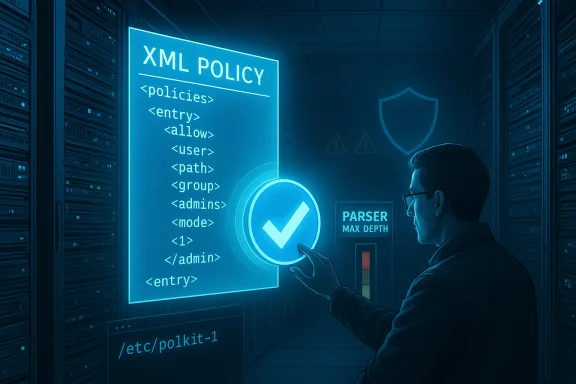
Upstream maintainers merged a small, surgical change into polkit that enforces a maximum parser depth (PARSER_MAX_DEPTH) — the fix explicitly checks the parser’s current depth and aborts with an error if the incoming structure would exceed the allowed limit. The corrective code was committed to the polkit repository and is tracked in the project’s pull request and commit history. (github.com)
Two implementation details make this especially pertinent for system administrators:
Red Hat and other downstream trackers recorded the CVE and published advisories that reference the upstream patch and vendor packaging status. The NVD entry consolidates Red Hat’s CNA metadata (description, CVSS vector, and references) and lists the upstream commit and PR as primary mitigations. Multiple security aggregators (Snyk, Rapid7, cvefeed) mirrored the technical details, severity assessments and the requirement that exploitation requires ability to place a policy file. Administrators should rely on their distribution’s packaged update as the authoritative fix and apply vendor errata as soon as feasible. (nvd.nist.gov)
Operational notes about applying fixes:
However, residual risks remain:
Conclusion: the bug is fixable and fixed upstream; the operational work now is rollout, verification, and supply‑chain hygiene. Apply vendor packages, rebuild untrusted images, and lock down who may place system policy files — those actions materially reduce the meaningful risk from this vulnerability. (nvd.nist.gov)
Source: MSRC Security Update Guide - Microsoft Security Response Center
 Background / Overview
Polkit (formerly PolicyKit) is the system component many Linux distributions use to mediate privilege escalation and authorization for system services. It exposes a small set of privileged helpers and a long‑running system daemon (polkitd) that consults policy files to decide whether a requesting process may perform privileged operations. Those policy files are XML documents placed in system-owned directories; because those directories are owned by root, the attack surface for policy tampering is generally limited to actors who already possess elevated filesystem privileges. (nvd.nist.gov)In mid‑July 2025 the polkit project, distributor trackers and the NVD cataloged CVE‑2025‑7519: a bounds‑checking mistake in the XML policy parser that allows an out‑of‑bounds write when the parser encounters a policy file with at least 32 levels of nested XML elements. The maintained and vendor‑supplied advisories assign a medium numeric score (Red Hat’s CNA gives a 6.7 CVSS v3.1 base score), but they also emphasize the severity of impact conditional on placement of a malicious policy file — an attacker needs the ability to write a system policy file (i.e., high privileges) to exploit this directly. (nvd.nist.gov)
Upstream maintainers merged a small, surgical change into polkit that enforces a maximum parser depth (PARSER_MAX_DEPTH) — the fix explicitly checks the parser’s current depth and aborts with an error if the incoming structure would exceed the allowed limit. The corrective code was committed to the polkit repository and is tracked in the project’s pull request and commit history. (github.com)
What the bug is — technical anatomy
At its simplest, CVE‑2025‑7519 is a classic bounds‑checking failure: the XML parsing loop increments a stack or depth counter as it descends into nested elements, then proceeds to write into a buffer (or index a structure) without verifying that the depth has not exceeded the space or index range that the code expects. Under normal policy files the parser’s depth is shallow; a malicious .policy file purposefully nests elements (32+ levels) to push the counter beyond safe limits and provoke a write outside the intended buffer. That write corrupts memory in polkit’s process context and typically results in a crash (denial of service), while the possibility of arbitrary code execution cannot be completely ruled out because memory corruption in C programs can be escalated into execution under the right allocator and environment conditions. (nvd.nist.gov)Two implementation details make this especially pertinent for system administrators:
- Policy files live in directories owned and writable only by privileged accounts. That restricts direct, unauthenticated remote exploitation: an attacker normally must already be able to place files as root (or equivalent), or rely on a supply‑chain / package compromise or an escalation from another vulnerability. (nvd.nist.gov)
- Polkit runs as a system service and mediates many common privilege checks. When polkitd crashes or fails to service authorization requests, the practical effect can be widespread denial of ability to perform system administrative operations (for example, graphical or programmatic privilege elevation requests may fail or hang). That makes the availability and integrity impacts operationally significant even if the exploit requires local write access. (nvd.nist.gov)
Upstream and vendor response
The upstream polkit project accepted a focused patch that adds a pre‑write check of the parser depth. In concrete terms the patch validates pd->stack_depth against PARSER_MAX_DEPTH and bails out with an error and warning when the limit would be exceeded; this prevents the code from performing the out‑of‑bounds write at parse time. The change is small but effective: it converts an unchecked, dangerous path into a safe failure mode. (github.com)Red Hat and other downstream trackers recorded the CVE and published advisories that reference the upstream patch and vendor packaging status. The NVD entry consolidates Red Hat’s CNA metadata (description, CVSS vector, and references) and lists the upstream commit and PR as primary mitigations. Multiple security aggregators (Snyk, Rapid7, cvefeed) mirrored the technical details, severity assessments and the requirement that exploitation requires ability to place a policy file. Administrators should rely on their distribution’s packaged update as the authoritative fix and apply vendor errata as soon as feasible. (nvd.nist.gov)
Exploitability, risk profile, and realistic threat scenarios
Understanding why this bug matters requires separating three things: (1) attack prerequisites, (2) immediate impact, and (3) escalation potential.- Attack prerequisites: to place a malicious policy file in the directories polkit reads, an attacker needs high privilege on the host (for example, root filesystem access) or must compromise an upstream package or image that will be installed on the target. Because policy directories are system‑owned, the vulnerability is not directly exploitable by an unprivileged remote user. This materially reduces the external, unauthenticated attack surface. (nvd.nist.gov)
- Immediate impact: due to the out‑of‑bounds write, executing polkitd against a crafted file reliably causes a crash or abort. A crashed polkitd means authorization queries for privileged actions fail or behave unexpectedly, which can produce a sustained availability problem for services and administrators. In environments where automation repeatedly triggers authorizations, the availability impact can cascade. (nvd.nist.gov)
- Escalation potential: memory corruption bugs in C are always unpleasant because they can sometimes be chained to produce code execution. The vendor advisories and NVD note that while arbitrary code execution is not proven, it cannot be completely discarded. Given the requirement for the attacker to place the file as root, the immediate concern remains integrity and availability rather than remote privilege escalation — but supply‑chain compromises, malicious packages, or misconfigured image builds could convert local prerequisites into more realistic attack paths. (nvd.nist.gov)
Who should worry most — systems and deployment patterns at elevated risk
Certain environments raise the practical risk considerably:- Multi‑tenant build or CI systems that accept contributed packages or run untrusted build scripts, and that do not isolate artifact creation from root‑owned system directories. An attacker who can cause a build artifact to be installed or staged as a system policy can weaponize this vulnerability. (nvd.nist.gov)
- Appliance images, container base images or prebuilt VM images that are produced by third parties and installed without integrity checks. If an upstream image includes a malicious .policy file or an older polkit build lacking the fix, operators inherit the risk. (nvd.nist.gov)
- Systems where administrative credentials are shared or where package signing and update validation are lax. Any foothold that allows writing into /etc/polkit-1 or equivalent policy directories is sufficient to weaponize the bug. (nvd.nist.gov)
Detection — what to look for in your logs and systems
Because the immediate effect is a crash or abort in polkitd, detection focuses on crash evidence and on unexpected changes to policy files:- Journal and systemd logs: watch for polkitd segfaults, backtraces or rapid restarts in journalctl output. A crash will often produce a stack trace referencing XML parsing functions or the polkit backend action pool handler. Capture several minutes of logs around the crash timestamp for forensic analysis. (github.com)
- Core dumps and crash reports: if your systems capture core dumps (coredumpctl, apport, ABRT), preserve and analyze the core with matching debug symbols. The top of the stack will point to the parser routine that experienced the write. Do not reboot hosts if you need to preserve volatile evidence unless necessary for recovery; instead collect logs and copy suspicious files safely off the host. (github.com)
- File integrity and unexpected policy files: audit the policy directories typically consulted by polkit (for example /usr/share/polkit-1/actions, /etc/polkit-1/localauthority) for recently added or modified .policy files. Unexpected new files, unusual ownership or timestamps, or policy entries that reference unfamiliar services are red flags. Implement file system monitoring and regular checksum comparison for these directories. (nvd.nist.gov)
- Package provenance and image scanning: check installed polkit package versions against vendor advisories and your distro’s security errata. If polkit was updated recently, verify that your installed package contains the upstream commit / PR that enforces the parser depth check. Many vendor advisories include commit IDs or changelog entries you can match. (github.com)
Practical remediation and hardening checklist (prioritized)
- Inventory: Identify systems running polkit and enumerate polkit package versions across your estate. Use your configuration management tooling or package manager queries to list installed polkit versions and compare them to vendor advisories. (nvd.nist.gov)
- Patch: Apply your distribution’s security update for polkit as supplied by the vendor. Where vendors have published errata, install the vendor package rather than attempting ad‑hoc local patches. Upstream commits are available if vendor packages are not yet provided, but production operators should prefer vendor‑tested fixes. (nvd.nist.gov)
- Restrict write access: As an immediate mitigation on systems where patching cannot be finished quickly, tighten who can write to policy directories: ensure only properly controlled admin accounts can place files in /etc/polkit-1/* and similar locations, and consider adding local filesystem ACLs or automount protections to make accidental or malicious writes more difficult. (nvd.nist.gov)
- Rebuild images: For container images, VM templates, and appliance builds, rebuild base images with patched polkit and validate that no unexpected .policy files are baked into images. Verify package signatures and rebuild any vendor images you cannot fully trust. (nvd.nist.gov)
- Sandboxing and least privilege: Reduce the number of processes and users who possess the ability to write system policy files. Apply SELinux, AppArmor or file ACL policies that prevent processes from modifying system policy directories without a privileged context. (nvd.nist.gov)
- Monitor and alert: Configure SIEM and host monitoring to alert on polkitd crashes, on the presence of policy files with abnormal nesting patterns (automated scanning), and on changes in /etc/polkit-1 and /usr/share/polkit-1/actions. Baseline normal authorization behavior and flag deviations. (github.com)
- Incident playbook: If you observe a polkitd crash with suspicious policy files present, collect logs, preserve the offending file for analysis, and isolate the host. Replace compromised images, rotate any credentials that could have enabled the file placement, and perform a post‑mortem to identify the initial root cause that allowed file creation. (nvd.nist.gov)
Patching options and the upstream patch
The upstream change is minimal and localized — it adds a defensive depth check in the policy parser that logs a warning and aborts parsing when the incoming element nesting would exceed PARSER_MAX_DEPTH. That behavior converts a memory‑corrupting path into a safe failure (parse error), which preserves the daemon’s integrity and prevents out‑of‑bounds writes. The commit is available in the polkit project repository and was referenced by vendor advisories as the canonical fix. (github.com)Operational notes about applying fixes:
- Prefer vendor packages: distributors test and package patches for specific release branches; use those packages when available to ensure compatibility with your OS release. (access.redhat.com)
- If a vendor package is not yet available and you must ship a hotfix, backport the upstream commit into your build pipeline, rebuild polkit with debug symbols for traceability, and run regression tests that exercise common authorization flows to avoid introducing regressions. (github.com)
- After applying updates, restart polkitd gracefully (systemctl restart polkit) and validate that existing authorizations and helper workflows behave as expected. Monitor for any regression crashes. (nvd.nist.gov)
Communication and risk messaging for stakeholders
For security and platform teams, the message is straightforward: this CVE is dangerous in principle because it corrupts memory in a privileged daemon, but it requires the attacker to be able to place a malicious system policy file — a condition that normally implies the attacker already controls the host or its build process. Prioritize remediation as follows:- Emergency patching for systems where multiple users can write or install system packages (CI runners, build hosts, image build infrastructure, and shared admin workstations).
- Rebuild and redeploy images that were built before the fix landed, especially if built by third parties.
- For desktop fleets where local root access is tightly controlled and package updates are current, patch on the normal OS update cadence but monitor for unexpected polkitd crashes. (nvd.nist.gov)
Open questions and limits to public knowledge
- Proof‑of‑concepts and in‑the‑wild exploitation: at the time of disclosure there were no widely reported exploitation campaigns using CVE‑2025‑7519. Public trackers note the potential for crash and the theoretical possibility of escalation, but they do not show confirmed, remote exploitation events. Treat any claim of remote, unauthenticated exploitation with skepticism unless reproducible PoCs are provided by threat researchers and validated by vendors.
- Scope of affected versions and packaging variance: distributor packaging and backports differ across distributions and releases. The NVD entry references Red Hat’s CNA and upstream commits; you must check your distribution’s advisory for the exact fixed package version applicable to your release. Do not assume that a vendor’s statement about upstream commits implies that your installed package includes the fix. (nvd.nist.gov)
- Exploitability to RCE: vendors and trackers note that arbitrary code execution is not discarded but do not publish public exploit chains demonstrating reliable RCE from this specific bug. Given the complicated and environment‑specific nature of turning an out‑of‑bounds write into stable execution, treat RCE as a possible but not yet observed outcome in widespread deployments. Flag this as a residual risk to be considered during forensic review. (nvd.nist.gov)
Checklist for on‑call and system owners (quick actions)
- Query inventory for polkit package versions across hosts. Flag any systems that haven’t received recent security updates. (nvd.nist.gov)
- Apply vendor polkit updates; if unavailable, pull the upstream commit and plan a controlled rebuild. (github.com)
- Audit /etc/polkit-1 and /usr/share/polkit-1/actions for unexpected files and unusual ownership. Create alerts for changes. (nvd.nist.gov)
- Rebuild container and VM images created before July 2025 to ensure images don’t carry vulnerable binaries or malicious policy files. (nvd.nist.gov)
- Configure monitoring to alert on polkitd crashes and to collect core dumps for forensic triage. Preserve evidence before rebooting when possible. (github.com)
Final analysis — strengths of the response and residual risk
The upstream and vendor response to CVE‑2025‑7519 is fast and appropriately targeted: the fix enforces a sensible parser depth limit and fails safely instead of allowing unchecked writes. That kind of defensive programming is the correct way to handle parser attack surface (fail early, avoid memory corruption). The fact that the fix is small and localized reduces the risk of large regressions and makes vendor backports straightforward. (github.com)However, residual risks remain:
- Supply‑chain and image hygiene: even with a patch available, malicious policy files baked into images or packages will continue to present a threat until upstream sources and third‑party vendors are verified and rebuilt. Operators must rebuild and re‑validate images and vendor artifacts. (nvd.nist.gov)
- Insider or compromised admin accounts: because exploitation requires the ability to write system policy files, an attacker who has escalated to administrative privileges or who has compromised a build system can weaponize this easily. Hardening privileged workflows remains essential. (nvd.nist.gov)
- Detection gaps: crashes are noisy and often obvious, but a carefully staged supply‑chain compromise may install a benign‑looking file that triggers only under specific conditions. Regular file integrity checks and provenance controls minimize this risk. (nvd.nist.gov)
Conclusion: the bug is fixable and fixed upstream; the operational work now is rollout, verification, and supply‑chain hygiene. Apply vendor packages, rebuild untrusted images, and lock down who may place system policy files — those actions materially reduce the meaningful risk from this vulnerability. (nvd.nist.gov)
Source: MSRC Security Update Guide - Microsoft Security Response Center