

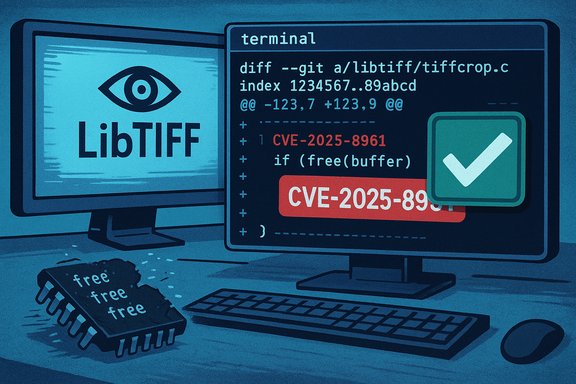
A locally exploitable memory‑corruption bug in LibTIFF’s tiffcrop utility — tracked as CVE‑2025‑8961 — has been publicly documented and patched upstream, and the technical trail points to a double‑free and missing cleanup checks in tools/tiffcrop.c that can crash or corrupt memory when processing malformed inputs.
Background
LibTIFF is a long‑lived, widely‑deployed C library for reading and writing TIFF image files and a small set of accompanying command‑line tools. The vulnerability CVE‑2025‑8961 was published in August 2025 and concerns the tiffcrop command‑line utility bundled with LibTIFF 4.7.0. Public vulnerability databases list the issue as a memory‑corruption defect affecting the function normally invoked from the main flow of tools/tiffcrop.c. The flaw is described as locally triggered — an attacker or local user must run the binary (or cause it to run) with crafted inputs — and multiple trackers indicate a public proof‑of‑concept or exploit fragments were available at disclosure. This article synthesizes the upstream fix, vendor/distributor advisories, and community analysis to provide a technical explainer, risk assessment, and a practical mitigation playbook for WindowsForum readers who manage image‑processing pipelines, developer workstations, or Linux systems that carry LibTIFF as a dependency.Overview of the vulnerability
What specifically is affected
- Component: LibTIFF 4.7.0 (tools/tiffcrop utility).
- File and function: tools/tiffcrop.c, within the main/crop path and the read/cleanup logic.
- Class of bug: memory corruption (double‑free / incorrect free condition / missing free checks), cataloged under CWE‑119 in public trackers.
- Attack vector: Local (attack requires local execution or local process control).
- Typical impact: Denial of service (crash) or memory corruption that could, in theory, be leveraged for more advanced exploitation with additional primitives.
Who discovered and who fixed it
Upstream GitLab activity (issue #721) flagged crashes in tiffcrop; maintainers committed a targeted patch that inserted missing free calls on error paths and changed a cleanup condition to prevent a double‑free by checking whether two buffers reference the same allocation before freeing. The upstream commit explicitly adds _TIFFfree(tilebuf) in several error branches and modifies a conditional from if (read_buff) to if (read_buff && read_buff != crop_buff), addressing a classical double‑free pattern. The patch was merged in September 2025.Technical analysis: how the bug works
Anatomy of the defect
At a high level the issue combines two related memory‑management mistakes:- Missing frees on error exit paths for temporary tile buffers, which can leave heap state inconsistent or cause resource leaks that lead to undefined behavior later.
- A double‑free condition when the code always freed the read buffer without checking whether that buffer was the same pointer as the crop buffer; if both pointers alias the same allocation, freeing both leads to heap metadata corruption.
Why this can be dangerous
- Double‑free: freeing the same pointer twice corrupts the allocator’s internal metadata and often leads to an immediate crash (SIGSEGV) or memory allocator confusion. In some environments and with sophisticated heap manipulation, double‑free bugs have been used to craft arbitrary write primitives, but that typically requires further heap grooming and favorable allocator behavior.
- Unreliable behavior in CLI tooling: tiffcrop is a command‑line image utility often used in scripts, batch jobs, or server‑side processing; a local crash can create denial‑of‑service (DoS) effects, or if run under privileged contexts or in automation, could be used to crash service agents or processing workers. Public trackers and distributors largely model the immediate impact as availability‑centric rather than a guaranteed RCE.
Trigger conditions and exploitability
- The vulnerability manifests when tiffcrop processes malformed or adversarial TIFF files where the tile‑reading or simplified read/write logic follows an error path that hits the missing frees or the double‑free scenario.
- Attack complexity is low in the sense that malformed files can be crafted; however, the attack requires local invocation of tiffcrop (or any process that calls the vulnerable code path). For remote services, the practical exploitability depends on whether a service automatically runs tiffcrop on uploaded images without sanitization; in that case an unauthenticated remote attacker could indirectly trigger the local vulnerability by uploading crafted content.
Evidence and corroboration
Key factual claims are supported by independent sources:- The National Vulnerability Database (NVD) entry for CVE‑2025‑8961 describes the bug and cites third‑party sources indicating a public exploit presence. This provides a canonical, authoritative catalog entry.
- The upstream GitLab commit shows the precise code changes that remediate the double‑free and missing free paths — the diffs reveal free insertions and the adjusted conditional to avoid freeing the same buffer twice. That commit is the primary technical evidence of the root cause and the upstream remedy.
- Distribution trackers such as Debian’s security tracker list affected package versions, the presence of the upstream issue reference, and package fix status for various releases; Debian’s notes also summarize the practical security impact for packagers (e.g., “Crash in CLI tool, no security impact” in some contexts). This gives practical distribution‑level context.
Proofs, PoCs, and public exploit code
Multiple vulnerability aggregators and trackers indicate that proof‑of‑concept code or exploit fragments were publicly available at disclosure, and the NVD references those third‑party artifacts. The presence of a PoC increases urgency because it lowers the bar for attackers to reproduce crashes or test exploitability in controlled environments. That said, publicly available PoC ≠ widely weaponized exploit: many PoCs demonstrate crash conditions or resource leaks rather than reliable privilege‑escalation payloads. Treat PoCs as significant but not definitive evidence of active, mass exploitation without corroborating telemetry from vendor or incident‑response sources. (Operational caution: if you encounter public PoC code in the wild, analyze it in isolated sandboxes only and follow responsible disclosure/legal guidance before sharing or reusing it externally.Distribution and packaging status
- Several major Linux distributors and package trackers picked up the CVE and mapped fixed package revisions or vendor advisories. Debian’s tracker lists affected package versions and fixed versions for unstable and stable branches; Amazon Linux advisories list fixed ALAS advisories for their platforms. Red Hat/SUSE pages and other vendor trackers recorded the issue and rated it low/medium depending on exposure. This is typical for a small, localized C tool defect: upstream fix + downstream packaging propagate at different cadences.
Mitigation and remediation
Immediate actions (0–24 hours)
- Inventory: locate all installations and binaries that include LibTIFF 4.7.0 or the tiffcrop utility. Search package managers, container images, and statically linked binaries.
- Restrict access: if tiffcrop is accessible to untrusted users or automated upload pipelines, temporarily disable or sandbox those processes until patched.
- Apply vendor patches: update LibTIFF / tiff packages from your OS vendor to the fixed versions where available, or deploy upstream patched builds if vendor packages are not yet available.
Patching guidance
- When available, prefer trusted vendor packages because they include build‑time flags and distro‑specific ABI considerations. If you must build from upstream, merge or apply the upstream commit that fixes the double‑free and missing free checks and rebuild with your standard packaging hygiene.
- For statically linked binaries (common in some desktop apps or appliances), you must rebuild the consumer binary against a patched LibTIFF or replace the bundled library inside the application package.
Workarounds and compensations
- For server endpoints that automatically process user uploads, disable automatic thumbnailing/preview generation for untrusted uploads until you can patch.
- Enforce strict input validation: reject files that do not match expected TIFF magic headers or that exceed expected sizes.
- Use process isolation and resource limits (e.g., run processors inside containers with limited privileges, CPU/memory caps, and seccomp filters) to reduce blast radius if a crash occurs.
Prioritization guidance
- High priority: public‑facing services that accept user uploads and run tiffcrop (or any LibTIFF tools) automatically — patch these first.
- Medium priority: developer workstations and CI runners that process untrusted TIFFs (patch and rebuild static images).
- Lower priority: isolated hosts without any path for attacker‑controlled TIFF input: these can be scheduled into the regular update cadence but still should be tracked.
Risk and threat model assessment
- Likelihood of exploitation: depends strongly on deployment. If tiffcrop is invoked by a network‑facing service that ingests user files, the effective exposure becomes remote because attackers can submit crafted TIFFs to trigger the local bug. For stand‑alone desktop use, exploitation requires local access to invoke the tool with crafted inputs. Public PoCs reduce exploit development time for attackers.
- Impact severity: most aggregators place base severity in the low‑to‑medium range because the vector is local and confidentiality/integrity impacts are minimal. However, for production services the availability impact is often the deciding factor, and that operational impact can be large.
- Exploit complexity: low to moderate to cause a crash; high to turn that into a reliable escalation or RCE primitive without additional vulnerabilities or favorable heap conditions.
Practical checklist for administrators and developers
- Prepare a list of all assets that ship or bundle LibTIFF (both dynamic and static links).
- For each asset, determine whether it:
- Runs tiffcrop directly as a CLI tool;
- Calls LibTIFF APIs or bundles a copy of LibTIFF;
- Processes untrusted TIFF files (e.g., web upload endpoints).
- Apply updates:
- Update OS packages to vendor‑provided patched versions where available.
- Rebuild and redeploy any statically linked applications against patched upstream.
- Replace container base images that contain vulnerable releases.
- Validate:
- Restart affected services.
- Monitor crash logs and system telemetry for failures referencing tiffcrop or libtiff stack frames.
- Optionally run benign fuzzers or test cases in staging to verify that the previously observed crash paths are fixed.
- Short‑term mitigations:
- Disable auto‑processing of untrusted uploads.
- Introduce input whitelisting based on MIME type and size thresholds.
- Run discovery scans for the presence of vulnerable binary versions in your estate.
Why the upstream fix is appropriate (and what it means for long‑term hygiene)
The upstream patch is conservative: the changes add necessary frees and a simple pointer equality check to avoid double‑free. This style of surgical fix is low‑risk and easy to backport. It restores clear ownership semantics for heap buffers and prevents a common C programming pitfall: freeing the same ownership twice.Longer term, developers and integrators should consider:
- Adopting memory‑safe tooling for user‑facing image processing where performance/compatibility allows (e.g., safer language wrappers or sandboxing).
- Expanding fuzzing and CI tests to exercise error paths and ownership semantics in native libraries.
- Avoiding untrusted automatic processing by default — treat image transformations as potentially risky operations unless explicit hardening is in place.
Unverifiable or ambiguous claims — caution flag
- Some public trackers and third‑party databases referenced a publicly available exploit at disclosure; while multiple aggregators reported PoCs, there is no public, vendor‑confirmed telemetry in the aggregated records proving widespread exploitation in the wild at scale. Treat claims of active mass exploitation as unverified unless backed by incident reports from vendors or national CERTs.
- The leap from double‑free → reliable remote code execution is nontrivial. While double‑free can be a powerful primitive, reliably converting it into arbitrary code execution on modern systems requires precise heap manipulation and often other environmental conditions. Do not assume RCE without a verified exploit chain.
Conclusion
CVE‑2025‑8961 is a practical reminder that even small command‑line utilities distributed with broadly used native libraries can carry memory‑safety defects with production impact. The vulnerability in LibTIFF’s tiffcrop was credible and was remediated upstream with a minimal, well‑scoped patch that inserts missing frees and prevents double‑free by checking pointer aliasing. The main operational risk is availability—crashes and instability in automated image pipelines—and the presence of public PoCs raises urgency for patching services that process untrusted TIFF inputs.Action items for WindowsForum readers and administrators:
- Inventory and prioritize updates for systems that run tiffcrop or bundle LibTIFF.
- Apply vendor updates or upstream patches promptly, especially for public‑facing image processors.
- Temporarily restrict automatic processing of untrusted TIFF uploads and use containerization/sandboxing to reduce blast radius until patches are applied.
Source: MSRC Security Update Guide - Microsoft Security Response Center
