

A remotely exploitable denial‑of‑service flaw in Rockwell Automation’s Compact GuardLogix® 5370 — tracked as CVE‑2025‑9124 — can be triggered by a crafted CIP unconnected explicit message and may drive affected controllers into a major non‑recoverable fault, forcing manual recovery and program reloads unless devices are updated to the corrected firmware.
The Compact GuardLogix® 5370 is a programmable automation controller (PAC) widely used in manufacturing and industrial control systems that require integrated safety and motion control over EtherNet/IP. The newly disclosed issue is an uncaught exception (CWE‑248) that manifests when the controller processes a specially crafted CIP (Common Industrial Protocol) unconnected explicit message. According to Rockwell Automation, affected firmware releases are version 30.012 and prior, and the vendor published a corrected firmware identified as version 30.14 or later. Government and vendor advisories characterize the flaw as a high‑severity availability impact: a CVSS v3.1 base score of 7.5 and a CVSS v4 base score of 8.7, reflecting remote exploitability with low attack complexity and no authentication required. The advisory ecosystem (vendor advisory plus aggregator feeds) reproduces these scores and descriptions in multiple vulnerability databases. This advisory re‑emphasizes an enduring reality in industrial cyber security: many high‑impact ICS vulnerabilities, even when limited to denial‑of‑service, carry outsized operational risk because they can halt production, disrupt safety systems, and require on‑site engineering intervention to recover.
For teams planning the upgrade, the immediate next steps are: confirm inventory, schedule a test upgrade to 30.14, implement restrictive firewall rules for CIP traffic, and deploy detection rules for malformed unconnected explicit CIP messages as part of a coordinated OT‑IT remediation plan.
Source: CISA Rockwell Automation Compact GuardLogix 5370 | CISA
 Background / Overview
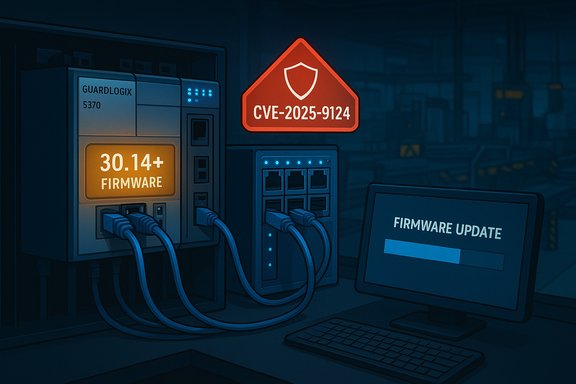
The Compact GuardLogix® 5370 is a programmable automation controller (PAC) widely used in manufacturing and industrial control systems that require integrated safety and motion control over EtherNet/IP. The newly disclosed issue is an uncaught exception (CWE‑248) that manifests when the controller processes a specially crafted CIP (Common Industrial Protocol) unconnected explicit message. According to Rockwell Automation, affected firmware releases are version 30.012 and prior, and the vendor published a corrected firmware identified as version 30.14 or later. Government and vendor advisories characterize the flaw as a high‑severity availability impact: a CVSS v3.1 base score of 7.5 and a CVSS v4 base score of 8.7, reflecting remote exploitability with low attack complexity and no authentication required. The advisory ecosystem (vendor advisory plus aggregator feeds) reproduces these scores and descriptions in multiple vulnerability databases. This advisory re‑emphasizes an enduring reality in industrial cyber security: many high‑impact ICS vulnerabilities, even when limited to denial‑of‑service, carry outsized operational risk because they can halt production, disrupt safety systems, and require on‑site engineering intervention to recover.What the vulnerability actually is
The technical mechanism in plain language
At its core, CVE‑2025‑9124 is an input‑handling failure where a crafted network message causes the controller’s CIP message parser (or a related handler) to hit a fault condition that the runtime does not gracefully handle. That fault escalates into a major non‑recoverable fault (MNRF), the controller’s safety‑oriented fail state that logs diagnostics and invalidates memory to preserve safety invariants. Recovery from an MNRF typically requires an engineering workstation to download the application program again, and in many production environments that means a controlled outage and on‑site staff.Exploitability model
- Attack vector: Network (CIP over EtherNet/IP).
- Authentication: None required (unauthenticated).
- Attack complexity: Low — crafting and sending a malformed CIP unconnected explicit message is not dependent on complex cryptographic work or privileged access in the controller.
- Impact: Availability loss only — there is no reported confidentiality or integrity compromise in the public advisory; the effect is to render the controller unavailable until manual recovery.
Affected products, versions, and corrective action
Rockwell’s advisory enumerates the product and firmware scope concisely:- Affected product: Compact GuardLogix® 5370 (catalog 1769‑L3xS).
- Affected software/firmware: version 30.012 and prior.
- Corrected in: version 30.14 and later.
Risk evaluation — operational and business impact
Successful exploitation produces a denial‑of‑service outcome with an MNRF. In industrial settings this translates into several concrete risks:- Immediate process stoppage for controllers that are left in Run mode until the MNRF occurs and the controller faults out.
- Engineering recovery time: an MNRF requires program reload and potentially revalidation of logic and safety settings, which can take hours and require on‑site engineers.
- Safety and regulatory exposure: while the vulnerability does not directly manipulate logic or sensor data, unplanned outages during critical operations (e.g., chemical processing, utilities) can produce safety incidents if failover procedures are immature.
- Supply chain disruption: repeated or coordinated attacks could force multi‑site outages, affecting delivery schedules and contractual obligations.
Why this matters to Windows‑centric engineering teams
Many engineering workstations, HMIs, and asset management tools that interact with Logix family controllers run on Windows platforms and are part of the attack surface that can mediate access to controllers. Common operational patterns that increase risk include:- Engineering workstations with dual connections to corporate and plant networks.
- Remote support VPNs or jump hosts that can reach the plant LAN.
- Insufficient firewall rules allowing CIP/EtherNet/IP traffic across segmentation boundaries.
Mitigation, detection, and remediation: a prioritized checklist
Operators should take a layered approach that combines immediate hardening, monitoring, and patching.Immediate (0–72 hours)
- Inventory: Identify every deployed Compact GuardLogix® 5370 controller and record current firmware versions (check for 30.012 or earlier).
- Network containment: Block EtherNet/IP / CIP traffic (or restrict it to known sources) at perimeter and segmentation firewalls to prevent unauthenticated access from corporate or remote networks.
- Remote access controls: Disable direct internet exposure to control networks; if remote access is required, enforce strict VPN controls, MFA for administrative channels, and implement jump servers with strong logging.
- Monitoring: Add detection for anomalous CIP unconnected explicit messages and sudden controller faults/MNRFs; watch for repeated CIP requests from single endpoints.
Short term (72 hours – 2 weeks)
- Patch planning: Schedule and test the firmware upgrade to 30.14 in a lab or staging environment before mass rollout. Validate controller behavior, I/O mappings, and safety interlocks.
- Apply compensating controls: If upgrade cannot be immediately applied, restrict access to controller management ports to only trusted engineering hosts and deploy host‑based controls on those systems.
- Logging and retention: Ensure engineering workstation logs, PLC logs, and firewall logs are centralized and retained long enough to support incident investigation.
Medium term (2–8 weeks)
- Patch deployment: Execute vendor‑approved firmware upgrades during planned maintenance windows and document rollbacks and validation steps.
- Detection tuning: Develop and deploy IDS/IPS signatures for the exploitation pattern and integrate with SOC/IR playbooks.
- Post‑patch validation: Perform controlled fault injection tests where safe and allowed, ensuring that patched devices properly handle malformed CIP messages.
Longer term (quarterly)
- Harden network segmentation per Purdue/ISA‑99 principles, treating controllers as critical assets with minimized exposure.
- Maintain an up‑to‑date asset inventory and software bill of materials for OT devices.
- Integrate OT patch management into broader enterprise patch governance with risk assessment for safety impacts.
Detection guidance: what to look for
- Major Non‑Recoverable Fault (MNRF) entries in controller diagnostic logs immediately after network traffic from an unexpected host.
- Unusual CIP unconnected explicit messages originating from non‑engineering assets or external IP ranges.
- Repeated unsolicited EtherNet/IP session or explicit message attempts from a single endpoint, especially if accompanied by subsequent controller faults.
- Correlation of firewall or NAC logs showing unexpected east‑west traffic flows to controller subnets.
Critical analysis — strengths, gaps, and residual risk
Strengths in the vendor and advisory response
- Timely correction: Rockwell released a corrected firmware (30.14) and published an advisory that documents the affected versions and the CVE identifier.
- Clear mitigation guidance: The advisory and broader CISA guidance consistently emphasize segmentation, reducing internet exposure, and secure remote access — practical, high‑value mitigations for most operators.
Gaps and risks to watch
- No workaround available: The vendor notes no temporary workaround, increasing reliance on network defenses until patches are installed. That places higher burden on network and SOC teams.
- Operational constraints: Applying firmware updates to controllers often requires coordination with safety engineering and may force production downtime, delaying remediation for high‑risk environments.
- Detection blind spots: Many plant networks do not monitor CIP traffic in depth; absent flow collection and IDS rules these attacks can be invisible until an MNRF occurs.
- Dependency on correct asset identification: Misidentified controllers or undocumented field devices can leave vulnerable devices unpatched.
Residual risk after patching
Patching reduces the specific MNRF risk from this defect, but residual risk remains as long as:- There are unpatched devices in the environment.
- Engineering hosts or remote access paths remain exposed.
- Other firmware vulnerabilities exist in the Logix family (these controllers have had multiple advisories historically), so a defense‑in‑depth posture remains essential.
Incident response playbook (condensed)
- Triage: Immediately identify affected host and isolate the controller logically (network level) while preserving logs.
- Containment: Block the attacker’s IPs and any non‑authorized CIP traffic to controller subnets.
- Recovery: If controller is in MNRF, coordinate with on‑site engineers to perform program reload and validate safety logic. Document steps and timestamps.
- Investigation: Pull firewall, switch, NAC, and controller logs to determine the source and timeline of the crafted CIP messages.
- Remediation: Apply firmware 30.14 to the affected controller and peer devices; harden remote access.
- Lessons learned: Update change control, SOC detection rules, and asset inventory to prevent recurrence.
Broader context and historical perspective
Rockwell’s Logix family and associated FactoryTalk components have been the subject of multiple advisories over recent years, spanning DoS, memory corruption, and authentication weaknesses. These advisories show a pattern: ICS controllers and management systems, because of their protocol complexity and product longevity, periodically surface high‑impact availability bugs that demand coordinated patching and operations planning. The current advisory fits that pattern and underscores the importance of established ICS patch governance and segmentation controls.Practical advice for WindowsForum readers and IT/OT teams
- Treat this advisory as a critical availability patching priority for sites running Compact GuardLogix® 5370 controllers with firmware ≤ 30.012.
- Don’t rely solely on vendor correctness — validate firmware images in a test environment before mass deployment.
- Work with OT engineering to plan maintenance windows for firmware updates; build rollback and verification procedures into the change ticket.
- Ensure engineering workstations (often running Windows) are segregated from the corporate network and hardened: patched OS, minimal services, restricted web/email use, and least‑privilege operator accounts.
- If you cannot immediately patch, use network controls to block unsolicited CIP messages from non‑trusted networks and enable packet capture and logging for forensics.
- Update SOC detection content to flag unusual CIP unconnected explicit messages and correlate with controller diagnostic events.
Verification and independent corroboration
The vendor advisory SD1755 documents the affected product, version range, corrected release, CVE identifier, and CVSS scores. Independent vulnerability feeds and aggregators mirror the same technical summary and scoring, and CISA’s public advisory text (provided) aligns with the vendor’s statements about exploitability and impact. These multiple independent records confirm the essential facts: the vulnerability identifier (CVE‑2025‑9124), the affected family and versions, the corrected release (30.14+), and the availability‑first impact model. If any local details (catalog numbers, exact installed module variant) are ambiguous in your inventory, validate on the device’s web or serial console and cross‑check the exact revision strings with Rockwell’s advisory before upgrading.Conclusion
CVE‑2025‑9124 is a high‑impact denial‑of‑service vulnerability for Compact GuardLogix® 5370 controllers that can be triggered remotely by a crafted CIP unconnected explicit message and lead to a Major Non‑Recoverable Fault requiring manual recovery. Rockwell Automation has released corrected firmware (30.14 or later) and the industry consensus is clear: prioritize patching where feasible, and where it is not immediately possible, enforce strict network segmentation, minimize attack surface exposure for CIP/EtherNet/IP, and improve detection for anomalous controller messages. The combination of an unauthenticated network attack vector and the lack of workaround elevates the urgency of applying layered defenses now while scheduling firmware updates during controlled maintenance windows.For teams planning the upgrade, the immediate next steps are: confirm inventory, schedule a test upgrade to 30.14, implement restrictive firewall rules for CIP traffic, and deploy detection rules for malformed unconnected explicit CIP messages as part of a coordinated OT‑IT remediation plan.
Source: CISA Rockwell Automation Compact GuardLogix 5370 | CISA
