

Background
FactoryTalk Services Platform, commonly abbreviated as FTSP, is not a single operator-facing application. It is a foundational collection of common services used across the Rockwell Automation ecosystem, including directory, security, communications, and shared infrastructure functions for FactoryTalk-based environments. Its importance is easy to underestimate because it often operates behind the scenes while supporting more visible products such as visualization, alarm, engineering, and production-management workloads.
The role of FactoryTalk Directory
FactoryTalk Directory is central to the platform’s architecture. It provides a shared location for system configuration, security definitions, application references, and service relationships across FactoryTalk components. In many deployments, it becomes one of the systems that determines who can interact with an application and what they can change after they have been authenticated.
That role makes directory infrastructure inherently sensitive. A weakness in a standalone operator workstation can be serious, but a weakness that enables unauthorized changes to a central directory or security service can create a broader trust problem. An attacker may not need to interfere directly with a programmable logic controller, a human-machine interface, or a process server if they can instead manipulate the identity and authorization mechanisms used to administer those systems.
Why FTSP matters in Windows environments
FactoryTalk Services Platform is deeply intertwined with Windows-based industrial computing. It commonly resides on engineering workstations, application servers, directory servers, HMI nodes, and other systems that may also participate in Active Directory domains, use Windows-linked accounts, or rely on enterprise identity services. That makes patching and hardening an FTSP deployment a joint responsibility for operational technology teams and Windows infrastructure administrators.
The affected release is FactoryTalk Directory within FactoryTalk Services Platform version 6.60, also known as CPR 9 SR 16. Rockwell’s release documentation identifies version 6.60 as a 2025-era platform release, which means many installations may still be relatively new and therefore assumed to be current. This disclosure is a useful reminder that “current” software still needs ongoing patch-rollup maintenance.
The timeline of the disclosure
Rockwell Automation published security advisory SD1786 on July 14, 2026. CISA republished the issue as ICSA-26-202-07 on July 21, 2026, classifying the affected sector as Critical Manufacturing and describing worldwide deployment. The dates matter because organizations should distinguish the original vendor disclosure from the government advisory republication when tracking their response deadlines and internal compliance evidence.
Rockwell states that the issue was identified internally during routine testing. That is encouraging in one important respect: the flaw was found and fixed before any known public exploitation campaign was reported. CISA likewise states that it has received no reports of public exploitation specifically targeting this vulnerability as of July 21, 2026.
The Vulnerability at a Glance
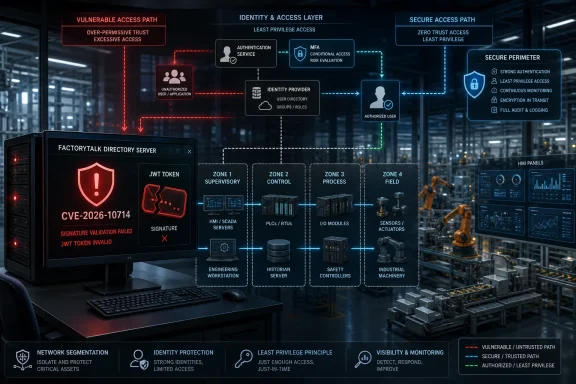
CVE-2026-10714 is categorized as CWE-1390, Weak Authentication. The core issue is not an ordinary password bypass, nor is it a conventional remote code-execution flaw. It is an authentication-validation weakness in which the affected FactoryTalk Services Platform component reportedly fails to enforce the expected RSA algorithm during JWT verification in an Okta web-authentication scenario.
What the attacker needs
The vulnerability is not described as remotely exploitable. CISA’s CVSS v3.1 vector lists local access, high attack complexity, low privileges required, no user interaction, and a scope change. That combination matters because it narrows the initial entry condition while increasing the possible consequences after a user is already in the environment.
An attacker would need an authenticated, low-privilege position on a relevant FTSP system or workflow. That could arise through several paths:
- A legitimate but overly broad user account could be abused.
- A contractor or integrator account could be compromised.
- A shared workstation could be accessed by an unauthorized person.
- Malware or an insider could operate under an existing low-privilege identity.
- A remote-support pathway could provide access to the plant environment if it is not adequately controlled.
The vulnerability therefore belongs in the category of post-compromise privilege escalation and identity abuse. It is not a reason to ignore perimeter security, but it is especially a reason to verify that internal trust boundaries are real rather than assumed.
Why the severity is High
The CVSS v3.1 base score is 7.8, while the CVSS v4.0 base score is 8.8. Both ratings classify the issue as High. The two scores should not be treated as competing assessments; they reflect different scoring systems and different ways of representing impact.
The higher v4.0 score underscores that the consequences can extend beyond the vulnerable service itself. If an attacker can impersonate an authorized identity and alter FactoryTalk configuration or permissions, the compromise can affect systems that depend on FTSP for centralized authorization. That is the operationally important point: the vulnerability can turn a limited account into a path toward broader administrative influence.
Understanding the JWT Validation Failure
JWTs, or JSON Web Tokens, are widely used to carry signed identity and authorization claims between systems. In a correctly implemented design, a receiving application validates the token’s structure, issuer, audience, expiration, and cryptographic signature. It also enforces which signing algorithms are acceptable.
Signature validation is not optional
A JWT consists of a header, a payload, and a signature-related component. The header describes metadata, including the algorithm expected for token handling. The payload contains claims, such as a subject identity or group-related information. The signature is the protection that makes those claims trustworthy.
If an application accepts token content without correctly validating the signature and algorithm policy, then it risks trusting information that was never authenticated by the identity provider. The token may appear structurally valid while carrying forged claims. That distinction is vital: format validity is not identity validity.
The “none” algorithm problem
The advisory says the affected FTSP implementation does not verify that the JWT algorithm is configured for RSA during Okta web authentication. An attacker may reportedly set the algorithm field to “none” and create a forged token. This is a long-recognized class of JWT implementation failure in which a system mistakenly accepts an unsigned or improperly authenticated token because it allows the token itself to influence the verification method.
Secure JWT handling requires applications to define an allowlist of accepted algorithms in server-side configuration and to reject anything outside that list. A token should never be permitted to dictate whether it needs a signature. In an industrial environment, where identity assertions can control access to production systems, this design principle is not merely a web-development best practice; it is a safety and availability requirement.
Why Okta integration changes the discussion
The reference to Okta web authentication is important because many organizations understandably view a modern identity provider as a security improvement. It often is. Centralized authentication, multifactor authentication, lifecycle management, and conditional-access controls can substantially improve identity governance.
However, a strong identity provider cannot compensate for a relying application that validates its tokens incorrectly. The issue here is not necessarily an Okta service failure or a failure of the underlying RSA cryptography. It is an application-side trust failure in the way FTSP accepts and verifies the identity artifact presented to it.
This is a useful lesson for Windows and industrial administrators: identity modernization should include testing of the full authentication chain. Security is only as strong as the least rigorous verifier in that chain.
Why This Is More Than an Account Impersonation Bug
The advisory’s most significant language is not the technical reference to JWTs. It is the stated impact: an authenticated low-privilege user could impersonate any authorized user on the FTSP server and obtain unauthorized access to system configuration, including the ability to grant permissions to other FTSP-protected systems.
Configuration control can become operational control
FactoryTalk environments often separate direct control functions from the management services used to configure applications, authorize users, organize assets, and distribute project information. That separation provides useful architecture, but it can lead teams to view central configuration as less critical than controllers or safety systems.
In reality, configuration authority can have major operational effects. A malicious actor who can alter permissions, directory relationships, or application settings may create durable access that survives ordinary password resets. They may also reposition themselves to modify more sensitive systems later, potentially during a maintenance window or production change.
The risk should be framed as administrative integrity compromise. The attacker may not immediately stop a process or change a controller tag. Yet they could weaken the guardrails that normally prevent future changes.
The significance of scope change
The CVSS v3.1 vector identifies a scope change. In plain language, that means exploitation can affect a security authority beyond the initially vulnerable component. This is consistent with the advisory’s warning that permissions can be granted to other systems protected by FTSP.
For defenders, this changes incident-response planning. A suspected compromise cannot be contained simply by reviewing the account used to access the vulnerable FTSP server. Teams must also assess what authorization decisions, accounts, groups, role assignments, and connected applications may have been affected after the impersonation event.
Persistence is the hidden danger
The obvious concern is unauthorized access. The subtler concern is persistence. If an attacker uses forged identity claims to create or elevate a legitimate-looking account, assign a role, modify a permission set, or change an application security relationship, the original pathway may no longer be necessary.
This is why logs and configuration baselines matter. A clean patch does not automatically undo changes made before the patch was applied. Organizations should pair remediation with a retrospective review of high-value directory and permission changes.
Affected Systems and Exposure Boundaries
The confirmed affected product is FactoryTalk Directory in FactoryTalk Services Platform version 6.60. The advisory does not claim that all historical FTSP versions share this precise defect, and administrators should not extrapolate beyond the listed product and version without vendor confirmation.
Inventory must go beyond product names
Many organizations know they use FactoryTalk View, FactoryTalk Linx, FactoryTalk Alarms and Events, or other Rockwell software, but do not maintain a clear inventory of the common service-platform version installed beneath those products. That is a common blind spot because platform components are often installed as dependencies rather than tracked as primary applications.
A meaningful exposure review should identify:
- The exact FactoryTalk Services Platform version on every server, engineering workstation, HMI workstation, and applicable client.
- Which systems host FactoryTalk Directory services.
- Whether a Network Directory or Local Directory model is in use.
- Whether Okta web authentication is configured or available in the deployment.
- Which users, service accounts, groups, and applications have administrative or configuration privileges.
- Whether the affected systems are connected to business networks, remote-access infrastructure, or vendor-support channels.
A spreadsheet is not enough if it is not reconciled against actual installed software. Windows inventory tools, endpoint-management platforms, software deployment records, and direct validation on representative systems should all be used to establish confidence.
Local access does not mean low risk
CISA states that the vulnerability is not remotely exploitable. That substantially reduces exposure compared with an unauthenticated internet-facing vulnerability, but it must not be mistaken for a low-impact issue. Industrial incidents often begin through trusted pathways: compromised credentials, phishing, unmanaged laptops, remote support sessions, removable media, or a breach of the adjacent IT network.
A local attack requirement also has a practical interpretation in Windows estates. If a user can log on to a server through Remote Desktop, use a jump host, access a virtual desktop, or control a workstation located in the same trust zone, the risk boundary may be broader than the word “local” initially suggests.
Critical manufacturing implications
CISA identifies Critical Manufacturing as the relevant infrastructure sector, which is appropriate given FactoryTalk’s presence in discrete manufacturing, process operations, packaging, automotive, food and beverage, life sciences, and other industrial settings. Availability is normally the foremost concern in these environments, but integrity is equally important when systems govern recipes, setpoints, alarms, operator displays, production records, and workflows.
The potential effect will vary widely by architecture. A tightly segmented, minimally privileged deployment with strong change control may contain the consequences. A flat network, shared local accounts, and broad directory permissions could magnify them. The vulnerability is therefore as much a test of operational discipline as it is a patch-management event.
The Windows Administration Angle
For WindowsForum readers, the immediate challenge is translating a specialized OT advisory into concrete Windows administration decisions. FTSP is an industrial software platform, but the patching, identity, logging, endpoint protection, certificate handling, remote access, and server-change processes around it are familiar Windows disciplines.
Preserve platform compatibility
Rockwell deployments often have carefully qualified combinations of operating system, FactoryTalk application versions, drivers, engineering tools, and patches. A rushed update that resolves one security issue but disrupts directory communication, HMI startup, application licensing, or alarm services can create its own production problem.
Administrators should therefore treat the remediation as a controlled platform change. Confirm the correct patch package, verify the target FTSP release, check prerequisites, preserve backups, schedule the work with operations, and document all service restarts. The need for deliberate testing does not weaken the urgency; it makes the response credible.
Keep platform versions aligned
A recurring operational reality in FactoryTalk estates is that central servers, clients, development workstations, and supporting components may not all receive updates at the same time. That can create instability, compatibility problems, and inconsistent behavior. While the vendor advisory specifically directs users of FTSP 6.60 to apply an individual patch or the February 2026 Patch Roll-up or a later update, administrators should also review version consistency across systems that participate in the same FactoryTalk Directory environment.
A mixed estate can complicate both security verification and troubleshooting. Before changing anything, record the installed FTSP version and patch-rollup level on every relevant node. After deployment, validate that the intended patch level is present and that core services reconnect as expected.
Identity and least privilege
The vulnerability requires low privileges, which makes least privilege especially relevant. Organizations should identify accounts that can authenticate through the affected pathway and determine whether their access is genuinely needed. Broad “engineering” roles, generic maintenance accounts, shared administrator credentials, and stale contractor accounts all increase the potential value of a successful impersonation attempt.
Windows administrators should pay particular attention to local Administrators membership, Remote Desktop Users membership, service-account permissions, cached credentials, and jump-server access. A plant’s FTSP environment may be secured on paper, yet still be reachable through overly permissive Windows access controls.
Remediation: Patch First, Then Validate
Rockwell’s recommended remediation for FactoryTalk Services Platform version 6.60 is straightforward in principle: apply individual patch RAID 1158263, install the February 2026 Patch Roll-up, or move to a later corrected update. The operational work required to do this safely is less simple, particularly in 24/7 environments.
A practical sequence for deployment
The following sequence balances urgency with industrial change control:
- Identify every FTSP 6.60 installation and determine which systems host or connect to FactoryTalk Directory.
- Confirm whether the Okta web-authentication workflow is enabled, while treating all affected 6.60 systems as patch candidates unless Rockwell confirms they are out of scope.
- Acquire the approved individual patch, February 2026 Patch Roll-up, or a later vendor-supported update through the organization’s authorized Rockwell support channel.
- Back up FactoryTalk application data, directory-related configuration, virtual machines where applicable, and relevant Windows system-state or recovery information.
- Test the update in a representative non-production environment whenever the operational schedule allows.
- Coordinate a maintenance window with engineering, operations, cybersecurity, and any managed-service or system-integrator partners.
- Deploy the fix and complete all required reboots or FactoryTalk service restarts.
- Validate authentication, directory connectivity, application startup, HMI behavior, alarm functions, engineering access, and connected-client communication.
- Review privilege assignments and configuration changes made before remediation, especially on high-value directory servers.
- Document the final version and patch state in the asset inventory and retain evidence for audit and incident-response purposes.
The goal is not simply to make a vulnerability scanner report “fixed.” It is to restore confidence that the identity boundary is working and that production applications remain healthy.
Validate the fix functionally
Post-patch validation should use real operational scenarios rather than a single service-status check. Confirm that authorized users can authenticate normally, that unauthorized users cannot gain access, and that applications dependent on FactoryTalk Directory continue to resolve their configuration and security relationships.
Testing should include the systems that matter most to the facility:
- Engineering workstations should open and modify only the applications for which they are authorized.
- HMI and client systems should successfully connect to the expected directory and application services.
- Alarm and event functions should continue recording and presenting expected information.
- Operator and maintenance roles should retain normal access without unintended elevation.
- Remote-support workflows should be reviewed to ensure no emergency exception created during patching remains in place.
Patching is not the only control
Organizations that cannot immediately update should apply Rockwell’s security best practices and intensify compensating controls. However, no combination of segmentation, monitoring, or process controls should be presented as equivalent to correcting a token-validation flaw. Compensating controls reduce the likelihood that an attacker reaches the vulnerable pathway; the patch removes the known application weakness.
For environments where downtime is tightly constrained, the right question is not “Can we avoid patching?” It is “What temporary measures best reduce risk until a tested patch can be deployed at the earliest safe opportunity?”
Detection and Incident Response Considerations
No known public exploitation has been reported, but that does not eliminate the need for detection. Identity abuse can blend into ordinary administration, especially when the attacker impersonates a legitimate authorized user rather than creating an obviously suspicious account.
Hunt for unusual authorization changes
Security teams should establish a review window beginning before the July 14, 2026 vendor disclosure, or earlier if internal evidence suggests the affected release has been in use for an extended period. Focus on changes involving FTSP-protected access, directory configuration, account relationships, permissions, and role assignments.
High-value questions include:
- Were any users granted new administrative capabilities without an approved change record?
- Did a low-privilege account appear to perform configuration actions normally associated with an engineer or administrator?
- Were new accounts, groups, or application permissions created outside normal maintenance windows?
- Did authentication events occur from unusual workstations, jump hosts, VPN sources, or time periods?
- Were there changes to Okta integration settings, trusted identity configuration, or FTSP authentication-related logs?
A well-maintained change-management system can be as valuable as a security-information and event-management platform here. If a permission change lacks a corresponding approved work order, it deserves scrutiny.
Preserve evidence before cleanup
If suspicious activity is discovered, preserve relevant Windows Event Logs, FTSP logs, application audit trails, identity-provider logs, endpoint telemetry, firewall records, remote-access logs, and configuration snapshots. Avoid the temptation to immediately rebuild or reset every component before evidence has been captured; doing so can make it harder to determine the extent of compromise.
At the same time, safety and availability come first. Incident responders must coordinate with plant personnel before taking action that may interrupt production systems. A normal enterprise containment playbook cannot simply be copied into an operational environment where restarting a server may affect plant visibility, alarms, or control-room workflows.
Resetting trust after suspected exploitation
If investigators determine that token forgery or identity impersonation may have occurred, a patch alone is insufficient. Organizations should consider forced credential resets for affected identities, revocation or renewal of relevant sessions and tokens, review of multifactor authentication enrollment, validation of service accounts, and comprehensive comparison of FTSP configuration against known-good baselines.
The incident may also warrant review of downstream systems protected by FTSP. The vulnerability’s scope-changing characteristic means responders should not limit their assessment to the server where the flaw was present.
Enterprise Impact Versus Smaller Deployments
The same vulnerability can look different in a multinational manufacturing enterprise than in a small plant or system-integrator lab. The technical defect is the same, but governance, exposure, and recovery capabilities differ dramatically.
Large enterprises: scale and hidden dependencies
Large organizations may operate many FactoryTalk environments across multiple sites, each with separate support agreements, upgrade histories, domain structures, and remote-access models. Their greatest challenge may be discovering where FTSP 6.60 exists and whether centralized identity integrations are configured consistently.
The opportunity is that large enterprises typically have mature vulnerability-management, endpoint-management, identity-governance, and logging tools. Those capabilities should be adapted to OT realities rather than left at the IT boundary. A central security team can help identify the software, but site engineering teams must validate the operational impact of each change.
Smaller facilities: limited redundancy and specialist access
Smaller manufacturers may have fewer systems to patch but less redundancy, thinner staffing, and a greater reliance on outside integrators. A single FactoryTalk Directory server might support the entire facility, making downtime more consequential and recovery more dependent on having current backups and support contacts.
Smaller teams should resist the assumption that a local-access vulnerability is irrelevant because their environment is not publicly exposed. Shared accounts, unmanaged engineering laptops, vendor VPNs, and flat plant networks can create a surprisingly broad local attack surface. In many cases, basic improvements in account hygiene and network separation deliver substantial risk reduction.
The consumer angle is indirect
This issue does not affect ordinary consumer Windows PCs in the way a browser, Office, or operating-system vulnerability might. Its relevance to home users is largely limited to engineers, students, integrators, and lab operators who run FactoryTalk software on personal or lightly managed systems.
Those users should still take the disclosure seriously. Development laptops often bridge environments: they may connect to corporate networks, customer sites, test benches, and removable media. A compromised engineering workstation can become the route through which an attacker gains the authenticated local position needed to exploit an industrial platform weakness.
Strengths and Opportunities
This disclosure also highlights several positive elements in the industrial security process.
Vendor remediation is available
Rockwell has provided a specific corrective path rather than merely describing the defect. The individual patch, the February 2026 Patch Roll-up, and later corrected updates give organizations flexibility to select the route that best fits their validation and support model.
The issue was identified before known public exploitation
The advisory says the vulnerability was discovered internally, and CISA reports no known public exploitation as of July 21, 2026. That creates a valuable window for proactive remediation instead of emergency response after a widespread campaign.
The attack prerequisites provide defensive leverage
The local-access and low-privilege requirements mean defenders can meaningfully reduce exposure through layered controls:
- Strong segmentation can limit an attacker’s ability to reach FTSP hosts from business networks or remote-access zones.
- Least-privilege access can reduce the number of accounts capable of reaching the affected authentication workflow.
- Multifactor authentication and secure remote access can reduce the risk of an attacker obtaining the required authenticated foothold.
- Centralized logging can help detect unusual permission changes or administrative actions before they become persistent.
- Tested backups and configuration baselines can accelerate recovery if unauthorized changes are discovered.
The lesson is not that the patch can be delayed indefinitely. It is that organizations have practical ways to reduce risk while they prepare a controlled deployment.
Risks and Concerns
The main danger is not necessarily a dramatic, immediate plant shutdown. It is the possibility of quiet trust abuse inside an environment where privileged configuration changes have outsized consequences.
Patching without reviewing permissions
A patched FTSP server may be secure against future exploitation, but it will not automatically identify malicious permissions or accounts created before the update. Organizations that patch without conducting a focused configuration review may leave attacker persistence in place.
Assuming identity-provider security solves everything
Centralized identity providers are valuable, but they do not protect a relying application that accepts improperly validated tokens. Security teams should avoid treating “we use SSO” or “we use MFA” as a complete answer to application-level identity flaws.
Underestimating internal access
“Not remotely exploitable” can lead decision-makers to downgrade urgency. Yet many industrial compromises begin from inside the trust boundary, whether through a vendor connection, an engineering workstation, a compromised domain account, or physical access to a shared environment.
Unplanned operational disruption
Conversely, an untested patch can create downtime or functional problems in a complex FactoryTalk deployment. The correct response is disciplined urgency: patch quickly, but with backups, a rollback plan, service validation, and operations involvement.
Weak asset visibility
Organizations may not know where FactoryTalk Services Platform 6.60 is installed, especially when it arrived as part of a larger FactoryTalk suite. Incomplete inventories delay remediation and make it difficult to verify that the exposure has been eliminated.
What to Watch Next
The immediate priority is confirmation that every affected FactoryTalk Directory 6.60 deployment has either received RAID 1158263, the February 2026 Patch Roll-up, or a later corrected release. Beyond that, administrators should monitor Rockwell’s advisory channel for revisions, support notices, compatibility guidance, or clarifications on affected deployment patterns.
Watch for advisory revisions
Security advisories can evolve after publication. Vendors may update affected-version lists, provide additional detection guidance, issue supplemental patch-rollups, or clarify prerequisites. CISA may also revise its assessment if exploitation information changes.
The specific dates should remain part of internal records: Rockwell’s original advisory was published on July 14, 2026, and CISA republished it on July 21, 2026. If future revisions appear, organizations should track them as separate events rather than overwriting the original response timeline.
Watch the authentication architecture
This vulnerability should trigger a broader review of all token-consuming industrial applications, not just FactoryTalk Services Platform. Security architects should ask whether every application enforces cryptographic algorithm allowlists, validates issuer and audience claims, handles key rotation correctly, rejects unsigned tokens, and logs authentication anomalies.
This is particularly relevant as OT environments adopt more web-based administration, cloud-connected services, centralized identity, and zero-trust concepts. Identity integration can simplify operations, but it also concentrates trust. Every component that consumes a token must deserve that trust.
Watch for changes in exploitation status
CISA currently reports no known public exploitation specifically targeting CVE-2026-10714. That status can change rapidly after a detailed advisory, proof-of-concept research, or patch analysis becomes available. Security teams should treat the present absence of reported exploitation as an opportunity to get ahead of attackers, not as a basis for deferral.
Looking Ahead
CVE-2026-10714 is a reminder that modern industrial cybersecurity increasingly depends on the integrity of identity systems, shared services, and Windows-hosted management infrastructure. The affected FactoryTalk Services Platform flaw does not offer an unauthenticated internet pathway, but it can undermine the trust model that limits what an already authenticated user is allowed to do. Organizations running FactoryTalk Directory 6.60 should therefore make the patch a near-term priority, pair it with a careful review of permissions and configuration history, and use the event to strengthen segmentation, least privilege, monitoring, and change control across the plant. The best outcome is not simply a patched server; it is an industrial environment where a low-privilege foothold no longer has a credible route to become broad administrative control.
References
- Rockwell Automation FactoryTalk Services Platform CISA · 2026-07-21T12:00:00+00:00