
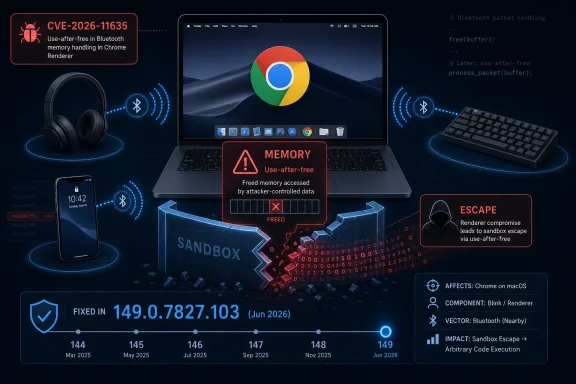
Google Chrome before version 149.0.7827.103 on macOS contains CVE-2026-11635, a critical Chromium Bluetooth use-after-free flaw disclosed June 8, 2026, that could let a remote attacker who already compromised the renderer process escape Chrome’s sandbox through a crafted HTML page. That is the dry vulnerability-database version of the story. The practical version is sharper: this is not the bug that starts the break-in, but it may be the bug that turns a compromised browser tab into something much more dangerous. For WindowsForum readers, the interesting part is not only that the affected platform is Mac, but that Chrome’s security model increasingly lives or dies by the seams between browser code, device APIs, and operating-system-specific plumbing.
CVE-2026-11635 lands in an uncomfortable category: a sandbox escape candidate in a component most users rarely think about. Bluetooth support in a browser sounds like a convenience layer for pairing peripherals or talking to nearby devices. In modern Chromium, however, it is also part of the sprawling attack surface created when web applications are allowed to reach beyond documents and forms into hardware-adjacent capabilities.
The vulnerability is described as a use-after-free in Chrome’s Bluetooth implementation on Mac. That class of bug means software continues to reference memory after it has been released, creating the possibility that an attacker can manipulate what occupies that memory next. In the right conditions, that can become a bridge from memory corruption to code execution or privilege boundary abuse.
The important qualifier is that the attacker first needs to have compromised the renderer process. Chrome’s renderer is where web content lives, and it is intentionally constrained. A renderer compromise is bad, but the sandbox is designed to keep that compromise boxed in; a sandbox escape is what allows an attacker to push past that containment.
That makes CVE-2026-11635 a second-stage vulnerability, not a casual drive-by bug in the simplest sense. But second-stage bugs are exactly what serious exploit chains need. A browser exploit that cannot leave the sandbox is an incident; a browser exploit paired with a sandbox escape is a campaign tool.
That bundling matters. Chrome users rarely patch one CVE; they patch a release. Administrators do not deploy “the Bluetooth fix” so much as they deploy the stable build that contains it, along with dozens of other changes that may or may not be relevant to their fleet.
The NVD record’s chronology is also revealing. Chrome submitted the CVE on June 8, CISA-ADP added a CVSS 3.1 vector the same day, and NIST added initial CPE analysis on June 9. That is a fast public enrichment cycle, but not a complete one: NVD had not yet provided its own CVSS score at the time reflected in the record, while the CISA-ADP vector scored it 8.3, high.
There is a small but familiar disconnect here. Chromium labels the issue critical, while the CISA-ADP CVSS score lands in the high range. That does not necessarily mean anyone is wrong. Vendor severity often reflects exploit-chain relevance and product architecture, while CVSS attempts to score the vulnerability in a more standardized way.
This one is explicitly described as affecting Google Chrome on Mac. The CPE configuration ties vulnerable Chrome versions to macOS rather than to Windows or Linux. That does narrow immediate exposure, and Windows administrators should not misread CVE-2026-11635 as a Windows Chrome vulnerability based on the version number alone.
But mixed fleets are now normal. Many organizations that are “Windows shops” still have MacBook users in engineering, design, executive, security, or bring-your-own-device populations. Those machines often authenticate to the same SaaS platforms, sync the same browser profiles, and carry the same session tokens as managed Windows endpoints.
A Mac-only browser escape can therefore become an enterprise-wide identity problem if the compromised machine belongs to a privileged user. The endpoint platform matters for exploitability; the account context matters for blast radius.
Bluetooth is a particularly awkward example because it sits near real-world devices and user trust. Users understand that a website may display text or run JavaScript. They are less likely to have a clear mental model for what happens when a browser mediates access to nearby hardware.
Chrome and other browsers do build permission prompts, sandbox boundaries, process isolation, and device mediation layers around these capabilities. CVE-2026-11635 is a reminder that the implementation details behind those layers still matter. The abstraction may be a tidy browser permission; the underlying machinery is native code, object lifetimes, callbacks, operating-system interfaces, and memory management.
That is why memory-safety bugs continue to appear in browsers despite the industry’s move toward stronger sandboxing. Sandboxing assumes bugs will exist and limits their damage. It does not eliminate the need to fix the bugs that let attackers climb from one compartment into another.
A renderer compromise can come from a separate vulnerability in V8, Blink, WebAssembly handling, media parsing, graphics paths, or another content-facing component. Once an attacker has code execution in the renderer, the next question is whether they can break out. Sandbox escapes are the answer to that question.
For defenders, this means CVE-2026-11635 should be evaluated as part of an exploit chain, not in isolation. A device-specific sandbox escape may be paired with a more generic renderer bug. A Mac-specific escape may be used only against selected targets after fingerprinting the environment. The absence of broad exploitation claims for this specific CVE does not make the architectural risk theoretical.
There is also a subtle operational issue: exploit-chain vulnerabilities are easy to underprioritize if patch dashboards treat every CVE as a standalone item. A renderer bug with active exploitation may get urgent treatment, while a sandbox escape with a higher complexity score waits for a maintenance window. Attackers do not schedule their chains according to your CVSS sorting.
The high attack complexity reflects the precondition: the renderer must already be compromised. User interaction reflects the crafted HTML page path. Changed scope reflects the boundary jump from one security domain to another, which is the entire reason sandbox escapes are feared.
But scoring systems have a habit of flattening context. A sandbox escape with high complexity may be less urgent than an actively exploited one-click remote code execution bug across all platforms. It may also be more valuable than a simpler bug if it completes a chain against a high-value target population.
The better question for administrators is not “is 8.3 high enough to care?” It is whether vulnerable Mac Chrome installations exist in the environment, whether they auto-update reliably, whether high-value users run Chrome as a daily driver, and whether browser patch compliance is measured in hours, days, or wishful thinking.
This is a place where vulnerability databases can look strange to humans. The affected product is Chrome, but the vulnerable condition is bounded by operating system. A scanner that only sees “Google Chrome before 149.0.7827.103” without platform logic may overreport exposure on Windows and Linux. A scanner that keys too narrowly on macOS may miss unmanaged Chrome installations if inventory data is weak.
The right answer is not necessarily “NVD forgot a CPE.” The better interpretation is that the CPE relationship needs to express both application version and platform. In this case, the presence of the macOS CPE is not incidental; it is part of the affected configuration.
That said, practitioners should still treat NVD enrichment as a starting point, not gospel. CPE mappings can lag, be corrected, or fail to match how commercial inventory tools identify software. If your tooling shows Chrome on Windows as vulnerable to this specific CVE, verify whether it is applying the platform constraint correctly before sending the desktop team on a false hunt.
There are good reasons to control browser updates in managed environments. Compatibility with internal applications, extension governance, change windows, and help-desk readiness all matter. But Chrome is not a quarterly desktop application anymore; it is a frontline security boundary that faces the internet all day.
For CVE-2026-11635, the immediate operational task is simple: confirm that Mac devices running Chrome have moved to 149.0.7827.103 or later. The larger task is to ensure that Chrome’s update state is visible across the fleet and not inferred from policy documents. A policy that allows updates is not the same as proof that updates landed.
This is especially important for remote and hybrid users. A Mac outside the office, asleep during update windows, or excluded from management because it sits in an executive exception group may be precisely the endpoint an attacker wants. Security programs fail less often because nobody wrote the policy and more often because the exception became the normal state.
A sandbox escape involving Bluetooth does not mean every website with a Bluetooth prompt can own a Mac. The CVE description is narrower than that. Still, it underscores that browser-mediated hardware features are not merely user-experience options; they are security-sensitive code paths.
Enterprises should therefore treat hardware-adjacent browser permissions as part of endpoint hardening. If users do not need Web Bluetooth, disable or restrict it through policy. If only a subset of applications needs it, scope access accordingly. Removing unnecessary exposed features is not paranoia; it is classic attack-surface reduction.
For home users, the advice is less elegant but still useful. Keep Chrome updated, restart it when updates are pending, and do not grant device permissions to sites that have no obvious reason to ask. The browser may be the operating system of daily life, but it should not be allowed to become a universal hardware broker by default.
The industry’s increasing interest in memory-safe languages is not academic in this context. A sandbox can contain damage, but memory corruption remains one of the ways attackers get to the point where containment is tested. Reducing that class of bug at the source is more attractive than endlessly refining mitigations around it.
Chromium has invested heavily in hardening, process isolation, fuzzing, exploit mitigations, and safer coding patterns. Yet CVE-2026-11635 shows why the long tail remains painful. Interfaces like Bluetooth, graphics, media, USB, printing, gamepads, and file handling connect modern browser ambition to old-fashioned native complexity.
The future browser security story will likely be less about one heroic mitigation and more about layered attrition: fewer unsafe components, tighter permissions, faster updates, better exploit detection, and more accurate inventory. None of those is glamorous. All of them matter.
 The Browser Sandbox Is Only as Strong as Its Weirdest Edge
CVE-2026-11635 lands in an uncomfortable category: a sandbox escape candidate in a component most users rarely think about. Bluetooth support in a browser sounds like a convenience layer for pairing peripherals or talking to nearby devices. In modern Chromium, however, it is also part of the sprawling attack surface created when web applications are allowed to reach beyond documents and forms into hardware-adjacent capabilities.The vulnerability is described as a use-after-free in Chrome’s Bluetooth implementation on Mac. That class of bug means software continues to reference memory after it has been released, creating the possibility that an attacker can manipulate what occupies that memory next. In the right conditions, that can become a bridge from memory corruption to code execution or privilege boundary abuse.
The important qualifier is that the attacker first needs to have compromised the renderer process. Chrome’s renderer is where web content lives, and it is intentionally constrained. A renderer compromise is bad, but the sandbox is designed to keep that compromise boxed in; a sandbox escape is what allows an attacker to push past that containment.
That makes CVE-2026-11635 a second-stage vulnerability, not a casual drive-by bug in the simplest sense. But second-stage bugs are exactly what serious exploit chains need. A browser exploit that cannot leave the sandbox is an incident; a browser exploit paired with a sandbox escape is a campaign tool.
Google’s Patch Says More Than the CVE Blurb
The fix threshold is clear: Chrome on Mac prior to 149.0.7827.103 is the vulnerable line called out for CVE-2026-11635. Google’s stable-channel desktop update in early June 2026 shipped that Mac build alongside corresponding Windows and Linux builds in the same release family. The Chrome security bulletin also covered a broader set of fixes, which is typical for the browser’s rolling security model.That bundling matters. Chrome users rarely patch one CVE; they patch a release. Administrators do not deploy “the Bluetooth fix” so much as they deploy the stable build that contains it, along with dozens of other changes that may or may not be relevant to their fleet.
The NVD record’s chronology is also revealing. Chrome submitted the CVE on June 8, CISA-ADP added a CVSS 3.1 vector the same day, and NIST added initial CPE analysis on June 9. That is a fast public enrichment cycle, but not a complete one: NVD had not yet provided its own CVSS score at the time reflected in the record, while the CISA-ADP vector scored it 8.3, high.
There is a small but familiar disconnect here. Chromium labels the issue critical, while the CISA-ADP CVSS score lands in the high range. That does not necessarily mean anyone is wrong. Vendor severity often reflects exploit-chain relevance and product architecture, while CVSS attempts to score the vulnerability in a more standardized way.
“Mac Only” Is Not the Same as “Not My Problem”
For a Windows-heavy audience, a Mac-specific Chrome Bluetooth sandbox escape can look like someone else’s fire drill. That would be the wrong lesson. Browser vendors increasingly maintain enormous cross-platform codebases with platform-specific interfaces, and security bugs often cluster around the places where shared browser abstractions meet operating-system APIs.This one is explicitly described as affecting Google Chrome on Mac. The CPE configuration ties vulnerable Chrome versions to macOS rather than to Windows or Linux. That does narrow immediate exposure, and Windows administrators should not misread CVE-2026-11635 as a Windows Chrome vulnerability based on the version number alone.
But mixed fleets are now normal. Many organizations that are “Windows shops” still have MacBook users in engineering, design, executive, security, or bring-your-own-device populations. Those machines often authenticate to the same SaaS platforms, sync the same browser profiles, and carry the same session tokens as managed Windows endpoints.
A Mac-only browser escape can therefore become an enterprise-wide identity problem if the compromised machine belongs to a privileged user. The endpoint platform matters for exploitability; the account context matters for blast radius.
Hardware APIs Keep Becoming Browser Security Problems
The web platform has spent years trying to become a universal application runtime. That ambition brings power: video conferencing, web-based IDEs, enterprise dashboards, password managers, device management portals, and cloud consoles all work because the browser exposes more than static HTML. It also brings an obvious tax: every new bridge between a web page and the local machine must be treated as a potential attack boundary.Bluetooth is a particularly awkward example because it sits near real-world devices and user trust. Users understand that a website may display text or run JavaScript. They are less likely to have a clear mental model for what happens when a browser mediates access to nearby hardware.
Chrome and other browsers do build permission prompts, sandbox boundaries, process isolation, and device mediation layers around these capabilities. CVE-2026-11635 is a reminder that the implementation details behind those layers still matter. The abstraction may be a tidy browser permission; the underlying machinery is native code, object lifetimes, callbacks, operating-system interfaces, and memory management.
That is why memory-safety bugs continue to appear in browsers despite the industry’s move toward stronger sandboxing. Sandboxing assumes bugs will exist and limits their damage. It does not eliminate the need to fix the bugs that let attackers climb from one compartment into another.
The Renderer Compromise Requirement Is a Comforting Trap
The phrase “who had compromised the renderer process” is doing a lot of work in the CVE description. It raises the bar beyond a single crafted page magically owning the host. It also describes exactly the kind of foothold attackers have repeatedly sought in real-world browser exploitation.A renderer compromise can come from a separate vulnerability in V8, Blink, WebAssembly handling, media parsing, graphics paths, or another content-facing component. Once an attacker has code execution in the renderer, the next question is whether they can break out. Sandbox escapes are the answer to that question.
For defenders, this means CVE-2026-11635 should be evaluated as part of an exploit chain, not in isolation. A device-specific sandbox escape may be paired with a more generic renderer bug. A Mac-specific escape may be used only against selected targets after fingerprinting the environment. The absence of broad exploitation claims for this specific CVE does not make the architectural risk theoretical.
There is also a subtle operational issue: exploit-chain vulnerabilities are easy to underprioritize if patch dashboards treat every CVE as a standalone item. A renderer bug with active exploitation may get urgent treatment, while a sandbox escape with a higher complexity score waits for a maintenance window. Attackers do not schedule their chains according to your CVSS sorting.
CVSS Captures the Shape, Not the Stakes
CISA-ADP’s CVSS 3.1 vector for CVE-2026-11635 describes a network attack requiring user interaction, no privileges, high attack complexity, changed scope, and high impact to confidentiality, integrity, and availability. That is a reasonable machine-readable summary. It is not a substitute for judgment.The high attack complexity reflects the precondition: the renderer must already be compromised. User interaction reflects the crafted HTML page path. Changed scope reflects the boundary jump from one security domain to another, which is the entire reason sandbox escapes are feared.
But scoring systems have a habit of flattening context. A sandbox escape with high complexity may be less urgent than an actively exploited one-click remote code execution bug across all platforms. It may also be more valuable than a simpler bug if it completes a chain against a high-value target population.
The better question for administrators is not “is 8.3 high enough to care?” It is whether vulnerable Mac Chrome installations exist in the environment, whether they auto-update reliably, whether high-value users run Chrome as a daily driver, and whether browser patch compliance is measured in hours, days, or wishful thinking.
The CPE Detail Is Messy Because Reality Is Messy
The user-submitted record asks whether a CPE is missing. The NVD change history shows a configuration using Chrome versions up to but excluding 149.0.7827.103, combined with an Apple macOS operating-system CPE. That reflects the platform-specific nature of the issue: vulnerable Chrome, but only in the Mac context.This is a place where vulnerability databases can look strange to humans. The affected product is Chrome, but the vulnerable condition is bounded by operating system. A scanner that only sees “Google Chrome before 149.0.7827.103” without platform logic may overreport exposure on Windows and Linux. A scanner that keys too narrowly on macOS may miss unmanaged Chrome installations if inventory data is weak.
The right answer is not necessarily “NVD forgot a CPE.” The better interpretation is that the CPE relationship needs to express both application version and platform. In this case, the presence of the macOS CPE is not incidental; it is part of the affected configuration.
That said, practitioners should still treat NVD enrichment as a starting point, not gospel. CPE mappings can lag, be corrected, or fail to match how commercial inventory tools identify software. If your tooling shows Chrome on Windows as vulnerable to this specific CVE, verify whether it is applying the platform constraint correctly before sending the desktop team on a false hunt.
Chrome’s Update Machinery Is Strong, But Enterprises Can Still Lose the Race
Chrome’s consumer update story is one of the security industry’s quiet successes. Most users get patched without understanding the release notes, and that is exactly how browser patching should work. The trouble starts when enterprises intentionally slow that machinery down.There are good reasons to control browser updates in managed environments. Compatibility with internal applications, extension governance, change windows, and help-desk readiness all matter. But Chrome is not a quarterly desktop application anymore; it is a frontline security boundary that faces the internet all day.
For CVE-2026-11635, the immediate operational task is simple: confirm that Mac devices running Chrome have moved to 149.0.7827.103 or later. The larger task is to ensure that Chrome’s update state is visible across the fleet and not inferred from policy documents. A policy that allows updates is not the same as proof that updates landed.
This is especially important for remote and hybrid users. A Mac outside the office, asleep during update windows, or excluded from management because it sits in an executive exception group may be precisely the endpoint an attacker wants. Security programs fail less often because nobody wrote the policy and more often because the exception became the normal state.
The Bluetooth Angle Should Make Permission Prompts Feel Less Reassuring
Users have been trained to click through prompts. Browsers ask for camera, microphone, notification, location, file, and device permissions with a rhythm that makes refusal feel like friction rather than security. The web’s permission model is necessary, but it is also increasingly overburdened.A sandbox escape involving Bluetooth does not mean every website with a Bluetooth prompt can own a Mac. The CVE description is narrower than that. Still, it underscores that browser-mediated hardware features are not merely user-experience options; they are security-sensitive code paths.
Enterprises should therefore treat hardware-adjacent browser permissions as part of endpoint hardening. If users do not need Web Bluetooth, disable or restrict it through policy. If only a subset of applications needs it, scope access accordingly. Removing unnecessary exposed features is not paranoia; it is classic attack-surface reduction.
For home users, the advice is less elegant but still useful. Keep Chrome updated, restart it when updates are pending, and do not grant device permissions to sites that have no obvious reason to ask. The browser may be the operating system of daily life, but it should not be allowed to become a universal hardware broker by default.
This Is Another Vote for Memory Safety, Not Another Lecture About Users
Use-after-free bugs are old, well understood, and stubbornly persistent. They thrive in complex native-code systems where object lifetimes are difficult to reason about and performance constraints discourage naive defensive programming. Browsers are among the most complex native-code applications most users run.The industry’s increasing interest in memory-safe languages is not academic in this context. A sandbox can contain damage, but memory corruption remains one of the ways attackers get to the point where containment is tested. Reducing that class of bug at the source is more attractive than endlessly refining mitigations around it.
Chromium has invested heavily in hardening, process isolation, fuzzing, exploit mitigations, and safer coding patterns. Yet CVE-2026-11635 shows why the long tail remains painful. Interfaces like Bluetooth, graphics, media, USB, printing, gamepads, and file handling connect modern browser ambition to old-fashioned native complexity.
The future browser security story will likely be less about one heroic mitigation and more about layered attrition: fewer unsafe components, tighter permissions, faster updates, better exploit detection, and more accurate inventory. None of those is glamorous. All of them matter.
The Patch Is Straightforward; the Lesson Is Not
The concrete action is not complicated: update Chrome on macOS to 149.0.7827.103 or later, and verify that managed systems have actually received the build. The more strategic action is to stop treating platform-specific browser CVEs as edge cases in environments where identities, sessions, and cloud access cross platform boundaries every day.- CVE-2026-11635 affects Google Chrome on macOS before 149.0.7827.103 and is tied to a Bluetooth use-after-free condition.
- The vulnerability matters because it could help an attacker escape Chrome’s sandbox after first compromising the renderer process.
- The CISA-ADP CVSS 3.1 score is 8.3 high, while Chromium’s own security severity is critical.
- The NVD CPE configuration appears to express a platform-bound application issue: vulnerable Chrome versions in combination with macOS.
- Windows-only fleets should avoid false positives, but mixed Windows-and-Mac environments should treat this as a real browser patch-compliance issue.
- Disabling unnecessary hardware-facing browser APIs remains a practical way to shrink attack surface while waiting for the next memory-safety win.
References
- Primary source: NVD / Chromium
Published: 2026-06-15T19:13:40-07:00
NVD - CVE-2026-11635
 nvd.nist.gov
- Security advisory: MSRC
Published: 2026-06-15T19:13:40-07:00
Original feed URL
Security Update Guide - Microsoft Security Response Center
 msrc.microsoft.com
- Related coverage: radar.offseq.com
CVE-2026-11634: Use after free in Google Chrome - Live Threat Intelligence - Threat Radar | OffSeq.com
Detailed information about CVE-2026-11634: Use after free in Google Chrome affecting Google Chrome. Get real-time updates, technical details, and mitigation strradar.offseq.com
