

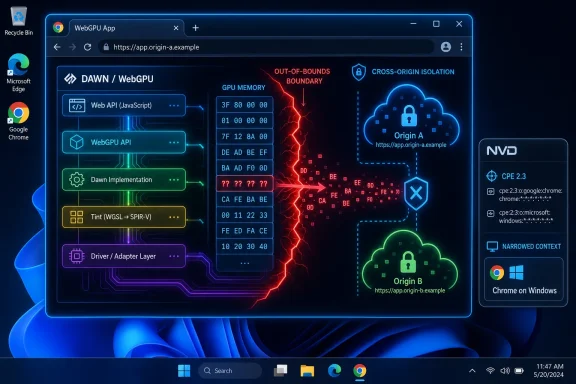
The CPE Is Narrow Because the Vulnerability Is Narrowly Stated
The NVD configuration for CVE-2026-11665 pairs Google Chrome versions before 149.0.7827.103 with Microsoft Windows. That looks odd at first glance because Chrome is a cross-platform product, Dawn is a cross-platform graphics abstraction layer, and Chromium-derived browsers are everywhere. But the CVE description itself is explicit: “Google Chrome on Windows.”
That wording matters. CPEs are not supposed to be a map of every codebase that contains a library; they are supposed to represent known affected products and platforms. If the assigning authority says the exploitable condition applies to Chrome on Windows, NVD’s Chrome-plus-Windows configuration is a defensible enrichment rather than an omission.
The temptation is to add Chromium, Microsoft Edge, Brave, Vivaldi, Opera, Electron, or even Dawn as separate affected products. That may eventually prove warranted if vendors publish advisories tying the same flaw to their builds. But absent that evidence, adding those CPEs would turn a vulnerability record into a guess.
That distinction is more than pedantry. Enterprise scanners, patch SLAs, risk dashboards, and compliance evidence often treat CPE matches as machine-readable truth. A too-broad CPE can create false positives at scale; a too-narrow one can hide exposure. CVE-2026-11665 is a case study in why CPE is useful but not sufficient.
Dawn Makes This More Than Just Another Chrome Memory Bug
Dawn is Chromium’s implementation layer for WebGPU, the modern browser graphics and compute API intended to give web applications controlled access to GPU capabilities. It exists because the browser is no longer just a document viewer with JavaScript bolted on. It is now a sandboxed runtime for video editors, games, CAD tools, AI demos, visualization apps, and increasingly ambitious enterprise web software.
That ambition creates a large attack surface. Graphics APIs must translate web-facing abstractions into GPU commands while enforcing origin boundaries, validation rules, memory safety, and driver compatibility. A bug in that path is not automatically catastrophic, but it can become highly sensitive when it permits reads outside the intended memory boundary.
CVE-2026-11665 is described as an out-of-bounds read, mapped to CWE-125. In plain English, the browser could be tricked into reading data it should not read. The stated impact is cross-origin data leakage, meaning a crafted HTML page could potentially expose information from another web origin that browser security rules are designed to keep isolated.
That is why this bug deserves attention even though CISA’s ADP CVSS 3.1 score lands at 4.3, or “medium.” The numeric score reflects a limited confidentiality impact, required user interaction, no privileges, and no integrity or availability impact. But browser vulnerabilities often live or die by context, and cross-origin leakage in a mainstream browser is never just a theoretical inconvenience.
“High” in Chromium and “Medium” in CVSS Are Not Actually Contradictory
One confusing part of this record is the severity split. Chromium labels the bug high severity, while the available CVSS 3.1 vector scores it as medium. That does not necessarily mean one party is wrong.
Chromium’s severity process is product-centered. It asks how dangerous the bug is inside Chrome’s security model, how reachable it is from web content, and what kind of browser boundary it undermines. A remote web page leaking cross-origin data is a serious browser security event even if it does not immediately execute code or crash the system.
CVSS, by contrast, is a generalized scoring framework. It compresses exploitability and impact into a vector. For CVE-2026-11665, the published vector says the attack is network-accessible, low-complexity, requires no privileges, requires user interaction, has unchanged scope, and causes low confidentiality impact only. That math yields a medium score.
For administrators, the practical reading is simple: do not downgrade the urgency merely because one field says “medium.” Browser bugs with low-friction web delivery deserve fast patching, particularly when the affected application is Chrome and the vulnerable surface is reachable through ordinary browsing.
The Windows Qualifier Is the Most Important Word in the Record
The phrase “on Windows” is doing real work here. It indicates that the known vulnerable configuration is not simply “all Chrome before 149.0.7827.103.” It is Chrome on Windows before that version.
That could mean the bug depends on a Windows-specific code path in Dawn, a graphics backend difference, a driver interaction, a build flag, or the way Chrome wires Dawn into the Windows desktop environment. The public record does not give enough detail to say which. Google’s bug tracker entry is restricted, as is common for Chrome security bugs until enough users have updated.
This is where vulnerability management gets uncomfortable. Security teams want crisp applicability rules. Browser engineering often produces messy platform-specific realities. The safest operational posture is to patch Chrome everywhere, but the cleanest CPE expression may still be Windows-only.
The version number also deserves care. The NVD text says Chrome on Windows prior to 149.0.7827.103. Google’s stable-channel updates around this release used closely related build numbers across Windows, macOS, and Linux, with some reporting noting 149.0.7827.102 and .103 depending on platform and rollout. For Windows administrators, the defensible rule is not to split hairs over the last digit in isolation; it is to ensure Chrome is at or beyond the fixed stable channel build offered by Google for that machine.
The Missing-CPE Question Exposes a Bigger Weakness in Asset Matching
If the concern is whether the NVD entry should include another CPE for Google Chrome, the current configuration appears aligned with the public description: Chrome application CPE constrained by Windows OS CPE. If the concern is whether the entry captures every downstream exposure in the Chromium ecosystem, then the answer is almost certainly no — and that is normal.
CPE was never designed to fully model modern software supply chains. Chromium is a browser project, a codebase, a dependency source, and an ecosystem foundation. Dawn itself is a component used inside Chromium and potentially elsewhere. A CPE entry for Google Chrome does not automatically tell you whether an Electron application, an embedded browser component, or another Chromium-based browser inherited the same vulnerable code and shipped it in an exploitable configuration.
That does not make NVD useless. It means NVD is a starting point, not an oracle. Mature vulnerability management programs already know this from OpenSSL, zlib, libwebp, ANGLE, V8, Skia, and other shared components. The product-level CVE record is often less complete than the code lineage.
For WindowsForum readers, this distinction is especially relevant because Windows fleets commonly contain multiple Chromium surfaces. Chrome may be the headline, but Edge WebView2 runtimes, Electron apps, bundled updaters, collaboration tools, password managers, endpoint consoles, and line-of-business wrappers may all carry pieces of the same browser universe. CVE-2026-11665 may not formally apply to all of them, but the security workflow it triggers should make administrators ask where Dawn and WebGPU-capable Chromium code actually exist in their environment.
Edge Is the Obvious Question, but Not an Automatic Answer
The first product many Windows admins will think of is Microsoft Edge. Edge is Chromium-based, ships broadly on Windows, and receives security updates that often track Chromium fixes. That does not automatically mean CVE-2026-11665 should list Edge as affected in NVD.
Microsoft typically publishes its own Edge release notes and security acknowledgments when Chromium CVEs apply to Edge. Until that vendor statement exists for this specific CVE, adding an Edge CPE to the Chrome record would be speculation. The right operational move is to patch Edge through its normal channel and monitor Microsoft’s advisory stream, not to rewrite Google’s CVE scope by inference.
The same logic applies to Brave, Opera, Vivaldi, Arc, and other Chromium-based browsers. They may consume the underlying fix. They may have different exposure depending on feature flags, platform support, build timing, and code integration. They may publish advisories after Google’s initial disclosure. None of that automatically belongs in the NVD record for Google Chrome unless the affected product relationship is established.
This is frustrating, but it is also the only sane way to keep machine-readable vulnerability data from collapsing under assumption. A vulnerability record that says “Chrome on Windows” should not silently become “all Chromium things everywhere” simply because that is operationally convenient.
Cross-Origin Leakage Is the Browser Bug That Refuses to Stay Small
The phrase “leak cross-origin data” can sound less dramatic than “remote code execution,” but it cuts directly into one of the browser’s central promises. The web security model depends on the idea that one site cannot simply read another site’s data. Your banking tab, webmail tab, internal dashboard, SaaS admin console, and random hostile page are supposed to be separated by origin boundaries, process isolation, sandboxing, cookies, site isolation, and a long stack of mitigations.
An out-of-bounds read in a graphics component threatens that model from an unexpected angle. The attacker is not necessarily breaking into the OS. They may be coaxing the browser into exposing memory or data that should be inaccessible from the attacker’s origin. In a world where web apps hold authentication tokens, document previews, session state, and enterprise data, low-confidentiality impact can still be consequential.
The public description says user interaction is required. In browser CVEs, that usually means the target must visit or open a crafted page. That is a low bar. Phishing emails, malicious ads, compromised websites, forum posts, chat links, and poisoned search results all exist to solve the “please visit this page” problem.
That is why Chrome security updates are operationally different from many application patches. A vulnerable browser sits in the path of arbitrary untrusted content all day. The exploit delivery mechanism is the product’s core function.
Restricted Bug Details Are a Feature, Not a Cover-Up
The Chromium issue linked from the CVE is permission-restricted. That is normal. Browser vendors routinely keep exploit details private until a large share of the installed base has received the fix, especially when the bug is security-sensitive or could help attackers build a working exploit.
This creates a familiar tension. Administrators want enough detail to prioritize. Researchers want transparency. Attackers want reproduction steps. Vendors try to thread the needle by publishing CVE descriptions, affected versions, severity, and update channels while withholding the exact trigger and patch diff context for a period of time.
For CVE-2026-11665, the restricted details leave several unanswered questions. We do not know the precise Dawn subsystem involved. We do not know whether WebGPU must be enabled in a particular configuration. We do not know whether a specific GPU vendor, driver family, or Windows version changes exposure. We do not know whether the bug can be chained with other issues to produce a larger compromise.
Those unknowns argue for patching, not panic. The record does not say this flaw is exploited in the wild. That distinction belongs to a different Chrome CVE from the same update cycle, CVE-2026-11645, a V8 issue that Google acknowledged had exploit activity. CVE-2026-11665 should not be inflated into a zero-day story without evidence.
Chrome’s Update Machinery Is Strong, but Enterprise Reality Is Messier
For consumers, the likely fix path is simple: Chrome updates itself, the user restarts the browser, and the vulnerable build disappears. For managed Windows environments, the story is less automatic. Browser restarts collide with help-desk culture, kiosk sessions, VDI images, app compatibility testing, change windows, and the eternal user habit of keeping 80 tabs open for weeks.
Chrome’s security model assumes rapid update velocity. Enterprise IT often assumes staged control. Those assumptions are not enemies, but they are in constant negotiation.
The right response to CVE-2026-11665 is not to create a bespoke crisis process. It is to verify that the existing Chrome update process actually reaches endpoints quickly enough. A high-severity browser bug that requires only a crafted page is a good test of whether update policy is real or merely documented.
On Windows, that means checking more than the browser icon on a gold image. It means verifying installed versions across user profiles, managed and unmanaged devices, remote systems, dormant laptops, and machines outside the VPN. It also means remembering that Chrome’s presence in an enterprise may not be limited to the standard installer path that inventory tooling expects.
Version Compliance Is the Only Reliable Short-Term Control
Workarounds for browser component vulnerabilities are rarely satisfying. Disabling experimental graphics features, blocking WebGPU, hardening site isolation, or restricting untrusted browsing may reduce risk in some environments, but those controls are difficult to validate against an undisclosed bug. The published fix is the fix.
For most organizations, the immediate control is version compliance. Chrome on Windows should be updated beyond the affected range. If administrators use Chrome Browser Cloud Management, Group Policy, Intune, ConfigMgr, third-party patch tools, or endpoint management suites, the job is to make the installed version visible and enforce restarts where necessary.
The restart is often the hidden failure point. Chrome can download an update and still remain vulnerable until the browser process restarts. In enterprise dashboards, “update available” and “update applied” are not the same thing. A browser that has not relaunched is a browser still running old code.
Security teams should also resist treating the CISA ADP medium score as permission to wait for the next routine patch cycle. A web-delivered confidentiality bug in Chrome belongs in the accelerated lane, even if it does not require an emergency all-hands bridge.
NVD’s Enrichment Lag Is Now Part of the Risk Model
The CVE record shows a familiar modern pattern: the CVE arrives from Chrome, CISA ADP adds a CVSS vector, and NIST later enriches the record with CPE configuration and reference types. That sequence is useful, but it also highlights how vulnerability intelligence is assembled in stages.
In the old mental model, a CVE record became “real” when NVD had a score, CPEs, CWEs, and references. In the current environment, waiting for that completeness can be a liability. Vendor advisories, CNA descriptions, CISA enrichment, and scanner plugin updates may all appear on different timelines.
CVE-2026-11665 is not a catastrophic example; NVD’s enrichment followed quickly. But the record still shows why defenders need to separate disclosure from enrichment. The risk exists when the vulnerable code is in the environment, not when every database field is populated.
This is especially important for Chrome because updates often arrive in clusters. The June 2026 desktop update included many security fixes, and public attention understandably gravitated toward the actively exploited V8 issue. CVE-2026-11665 could be easy to miss because it was not the zero-day headline. But inventory systems do not get to patch only the famous CVEs; they must verify the fixed build.
The Record Should Not Be Used to Minimize Non-Windows Browsers
The Windows-specific CPE is appropriate for the record as written, but it should not be misread as proof that non-Windows browsers need no action. Chrome updates are cumulative. Even if CVE-2026-11665 is Windows-only, the same stable update train fixed other vulnerabilities across platforms.
This is where product security and vulnerability accounting diverge. A Mac or Linux admin may not need to track CVE-2026-11665 as directly applicable. They still need the Chrome update because the release contains other fixes. Patch management should follow vendor release channels, not cherry-pick individual CVEs from a multi-fix browser release.
Windows administrators face the reverse problem. They should not assume that because the bug is “only” a data leak and “only” Chrome, it is isolated from enterprise risk. Chrome is often the most exposed application on a Windows endpoint. It is also one of the fastest-moving, which means stale versions become visible markers of weak hygiene.
The same principle applies to vulnerability scanners. If a scanner flags CVE-2026-11665 on Chrome for Windows before 149.0.7827.103, that is consistent with the public record. If it flags every Chromium-derived product without vendor support, teams should inspect the logic. If it fails to flag Chrome on Windows because NVD scoring is incomplete or delayed, that is a scanner workflow problem.
The Practical Answer for Windows Admins Is Smaller Than the Implications
The immediate remediation is not complicated. Update Chrome on Windows to the fixed stable build or later, force or encourage a browser restart, and verify the installed version through management tooling rather than assumption. The complication lies in what this CVE reveals about the modern browser attack surface.
Dawn and WebGPU are part of the web’s future. They allow richer applications and better performance, but they also carry the burden of safely exposing complex hardware-backed capabilities to hostile content. Every layer that makes the browser more powerful becomes another layer where memory safety, validation, and isolation must hold.
That is not an argument against WebGPU. It is an argument against pretending the browser is a solved security problem. Chrome’s sandbox, site isolation, process model, and update cadence are formidable defenses, but they are defenses under constant pressure.
For WindowsForum’s audience, the lesson is not “fear Dawn.” It is “understand what your browser has become.” Chrome is now a graphics runtime, media engine, JavaScript VM, WebAssembly host, identity surface, document viewer, password broker, and enterprise application platform. A bug in any one of those layers can become a browser security event.
The Concrete Moves This CVE Demands
CVE-2026-11665 is narrow in the database and broad in its operational implications. The right response is disciplined patching, careful inventory, and skepticism toward both under-scoped and over-scoped vulnerability matches.
- Chrome on Windows installations before 149.0.7827.103 should be treated as affected by CVE-2026-11665 and updated promptly.
- The current NVD CPE configuration appears consistent with the public CVE wording because the vulnerability is described as affecting Google Chrome on Windows.
- Administrators should not add Edge, Brave, Opera, Electron, or generic Chromium exposure to this CVE unless those vendors or projects publish affected-product guidance.
- Security teams should still patch other Chromium-based browsers through their own update channels because shared-code risk is operationally real even when a specific CVE record is product-limited.
- A medium CVSS score should not push this into a slow patch lane, because web-delivered cross-origin data leakage in a mainstream browser is a practical security concern.
- Version reporting should confirm that Chrome has restarted into the fixed build, not merely that an update package was downloaded.
The deeper story of CVE-2026-11665 is that browser vulnerability management has outgrown the neat boundaries of old asset databases. In this case, NVD does not appear to be missing the obvious Chrome-on-Windows CPE; rather, the record shows how precise public vulnerability data can still leave administrators with broader ecosystem questions. That gap will only widen as browsers absorb more GPU, AI, media, and application-runtime responsibilities, and the organizations that handle it best will be the ones that treat CPE as a signal — not a substitute for understanding the software they actually run.