

The Vulnerability Is Android-Specific, but the Advisory Trail Starts on Desktop
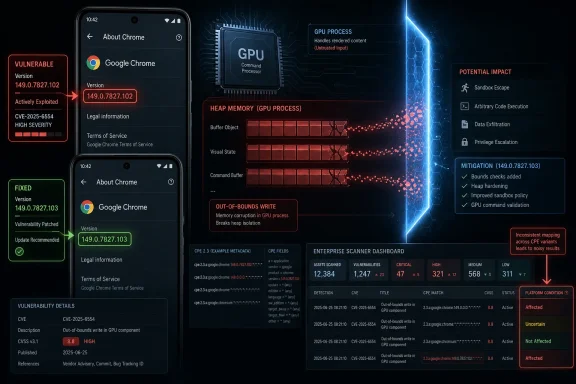
CVE-2026-11672 is described as an out-of-bounds write in Chrome’s GPU component, affecting Google Chrome on Android before 149.0.7827.103. The core exploitation condition is notably more specific than the usual “visit a malicious website” shorthand: an attacker would first need to compromise the renderer process, then use a crafted HTML page to potentially escape the sandbox.
That makes this a second-stage browser bug, not the first domino. In a real exploit chain, the first stage would likely be a renderer compromise, such as a JavaScript engine or DOM-related memory corruption issue. The GPU flaw then becomes valuable because it offers a way to break out of the renderer sandbox boundary and reach a more privileged context.
The confusing part is that one of the references attached to the CVE is Google’s Stable Channel Update for Desktop, which shipped Chrome 149.0.7827.102/.103 for Windows and Mac and 149.0.7827.102 for Linux. That same update included a long list of security fixes, including CVE-2026-11672 as a high-severity GPU issue. The CVE wording, however, narrows this specific impact to Chrome on Android.
That distinction matters. A security team that sees the desktop advisory, the Android wording, and the NVD configuration in the same record may reasonably ask whether Chrome on Windows is vulnerable, whether Android itself is vulnerable, or whether the database is trying to express a platform condition that does not map neatly to one product name.
The CPE Record Is Trying to Say “Chrome on Android,” Not “Android Is the Bug”
The user’s question — are we missing a CPE here? — gets to the heart of how CPEs work badly in precisely the cases that matter most. NVD’s initial analysis added a configuration that effectively combines a vulnerable Google Chrome application CPE with an Android operating-system CPE. In plain English, that reads as Chrome versions before the fixed release, when running on Android.
That is probably not meant to say that the Android operating system itself contains the heap buffer overflow. The CVE description attributes the flaw to Google Chrome’s GPU component on Android. Android appears in the configuration because it is the platform condition under which this particular Chrome vulnerability is known to apply.
But the phrasing is still awkward because CPE is a blunt instrument. It is good at saying “this named product version is vulnerable.” It is much worse at saying “this application is vulnerable only when built for this platform, using this process model, graphics stack, and sandbox arrangement.” Browser vulnerabilities frequently sit in that gap.
So yes, one could argue that the record is missing a cleaner product representation if a distinct Chrome-for-Android CPE exists or should exist in the affected-software list. But it is also fair to read the current configuration as NVD’s attempt to model a compound condition: vulnerable Chrome plus Android platform. That is not elegant, but it is a recognizable pattern in vulnerability data.
The Version Mismatch Is the Real Metadata Smell
The more consequential oddity is the version boundary. The CVE description says Chrome on Android prior to 149.0.7827.103. NVD’s change history, as provided, says the CPE configuration was added for Google Chrome versions up to, but excluding, 149.0.7827.102, combined with Android.
That is the kind of one-build discrepancy that makes automated compliance reporting brittle. If the fixed Android version is 149.0.7827.103, then excluding only 149.0.7827.102 could understate exposure for a narrow band of builds. If the desktop advisory’s Windows/Linux versioning bled into the CPE analysis, then scanners may inherit a platform-specific mismatch.
Chrome version numbers are not uniform across every platform in every release. It is common for the same security advisory to mention slightly different build numbers for Windows, Mac, Linux, and mobile. That does not mean the patch is absent on one platform, but it does mean database maintainers need to preserve the platform-specific fixed version rather than flattening everything into one boundary.
For admins, the practical answer is to treat 149.0.7827.103 as the safer Android threshold because that is what the CVE description names. If a scanner says an Android Chrome build below .102 is vulnerable but says nothing about .102 versus .103, the scanner is not precise enough for this CVE.
The GPU Process Is No Longer a Peripheral Risk
For years, the browser security conversation has revolved around JavaScript engines. V8 bugs are easy to explain: malicious page, memory corruption, code execution, emergency update. GPU bugs are harder to narrate, but they are increasingly central to browser exploitation because the web platform has become graphically ambitious.
The GPU process sits at a high-pressure junction. It handles accelerated compositing, WebGL, WebGPU-related plumbing, video paths, canvas work, and cross-platform abstraction layers that differ sharply between desktop and mobile. It is exactly the place where untrusted web content meets drivers, shaders, memory buffers, and platform-specific graphics APIs.
An out-of-bounds write in that neighborhood is therefore not just another memory-safety defect. It can become a bridge between a compromised renderer and a more privileged browser component. That is why the phrase sandbox escape carries more operational weight than the “High” label alone.
On Android, this attack surface is especially interesting because Chrome’s sandboxing model, Android’s app isolation, GPU driver behavior, and device-vendor update realities all overlap. Even when Google fixes Chrome quickly, the ecosystem still depends on users, OEM policies, managed-device settings, and Play Store rollout timing to make the fix real.
A High CVSS Score With High Attack Complexity Still Deserves Attention
CISA-ADP assigned the vulnerability a CVSS 3.1 score of 8.3, with network attack vector, no privileges required, user interaction required, changed scope, and high confidentiality, integrity, and availability impact. The attack complexity is marked high, which is consistent with a bug that requires a prior renderer compromise rather than standing alone as a one-click full-chain exploit.
That combination should not reassure anyone into inaction. High attack complexity often means “hard to weaponize independently,” not “irrelevant.” Browser exploit chains routinely combine multiple bugs, and the second bug in the chain can be the one that turns a contained crash or renderer compromise into device-level consequences.
The CVE’s wording also says the attacker must have compromised the renderer process. That is an important condition, but not a fantasy condition. Renderers are exactly where attackers aim first because they parse and execute the web’s hostile input stream.
The absence of an NVD-provided CVSS score at the time of the record’s early enrichment is another reminder that the score is not the vulnerability. The technical description, fixed version, affected platform, and exploitability conditions are more useful than waiting for a final badge color.
Windows Admins Still Have a Reason to Care
At first glance, a Chrome-on-Android GPU bug sounds outside the usual WindowsForum lane. It is not. Most enterprise Windows environments now include Android devices, Android work profiles, Chrome sync, mobile access to Microsoft 365, passkeys, conditional access flows, and browser-based identity sessions that do not respect the old desktop perimeter.
A compromised mobile browser can become an identity problem before it becomes a device problem. Session cookies, OAuth tokens, saved credentials, enterprise web apps, and cloud admin portals all live in the browser’s blast radius. If an attacker can chain a renderer compromise with a sandbox escape, the security boundary between “just a tab” and “the user’s working environment” becomes much thinner.
Windows shops also need to remember that Chromium is not Chrome alone. Microsoft Edge, Brave, Vivaldi, Opera, Samsung Internet, and many embedded browser surfaces ride the Chromium train in different ways and at different speeds. CVE-2026-11672 is described for Google Chrome on Android, but the underlying issue lives in Chromium’s GPU codebase, which means downstream vendors must be watched even when the original advisory names Chrome.
The right operational response is not panic; it is inventory. If your patch dashboard cannot tell you which Android devices are running which browser engine version, you do not have a browser vulnerability-management program. You have a desktop patch program with a mobile blind spot.
The Scanner Will Be Only as Smart as the CPE
The CPE question is not academic because scanners ingest this metadata and then produce dashboards that executives treat as reality. If the CPE says Google Chrome before one build number and Android as a platform condition, some tools will interpret it correctly. Others may flag every Android device, miss Chrome for Android entirely, or confuse desktop Chrome exposure with mobile Chrome exposure.
That is the risk of compound CPE configurations. They require the scanner to understand the logical relationship between application and operating system. A careless implementation can turn an AND condition into two separate findings, or treat the OS CPE as the vulnerable product rather than the platform context.
For security teams, this is where blind trust in vulnerability feeds becomes dangerous. The feed may be directionally correct and still operationally misleading. A human needs to read the CVE description, compare it with the vendor advisory, and check whether the fixed version boundary matches the platform actually deployed.
This is also why software bills of materials and package inventories do not magically solve endpoint vulnerability management. Knowing that “Chrome” exists is not enough. You need to know the channel, platform, version, update source, and whether a Chromium-derived browser has pulled the relevant patch.
Google’s Disclosure Style Protects Users and Frustrates Defenders
Google’s Chrome advisories routinely restrict bug details until most users have received the fix. That policy is sensible. Publishing exploit-grade details before the update has propagated would help attackers more than defenders.
But the same restriction leaves defenders with a sparse record. In this case, the public trail gives us the component, weakness type, platform condition, severity, broad exploit prerequisite, and fixed version. It does not give a proof of concept, affected code path, crash signature, or reliable detection logic.
That puts enterprise defenders in the familiar position of patching based on trust in the vendor and the severity model. For Chrome, that trust is usually warranted, but it does not eliminate the operational problem. A SOC cannot easily hunt for exploitation of a bug whose details are intentionally sealed.
The practical defense is therefore boring but effective: update quickly, verify the version, reduce risky browser extension exposure, isolate high-value admin work, and avoid treating mobile browsers as casual endpoints. The lack of exploit details is not a reason to wait. It is the reason the patch window matters.
Android’s Browser Update Model Is Better Than It Used to Be, but Still Uneven
Chrome on Android benefits from Play Store delivery, which is a major improvement over the old model of waiting for a full operating-system update. In many consumer and enterprise environments, the browser can be updated independently of the OEM firmware cadence. That makes Chrome vulnerabilities more manageable than baseband or kernel flaws trapped behind carrier approval.
Still, “available” is not the same as “installed.” Users can disable automatic updates, managed devices can lag behind policy windows, Play Store availability can roll out gradually, and corporate mobility stacks can delay app updates for testing. Kiosk devices, shared tablets, ruggedized Android hardware, and devices without standard Google services may be even more complicated.
The enterprise answer is to stop treating mobile app patching as a consumer convenience. Chrome should be under the same kind of version enforcement as desktop browsers. If access to sensitive corporate resources depends on a browser, that browser’s patch level should be part of conditional access decisions.
The consumer answer is simpler. Open Chrome’s settings, check the version, update from the Play Store, and restart the browser. Browser updates that fix sandbox escapes do not help until the fixed code is actually running.
The Correct Patch Story Is Narrower Than the Fear Story
There is a temptation to describe every browser memory bug as a remote-code-execution emergency. CVE-2026-11672 deserves attention, but precision matters. The public description does not say that a remote attacker can directly compromise Chrome on Android from a clean starting point using only this bug.
It says a remote attacker who had already compromised the renderer process could potentially perform a sandbox escape via crafted HTML. That makes CVE-2026-11672 a chain amplifier. It increases the value of a separate renderer exploit by giving the attacker a path beyond the sandbox.
That distinction should shape response priorities. If you manage Android devices with Chrome below 149.0.7827.103, patching is urgent. If you are triaging vulnerability reports, do not misclassify this as a standalone unauthenticated full device takeover based solely on the CVE name.
The words “potentially perform” also matter. They reflect the uncertainty built into vulnerability descriptions before full technical details are public. A high-severity sandbox escape path is serious enough without inflating it into certainty the record does not support.
The CPE Should Be Treated as Provisional Until the Databases Catch Up
NVD records often evolve after initial publication. Enrichment can add CPEs, adjust configurations, import CVSS vectors, and correct references. The CVE-2026-11672 record had already changed several times within days of publication, which is normal for a fresh browser vulnerability.
That makes the CPE question a good candidate for feedback to NVD or the CNA if the configuration remains ambiguous. The ideal record would make three things unambiguous: the vulnerable product is Google Chrome for Android, the affected versions are prior to 149.0.7827.103, and Android is a platform condition rather than the vulnerable code owner.
If NVD’s CPE dictionary lacks a clean way to express Chrome for Android separately from generic Google Chrome plus Android, then the problem is structural rather than merely clerical. The vulnerability ecosystem has long struggled with products that are both applications and platform-specific builds. Browsers expose that weakness constantly.
For now, defenders should annotate the finding internally. A ticket that simply says “CVE-2026-11672 affects Android” will confuse asset owners. A ticket that says “Update Google Chrome on Android to 149.0.7827.103 or later because of a GPU sandbox-escape bug” will get fixed.
The Practical Reading of This Record Is Smaller, Sharper, and More Useful
The actionable story is not that Android itself suddenly has a Chrome GPU vulnerability, nor that every desktop Chromium user is necessarily exposed to this exact CVE. The actionable story is that Chrome on Android had a high-severity GPU heap buffer overflow before 149.0.7827.103, and the public metadata around it is messy enough to require human interpretation.
- Google’s public Chrome advisory listed CVE-2026-11672 among the June 8, 2026 Stable Channel security fixes, while the CVE description specifically calls out Chrome on Android before 149.0.7827.103.
- The vulnerability is best understood as a potential sandbox-escape stage after a renderer compromise, not as a complete exploit chain by itself.
- The Android CPE in NVD’s configuration appears to describe the affected platform condition, not to identify Android itself as the component containing the bug.
- The version boundary should be checked carefully because the CVE description names 149.0.7827.103, while the NVD configuration shown in the change history appears to use a .102 cutoff.
- Vulnerability scanners may misread compound CPE logic, so administrators should validate findings against actual Chrome-on-Android versions rather than relying only on dashboard severity.
- Managed Android fleets should treat Chrome updates as security-controlled software updates, not as optional app-store housekeeping.
The broader lesson is that browser security has outgrown the tidy product boxes our vulnerability databases still prefer. CVE-2026-11672 is a small, sharp example: a GPU bug in a mobile Chrome build, disclosed through a desktop-flavored advisory, scored by one enrichment source before NVD completed its own assessment, and represented through a CPE structure that may be technically defensible while still operationally confusing. The fix is to update, but the durable improvement is to make browser inventory and vulnerability interpretation precise enough that the next ambiguous record does not become a week-long argument between the scanner, the mobile team, and the people actually carrying the risk.