
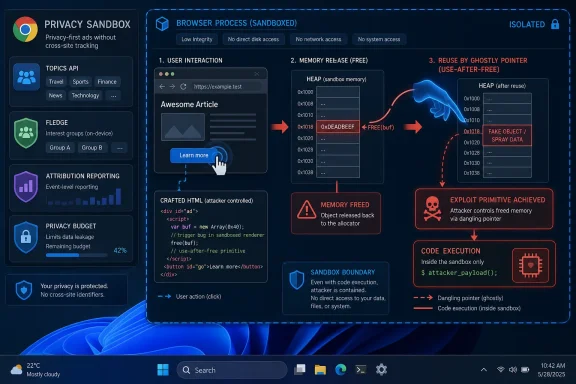
Google assigned CVE-2026-11673 to a high-severity use-after-free flaw in Chrome’s InterestGroups component, fixed in Chrome 149.0.7827.103 for Windows and macOS before June 9, 2026, after NVD published the entry on June 8. The exploit condition is brutally familiar: a crafted HTML page, user interaction, and arbitrary code execution inside Chrome’s sandbox. The interesting part is not that Chrome had another memory-safety bug; it is where the bug lived. InterestGroups sits in the machinery of privacy-preserving ad targeting, which means this vulnerability lands precisely where modern browsers are trying to do more computation on behalf of advertisers while promising users less tracking.
CVE-2026-11673 is not a browser bug in the abstract. It is a bug in InterestGroups, the Chrome technology associated with on-device advertising audiences under the Privacy Sandbox umbrella. That matters because the component is part of Google’s long-running attempt to replace older cross-site tracking mechanisms with browser-mediated ad auctions and audience membership.
The vulnerability description is short, as Chrome CVEs often are: use after free, crafted HTML page, code execution inside the sandbox. In security terms, that says enough. A remote attacker does not need an account on the victim’s machine, does not need local access, and does not need a privileged foothold. They need the user to reach attacker-controlled content that can trigger the memory corruption.
The phrase “inside a sandbox” should not be read as “safe.” Chrome’s sandbox is a major mitigation boundary, and it usually prevents a renderer compromise from becoming immediate full-system compromise. But renderer-level code execution is still a serious breach of the browser’s trust model, especially when paired with a second bug that escapes the sandbox or abuses exposed browser surfaces.
That is why CISA’s ADP scoring landed at 8.8 High under CVSS 3.1, with network attack vector, low attack complexity, no privileges required, and user interaction required. The score is not panic theater. It is a sober reflection of what happens when remote web content can steer memory corruption in the most exposed application on most desktops.
Chrome has invested heavily in hardening against this class of bug. Site isolation, sandboxing, MiraclePtr-style protections, fuzzing, and memory-safety initiatives have all raised the cost of exploitation. Yet the fact that high-severity use-after-free CVEs still appear in Chrome is a reminder that mitigations reduce the blast radius and exploit reliability; they do not magically erase complex C++ lifetimes.
What changes over time is the neighborhood where these bugs appear. Ten years ago, the canonical browser bug lived in parsing, layout, media codecs, or JavaScript engines. Those are still fertile ground. But modern browser risk increasingly lives in newer, higher-level subsystems: identity, payments, sync, machine-learning helpers, device APIs, and now ad-tech privacy infrastructure.
InterestGroups is a particularly revealing location because it is not a nostalgic plug-in or legacy corner. It is part of the browser’s future-facing policy argument: let Chrome mediate ad relevance without leaking the same cross-site identifiers that defined the cookie era. CVE-2026-11673 does not prove that model is doomed. It does prove that moving ad logic into the browser also moves security responsibility there.
A compromised renderer can still observe and manipulate a large amount of browser-mediated state. Depending on the exact exploit path and site isolation boundaries, an attacker may be able to tamper with content in the compromised process, steal data available to that process, stage further exploitation, or attack interfaces exposed between the renderer and the browser process. The sandbox is a wall, not a disinfectant.
The CVSS vector captures this nuance. User interaction is required, because a victim generally has to visit or load malicious content. Scope is unchanged, because the published scoring does not assert a cross-boundary escape. Confidentiality, integrity, and availability are all high, because arbitrary code execution in the browser context is not a cosmetic fault.
For Windows users, the practical story is mundane and urgent: Chrome must be updated, and Chromium-derived browsers need their vendor-specific patches when applicable. Microsoft Edge, Brave, Vivaldi, Opera, and other Chromium-based browsers do not automatically become safe because Google shipped Chrome. They inherit much of the Chromium engine, but their patch timing, version numbers, and enterprise deployment channels differ.
This distinction matters in vulnerability management dashboards. A Windows endpoint showing exposure to CVE-2026-11673 is not telling you that Windows itself needs a monthly cumulative update to remediate the Chrome bug. It is telling you that Chrome on that Windows endpoint is below the fixed version, or that asset inventory believes it is.
That sounds obvious until patch compliance reporting gets involved. Security teams often aggregate CVEs by device, operating system, and severity, then ask desktop engineering why Windows has another high-severity finding. In this case, remediation belongs to the browser update channel, software management platform, or application control workflow.
There is also the usual CPE caveat. NVD’s CPEs are useful for coarse matching, but they are not a perfect inventory model. Portable Chrome builds, enterprise-pinned update channels, stale user profiles, VDI images, and Chromium forks can all complicate detection. A scanner that only sees “Chrome installed” may not understand whether the executable actually launched by users is the fixed one.
That caution is rational. Browsers are business-critical runtimes now, not mere applications. A Chrome update can affect authentication flows, intranet portals, print workflows, line-of-business web apps, extensions, and endpoint security agents that hook browser behavior. The result is a recurring negotiation between speed and confidence.
CVE-2026-11673 leans that negotiation toward speed. The exploit requires user interaction, but “visit a crafted page” is not a high bar in a world of malvertising, phishing, compromised legitimate sites, and collaboration platforms that render links all day. The absence of a public NVD score from NIST at the time of publication is not a reason to wait; CISA’s ADP score and Google’s high-severity classification are enough to prioritize deployment.
The better enterprise posture is staged urgency: canary a small ring, watch for breakage, then push rapidly. Browser updates are among the few patches where delay has an unusually direct relationship to exposure. Every day an employee browses with a vulnerable build is another day the attack surface is open to the public web.
That is not an argument for preserving third-party cookies. The old tracking model had its own security and privacy costs, and it encouraged a sprawling ecosystem of scripts, redirects, fingerprinting, and data brokers. But it is an argument against treating privacy-preserving browser features as inherently benign simply because their policy intent is better.
Security engineers tend to be allergic to good intentions. They care about parser exposure, state machines, object lifetimes, IPC boundaries, and whether untrusted web content can reach complicated code. InterestGroups is complicated by design because it must encode business logic, auction logic, privacy constraints, and browser policy into something web pages can invoke.
That is the uncomfortable bargain of the modern web. The browser is no longer just a document renderer with a JavaScript engine. It is an operating environment for identity, commerce, advertising, graphics, storage, encryption, video conferencing, and increasingly local computation. Every additional responsibility expands the patch surface.
That means browser patching deserves the same operational seriousness as Windows Update. A fully patched Windows 11 machine running an outdated browser is not a fully patched endpoint in any meaningful security sense. The browser is the front door.
Home users should confirm that Chrome is at or beyond 149.0.7827.103 on Windows and macOS, and at or beyond the fixed Linux build in their distribution or vendor channel. Enterprises should query actual installed versions, not just update policy status. If Chrome is managed, administrators should verify that the update has reached stable rings and that users have restarted the browser.
Restart friction is the silent failure mode. Chrome can download an update and still leave users running the old executable until relaunch. On shared machines, kiosk systems, call-center desktops, and VDI sessions, that can stretch a “patched” deployment into a long tail of vulnerable runtime.
But the lack of known exploitation is not the same as low risk. Browser bugs are attractive because the delivery mechanism is universal. The exploit primitive starts at the web page, the target application is widely installed, and the user behavior required is ordinary browsing. Attackers do not need to persuade a victim to install an executable when the browser is already an execution environment.
The limited public detail is also normal. Chrome often restricts bug tracker access until most users are updated, both to protect users and to avoid handing exploit developers a roadmap. That opacity can frustrate defenders who want root-cause detail, but the operational answer remains clear: update first, analyze later.
This is where security teams sometimes overfit to exploit chatter. Waiting for proof-of-concept code before prioritizing a browser memory corruption flaw is backward. Public PoCs are useful for validation and detection engineering, but they are not the starting gun. By the time a reliable exploit is public, the patch window has already narrowed.
This is where Windows administrators should resist simplistic version matching. Edge does not use Chrome’s version number. Electron applications may lag behind Chromium releases. Some software bundles ship their own Chromium runtime and never show up as “Google Chrome” in inventory. A vulnerability report that stops at the main browser can miss the embedded browser problem entirely.
For ordinary users, the highest-value move is still updating the primary browser. For enterprises, the more mature move is to maintain an inventory of Chromium runtimes across the fleet. That includes collaboration apps, password managers, developer tools, helpdesk utilities, and internal apps that quietly embed a browser engine.
CVE-2026-11673 may or may not be reachable in every Chromium-derived context. The point is broader: when Chromium patches a memory-corruption issue in a web-exposed component, downstream lag becomes part of the risk model. The browser monoculture debate is not just about market share. It is about synchronized vulnerability inheritance.
What the patch does not close is the larger architectural tension. Browsers keep absorbing functions that used to live in plug-ins, native applications, operating systems, or third-party services. Each absorption can improve user experience and sometimes privacy. Each also creates new code paths reachable from the hostile internet.
InterestGroups is a case study in that tension. Privacy Sandbox aims to reduce old tracking harms, but it also asks the browser to perform sophisticated ad-market work. That work must be implemented, tested, fuzzed, sandboxed, updated, and defended like every other powerful browser feature.
The answer is not to freeze the browser in place. The web’s history is a history of browsers becoming more capable. The answer is to stop pretending that privacy, competition, and security can be evaluated in separate rooms. A privacy feature that expands attack surface must be judged as both policy and code.
 Chrome’s Ad-Tech Privacy Layer Now Has a Security Headline
CVE-2026-11673 is not a browser bug in the abstract. It is a bug in InterestGroups, the Chrome technology associated with on-device advertising audiences under the Privacy Sandbox umbrella. That matters because the component is part of Google’s long-running attempt to replace older cross-site tracking mechanisms with browser-mediated ad auctions and audience membership.The vulnerability description is short, as Chrome CVEs often are: use after free, crafted HTML page, code execution inside the sandbox. In security terms, that says enough. A remote attacker does not need an account on the victim’s machine, does not need local access, and does not need a privileged foothold. They need the user to reach attacker-controlled content that can trigger the memory corruption.
The phrase “inside a sandbox” should not be read as “safe.” Chrome’s sandbox is a major mitigation boundary, and it usually prevents a renderer compromise from becoming immediate full-system compromise. But renderer-level code execution is still a serious breach of the browser’s trust model, especially when paired with a second bug that escapes the sandbox or abuses exposed browser surfaces.
That is why CISA’s ADP scoring landed at 8.8 High under CVSS 3.1, with network attack vector, low attack complexity, no privileges required, and user interaction required. The score is not panic theater. It is a sober reflection of what happens when remote web content can steer memory corruption in the most exposed application on most desktops.
The Bug Class Is Old, but the Attack Surface Keeps Moving
A use-after-free flaw is one of the oldest forms of modern memory corruption. Software releases an object, later continues to use a stale pointer to it, and an attacker attempts to shape memory so that the program acts on something malicious instead. The bug class has powered browser exploits for years because browsers are large, asynchronous, state-heavy systems that constantly allocate and discard objects while parsing untrusted content.Chrome has invested heavily in hardening against this class of bug. Site isolation, sandboxing, MiraclePtr-style protections, fuzzing, and memory-safety initiatives have all raised the cost of exploitation. Yet the fact that high-severity use-after-free CVEs still appear in Chrome is a reminder that mitigations reduce the blast radius and exploit reliability; they do not magically erase complex C++ lifetimes.
What changes over time is the neighborhood where these bugs appear. Ten years ago, the canonical browser bug lived in parsing, layout, media codecs, or JavaScript engines. Those are still fertile ground. But modern browser risk increasingly lives in newer, higher-level subsystems: identity, payments, sync, machine-learning helpers, device APIs, and now ad-tech privacy infrastructure.
InterestGroups is a particularly revealing location because it is not a nostalgic plug-in or legacy corner. It is part of the browser’s future-facing policy argument: let Chrome mediate ad relevance without leaking the same cross-site identifiers that defined the cookie era. CVE-2026-11673 does not prove that model is doomed. It does prove that moving ad logic into the browser also moves security responsibility there.
“Inside the Sandbox” Is Still Inside the User’s Session
There is a temptation to down-rank any browser vulnerability that stops at sandboxed code execution. Administrators have learned to reserve their worst dread for sandbox escapes, kernel bugs, and chained zero-days. That instinct is understandable, but it can become dangerous shorthand.A compromised renderer can still observe and manipulate a large amount of browser-mediated state. Depending on the exact exploit path and site isolation boundaries, an attacker may be able to tamper with content in the compromised process, steal data available to that process, stage further exploitation, or attack interfaces exposed between the renderer and the browser process. The sandbox is a wall, not a disinfectant.
The CVSS vector captures this nuance. User interaction is required, because a victim generally has to visit or load malicious content. Scope is unchanged, because the published scoring does not assert a cross-boundary escape. Confidentiality, integrity, and availability are all high, because arbitrary code execution in the browser context is not a cosmetic fault.
For Windows users, the practical story is mundane and urgent: Chrome must be updated, and Chromium-derived browsers need their vendor-specific patches when applicable. Microsoft Edge, Brave, Vivaldi, Opera, and other Chromium-based browsers do not automatically become safe because Google shipped Chrome. They inherit much of the Chromium engine, but their patch timing, version numbers, and enterprise deployment channels differ.
NVD’s CPE Entry Tells Admins Where to Look, Not Everything to Fix
The NVD change history shows a CPE configuration tying vulnerable Google Chrome versions before 149.0.7827.103 to Windows, Linux, and macOS. That is the expected shape for a cross-platform Chrome flaw. The affected application is Chrome; the operating systems describe where the vulnerable application runs.This distinction matters in vulnerability management dashboards. A Windows endpoint showing exposure to CVE-2026-11673 is not telling you that Windows itself needs a monthly cumulative update to remediate the Chrome bug. It is telling you that Chrome on that Windows endpoint is below the fixed version, or that asset inventory believes it is.
That sounds obvious until patch compliance reporting gets involved. Security teams often aggregate CVEs by device, operating system, and severity, then ask desktop engineering why Windows has another high-severity finding. In this case, remediation belongs to the browser update channel, software management platform, or application control workflow.
There is also the usual CPE caveat. NVD’s CPEs are useful for coarse matching, but they are not a perfect inventory model. Portable Chrome builds, enterprise-pinned update channels, stale user profiles, VDI images, and Chromium forks can all complicate detection. A scanner that only sees “Chrome installed” may not understand whether the executable actually launched by users is the fixed one.
The Enterprise Problem Is Not Knowing the Fix; It Is Proving the Fix Landed
Chrome’s consumer update story is simple: restart the browser and let the updater do its job. Enterprise reality is less tidy. Managed Windows fleets may have Chrome updates controlled by Group Policy, third-party patching tools, VDI golden images, software restriction rules, or staged rings intended to avoid breaking web apps.That caution is rational. Browsers are business-critical runtimes now, not mere applications. A Chrome update can affect authentication flows, intranet portals, print workflows, line-of-business web apps, extensions, and endpoint security agents that hook browser behavior. The result is a recurring negotiation between speed and confidence.
CVE-2026-11673 leans that negotiation toward speed. The exploit requires user interaction, but “visit a crafted page” is not a high bar in a world of malvertising, phishing, compromised legitimate sites, and collaboration platforms that render links all day. The absence of a public NVD score from NIST at the time of publication is not a reason to wait; CISA’s ADP score and Google’s high-severity classification are enough to prioritize deployment.
The better enterprise posture is staged urgency: canary a small ring, watch for breakage, then push rapidly. Browser updates are among the few patches where delay has an unusually direct relationship to exposure. Every day an employee browses with a vulnerable build is another day the attack surface is open to the public web.
InterestGroups Makes the Privacy Sandbox Debate Less Abstract
The Privacy Sandbox has usually been argued in policy terms: competition, tracking, ad measurement, publisher revenue, and Google’s control over the browser. CVE-2026-11673 adds a more concrete engineering concern. If the browser becomes the platform for privacy-preserving ad selection, then ad infrastructure becomes browser attack surface.That is not an argument for preserving third-party cookies. The old tracking model had its own security and privacy costs, and it encouraged a sprawling ecosystem of scripts, redirects, fingerprinting, and data brokers. But it is an argument against treating privacy-preserving browser features as inherently benign simply because their policy intent is better.
Security engineers tend to be allergic to good intentions. They care about parser exposure, state machines, object lifetimes, IPC boundaries, and whether untrusted web content can reach complicated code. InterestGroups is complicated by design because it must encode business logic, auction logic, privacy constraints, and browser policy into something web pages can invoke.
That is the uncomfortable bargain of the modern web. The browser is no longer just a document renderer with a JavaScript engine. It is an operating environment for identity, commerce, advertising, graphics, storage, encryption, video conferencing, and increasingly local computation. Every additional responsibility expands the patch surface.
Windows Users Should Treat Chrome Like a System Component
For most WindowsForum readers, the lesson is not “avoid Chrome.” The lesson is that Chrome and its Chromium cousins are effectively system components now. They are where users open documents, authenticate to cloud services, manage passwords, access admin consoles, approve MFA prompts, and run software that used to be installed locally.That means browser patching deserves the same operational seriousness as Windows Update. A fully patched Windows 11 machine running an outdated browser is not a fully patched endpoint in any meaningful security sense. The browser is the front door.
Home users should confirm that Chrome is at or beyond 149.0.7827.103 on Windows and macOS, and at or beyond the fixed Linux build in their distribution or vendor channel. Enterprises should query actual installed versions, not just update policy status. If Chrome is managed, administrators should verify that the update has reached stable rings and that users have restarted the browser.
Restart friction is the silent failure mode. Chrome can download an update and still leave users running the old executable until relaunch. On shared machines, kiosk systems, call-center desktops, and VDI sessions, that can stretch a “patched” deployment into a long tail of vulnerable runtime.
The Security Signal Is High Even Without a Zero-Day Claim
Nothing in the provided advisory text says CVE-2026-11673 was exploited in the wild. That distinction matters. A vulnerability can be severe without being a confirmed zero-day, and defenders should avoid inflating every high-severity Chrome CVE into an active campaign.But the lack of known exploitation is not the same as low risk. Browser bugs are attractive because the delivery mechanism is universal. The exploit primitive starts at the web page, the target application is widely installed, and the user behavior required is ordinary browsing. Attackers do not need to persuade a victim to install an executable when the browser is already an execution environment.
The limited public detail is also normal. Chrome often restricts bug tracker access until most users are updated, both to protect users and to avoid handing exploit developers a roadmap. That opacity can frustrate defenders who want root-cause detail, but the operational answer remains clear: update first, analyze later.
This is where security teams sometimes overfit to exploit chatter. Waiting for proof-of-concept code before prioritizing a browser memory corruption flaw is backward. Public PoCs are useful for validation and detection engineering, but they are not the starting gun. By the time a reliable exploit is public, the patch window has already narrowed.
The Chromium Ecosystem Turns One Bug Into Many Patch Timelines
Chrome is the named product in CVE-2026-11673, but Chromium’s reach is much wider. Microsoft Edge, Electron-based desktop apps, alternative Chromium browsers, embedded webviews, and Linux distribution packages all sit somewhere in the blast radius whenever Chromium receives a security fix. The exact exposure depends on whether the vulnerable component is present, reachable, enabled, and patched in that downstream product.This is where Windows administrators should resist simplistic version matching. Edge does not use Chrome’s version number. Electron applications may lag behind Chromium releases. Some software bundles ship their own Chromium runtime and never show up as “Google Chrome” in inventory. A vulnerability report that stops at the main browser can miss the embedded browser problem entirely.
For ordinary users, the highest-value move is still updating the primary browser. For enterprises, the more mature move is to maintain an inventory of Chromium runtimes across the fleet. That includes collaboration apps, password managers, developer tools, helpdesk utilities, and internal apps that quietly embed a browser engine.
CVE-2026-11673 may or may not be reachable in every Chromium-derived context. The point is broader: when Chromium patches a memory-corruption issue in a web-exposed component, downstream lag becomes part of the risk model. The browser monoculture debate is not just about market share. It is about synchronized vulnerability inheritance.
The Patch Is Simple; the Trust Boundary Is Not
The fix version gives administrators a clean compliance target. Chrome prior to 149.0.7827.103 is the line called out for this CVE on Windows and macOS. Once devices are at or beyond the fixed version, the specific Chrome exposure described by CVE-2026-11673 should be closed.What the patch does not close is the larger architectural tension. Browsers keep absorbing functions that used to live in plug-ins, native applications, operating systems, or third-party services. Each absorption can improve user experience and sometimes privacy. Each also creates new code paths reachable from the hostile internet.
InterestGroups is a case study in that tension. Privacy Sandbox aims to reduce old tracking harms, but it also asks the browser to perform sophisticated ad-market work. That work must be implemented, tested, fuzzed, sandboxed, updated, and defended like every other powerful browser feature.
The answer is not to freeze the browser in place. The web’s history is a history of browsers becoming more capable. The answer is to stop pretending that privacy, competition, and security can be evaluated in separate rooms. A privacy feature that expands attack surface must be judged as both policy and code.
The Version Number Is the Message This Week
For WindowsForum readers trying to turn the noise into action, CVE-2026-11673 is a crisp reminder that browser security remains a moving target. The facts are narrow, but the operational implications are wide.- Chrome builds before 149.0.7827.103 are the affected line called out for CVE-2026-11673 on Windows and macOS.
- The flaw is a use-after-free issue in InterestGroups, a Chrome component tied to browser-mediated ad targeting.
- Exploitation requires crafted HTML and user interaction, but ordinary web browsing can satisfy that condition.
- The published impact is arbitrary code execution inside Chrome’s sandbox, which is serious even without a documented sandbox escape.
- Enterprise teams should verify running browser versions and restart completion, not merely update availability.
- Chromium-based browsers and embedded Chromium runtimes deserve follow-up attention because downstream patch timing can differ from Chrome’s.
References
- Primary source: NVD / Chromium
Published: 2026-06-15T19:14:32-07:00
NVD - CVE-2026-11673
 nvd.nist.gov
- Security advisory: MSRC
Published: 2026-06-15T19:14:32-07:00
Original feed URL
Security Update Guide - Microsoft Security Response Center
 msrc.microsoft.com
- Related coverage: vulnerability.circl.lu
Vulnerability-Lookup
Vulnerability-Lookup - Fast vulnerability lookup correlation from different sources.vulnerability.circl.lu - Related coverage: radar.offseq.com
CVE-2026-11673: Use after free in Google Chrome - Live Threat Intelligence - Threat Radar | OffSeq.com
Detailed information about CVE-2026-11673: Use after free in Google Chrome affecting Google Chrome. Get real-time updates, technical details, and mitigation strradar.offseq.com
