

The CPE Was There, Just Not Where the Page Made It Look
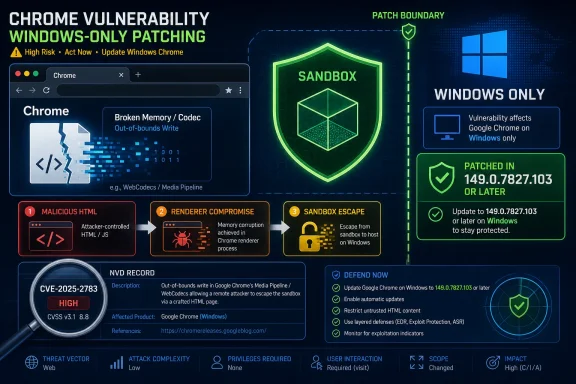
The most important line in the NVD record is not the empty-looking “Known Affected Software Configurations” panel. It is the change-history entry added during NIST’s initial analysis on June 9, which defines the affected configuration as Google Chrome versions before 149.0.7827.103 combined with Microsoft Windows.
That matters because NVD is not saying “all Chrome everywhere” in the configuration it added. It is saying Chrome as an application, constrained by the operating system CPE for Windows. In plain English: vulnerable Chrome builds on Windows are in scope; the NVD enrichment does not currently model macOS or Linux for this specific CVE.
That may look odd to admins who expect a single Chrome CPE to carry the whole burden. But the CVE description itself says “Google Chrome on Windows,” and the CPE logic follows that wording. If the affected-platform statement is Windows-only, then an AND configuration pairing the Chrome application CPE with the Windows OS CPE is the correct way for NVD to express it.
The “CPEs loading” message is therefore a presentation problem, not necessarily a data problem. If a scanner or asset system is consuming the NVD feed rather than scraping the rendered page, the configuration should be visible in the structured data. If a human is looking only at the web page and JavaScript fails, the record can appear emptier than it really is.
This Is Not Just Another Chrome Memory Bug
CVE-2026-11679 is classified as CWE-416, a use-after-free condition, which is one of the recurring villains in browser security. The bug lives in Chrome’s Codecs component, a part of the browser that sits uncomfortably close to complex media parsing, hardware acceleration paths, and web-exposed content handling.
The important phrase is not merely “use after free.” It is “sandbox escape.” Chrome’s security model assumes that the renderer process is a dangerous neighborhood; untrusted web content lives there precisely because it might be compromised. A renderer bug can be bad, but a renderer bug plus a sandbox escape is how a browser exploit chain starts to look like a real endpoint compromise.
The CVE wording says the attacker must already have compromised the renderer process. That raises the attack complexity and explains why CISA-ADP scored the flaw as high rather than treating it as a one-click universal code-execution disaster. But it should not be mistaken for comfort. Browser exploitation often works as a chain, and sandbox escapes are the second-stage tools that turn “code execution in a cage” into “code execution with consequences.”
The crafted HTML page is the delivery vehicle. In practice, that means the attack surface is the ordinary web: a link, an embedded frame, a malicious ad path, a compromised legitimate site, or a targeted lure. The exploit does not need local privileges, and the CVSS vector reflects that network reach.
The Renderer Requirement Is a Speed Bump, Not a Wall
Security scoring has a way of making words like “high complexity” sound reassuring. In this case, high complexity mostly means the attacker’s exploit has prerequisites. They need a path into the renderer before CVE-2026-11679 becomes the escape hatch.
For defenders, that distinction is useful but limited. Attackers who target browsers rarely think in single-CVE units. They chain a renderer issue, a type confusion, an out-of-bounds read/write, or a JavaScript engine bug with a sandbox escape, then finish with post-exploitation tooling that depends on the value of the target.
That is why Chrome sandbox escapes deserve attention even when they are not disclosed as actively exploited. They are not always the loudest CVEs in an advisory, but they are often the part of an exploit chain that decides whether the attacker gets a foothold beyond the tab. A browser that can contain a renderer compromise is annoying to exploit; a browser that cannot is a much better initial-access mechanism.
The user interaction requirement also deserves a sober reading. “User interaction required” in browser CVEs usually means the victim visits or renders attacker-controlled content. It does not mean they must run an installer, approve a UAC prompt, or knowingly execute a suspicious file.
Windows Specificity Is the Real Signal
The Windows-only wording is the most interesting part of this CVE for this audience. Chrome is cross-platform, Chromium is cross-platform, and the Codecs area is hardly a Windows-only concept. Yet the record narrows the affected product statement to Chrome on Windows prior to 149.0.7827.103.
That could reflect a Windows-specific implementation path, a platform-specific exploitability condition, a mitigation difference, or simply the scope of Google’s vulnerability assessment when assigning the CVE. Without public bug details, which remain permission-restricted in the Chromium issue tracker, outside observers should not pretend to know which of those explanations is correct.
For Windows admins, the practical outcome is simpler. If you manage Chrome on Windows, you should treat pre-149.0.7827.103 builds as vulnerable. If you manage Chromium-derived browsers, you should watch vendor advisories rather than assume automatic immunity or automatic exposure from this single NVD entry.
Microsoft Edge is the obvious question, because Edge is Chromium-based and dominant in many Windows fleets. But this CVE record names Google Chrome, not Edge. That does not prove Edge was unaffected; it means Edge needs to be assessed through Microsoft’s release notes and its own build numbers, not through a guess based on Chromium lineage.
NVD’s AND Logic Is Easy to Misread
The CPE configuration added by NIST uses an AND relationship: one branch for the Chrome application CPE up to but excluding 149.0.7827.103, and one branch for Microsoft Windows. That is not two separate vulnerable products. It is the vulnerable condition.
This is a common trap for vulnerability dashboards. A naive parser can flatten the CPEs and make it appear that Windows itself is vulnerable to CVE-2026-11679. It is not. Windows is the platform condition under which the affected Chrome application is considered vulnerable.
That distinction matters for reporting. A Windows server with no Chrome installed should not be counted as exposed simply because the OS CPE appears in the record. A Windows workstation with Chrome 149.0.7827.102 should be. A macOS system with the same Chrome version may need separate vendor analysis, but this NVD configuration does not currently declare it in scope for this CVE.
The better mental model is “Chrome-before-version-X on Windows,” not “Chrome or Windows.” Asset systems that preserve the AND/OR structure will get this right. Asset systems that flatten CPE lists will generate noise, and noise is where real patch urgency goes to die.
The Version Number Is the Patch Boundary
The remediation line is brutally simple: Chrome on Windows needs to be at 149.0.7827.103 or later for this CVE. Anything before that belongs on the wrong side of the boundary.
The Chrome release process complicates the optics because version availability can vary by platform and channel. Google often rolls updates gradually, and enterprise fleets may intentionally stage browser releases through policy, rings, or third-party patch management tools. That is defensible operationally, but it creates a short window where the browser is both known-vulnerable and still widely deployed.
For consumer systems, the check is familiar: open Chrome’s settings, go to the About Chrome page, let it update, and relaunch. For managed Windows environments, the real work is verifying that update policy, update services, and endpoint inventory agree with one another. The browser’s displayed version is the truth that matters most.
There is also a human problem. Chrome’s automatic updater is good, but it is not magic. A browser can download an update and remain vulnerable until restart. Users who leave Chrome open for days can stretch the exposure window long after the patch has technically arrived.
The Locked Bug Tracker Is Doing Its Job
The Chromium issue for CVE-2026-11679 is permission-restricted, which is normal for freshly disclosed browser vulnerabilities. Google routinely limits access to bug details until most users have received fixes, and that restraint is not mere corporate secrecy. It is a race-management tactic.
Detailed exploit notes, proof-of-concept code, crash cases, and component-level analysis can help defenders, but they can also help attackers reproduce the bug. In a browser ecosystem where billions of installations do not update simultaneously, early transparency can become an exploit-development subsidy.
That leaves defenders in an uncomfortable middle. They have enough information to know the class of bug, the affected component, the affected platform, the patch boundary, and the severity. They do not have enough information to write perfect detections or judge exploit maturity.
This is where security teams need discipline. The absence of public technical detail is not evidence of low risk. It is evidence that the disclosure process is still in its containment phase.
CVSS Says High, the Exploit Chain Says Pay Attention
CISA-ADP’s CVSS 3.1 score of 8.3 high captures the tradeoff neatly. The attack vector is network-based, no privileges are required, user interaction is required, scope changes, and confidentiality, integrity, and availability impacts are all high. The complexity is high because the attacker needs a renderer compromise first.
That score is useful, but it is not the whole story. In enterprise patching, a high-severity browser sandbox escape may deserve more urgency than a higher-scored flaw in a rarely deployed server component. Exposure, exploitability, and deployment density matter as much as arithmetic.
Chrome is not a niche dependency. It is an everyday runtime for email, SaaS, identity portals, admin consoles, file previews, video meetings, and internal applications. A Chrome flaw is therefore not just a “browser” flaw; it is a flaw in the interface through which many users touch the rest of the enterprise.
The sane response is not panic. It is accelerated verification. If the browser is updated, the risk collapses quickly. If it is not, the machine remains exposed to a class of attack that modern endpoint security has historically struggled to prevent once a working chain exists.
Patch Management Still Trips Over the Browser
Browsers sit in a strange patch-management category. They update more frequently than operating systems, carry more direct exposure to hostile content than most desktop applications, and are often managed by teams that do not own the rest of endpoint security. That makes them operationally slippery.
In Windows fleets, Chrome may be installed per-machine or per-user, delivered by Google’s updater, managed by Group Policy, packaged by Intune, deployed by ConfigMgr, or handled by a third-party patching product. Each path can report success while leaving exceptions behind. The machines that miss browser updates are often the same machines with stale agents, user-installed copies, or broken management state.
CVE-2026-11679 also illustrates why version precision matters. “Chrome 149” is not sufficient. The vulnerable boundary is before 149.0.7827.103. A dashboard that reports only major versions or collapses patch versions into a friendly label can hide the difference between fixed and vulnerable.
Admins should also remember profile persistence. Updating Chrome does not erase stolen cookies, tokens, or session artifacts if a machine was previously compromised. Patching is the first move; investigation depends on whether there are signs the endpoint was targeted before the update landed.
The Chrome Ecosystem Makes Single-CVE Thinking Dangerous
A Chrome CVE rarely lives alone. It appears inside a release train that may fix dozens of security issues across V8, WebCodecs, media, UI, extensions, GPU, and other components. The public often latches onto the named bug, but the release itself is the security event.
That is especially true for Chromium-based browsers. Chrome is the reference point because Google publishes the advisory and assigns many of the CVEs, but the underlying codebase feeds Edge, Brave, Vivaldi, Opera, Electron apps, embedded browsers, and enterprise software that quietly includes Chromium components. Not all of them are affected by every Chrome CVE, and not all of them patch on the same schedule.
This is where the vendor-specific scope of CVE-2026-11679 should be respected but not overinterpreted. The record says Chrome on Windows. It does not give every Chromium derivative a clean bill of health. It tells administrators where the confirmed affected product boundary sits.
For WindowsForum readers, the practical habit is to treat Chrome as one part of the Chromium estate. Update Chrome immediately, then check Edge and other Chromium-based applications against their own vendor builds. The browser monoculture problem is not that every product is always vulnerable in the same way; it is that too many products depend on the same fast-moving foundation.
The Useful Reading of “High” Is “Do Not Wait for Drama”
No public record attached to CVE-2026-11679 currently says this specific vulnerability is being exploited in the wild. That is an important distinction, particularly because other Chrome vulnerabilities around the same release window may receive zero-day attention. Mixing them together creates bad reporting and worse patch decisions.
But “not known exploited” is not the same as “safe to defer.” The bug class is serious, the affected component is web-exposed, the impact is sandbox escape, and the affected platform is Windows. That combination should be enough to move the patch into the near-term queue.
The most mature vulnerability programs do not wait for a CVE to become famous before acting. They look at exploit chain value. A Windows Chrome sandbox escape has value because it helps bridge the gap between malicious web content and the host environment.
This is also why home users should not shrug. Attackers do not need to know whether a machine is “enterprise-managed” before serving browser exploits. Consumers may be less likely to face bespoke targeting, but they are often more likely to run stale browsers, ignore restarts, and reuse sessions across sensitive services.
The Practical Read for Windows Admins Is Narrow but Urgent
CVE-2026-11679 does not require a grand architectural rethink. It requires disciplined browser hygiene and accurate inventory. The systems that matter are Windows machines running Google Chrome before 149.0.7827.103.
The CPE concern should be resolved in favor of the existing NVD logic. The Chrome application CPE and Windows OS CPE appear together because the vulnerable configuration is conditional. If your tooling cannot represent that relationship, the tooling may overcount Windows or undercount Chrome.
The right operational response is to verify the installed Chrome version, force or encourage relaunch where needed, and make sure reporting captures patch-level builds. Anything less precise is an invitation to false confidence.
The Patch Boundary Is the Story Windows Teams Can Act On
The cleanest lesson from CVE-2026-11679 is that the public record gives enough information to act, even if it does not give enough information to satisfy curiosity. Treat the bug as a Windows Chrome sandbox-escape risk, not as a generic Windows flaw and not as an abstract Chromium rumor.
- Chrome on Windows should be updated to 149.0.7827.103 or later to address the vulnerable range described for CVE-2026-11679.
- The NVD CPE configuration is not missing the key product data; it models Chrome and Windows together as the affected condition.
- Vulnerability tools that flatten CPE logic may incorrectly imply that Windows alone is vulnerable, so reports should preserve the AND relationship.
- The renderer-compromise prerequisite lowers exploit simplicity but does not remove the risk, because browser attacks are commonly chained.
- Administrators should verify the actual installed browser build and ensure users relaunch Chrome after the update is staged.
- Chromium-based browsers and embedded Chromium runtimes should be checked through their own vendor advisories rather than assumed fixed or vulnerable solely from this Chrome CVE.
The browser has become the new operating-system edge: always exposed, constantly patched, and too important to leave to vague version labels. CVE-2026-11679 is not the loudest Chrome bug imaginable, but it is exactly the kind of Windows-facing sandbox escape that rewards fast, boring, accurate maintenance. The organizations that handle it well will not be the ones with the most dramatic incident response; they will be the ones whose inventories quietly show Chrome at or beyond 149.0.7827.103 before attackers have time to care.