

The Vulnerability Is Small Enough to Miss and Serious Enough to Matter
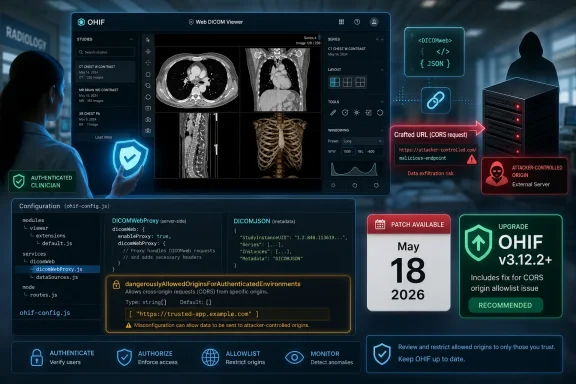
CVE-2026-12473 affects the Open Health Imaging Foundation’s OHIF DICOM Web Viewer Framework, specifically versions up to and including v3.12.0. The vulnerability sits in two data sources shipped in the default configuration: DICOMWebProxy and DICOMJSON. Those components can fetch a URL supplied as a parameter, and in vulnerable authenticated deployments they do so without the validation needed to prevent a hostile destination.
That alone would be a familiar server-side request forgery story. The sharper edge is that OHIF’s global authentication service may automatically inject the authenticated user’s OIDC bearer token into the outgoing request. If an attacker can persuade a logged-in clinician to follow a crafted link, the viewer can send the clinician’s token to infrastructure controlled by the attacker.
The reported severity reflects that chain. CISA lists the CVSS v3.1 score as 8.2, high severity, with network attack vector, low complexity, no privileges required, and user interaction required. The CVSS v4.0 score is 8.3, also high. Those numbers are not “drop everything, the internet is on fire” territory, but they are high enough that a hospital should not treat this as a theoretical developer footnote.
The important qualifier is that DICOMweb data sources are not impacted, according to the advisory. That matters because many deployments will use DICOMweb as the standard path for imaging retrieval. But in hospitals, research environments, and vendor-customized portals, the difference between a standard data source and a legacy or integration-specific data source is often buried in configuration files few people regularly audit.
OHIF’s Strength Is Also Its Attack Surface
OHIF is popular because it solves a real problem elegantly. It is a configurable, extensible, web-based medical imaging viewer that can sit in front of archives and workflows that were never designed for the browser era. That adaptability is why it appears in academic systems, research portals, clinical prototypes, vendor products, and internal healthcare applications.
But extensibility is never neutral. A viewer that can be launched with dynamic configuration, pointed at external resources, embedded into portals, and adapted to local workflows necessarily has to decide which remote endpoints are trusted. The vulnerability here is not merely that arbitrary URLs could be fetched. It is that a trusted authenticated context could be stretched far enough to include an attacker’s URL.
That is a classic web security failure mode, but the healthcare context changes the stakes. A bearer token is not a password in the traditional sense, yet it can function like a temporary pass to systems, APIs, image metadata, or protected workflow services. If the token is scoped broadly or accepted by downstream services without enough audience or origin checks, the attacker may gain a foothold well beyond a single viewer session.
This is why the “custom integration version” language in the advisory should not reassure anyone too quickly. Most serious OHIF deployments are custom integrations in one way or another. The default viewer may be open source, but the thing clinicians actually use is often wrapped in identity plumbing, reverse proxies, app-config changes, EHR launch flows, PACS connectors, and local assumptions accumulated over years.
The Crafted Link Is the New Phishing Attachment
The exploit path described by CISA requires user interaction. In older advisories, that phrase could sound like a discount: the attacker needs the victim to click. In 2026, “requires a click” is less comforting. Healthcare organizations live on email, messaging, portals, referral systems, shared studies, and external collaboration links, all of which train staff to open URLs as part of ordinary work.
A crafted OHIF link would not need to look exotic to be dangerous. If it resembles a study link, a consult link, a QA case, a research viewer, or a “please review these images” request, it fits naturally into the workflow. Radiologists, clinicians, and technologists already operate in environments where speed and trust are rewarded.
The failure mode is subtle because the attacker is not necessarily trying to make the browser display something obviously malicious. The target is the authenticated context. The victim’s browser, identity session, and application configuration become the machinery that transfers a token to the wrong place.
That makes this vulnerability closer to a phishing-assisted token exfiltration flaw than a conventional back-end SSRF bug. The server-side request forgery label is technically important, but from the defender’s point of view, the operational story is about where authenticated requests are allowed to go.
The Patch Adds a Gate Where the Product Once Relied on Trust
OHIF has released version 3.12.2, dated May 18, 2026, to address the reported issue. CISA’s advisory points users to that version or later. The maintainer also introduced a new configuration control for environments that need DICOMWebProxy or DICOMJSON in authenticated deployments: dangerouslyAllowedOriginsForAuthenticatedEnvironments.
The name is doing real work. Good security controls often sound boring, but this one sounds like a warning sign because it is one. The setting is an allowlist for origins that may be used in authenticated environments. If an organization must keep these data sources active, it now has to explicitly say which origins are trusted to receive authenticated traffic.
That is the right design direction. In unauthenticated contexts, fetching arbitrary public configuration may be acceptable for demos, research sandboxes, or limited workflows. In authenticated clinical environments, the default should be fail-closed. The token-bearing viewer should not be allowed to improvise trust at runtime because a URL parameter told it to.
The patch also creates work for administrators. Upgrading is necessary, but not sufficient for every deployment. Operators must inspect the deployed configuration, decide whether DICOMWebProxy or DICOMJSON are actually needed, and remove unused configurations. If they are needed, the new allowlist must be populated deliberately, not copied from a sample file and forgotten.
Healthcare IT Cannot Patch Its Way Out of Configuration Debt
The advisory’s mitigation language is unusually practical: remove all unused DICOMWebProxyDataSource and DICOMJSONDataSource configurations from authenticated deployments. That sentence is the real operational center of the story. It recognizes that software vulnerabilities are often amplified by stale configuration.
Hospitals are full of systems that were configured for a pilot, modified for a vendor demo, extended for a research project, and then quietly promoted into production because they worked. Imaging systems are especially vulnerable to this pattern because they bridge clinical care, research, teaching, and enterprise IT. A viewer may have started life as a low-risk front end and later gained single sign-on, network access, patient context, and production data.
Unused data sources are dangerous because they preserve capability without preserving institutional memory. Nobody means to expose token-bearing requests to arbitrary origins. But if a configuration file still contains a data source that can be activated through a URL parameter, the system may retain behavior that administrators no longer know exists.
This is why the best remediation plan is not just “upgrade OHIF.” It is “upgrade OHIF, remove what you do not use, constrain what you must keep, and test the actual deployed paths.” The distinction matters because healthcare software is rarely deployed exactly as the upstream maintainer imagines. Local reverse proxies, identity providers, launch parameters, and app wrappers can all change the risk.
Token Theft Is a Clinical Workflow Problem, Not Just an Identity Problem
Security teams tend to think of token theft in terms of identity providers, OAuth flows, and API authorization. Clinicians experience it differently. They see an application that either lets them read images or gets in the way. The risk, then, is that an attacker can exploit the invisible machinery of identity while the visible workflow appears ordinary.
OIDC bearer tokens are meant to reduce password exposure and support modern single sign-on. They are not magic shields. A bearer token is called a bearer token for a reason: possession can be enough, depending on scope, lifetime, audience, and enforcement. If a token intended for one service is sent to an attacker-controlled server, the defensive question becomes what that token can do before it expires.
A well-designed identity architecture limits the blast radius. Tokens should be short-lived, audience-restricted, and useless outside the intended relying party or API. Downstream services should validate issuer, audience, scopes, and claims. Logs should make abnormal token use visible. But healthcare environments often carry legacy services, middleware shims, and broad scopes created to keep fragile workflows running.
That is where CVE-2026-12473 becomes more than an OHIF issue. It is a test of whether the surrounding identity environment assumes applications will always send tokens only to the right place. If that assumption is embedded in policy, the vulnerability has more room to hurt.
CISA’s ICS Framing Fits Better Than It First Appears
Some readers may wonder why a web-based DICOM viewer appears in a CISA ICS medical advisory. It is not a pump, scanner, or embedded controller. It is a browser-facing application framework. But modern healthcare infrastructure is not cleanly divided between clinical devices and web software anymore.
Medical imaging depends on a chain of acquisition devices, archives, workstations, viewers, identity systems, network storage, and clinical portals. A web viewer may not be the device that captures the scan, but it is part of the system that turns imaging data into clinical action. If the viewer becomes a route to credential theft or unauthorized data access, the impact can still be clinical.
CISA’s generic defensive recommendations — minimize exposure, isolate systems behind firewalls, use secure remote access, perform impact analysis, and watch for social engineering — can read boilerplate. In this case, the boilerplate is not wrong, but it is incomplete without application-level configuration review. A firewall will not help much if the vulnerable viewer is intentionally available to authenticated clinicians and the attack travels through a link they click.
The better lesson is layered. Keep imaging systems off the open internet where possible, segment clinical networks, and harden remote access. But also treat browser-based clinical applications as first-class security assets, not as harmless front ends to “real” systems.
The Absence of Known Exploitation Is Not a Permission Slip
CISA says it has no known public exploitation specifically targeting this vulnerability at the time of publication. That is useful information, but it is not a reason to wait. Token exfiltration bugs are often hard to observe after the fact, especially when the trigger looks like a legitimate user following a link and the stolen credential is used quickly or indirectly.
The lack of public exploitation also says little about private discovery. OHIF is open source, the patch is public, and the advisory describes the vulnerable behavior at a high level. Once a fix exists, attackers and defenders both know where to look. That does not mean exploitation is trivial in every environment, but it does mean the clock starts ticking.
Healthcare organizations should be particularly cautious because patch windows can be slow. Clinical software is often entangled with validation requirements, vendor contracts, change-control boards, and after-hours maintenance windows. The practical reality is that “upgrade immediately” may translate into days or weeks of coordination.
That makes compensating controls important. If an upgrade cannot happen today, remove unused vulnerable data source configurations, restrict access to the viewer, monitor for suspicious outbound requests from viewer infrastructure, and warn users about unexpected study links. None of that replaces the patch, but it can reduce exposure while the change process catches up.
Windows Shops Should Look Beyond the Viewer Itself
For WindowsForum readers, the interesting part is not that OHIF runs in a browser. It is that many Windows-heavy healthcare environments will encounter this vulnerability through the surrounding stack: IIS reverse proxies, Windows Server-hosted portals, Active Directory Federation Services or Entra-linked identity, endpoint browsers, EHR launch workflows, and PACS workstations.
A Windows administrator may not own the OHIF codebase, but they may own the route by which clinicians reach it. That includes TLS termination, firewall rules, proxy logs, endpoint browser policy, DNS filtering, and identity conditional access. If the exploit requires a crafted link and a token-bearing browser session, then endpoint and network telemetry can matter.
The most useful logs may not be in the application alone. Proxy logs can reveal unusual outbound destinations. Identity logs can show token use patterns, consent changes, or anomalous resource access. Endpoint controls can reduce the chance that users reach suspicious domains. DNS security can block known malicious infrastructure, though it will not stop an attacker using a fresh domain.
This is also a reminder that open-source components do not remove vendor management obligations. If a commercial imaging product embeds OHIF, customers may not know immediately which upstream version is included. Procurement and security teams should ask vendors whether OHIF is present, which version is deployed, whether DICOMWebProxy or DICOMJSON are enabled, and whether the May 18 fix has been integrated.
The Real Risk Is the Integration Nobody Owns
OHIF’s advisory points to “custom integration” exposure, and that phrase is where governance often goes to die. Custom integrations are frequently owned by everyone and no one. The clinical department needs the workflow, the vendor supports the application, the identity team manages authentication, the infrastructure team runs the server, and the security team is asked to bless the result after it already works.
This vulnerability punishes that split ownership. The maintainer can fix the framework, but only the operator can know whether a particular data source is still needed. The identity team can harden tokens, but only the application owner can ensure they are not sent to arbitrary origins. The network team can segment systems, but only clinical stakeholders can decide which remote workflows are truly necessary.
The answer is not to ban customization. Healthcare needs customization because clinical workflows vary, research requirements evolve, and interoperability remains messy. The answer is to treat integration features as privileged pathways. Any feature that fetches external configuration, accepts URL parameters, bridges authentication, or rewrites data-source behavior should be documented and periodically reapproved.
That kind of inventory sounds unglamorous, but it is the difference between secure flexibility and accidental exposure. If a hospital cannot say which OHIF data sources are enabled and why, it cannot confidently say whether CVE-2026-12473 is contained.
A High-Severity Bug With a Narrower Blast Radius Than the Score Suggests
It is worth resisting both minimization and panic. This is not a remote unauthenticated takeover of every OHIF deployment. It requires a vulnerable version, relevant data source configuration, authentication behavior, and user interaction. Some organizations using OHIF may not be affected in practice, especially if they do not use the vulnerable data sources or do not run the viewer in the described authenticated pattern.
At the same time, the score is not inflated nonsense. Confidentiality impact is high because a stolen token can be powerful. Scope is changed because the attack can cross trust boundaries. The complexity is low once the environmental conditions exist. And in healthcare, a single clinician’s access can be broad enough to matter.
The “custom integration” caveat should drive investigation, not complacency. An organization that has simply deployed the standard viewer with limited configuration may have a straightforward patch task. An organization that has embedded OHIF into a clinical portal, research archive, or federated identity workflow has a more serious review ahead.
The practical priority is to find the actual deployed risk. Version banners, package manifests, container images, build artifacts, and vendor documentation should be checked against v3.12.0 and earlier. Configuration files should be searched for DICOMWebProxy and DICOMJSON. Authentication settings should be reviewed for token injection behavior. The goal is to replace assumption with evidence.
The Fix Is an Allowlist, but the Lesson Is Least Privilege
The new dangerouslyAllowedOriginsForAuthenticatedEnvironments control is a useful repair because it makes trust explicit. But an allowlist is not a decoration. If it contains broad, stale, or poorly understood origins, it can become another place where yesterday’s convenience becomes tomorrow’s incident report.
A proper allowlist should be short, justified, and owned. Each entry should correspond to a known service with a known purpose. Localhost entries should be limited to development or carefully controlled scenarios. Any origin that cannot be explained should not be present in production.
The same principle applies to tokens. If a viewer only needs to retrieve imaging metadata from a specific service, the token should not authorize half the clinical universe. If a downstream API accepts tokens, it should verify that the token was meant for that API. If the token appears from an unexpected client, origin, or network path, that should be visible.
Least privilege is easy to praise and difficult to implement in clinical software, where usability pressure is constant. But CVE-2026-12473 shows why the effort matters. The safest token is not merely one that is hidden from JavaScript or protected by TLS. It is one that remains low-value when it inevitably appears somewhere defenders did not expect.
The Patch Queue Now Has a Clinical Viewer in It
Administrators should treat this advisory as an application security update with identity implications. The upgrade target is clear: OHIF v3.12.2 or later. The configuration guidance is clear as well: remove unused DICOMWebProxyDataSource and DICOMJSONDataSource entries, and configure the new allowlist if those sources are required in authenticated deployments.
The harder part is finding every deployment. OHIF may appear as a standalone viewer, inside a research portal, bundled with vendor software, or deployed as part of a containerized imaging stack. It may be maintained by a clinical engineering group rather than central IT. It may also exist in test or teaching environments connected to identity systems that are more production-like than anyone wants to admit.
Healthcare organizations should also review outbound network policy. If the viewer or its hosting environment can send requests anywhere on the internet, token exfiltration scenarios become easier. Egress controls are not fashionable, but they remain one of the most reliable ways to make data theft harder.
User awareness has a role, but it should not become the main defense. Telling clinicians not to click suspicious links is necessary and insufficient. The application should not leak tokens when a user clicks a plausible clinical link. The network should not allow arbitrary egress if it is not needed. The identity layer should not make stolen tokens more useful than necessary.
The Imaging Stack Gets Its Own Supply-Chain Moment
The open-source nature of OHIF is not the problem here. In fact, the availability of a fix and the transparency of the advisory are advantages. The uncomfortable truth is that healthcare has become dependent on layered software supply chains while still managing many applications as if they were isolated devices.
A hospital may track firmware for scanners and patches for Windows endpoints, but have weaker visibility into JavaScript frameworks, web viewers, container images, and open-source components embedded in clinical tools. That gap is no longer sustainable. The clinical application stack is now a software supply chain, and vulnerabilities in frameworks can have clinical consequences.
This does not mean every hospital needs to become an open-source maintainer. It does mean healthcare IT needs software bills of materials that are actually usable, vendor attestations that answer specific component questions, and internal processes that can map a CVE to deployed systems quickly. “Do we use OHIF?” should not require a week of hallway archaeology.
The more web-native clinical tooling becomes, the more these issues will look like mainstream application security problems. SSRF, token leakage, unsafe redirects, CORS misconfiguration, and overly permissive URL parameters are not exotic in the broader web world. They become more consequential when wrapped around patient data and clinical decision-making.
The OHIF Advisory Leaves Five Jobs for Defenders
The operational message is narrower than the vulnerability headline and broader than the patch note. This is a high-severity issue in a specific viewer framework, but the remediation path runs through application inventory, configuration hygiene, identity hardening, and user-facing workflow controls. Organizations that treat it as a simple version bump may fix the code while leaving the same design assumptions intact.
- Organizations using OHIF Viewers DICOM Framework v3.12.0 or earlier should upgrade to v3.12.2 or a later release.
- Authenticated deployments should remove unused DICOMWebProxyDataSource and DICOMJSONDataSource configurations rather than leaving dormant integration paths in production.
- Deployments that still require DICOMWebProxy or DICOMJSON should configure
dangerouslyAllowedOriginsForAuthenticatedEnvironmentswith a narrow, documented allowlist. - Security teams should review whether OIDC bearer tokens used by the viewer are audience-restricted, short-lived, and rejected by services they were not intended to access.
- Administrators should inspect proxy, DNS, and identity logs for unexpected cross-origin requests or unusual token activity around viewer sessions.
- Vendors embedding OHIF should be asked directly which upstream version they ship and whether the May 18, 2026 fix has been incorporated.
The uncomfortable lesson of CVE-2026-12473 is that the browser-based clinical viewer is no longer just a convenience layer over the “real” medical system. It is part of the trust boundary. As healthcare imaging continues to move through web applications, federated identity, and open-source frameworks, the organizations that fare best will be the ones that treat integration points as security-critical infrastructure before the next crafted link proves it for them.