

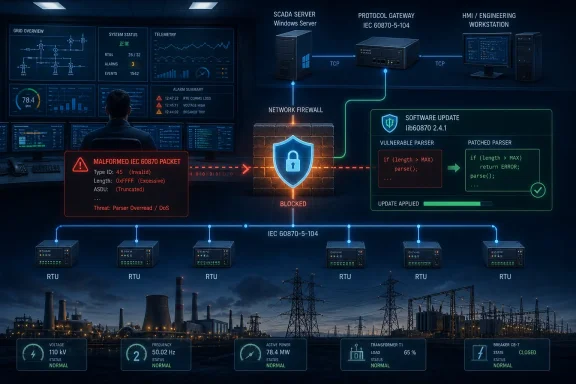
For Windows administrators, industrial IT teams, systems integrators, and security operations staff, the immediate challenge is not simply applying a library update. lib60870 is typically embedded inside larger applications, gateways, engineering tools, field-device software, protocol converters, and custom-built SCADA components. That means many organizations may be exposed without seeing “lib60870” in an installed-programs list or conventional endpoint inventory.
The vulnerability is rated High in the published industrial-control-system advisory, with a CVSS v3.1 score of 8.2 and a CVSS v4.0 score of 8.8. Its most direct outcome is denial of service: an attacker able to send a specially malformed IEC 60870-5 message to a vulnerable parser may cause the parsing process to crash. In a business application that may mean an outage. In a utility, water, chemical, or energy environment, it can mean a loss of telemetry, alarm visibility, historical collection, or communications at exactly the wrong time.
Overview: What CVE-2026-16002 Means
CVE-2026-16002 is an out-of-bounds read vulnerability, categorized as CWE-125. In plain terms, software attempts to read beyond the end of the memory buffer holding an incoming message. The affected parser does not adequately validate the full amount of data required for a particular IEC 60870 application-service-data-unit object before reading it.
The immediate technical consequence is a crash condition. A malformed message can cause the application’s parser to access memory that is not safely available, interrupting normal operation.
The vulnerable code path concerns a specific IEC 60870-5 information object:
- ASDU Type ID 41
- S_IT_TC_1
- Integrated totals for security statistics with a time tag
The advisory identifies the exposure in components using the library’s CS101 master and CS104 client functionality. That detail matters because it narrows the first priority group: organizations should focus initially on applications and appliances that receive and parse IEC 60870-5-101 or IEC 60870-5-104 traffic through those roles.
The library is written in C and is designed for IEC 60870-5-101 and IEC 60870-5-104 protocol support. It is commonly relevant to industrial communications deployments, including SCADA systems, remote terminal unit integrations, protocol gateways, telemetry collectors, substation-related applications, and bespoke OT software.
Why an Out-of-Bounds Read Can Become an Operational Event
Out-of-bounds reads are sometimes treated as less urgent than memory corruption flaws that enable code execution. That instinct can be dangerous in operational technology.
The published technical material for CVE-2026-16002 identifies this as a read, not a write. No out-of-bounds write or remote code execution has been demonstrated in the available disclosure. That is an important boundary: organizations should not overstate the issue as a confirmed remote takeover vulnerability.
However, the available evidence supports a meaningful denial-of-service risk. If a crafted protocol frame causes a process crash, the impact depends on what that process does and how it is deployed.
Potential outcomes include:
- A crashed protocol gateway that stops forwarding telemetry.
- A failed IEC 60870 client that loses connectivity to remote equipment.
- Interrupted SCADA data acquisition.
- Loss of alarms, trends, or situational awareness at an operator workstation.
- A service restart loop that causes intermittent or persistent communications loss.
- A high-availability failover event, possibly exposing weak redundancy design.
- Increased operator workload while teams determine whether an outage is malicious, accidental, or equipment-related.
In a well-designed environment, a crash should remain contained to the affected service and trigger rapid automatic recovery. In a poorly segmented or tightly coupled design, one parser failure can cascade into missing data, stale values, nuisance alarms, and manual intervention.
The security concern is therefore inseparable from resilience engineering. A vulnerability that “only” crashes a parser can still disrupt operations if the parser is a critical link between field communications and control-room visibility.
The Technical Trigger: Insufficient Length Validation
The vulnerable handling path involves a message whose declared structure claims more data elements than the received frame actually contains. The parser validates only part of the required object length, then proceeds to read a larger full object that includes counter data and a time tag.
This creates a mismatch between two values:
- The amount of data the code verifies is present.
- The amount of data the code actually consumes while decoding the object.
When the message’s variable structure qualifier declares a larger element count than the physical frame contains, the decoder can continue past the end of the message buffer. The result is an out-of-bounds heap read.
The affected Type ID 41 object is notable because it is associated with security statistics. Organizations may be tempted to assume that systems not actively using security counters are automatically safe. That conclusion is not sufficiently reliable for patch prioritization.
A protocol parser may still encounter malformed Type ID 41 traffic if it accepts incoming IEC 60870 frames before application-level logic filters or ignores the object. The more relevant question is whether an exposed application or device can receive attacker-controlled or untrusted protocol data and reaches the vulnerable decode path.
Why Message Validation Failures Matter in OT Protocols
Industrial protocols are often deployed in environments that historically assumed trusted links, dedicated circuits, controlled serial networks, or tightly restricted operational access. Modern deployments increasingly bridge these communications models with Ethernet, IP networking, remote maintenance, virtualization, centralized monitoring, and third-party integration.
That evolution changes the threat model.
IEC 60870-5-104 commonly operates over TCP/IP, often associated with TCP port 2404. If a vulnerable endpoint is reachable from an untrusted network segment, from a compromised enterprise host, through an overly broad VPN, or from a vendor remote-access channel, malformed protocol traffic can become a practical operational risk.
The key security lesson is simple: protocol reachability is the prerequisite for exploitation. The library flaw is serious, but an attacker must still be able to deliver data to the vulnerable parser.
Affected Versions and the Patch
The industrial advisory describes lib60870 versions 2.4.0 and earlier as affected and directs users to update to version 2.4.1 or later.
The vendor’s public security advisory is more narrowly framed around version 2.4.0 and a development branch state before the fix. This difference is worth handling carefully in real-world remediation planning.
Organizations should use the more conservative operational approach:
- Treat lib60870 2.4.0 and earlier as potentially affected unless the supplier of the dependent product confirms otherwise.
- Treat lib60870 2.4.1 as the minimum fixed version.
- Confirm whether an appliance, commercial product, gateway, or internally developed application has statically linked, dynamically linked, copied, or otherwise incorporated vulnerable library code.
- Do not assume that an application is safe merely because its own product version is newer than lib60870 2.4.0.
The library’s upstream repository is a useful development reference, but industrial operators should generally obtain updates through their equipment or software supplier when lib60870 is embedded inside a supported commercial product. Replacing shared components independently can create support, compatibility, licensing, validation, or safety concerns.
The Importance of Version 2.4.1
The fix in lib60870 2.4.1 addresses the vulnerable parsing condition by ensuring that the decoder checks the complete data size that will be consumed before it reads the element.
That is the correct remediation pattern for this class of bug. Parser length checks must match the actual object layout, including optional fields, addresses, counters, timestamps, sequence behavior, and element repetition rules. A check that validates only a partial minimum can become unsafe as soon as the decoder reads additional fields.
For software teams maintaining forks or customized builds, merely changing a visible version string is not enough. They need to verify that the code-level correction is present in the build shipped to production.
Why the Severity Ratings Need Context
The advisory carries a CVSS v3.1 score of 8.2, characterized as High, with this general profile:
- Network reachable
- Low attack complexity
- No privileges required
- No user interaction required
- High availability impact
- Limited confidentiality impact
- No integrity impact
A CVSS v4.0 score of 8.8 likewise places the flaw in the High range.
At the same time, the vendor-hosted advisory presents a lower severity assessment for the narrowly documented scenario. This is not unusual in vulnerability management. Different scoring authorities can interpret environmental assumptions, confidentiality implications, affected roles, and availability consequences differently.
The practical takeaway is not that one score is “wrong.” It is that a generic score cannot substitute for local impact analysis.
For example, the following factors can raise practical urgency:
- The vulnerable process is exposed to a broad network segment.
- The affected asset is an internet-facing gateway or reachable through poorly restricted remote access.
- A single crash disrupts many field devices or a large operational area.
- Restart behavior is slow, manual, or unreliable.
- The application runs on a lightly monitored Windows Server, embedded Windows deployment, Linux appliance, or unmanaged engineering workstation.
- There is no tested failover path.
- A compromised enterprise asset could reach the OT network.
Conversely, urgency may be lower where the protocol path is physically isolated, tightly firewalled, monitored, and limited to authenticated jump-host administration. Lower urgency does not remove the need to patch; it simply affects the order and speed of remediation.
Windows Environments: Where lib60870 May Be Hiding
The name lib60870 is unlikely to appear in many Windows endpoint-management consoles. The library may be bundled into vendor software as a DLL, statically compiled into an executable, included in a container image, or nested inside an appliance firmware package.
This is a classic software supply chain visibility problem.
Windows administrators should not limit their investigation to Add/Remove Programs, Windows Update history, or standard vulnerability scanner results. A vulnerable open-source protocol library can be present without being separately registered with the operating system.
Likely Locations to Investigate
The following environments deserve review:
- Windows-based SCADA servers.
- Data concentrators and protocol gateway hosts.
- Historian collectors and telemetry aggregation servers.
- Engineering workstations that run communications or test tools.
- Remote terminal unit management software.
- Vendor applications communicating with IEC 60870-5-101 or IEC 60870-5-104 endpoints.
- Custom Windows services written in C, C++, .NET with native interop, Python extensions, Java native bindings, or mixed-language stacks.
- Docker, Podman, Kubernetes, or Windows container deployments containing industrial communication services.
- Virtual appliances where a Windows host provides management, routing, monitoring, or integration around a Linux-based protocol component.
A Practical Discovery Process
A disciplined investigation should combine vendor outreach, software inventory, and network evidence.
- Identify systems that speak IEC 60870.
Start with architecture diagrams, firewall rules, OT asset inventories, engineering documentation, and network flow records. Search for systems communicating over TCP port 2404, while recognizing that protocol use can be configured on non-default ports. - Ask suppliers precise questions.
Request confirmation of whether each product uses lib60870, which version is incorporated, whether Type ID 41 parsing is reachable, and which product release contains the fix. - Review bills of materials.
If suppliers provide a software bill of materials, search it forlib60870,lib60870-C,mz-automation, version2.4.0, and older versions. - Inspect internally built applications.
Check source dependency manifests, build scripts, Git submodules, vendor source directories, package caches, container Dockerfiles, and compiled binary metadata. - Correlate with network exposure.
Determine which potentially vulnerable endpoints accept IEC 60870 traffic and from where. A library finding without an exposure map is incomplete risk assessment. - Document asset criticality.
Record whether a crash would affect only a test system, one remote site, a regional telemetry path, a process-control zone, or an enterprise-wide operations center.
This approach produces a defensible remediation plan rather than a rushed and potentially disruptive patch campaign.
Immediate Mitigations Before Maintenance Windows
Patching to lib60870 2.4.1 or later is the primary remedy. But industrial environments often require scheduled maintenance, regression validation, supplier coordination, backups, and operational approval before software changes can be deployed.
Until patching is complete, organizations should reduce the chance that untrusted traffic reaches the parser.
Restrict Network Exposure
The strongest short-term control is to limit who can send IEC 60870 traffic to the affected endpoint.
Useful measures include:
- Block inbound IEC 60870-5-104 traffic from enterprise user networks.
- Allow only explicitly required source IP addresses, remote terminal units, gateways, or control-center systems.
- Use firewall rules that restrict destination ports and directions, not broad “any-any” permits.
- Remove legacy temporary rules and unused vendor-access paths.
- Prevent direct internet exposure of OT protocol services.
- Review NAT configurations, port forwards, cloud connectivity, and remote-access gateways.
- Place vulnerable systems behind industrial firewalls with default-deny rules.
Network segmentation is particularly valuable because it reduces exposure even if a vulnerable component remains present elsewhere in the environment.
Harden Remote Access Paths
Remote access can unintentionally transform a segmented architecture into a flat one. A VPN connection, vendor support tunnel, remote desktop gateway, or dual-homed engineering laptop may provide a route to a protocol endpoint that was assumed to be isolated.
Remote access should use:
- Multi-factor authentication.
- Named, individual accounts rather than shared credentials.
- Time-limited access approval.
- Session logging where feasible.
- Jump hosts separated from operational systems.
- Least-privilege firewall rules.
- Current, supported VPN and remote-access software.
A VPN is not a substitute for segmentation. It is an additional access path whose endpoints and authorization policies must be treated as part of the OT attack surface.
Improve Detection and Recovery
Because the known outcome is a process crash, defenders should tune monitoring around availability signals.
Track:
- Unexpected service terminations.
- Application crash reports.
- Windows Event Viewer entries related to faulting applications.
- Repeated service restart events.
- Lost IEC 60870 sessions.
- Communication timeout alarms.
- Gaps in telemetry or quality-state changes.
- Abnormal inbound traffic volumes or malformed-frame alerts at OT network sensors.
- Unexpected Type ID 41 traffic where it is not operationally expected.
Recovery plans also deserve scrutiny. A service configured to restart automatically may improve resilience, but repeated automatic restart can conceal an active attack or turn a crash into a persistent availability issue. Alerting should distinguish a one-time recovery from a recurring failure pattern.
Patch Management Without Creating a New Operational Risk
Industrial software updates must be carefully validated. The urgency of CVE-2026-16002 should not lead to bypassing change control, safety review, or supplier guidance.
A sound deployment sequence includes:
- Confirm the exact affected application and dependency version.
- Obtain the approved fixed release from the application or equipment supplier.
- Back up configurations, certificates, project files, and relevant system states.
- Test the update in a representative environment where possible.
- Validate protocol interoperability with remote devices, gateways, and control-center systems.
- Schedule production deployment with operations personnel involved.
- Monitor communications, alarms, and service health after installation.
- Record the patched version and evidence of validation in the asset and vulnerability-management systems.
The crucial test is not merely whether the application launches. Teams should verify IEC 60870 connectivity, expected data points, command paths where applicable, protocol timing, failover behavior, logging, and alarm processing.
Special Considerations for Custom Builds
Organizations that compile lib60870 themselves have more direct control, but also more responsibility.
They should:
- Update the library source to a fixed revision or version 2.4.1.
- Rebuild all dependent binaries, not just one service.
- Confirm that old statically linked executables are retired.
- Scan build pipelines and artifact repositories for outdated packages.
- Run unit, integration, and protocol conformance tests.
- Use memory-safety testing where development practices permit it.
- Ensure their deployment process can distinguish a newly built binary from an older artifact with the same product label.
The broader engineering lesson is that protocol parsers should be treated as hostile-input boundaries. Even when a protocol is “internal,” every received frame should be validated as though it may be malformed, truncated, replayed, or intentionally adversarial.
No Reported Public Exploitation, but No Reason to Delay
At publication, there are no known reports of public exploitation specifically targeting CVE-2026-16002. That is reassuring, but it should not become a reason to defer action.
The vulnerability is now documented with enough technical detail for knowledgeable attackers and defenders to understand the affected parsing logic, the relevant message type, and the general failure condition. Public disclosure changes the defensive timeline. Organizations should assume that exposure discovery and exploit development efforts could follow.
The absence of confirmed exploitation also does not reveal whether internal incidents have occurred, whether crashes were misclassified as reliability faults, or whether attackers have attempted malformed traffic in environments with weak logging.
This makes rapid but controlled remediation the appropriate course.
The Broader Lesson for ICS and Windows Security Teams
CVE-2026-16002 illustrates why industrial vulnerability management cannot be separated into “Windows issues” and “OT issues.” A Windows Server may host the application, manage the network path, run a historian connector, provide remote access, or store the engineering configuration, while the vulnerable protocol library operates inside a vendor product, a native service, or a containerized gateway.
The security boundary is the whole operational workflow:
- The software dependency.
- The endpoint that runs it.
- The network path that reaches it.
- The remote-access system that exposes the path.
- The monitoring stack that identifies service failure.
- The recovery design that restores communications.
- The change process that gets the patch into production safely.
Organizations with mature asset visibility, robust segmentation, supplier relationships, tested recovery procedures, and software bill-of-material practices will handle this issue far more effectively than organizations that rely on endpoint scans alone.
Conclusion
CVE-2026-16002 in MZ Automation lib60870 is a high-priority industrial communications vulnerability because a single malformed IEC 60870 message can crash a vulnerable parsing process. The documented flaw is an out-of-bounds read rather than a demonstrated remote-code-execution bug, but availability failures in SCADA and telemetry environments can carry serious operational consequences.
The central remediation step is clear: move affected deployments to lib60870 2.4.1 or later, or obtain the corresponding fixed release from the vendor whose product embeds the library. The more difficult work is identifying every affected dependency, verifying real network exposure, applying compensating controls during maintenance planning, and testing updates against live operational requirements.
For Windows and OT administrators alike, the priority is to treat protocol parsers as critical infrastructure components. Patch the vulnerable code, reduce network reachability, monitor for crashes and communication loss, and ensure that a single malformed packet cannot become a prolonged loss of operational visibility.