

Microsoft has assigned CVE‑2026‑20814 to a recently disclosed vulnerability in the DirectX Graphics Kernel (dxgkrnl.sys) that Microsoft classifies as an elevation of privilege issue; the vendor’s Security Update Guide lists the entry and maps it to updates administrators must apply to remediate the problem. This advisory continues a long-running pattern where kernel‑mode graphics handlers — because they execute with high privilege and are reachable from many user‑facing code paths — present attractive targets for local privilege escalation and service‑impact exploits.
The DirectX Graphics Kernel (dxgkrnl.sys) is the kernel‑mode component of the Windows graphics stack responsible for GPU scheduling, surface lifetimes, and other privileged operations. Faults inside dxgkrnl.sys can lead to host‑wide impacts: arbitrary kernel memory corruption, loss of confidentiality via information disclosure, local escalation to SYSTEM, or system instability and blue screens. This family of defects has recurred across multiple Patch Tuesday cycles and is notable because its trigger surface is extremely broad: thumbnailing and document previews, media playback, GPU‑accelerated browser operations, remote desktop sessions, and server‑side rendering pipelines can all exercise DirectX code paths.
Microsoft’s Security Update Guide is the authoritative record for the CVE and the KB mappings required for each Windows build; administrators should confirm the exact update package for their OS versions there or in the Microsoft Update Catalog. Because the MSRC UI renders dynamically, retrieving the KB → build mapping may require an interactive browser.
In summary, CVE‑2026‑20814 is another reminder that kernel‑mode graphics code carries outsized risk: it runs privileged logic and is reachable from many everyday operations. The vendor has published an MSRC advisory and updates; administrators must act promptly to identify high‑exposure hosts, test vendor packages against representative hardware, apply patches, and strengthen compensating controls where immediate patching is impossible. Confirm KB mappings in the Microsoft Update Catalog, raise telemetry for dxgkrnl and vendor driver crashes, and prioritize RDS/VDI hosts and server‑side rendering pipelines — these are the systems where a local elevation or DoS in the graphics kernel causes the most operational damage.
Source: MSRC Security Update Guide - Microsoft Security Response Center
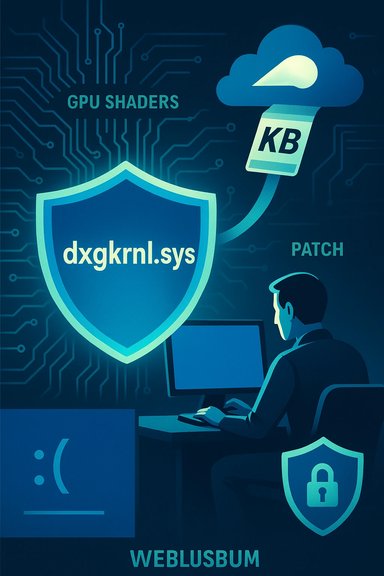 Background / Overview
The DirectX Graphics Kernel (dxgkrnl.sys) is the kernel‑mode component of the Windows graphics stack responsible for GPU scheduling, surface lifetimes, and other privileged operations. Faults inside dxgkrnl.sys can lead to host‑wide impacts: arbitrary kernel memory corruption, loss of confidentiality via information disclosure, local escalation to SYSTEM, or system instability and blue screens. This family of defects has recurred across multiple Patch Tuesday cycles and is notable because its trigger surface is extremely broad: thumbnailing and document previews, media playback, GPU‑accelerated browser operations, remote desktop sessions, and server‑side rendering pipelines can all exercise DirectX code paths.Microsoft’s Security Update Guide is the authoritative record for the CVE and the KB mappings required for each Windows build; administrators should confirm the exact update package for their OS versions there or in the Microsoft Update Catalog. Because the MSRC UI renders dynamically, retrieving the KB → build mapping may require an interactive browser.
What we know about CVE‑2026‑20814
- The vendor classifies CVE‑2026‑20814 as a DirectX Graphics Kernel elevation of privilege vulnerability.
- Public summaries and community triage place this entry within the broader family of dxgkrnl defects that have historically included use‑after‑free, race conditions (TOCTOU), null/untrusted pointer dereferences, and occasional information‑disclosure issues. Those motifs determine likely exploitation trajectories and remediation patterns.
- Typical attack vector: local (an authenticated user or process with the ability to run crafted code or coerce rendering of malicious content). The attack usually requires low privileges to start but aims to elevate to SYSTEM.
- Exploitation complexity: community and vendor signals indicate timing sensitivity — exploitation is often associated with winning a race window or orchestrating heap layouts — which raises complexity but does not eliminate real‑world exploitability; experienced exploit authors and automated tooling have historically produced reliable harnesses for similar DirectX bugs after disclosure.
Technical anatomy (what the vulnerability likely looks like)
Microsoft’s public metadata and community write‑ups do not always include patch diffs or function‑level traces; however, the family of dxgkrnl vulnerabilities exposes a tight set of recurring root causes that are useful for defensive planning:- Use‑after‑free (UAF): one thread frees or invalidates a kernel object while another thread still holds a reference. If an attacker can reallocate the freed slot with attacker‑controlled data inside the race window, the kernel may dereference corrupted pointers in privileged context — producing arbitrary read/write primitives or pointer overwrite opportunities. These primitives are the canonical path from local code execution to SYSTEM escalation in the DirectX kernel family.
- Race conditions / TOCTOU: concurrent access to shared kernel resources without correct synchronization yields inconsistent state that attackers can induce deterministically with careful scheduling and allocator grooming. Race classes are timing‑sensitive and historically labeled “complex,” yet automation and clever harnesses can reduce that complexity quickly.
- Null / untrusted pointer dereference: dereferencing NULL or attacker‑influenced pointers in kernel mode causes crashes and blue screens (DoS). While a pure DoS does not directly equate to code execution, these faults raise operational risk—especially on multi‑user hosts—and sometimes form part of chained attacks.
- Information disclosure: improper bounds checks or stale/bad pointer reads can leak kernel or process memory to userland, lowering the bar to subsequent exploitation steps. Prior DirectX advisories have included memory disclosure primitives that were later leveraged or combined with other bugs.
Verified facts and gaps — what’s confirmed, what remains unverified
What we can confirm with high confidence:- An MSRC entry exists for CVE‑2026‑20814 and Microsoft has released an update mapping for affected SKUs; administrators should rely on MSRC/Update Catalog for the authoritative KB→build table.
- The vulnerability affects a DirectX Graphics Kernel component (dxgkrnl family) and is categorized as an elevation of privilege risk reachable from an authenticated local process or by rendering crafted content.
- Vendor advisories rarely publish low‑level exploit primitives: exact function names, IOCTL numbers, or heap layout details are intentionally omitted. Any claims of precise exploitation sequences found outside the vendor patch should be considered provisional until independently confirmed by researcher write‑ups or patch diffs.
- Exact CVSS v3.x or v4.0 numeric score for CVE‑2026‑20814 may not be present in third‑party mirrors or might be omitted on MSRC; verify the published score on the MSRC entry and the NVD once the record completes enrichment. The authoritative CVSS vector is the one published by Microsoft or NVD (if available) — do not rely solely on mirrored feeds.
- Whether there are confirmed in‑the‑wild exploitations at the time of reading: absence of a public PoC or observed exploitation does not guarantee the vulnerability is not being exploited privately. Historically, attackers have weaponized similar DirectX primitives after disclosure and patch publication.
Real‑world impact and the attack surface
The practical effect of a successful exploit depends on the victim host’s role and exposure:- High‑impact targets
- Remote Desktop Services (RDS), Virtual Desktop Infrastructure (VDI), terminal servers and cloud desktop hosts: a local EoP or DoS in the graphics kernel on these hosts can affect many users simultaneously and is therefore top priority.
- Mail gateways, CMSs, document‑preview services, and web upload processors that render thumbnails or previews: server‑side rendering of untrusted user content can transform a local bug into a remotely reachable attack surface if unauthenticated uploads reach rendering pipelines.
- Admin jump boxes, domain controllers, and privileged workstations: escalation to SYSTEM here enables attacker persistence, credential theft, and lateral movement.
- Moderate‑impact targets
- Individual workstations and developer laptops: compromise risk is lower than shared servers but still material for admins, developers, and power users who handle untrusted documents. Timely patching is advised.
- Low‑impact (but not ignored)
- Isolated single‑user desktops with controlled content flows; these can be patched on standard windows but should not be permanently deferred.
Patching, mitigation, and detection playbook
Immediate action (0–24 hours)- Confirm the MSRC advisory entry and record the KB(s) that map to each Windows SKU in your inventory; use an interactive browser for the MSRC Security Update Guide or consult the Microsoft Update Catalog to retrieve exact package names.
- Identify and prioritize hosts that accept untrusted content or host multiple users (RDS/VDI, mail/web preview servers, admin jump boxes).
- Apply the Microsoft update(s) to a representative pilot group that covers typical GPU vendors and OEM driver variants in your environment. Graphics kernel updates frequently interact with vendor drivers; test before broad rollout to avoid regressions.
- Reboot hosts as required: kernel/driver updates usually require full OS restarts to complete the replacement of dxgkrnl or vendor driver binaries.
- Disable automatic file previewing and thumbnail generation on servers that process untrusted uploads.
- Restrict who can interact with session hosts via RDP; apply host‑level firewall rules and network segmentation for public upload endpoints.
- Enforce least privilege on endpoints and reduce the number of users with local admin rights. Use AppLocker/WDAC where feasible.
- Increase kernel crash diagnostics (WER/minidump) collection for dxgkrnl.sys and vendor GPU driver crashes; centralize and correlate crash spikes with recent file previews and user sessions.
- Create EDR/SIEM rules to detect: unexpected process elevation to SYSTEM originating from user sessions, repeated rendering operations immediately preceding kernel crashes, and suspicious driver or service installations following rendering activity.
- Hunt recipe examples:
- Alert on “dxgkrnl.sys referenced in kernel bugcheck / blue screen” correlated with an RDP session ID.
- Alert on “user process spawned a SYSTEM child process shortly after rendering preview” for rapid investigation.
- Verify that crash rates for dxgkrnl.sys and associated vendor drivers have normalized and that there are no regressions in graphics stability, remote session reliability, or application compatibility.
Strengths and potential risks in Microsoft’s response
Strengths- Microsoft has issued a coordinated advisory and mapped the CVE to updates via the Security Update Guide, enabling enterprise patching pipelines to pull authoritative packages. This is the correct operational signal: apply vendor fixes and validate.
- High‑level vendor guidance correctly emphasizes exposure patterns (multi‑user hosts and content‑processing servers), which aligns with real‑world priorities for remediation.
- The MSRC UI’s dynamic rendering complicates automated scanning of advisory content; many third‑party mirrors lag or mis‑index MSRC entries, creating a risk that organizations relying solely on passive CVE feeds miss KB→build mappings. Administrators should confirm KB IDs via an interactive MSRC view or the Microsoft Update Catalog.
- Patches to kernel graphics subsystems interact with vendor GPU drivers and OEM firmware. Environments with mixed hardware may see compatibility regressions; testing on representative hardware is essential before widescale deployment.
- Vendor redaction of low‑level details is deliberate and correct for short‑term risk reduction, but it increases uncertainty for defenders who must judge exploitability without precise primitives. Use conservative assumptions for high‑exposure hosts.
How to prioritize in the enterprise: a short playbook
- Inventory: map hosts that accept untrusted content and multi‑user hosts; classify them as tier‑1 for this vulnerability.
- Pilot: deploy vendor patches to a pilot ring that includes representative GPU drivers and OEM laptop/desktop images. Validate stability and session reliability.
- Rollout: after pilot validation, expand patching to production with monitoring and change control. Reboot machines where the update requires it.
- Compensate: where patching cannot be immediate, apply compensations (disable previews, isolate hosts) and increase telemetry.
Why “less likely” does not mean “safe to defer”
Microsoft’s advisory language for similar DirectX vulnerabilities has sometimes described exploitation as “less likely” due to technical complexity (timing, heap grooming). While that reduces the immediacy for some environments, historical precedent shows that public disclosure plus patch release often triggers researcher PoCs and, in some cases, private exploitation attempts. DirectX and Win32K kernel defects have been weaponized after disclosure in the past. Therefore, prioritize by exposure: do not use “less likely” as a blanket justification to delay patching on high‑value or multi‑user systems.Final verification notes and cautions
- Confirm the KB package for each affected Windows build via Microsoft’s Security Update Guide or the Microsoft Update Catalog before declaring systems remediated. MSRC is the canonical source for the CVE → KB mapping; third‑party mirrors can lag.
- Treat claims of active exploitation or detailed exploit mechanics found outside vendor patches as provisional until corroborated by independent researchers and forensic telemetry. The vendor’s deliberate omission of low‑level details is a normal protective practice.
- If you manage public or server‑side content ingestion (mail gateways, CMS, image previewers), treat those services as high‑priority remediation targets because automated uploads can convert local attack primitives into remotely reachable abuse cases.
In summary, CVE‑2026‑20814 is another reminder that kernel‑mode graphics code carries outsized risk: it runs privileged logic and is reachable from many everyday operations. The vendor has published an MSRC advisory and updates; administrators must act promptly to identify high‑exposure hosts, test vendor packages against representative hardware, apply patches, and strengthen compensating controls where immediate patching is impossible. Confirm KB mappings in the Microsoft Update Catalog, raise telemetry for dxgkrnl and vendor driver crashes, and prioritize RDS/VDI hosts and server‑side rendering pipelines — these are the systems where a local elevation or DoS in the graphics kernel causes the most operational damage.
Source: MSRC Security Update Guide - Microsoft Security Response Center
