

Microsoft’s formal entry for CVE-2026-20848 confirms an elevation-of-privilege vulnerability in the Windows SMB Server component and places the issue squarely in the January 2026 security rollup; the vendor’s terse public advisory establishes the vulnerability’s existence but intentionally limits low‑level exploit details, making rapid patching and conservative hardening the appropriate immediate response.
Windows Server Message Block (SMB) has long been a critical and frequently targeted surface: it handles file sharing, named pipes, remote administration, and several kernel‑adjacent operations that services and users rely on. Vulnerabilities in SMB server code therefore carry outsized operational risk because they often run in privileged contexts, are widely deployed across enterprise estates, and can be combined with credential or coercion tricks to create powerful attack chains. Microsoft’s Security Update Guide records CVE‑2026‑20848 as an SMB Server elevation‑of‑privilege, and maps it into the January 2026 update wave — an authoritative signal that a patch exists and should be applied following normal validation procedures.
Key strengths in the current posture:
Cautionary note: the absence of vendor‑published exploit mechanics does not equal safety — it only reduces short‑term public exploitability. Any claim about the exact exploit chain should be labeled provisional until Microsoft publishes patch diffs or independent researchers release reproducible technical analyses.
Conclusion: CVE‑2026‑20848 is real, Microsoft provides KB‑mapped remediation, and defenders must act now — patch, harden, and hunt — while treating speculative technical narratives with healthy skepticism.
Source: MSRC Security Update Guide - Microsoft Security Response Center
 Background
Windows Server Message Block (SMB) has long been a critical and frequently targeted surface: it handles file sharing, named pipes, remote administration, and several kernel‑adjacent operations that services and users rely on. Vulnerabilities in SMB server code therefore carry outsized operational risk because they often run in privileged contexts, are widely deployed across enterprise estates, and can be combined with credential or coercion tricks to create powerful attack chains. Microsoft’s Security Update Guide records CVE‑2026‑20848 as an SMB Server elevation‑of‑privilege, and maps it into the January 2026 update wave — an authoritative signal that a patch exists and should be applied following normal validation procedures.The “degree of confidence” metric explained
Microsoft and many vulnerability-tracking bodies use a confidence metric to express two distinct signals at once:- the vendor’s confidence that the vulnerability is real and worthy of a CVE,
- and the amount of technical detail the vendor is publishing at disclosure.
What we can say with confidence
- The CVE is recorded against Windows SMB Server and is classified as Elevation of Privilege (EoP). This is Microsoft’s public classification in the Security Update Guide, which is the canonical mapping for administrators.
- A vendor‑mapped KB (or set of KBs) is available as part of the January 2026 updates; those KB identifiers are the operational artifact defenders should use for patch automation and verification.
- Microsoft’s initial advisory for this CVE intentionally omits low‑level exploit mechanics; therefore, claims about the exact exploit chain should be treated as speculative unless corroborated by the vendor’s KB diffs or independent technical write‑ups.
Technical context and plausible attack classes
Microsoft’s brief advisory does not state the precise root cause (for example, whether the bug is a race condition, improper access control, or memory‑safety defect). Historically, however, SMB Server EoP advisories fall into a small set of recurring patterns — and these are the threat models defenders should use for planning until concrete technical details are published. Treat the following as evidence‑informed plausibilities, not confirmed exploit steps:- Credential coercion / relay-style attacks: Attackers coerce a victim process to connect to an attacker‑controlled SMB server (for example via malicious UNC paths, document previews, or scripted SMB URIs). If server logic mishandles authentication negotiation, this can result in privilege escalation or credential relay. This is a common SMB pattern.
- Improper server‑side access checks / TOCTOU (time‑of‑check/time‑of‑use): Logic or race‑condition defects in SMB server handlers can let an attacker win a timing window and bypass checks that guard privileged operations. Microsoft’s prior SMB advisories and community analyses frequently highlight TOCTOU and race conditions as root causes for EoP in server code.
- Parsing or resource‑handling flaws: Malformed SMB requests, specially crafted filenames, or unexpected handle semantics can trigger code paths that run with elevated privileges. Memory safety problems (use‑after‑free, buffer overflows) are less common for SMB server code than logic bugs, but they remain possible and consequential.
Operational impact — who should prioritize this CVE
- Domain controllers, file servers, and SMB‑facing hosts: These are highest priority because SMB services are core to authentication and file infrastructure. A successful EoP here can enable credentials theft and lateral movement.
- Jump boxes, admin workstations, and management servers: Privileged administrative systems that mount SMB shares or host SMB endpoints are high risk because they are trusted by operators and often run privileged tooling.
- RDS/VDI farms and content‑processing hosts: Servers that process untrusted uploads (thumbnailing, previewing, antivirus scanning) can amplify a local or upload‑based primitive into broader exposure.
Immediate, tactical checklist (24–72 hours)
- Confirm vendor KB mapping — Use Microsoft’s Security Update Guide and Microsoft Update Catalog to map CVE‑2026‑20848 to the exact KB(s) for every Windows SKU in your inventory. The Update Guide is the authoritative source; automated mirrors can lag.
- Patch high‑value systems first — Deploy the tested security update to domain controllers, file servers, jump boxes, patch-management servers, and any host that runs the SMB Server role. Reboot if required.
- Apply short‑term network restrictions — Block inbound SMB (TCP 445/139) at the perimeter for hosts that do not require Internet‑facing SMB exposure. Restrict SMB egress from servers that should never initiate outbound SMB connections.
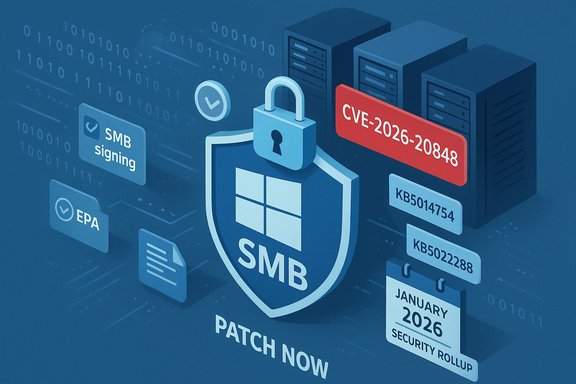
- Enable or audit SMB signing / EPA — Where compatibility allows, enable SMB signing and Extended Protection for Authentication (EPA); if enforcement would break legacy clients, enable audit mode first to identify incompatibilities. These mitigations reduce the feasibility of relay and negotiation‑based attacks.
- Increase telemetry and hunting — Run detection queries for unusual outbound SMB sessions, new or suspicious service process launches on SMB hosts, and anomalous authentication events. Use EDR/XDR to hunt for post‑exploit behaviors (token abuse, unexpected scheduled tasks, file writes to system paths).
Medium‑term actions (72 hours–2 weeks)
- Complete the full patch roll‑out and verify KBs are installed and that critical functionality (DFS replication, backup jobs, third‑party filter drivers) remains operational. Test reboots and failovers in a representative pilot ring before broad rollout.
- Reassess temporary network mitigations and transition audit rules to enforcement when compatibility issues have been resolved. Document exceptions and maintain a controlled change log for any host‑level firewall or signing enforcement modifications.
- Conduct targeted detection hunts for the 72‑hour windows before and after applying patches; historically attackers attempt exploit attempts or lateral movement close to patch availability, and rapid detection in that window is crucial.
Detection signals and hunting tips
- Monitor for outbound SMB (TCP/445) from servers, especially those that should not initiate SMB traffic. Outbound SMB to unfamiliar IPs is a strong indicator of coercion/relay attempts.
- Watch for unexpected process spawns originating from SMB service contexts: unsigned binaries, cmd.exe, PowerShell, or service creation immediately following SMB sessions. Those behaviors often mark post‑exploit activity.
- Audit Windows event logs for SMB session creations, authentication failures/successes, and events tied to Extended Protection for Authentication or SMB signing compatibility checks. Correlate with network telemetry to flag suspicious sequences.
- If compromise is suspected, follow incident response playbooks: isolate the host, collect volatile evidence (memory dumps, live connection lists), preserve logs, and engage forensic teams to analyze token and process state before remediating.
Why Microsoft’s disclosure posture matters — strengths and risks
Microsoft’s approach of confirming the CVE and mapping it to KBs while withholding exploit‑level detail has operational tradeoffs:- Strengths
- It prevents immediate disclosure of exploit recipes to attackers while customers begin to patch.
- The vendor’s mapping to KB artifacts gives a definitive remediation path for automated patch management systems.
- Risks
- Detection teams that rely on patch diffs or PoCs to craft signatures are temporarily hamstrung and must rely on behavioral detection rather than content‑based signatures.
- Public mirrors and third‑party trackers may lag or misinterpret per‑SKU applicability; administrators must confirm KB→SKU mappings interactively rather than trusting a single aggregator.
Practical hardening checklist (beyond the immediate patch)
- Disable SMBv1 everywhere it is still present. It is legacy and frequently implicated in high‑impact incidents.
- Harden NTLM/Kerberos policies: reduce NTLM allowances, disable unconstrained delegation where not required, and prefer Kerberos with constrained delegation.
- Segment SMB hosts: place file servers and administrative hosts on separate VLANs or subnets and limit access via firewall rules and ACLs.
- Use application allow‑listing and WDAC/AppLocker on jump boxes and admin workstations to limit the impact of account compromise.
- Move untrusted processing into sandboxes: previewing, virus scanning, and thumbnail generation for externally supplied files should run in isolated, short‑lived containers or VMs.
What remains uncertain (and how to treat unverified claims)
- Microsoft’s advisory for CVE‑2026‑20848 does not, at publication, provide a full technical root‑cause or exploit recipe; therefore any public technical claim that specifies an exploit chain should be treated as unverified until corroborated by:
- vendor patch diffs or expanded technical notes, and
- at least one independent researcher write‑up that reproduces the behavior.
- There is no universally authoritative public proof‑of‑concept (PoC) or confirmed in‑the‑wild exploitation tied to this CVE at the time the vendor published the KB mapping. Absence of a PoC reduces immediate mass‑exploit urgency but does not remove the need for prioritized remediation on critical hosts. Historical precedent shows weaponization can follow quickly after public analysis or after PoCs appear.
Recommended timeline for response
- 0–24 hours: Inventory SMB Server hosts, confirm KB mappings, and begin staging patches for the highest‑risk hosts. Enable audit modes for SMB signing/EPA to detect incompatible clients.
- 24–72 hours: Deploy tested patches to domain controllers, file servers, jump boxes, and management servers. Apply temporary network and host firewall restrictions where patching is delayed. Increase EDR/IDS monitoring windows.
- 72 hours–2 weeks: Complete full roll‑out, transition audit policies to enforcement where feasible, run post‑patch hunts for pre‑patch exploitation artifacts, and perform after‑action reviews to capture lessons learned.
Final analysis — strengths, risks, and verdict
CVE‑2026‑20848 is a high‑priority entry because it affects SMB Server, a privileged and network‑facing Windows subsystem. Microsoft’s vendor acknowledgement and KB mapping make the vulnerability real and actionable; the vendor’s conservative disclosure of technical detail is intended to limit short‑term attacker advantage, but it increases operational pressure on defenders to patch swiftly and harden defenses preemptively.Key strengths in the current posture:
- Vendor‑mapped KBs provide an authoritative remediation path and support automated patching pipelines.
- The established set of compensating controls (SMB signing, EPA, blocking SMB egress/ingress) are practical and effective mitigations while patches are staged.
- Rapid weaponization if an independent PoC appears or if attackers reverse‑engineer the patch. Detection teams must focus on behavioral indicators rather than waiting for signatureable IOCs.
- Incomplete KB→SKU mapping in third‑party mirrors; administrators must confirm per‑build applicability interactively.
Cautionary note: the absence of vendor‑published exploit mechanics does not equal safety — it only reduces short‑term public exploitability. Any claim about the exact exploit chain should be labeled provisional until Microsoft publishes patch diffs or independent researchers release reproducible technical analyses.
Conclusion: CVE‑2026‑20848 is real, Microsoft provides KB‑mapped remediation, and defenders must act now — patch, harden, and hunt — while treating speculative technical narratives with healthy skepticism.
Source: MSRC Security Update Guide - Microsoft Security Response Center
