

Microsoft's January security rollup includes a newly cataloged information‑disclosure flaw affecting the Windows Management Services component, tracked as CVE‑2026‑20862, and administrators should treat it as a firm reason to validate and accelerate patching on any system that exposes Windows management interfaces to local users or third‑party management agents. At face value the bug is an information‑disclosure issue — not remote code execution — but the vulnerability class, the privileged context of the affected service, and the way attackers chain small leaks into larger escalations make this a notable item in the January 2026 bulletin that requires prompt operational attention.
This class of management‑service vulnerability is neither novel nor theoretical. Windows has had multiple management and kernel components patched historically for information disclosure and memory‑safety defects, and the practical attacker model for many of those bugs is the same: a low‑privilege or authorized local account crafts requests (or triggers behavior) that cause the service to return uninitialized memory or to expose internal fields, then uses the harvested data to escalate or pivot.
CVE‑2026‑20862 is a manageable but meaningful risk: install the January 2026 updates, prioritize privileged and multi‑user hosts, and strengthen local access controls and monitoring for management‑service activity to neutralize the most dangerous follow‑on attack paths.
Source: MSRC Security Update Guide - Microsoft Security Response Center
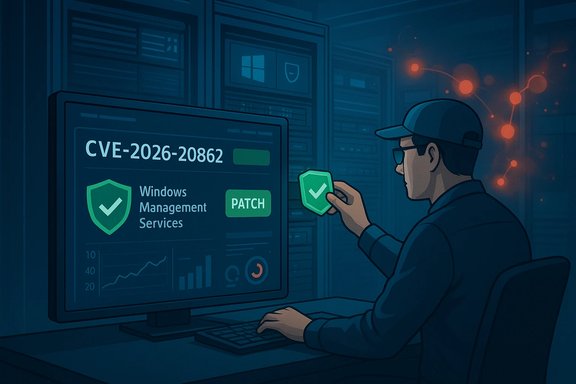 Background
What is Windows Management Services and why it matters
Windows Management Services (the service identified in vendor advisories under that name) is a privileged management subsystem used by Windows to coordinate configuration, remote administration, and management tasks. It frequently runs in server and multi‑user environments and interfaces with management tools, scripting subsystems, and remote management endpoints. Because it mediates privileged operations and often processes structured requests from local and remote clients, any memory‑safety or object‑initialization flaw inside this component can leak sensitive data — authentication tokens, internal state, or configuration details — that materially lower the effort required to mount larger attacks.This class of management‑service vulnerability is neither novel nor theoretical. Windows has had multiple management and kernel components patched historically for information disclosure and memory‑safety defects, and the practical attacker model for many of those bugs is the same: a low‑privilege or authorized local account crafts requests (or triggers behavior) that cause the service to return uninitialized memory or to expose internal fields, then uses the harvested data to escalate or pivot.
Where CVE‑2026‑20862 appears in the update stream
CVE‑2026‑20862 is listed among the January 2026 Microsoft security updates affecting Windows Management Services. Microsoft’s security guidance groups multiple Windows Management Services defects across recent releases; when combined with other nearby CVEs in the same component, the pattern suggests repeated memory‑safety or resource‑initialization errors rather than a single exotic attack vector. The immediate operational implication is straightforward: apply the January security updates to all supported Windows installations, and prioritize hosts that run management endpoints or provide multi‑user access.Technical summary of CVE‑2026‑20862
Reported impact
- Primary issue: Information disclosure within Windows Management Services.
- Practical effect: An authorized local account can cause the service to disclose information that should remain confidential to other accounts or processes.
- Attack vector: Local (the service requires interaction from an authenticated local user or agent).
- Remote exploitation: There is no public evidence that this CVE is exploitable over a network without local access.
- Exploitability context: Because the flaw is an information disclosure and not a direct code‑execution bug, the most likely real‑world scenarios involve local misuse or chaining with other vulnerabilities.
Likely root causes (informed inference)
Public advisories for related Windows Management Services CVEs over the past year commonly list one of the following root causes:- Use of uninitialized resources (CWE‑908) — the service returns memory contents that were never initialized, leaking residual secrets.
- Out‑of‑bounds reads — an input triggers a read beyond an object/array boundary and returns adjacent memory.
- Race conditions or synchronization bugs — concurrent accesses expose partially initialized objects or stale memory.
Scope and affected products
Microsoft’s monthly rollup lists affected Windows versions and servicing channels. The vulnerable component appears in multiple supported client and server SKUs, meaning:- Production servers with role‑based management tools
- Managed workstations that accept local management agents
- Domain controllers and admin hosts where management interfaces are enabled
The "degree of confidence" (Exploitability / Known Technical Details) — what Microsoft’s metric means
Microsoft’s advisory framework includes a short metric describing the degree of confidence in the vulnerability’s existence and how much technical detail is known publicly. That metric is important because it tells defenders and incident responders how much actionable information is available to attackers. The metric ranges from minimal public mention with little technical detail, through independent researcher corroboration, to vendor confirmation and a published technical analysis.- A low‑confidence listing (minimal details) means the vendor has taken steps to assign a CVE and may have mitigated code paths, but the exact root cause and exploit techniques are not public. Attackers with advanced reverse‑engineering skills may still find workarounds, but casual or copycat exploitation is unlikely.
- A medium‑confidence listing indicates at least one public researcher or third‑party tracker has published technical analysis or a proof‑of‑concept indicative of more specific root cause hypotheses.
- A high‑confidence listing corresponds to vendor acknowledgement (advisory or patch) plus corroborating technical information, documentation, or a public proof‑of‑concept; this raises urgency because the details are readily available to attackers.
Why information‑disclosure bugs matter — beyond immediate confidentiality loss
Information disclosure is sometimes dismissed by non‑technical stakeholders as “only leakage” compared to code execution or privilege escalation. That’s a mistake. There are three reasons to treat CVE‑2026‑20862 with elevated priority:- Disclosure as an enabler
- Small disclosures — a token fragment, a partial credential, a configuration string — dramatically reduce the difficulty of other attacks. Credential fragments can be combined offline, and leaked configuration details can reveal attack surfaces or authentication endpoints that were previously hidden.
- Chaining and persistence
- Attackers use information leaks to escalate privileges or to bypass controls. For example, a leaked authentication blob for a management API may allow attackers to orchestrate privilege escalation or lateral movement.
- Data sensitivity and regulatory exposure
- Systems with regulated data (financial, healthcare, identity) must treat any confidentiality loss as a material risk. Even a local information disclosure that remains confined to a single host can create compliance liabilities if it exposes protected data.
Detection and assessment — indicators to watch for
Because CVE‑2026‑20862 is a local information‑disclosure issue, detection requires focusing on local behavior and subtle signals:- Unusual management‑service activity
- Frequent calls to management endpoints from non‑admin accounts, repeated malformed requests, or repeated restarts of management services.
- Unexpected process behavior
- Local agents invoking management APIs in non‑standard patterns; scripted access outside normal operational windows.
- EDR telemetry
- Memory reads or dumps triggered by low‑privilege processes, unexplained interprocess communication (IPC) between management agents and user‑space utilities.
- Configuration drift
- New local agents, unsigned plugins, or third‑party management tools installed without change control.
Mitigation and remediation: actionable checklist
Apply these recommendations immediately and adapt them into standard operating patch workflows.- Install the official January 2026 Microsoft security updates that include the fix for CVE‑2026‑20862 on all affected systems. Prioritize domain controllers, management servers, and multi‑user hosts.
- For systems that cannot be patched immediately:
- Disable or restrict Windows management services when not required.
- Apply host‑level access controls (AppLocker, Windows Defender Application Control) to prevent untrusted local agents from invoking management endpoints.
- Harden local access:
- Enforce least privilege for local accounts.
- Remove unnecessary administrative group membership.
- Limit local interactive logon where possible.
- Update detection and response:
- Add EDR rules to flag repeated local calls to management services and suspicious IPC patterns.
- Monitor for new or unsigned management agents and unexpected changes to management configurations.
- Test fixes:
- Validate updates in a staging environment, ensure management workflows still function, and verify no regressions in monitoring or automation tooling.
- Inventory and patch image builds:
- Update golden images, cloud images, and deployment pipelines so new hosts are not provisioned with the vulnerable component.
Risk assessment and prioritization guidance
Use the following rubric to prioritize patch deployment:- Critical priority (apply within 24–72 hours)
- Admin servers, multi‑tenant hosts, domain controllers, jump servers, and any system that exposes management interfaces to multiple users.
- High priority (apply within 7 days)
- Workstations and systems that accept local management agents from service accounts, as well as servers hosting sensitive workloads.
- Medium priority (apply in routine cycle)
- Single‑user developer machines and isolated hosts with no management services enabled.
What we verified, and what remains unconfirmed
This analysis cross‑checked vendor guidance and independent vulnerability trackers to establish the advisory’s presence in the January 2026 updates and to confirm that the vulnerability class is information disclosure with local attack vector requirements. However, a few items remain unconfirmed in public channels as of this writing:- Microsoft’s Security Update Guide entry for CVE‑2026‑20862 lists the CVE; a full technical writeup with line‑level cause analysis is not publicly available yet.
- There is no widely distributed public proof‑of‑concept for CVE‑2026‑20862 as of the time of this article; this lowers the immediate risk of mass exploitation but does not remove the threat of targeted attacks or private proofs.
- Some third‑party trackers and security databases catalog neighboring Windows Management Services CVEs (in late 2025) that share root‑cause classes (uninitialized resource, use‑after‑free, out‑of‑bounds). Inferring the exact bug mechanics for CVE‑2026‑20862 from those examples is reasonable but not a substitute for vendor technical notes.
Threat model scenarios — how an attacker might use this bug
- Local insider reconnaissance
- A non‑privileged account with local logon might query the management service repeatedly to recover configuration blobs or partial credential material and then use that data to escalate privileges or access network resources.
- Adjacent‑compromise chain
- An attacker who compromises a user workstation can leverage the disclosure to harvest tokens or service secrets that allow lateral movement to servers with higher privileges.
- Targeted escalation
- In a carefully targeted attack, defenders’ lack of telemetry around local management calls leaves reconnaissance blind spots; an attacker can consistently probe management services for micro‑leaks, stitch fragments together, and reach effective privilege elevation.
Operational recommendations for security teams
- Treat CVE‑2026‑20862 as a required patch item for January 2026 maintenance windows. Update deployment plans to include:
- Pre‑deployment testing on a subset of servers and workstations.
- Post‑deployment validation of management flows and monitoring rules.
- Remind incident responders to preserve affected hosts for forensic imaging if they suspect a targeted compromise occurred prior to patching.
- Conduct a short tabletop that focuses on local threat vectors: how would an attacker with a low‑privilege local account move within the environment, and what counters (EDR rules, configuration restrictions) are in place?
- Use the patch cycle as a trigger to audit and reduce the number of local administrative accounts and to enforce stronger control of local management agents.
- Track and prioritize other Windows Management Services CVEs appearing in the same bulletin — multiple fixes in the same component often indicate systemic issues that deserve deeper architectural attention (hardening, sandboxing, and memory‑safety investments).
Final analysis — strengths and risks
- Strengths
- Microsoft has assigned a CVE and released patches as part of the January 2026 update cadence, which gives organizations a clear remediation path.
- The public record does not show a widely observed exploit for CVE‑2026‑20862 at the time of publication; that buys defenders time for measured patching and validation.
- The vulnerability is an information‑disclosure class rather than remote code execution, which reduces immediate catastrophic risk on systems that are otherwise well‑hardened.
- Risks
- Information leaks are powerful enablers; even limited disclosure can materially reduce attacker effort in follow‑on stages.
- The affected service runs in a privileged context and is widely present across Windows SKUs, increasing the attack surface for multi‑tenant and enterprise environments.
- The degree of public technical detail is limited; when vendors publish fixes without full technical analysis, skilled attackers can reverse‑engineer patches to develop exploits.
CVE‑2026‑20862 is a manageable but meaningful risk: install the January 2026 updates, prioritize privileged and multi‑user hosts, and strengthen local access controls and monitoring for management‑service activity to neutralize the most dangerous follow‑on attack paths.
Source: MSRC Security Update Guide - Microsoft Security Response Center
