

Microsoft’s Security Update Guide lists a new vulnerability, tracked as CVE‑2026‑20868, that affects the Windows Routing and Remote Access Service (RRAS) and is described as a remote code execution (RCE) issue — an urgent operational problem for any organization that runs RRAS‑based VPN or routing endpoints.
Microsoft’s listing for CVE‑2026‑20868 appears in the vendor’s Security Update Guide, which is the canonical place Microsoft publishes CVE mappings and KB remediation packages. Because the MSRC UI is delivered as a JavaScript application, the advisory page confirms the CVE entry but often requires a full browser render to extract the exact KB numbers and per‑build remediation details. Administrators should treat a presence in MSRC as vendor acknowledgement that a fix exists or is being tracked. Public reporting and community playbooks for RRAS vulnerabilities across 2024–2025 show a recurring pattern: RRAS protocol and packet parsing bugs — especially heap‑based overflows, out‑of‑bounds reads, and related memory‑safety failures — frequently carry a high operational impact because RRAS typically runs with elevated privileges and terminates VPN flows at network perimeters. Those historical incidents provide practical context for why any RRAS RCE entry is treated with high urgency by defenders.
Independent vulnerability trackers and vendor advisories documented multiple RRAS issues in 2024–2025 that followed the same operational pattern: vulnerability disclosed → vendor patch released (MSRC / KB) → rapid opportunistic scanning of RRAS ports. Community guidance from incident responders, security vendors, and operations playbooks converges on the same triage steps: inventory, patch (map CVE → KB → build), and perimeter containment (block RRAS‑related ports if immediate patching is not possible).
Exploitability: Heap overflows are not trivial to weaponize on modern Windows due to mitigations (ASLR, DEP/NX, Control Flow Guard, heap hardening), but they are also not impossible. Skilled actors combine information leaks and heap primitives to bypass mitigations; once a reliable primitive exists, weaponization and mass scanning follow quickly. Historical RRAS disclosures show a common pattern of rapid scanning and automated exploit attempts after disclosure.
High‑priority targets:
Key operational reminder: patch first, verify the exact KB for your OS builds from Microsoft’s Security Update Guide or the Microsoft Update Catalog, and apply perimeter controls while you stage updates.
Source: MSRC Security Update Guide - Microsoft Security Response Center
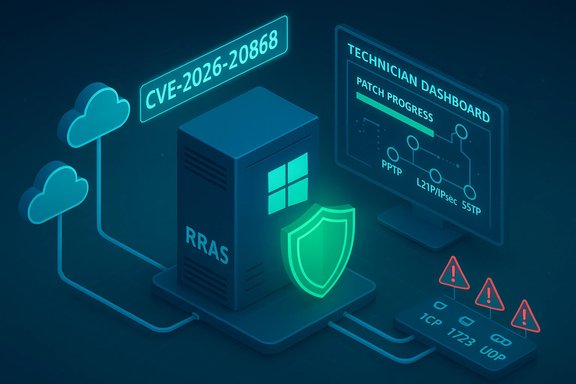 Overview
Microsoft’s listing for CVE‑2026‑20868 appears in the vendor’s Security Update Guide, which is the canonical place Microsoft publishes CVE mappings and KB remediation packages. Because the MSRC UI is delivered as a JavaScript application, the advisory page confirms the CVE entry but often requires a full browser render to extract the exact KB numbers and per‑build remediation details. Administrators should treat a presence in MSRC as vendor acknowledgement that a fix exists or is being tracked. Public reporting and community playbooks for RRAS vulnerabilities across 2024–2025 show a recurring pattern: RRAS protocol and packet parsing bugs — especially heap‑based overflows, out‑of‑bounds reads, and related memory‑safety failures — frequently carry a high operational impact because RRAS typically runs with elevated privileges and terminates VPN flows at network perimeters. Those historical incidents provide practical context for why any RRAS RCE entry is treated with high urgency by defenders.Background: Why RRAS matters and why this class of bug is dangerous
Routing and Remote Access Service (RRAS) is Microsoft’s long‑running role for VPN termination (PPTP, L2TP/IPsec, SSTP), NAT, and routing on Windows Server. RRAS endpoints often sit on the network edge — VPN concentrators, branch gateways, cloud VM images used for remote access — and they handle complex, attacker‑controlled protocol inputs. A memory‑safety bug in RRAS parsing logic can therefore allow an unauthenticated network actor to achieve SYSTEM‑level code execution on an exposed host. That combination (network‑reachable service + privileged context + complex parser) is a high‑value target profile for attackers.Independent vulnerability trackers and vendor advisories documented multiple RRAS issues in 2024–2025 that followed the same operational pattern: vulnerability disclosed → vendor patch released (MSRC / KB) → rapid opportunistic scanning of RRAS ports. Community guidance from incident responders, security vendors, and operations playbooks converges on the same triage steps: inventory, patch (map CVE → KB → build), and perimeter containment (block RRAS‑related ports if immediate patching is not possible).
What the MSRC entry says (and what it does not)
- Microsoft’s Security Update Guide shows an entry for CVE‑2026‑20868, identifying it as an RRAS remote code execution vulnerability. This is the vendor’s formal acknowledgement and makes the advisory authoritative for mapping to updates for specific Windows builds.
- The MSRC UI generally lists affected products and the KB/security update that mitigates the CVE, but the content is rendered dynamically. Administrators must open the MSRC advisory in a browser or use the Microsoft Update Catalog/WSUS to obtain the exact KB number(s) that apply to their OS builds. Treat MSRC as the final authority for CVE→KB mapping.
- Public technical details listed in MSRC entries for RRAS CVEs are often terse; vendor advisories frequently describe the impact class (heap‑based overflow, RCE) and affected component but omit step‑by‑step exploit mechanics. Where exploit mechanics are absent, independent technical write‑ups or vendor follow‑ups may be needed to understand exploitation complexity. If independent PoC or technical analysis is not available, treat detailed exploit claims as unverified until corroborated.
Technical characterization: likely root cause and attack vector
Microsoft’s MSRC entry classifies CVE‑2026‑20868 as an RRAS vulnerability resulting in remote code execution. Historical RRAS CVEs in the same family were frequently reported as one of these root cause classes:- Heap‑based buffer overflow (CWE‑122) — attacker sends crafted protocol messages that overflow a heap buffer in the RRAS parser and, under the right conditions, convert heap corruption into control of execution. This class has produced high CVSS scores in previous advisories.
- Out‑of‑bounds reads / uninitialized memory exposure (CWE‑125 / CWE‑908) — these produce information leaks that can lower the bar for a subsequent memory‑corruption exploit.
- Use‑after‑free / double‑free and other memory‑management defects that can be chained to achieve RCE in privileged service contexts. Public vulnerability databases and vendor advisories have cataloged various memory‑safety defect classes for RRAS.
Exploitability: Heap overflows are not trivial to weaponize on modern Windows due to mitigations (ASLR, DEP/NX, Control Flow Guard, heap hardening), but they are also not impossible. Skilled actors combine information leaks and heap primitives to bypass mitigations; once a reliable primitive exists, weaponization and mass scanning follow quickly. Historical RRAS disclosures show a common pattern of rapid scanning and automated exploit attempts after disclosure.
Who is affected and how to prioritize
Affected systems: any Windows host with the Routing and Remote Access role installed and the RemoteAccess service running. RRAS is not installed by default on many Windows SKUs, but it is commonly used for on‑prem VPN termination, branch gateways, and some cloud VM images where administrators enable the role. Inventory accuracy is a common operational blind spot; unmanaged or forgotten RRAS instances on cloud images are frequently the cause of lingering exposure.High‑priority targets:
- Internet‑facing RRAS servers (VPN gateways, DMZ concentrators, cloud VMs used as VPN endpoints).
- Internal RRAS hosts reachable from less‑trusted network segments.
- RRAS hosts tied to identity stores or Active Directory where compromise would amplify damage.
Immediate operational response (0–72 hours)
This playbook mirrors the consensus across MSRC advisory guidance, vendor trackers, and incident‑response community writeups. Prioritize actions in the order shown.- Patch first (highest priority)
- Map CVE‑2026‑20868 → KB for every Windows build in your environment using the Microsoft Security Update Guide or Microsoft Update Catalog, then stage and deploy updates through your patch management system (WSUS, SCCM, Intune). MSRC is authoritative for the mapping.
- If you cannot patch immediately — contain
- Block RRAS/VPN ports at network perimeter and host firewalls: TCP 1723 (PPTP), GRE (IP 47), UDP 1701 (L2TP), UDP 500/4500 (IKE/IPsec), TCP 443 (SSTP). Restrict access to known client/partner IP ranges.
- Stop and disable the RemoteAccess service on non‑critical hosts:
- Stop-Service -Name RemoteAccess -Force
- Set-Service -Name RemoteAccess -StartupType Disabled
- Uninstall the RRAS role where it’s not required: Uninstall‑WindowsFeature -Name RemoteAccess -IncludeManagementTools.
- Harden authentication and session state
- Enforce certificate‑based VPN authentication and multi‑factor authentication (MFA). Rotate long‑lived keys and expire suspicious or long‑standing sessions if RRAS endpoints were exposed pre‑patch.
- Increase detection and telemetry
- Forward RRAS logs (Applications and Services Logs → Microsoft → Windows → RemoteAccess and RasMan) to your SIEM. Alert on frequent negotiation failures, service crashes/restarts, and anomalous traffic to RRAS ports. Capture packet captures (PCAPs) for suspected probing and preserve crash dumps and memory images for forensic analysis if exploitation is suspected.
Detection, hunting, and post‑patch validation
Detection cues to prioritize:- Network telemetry showing spikes or repeated connections to RRAS‑related ports (TCP 1723, GRE 47, UDP 1701, UDP 500/4500, TCP 443).
- Repeated negotiation failures or malformed requests from a single IP or a small cluster — a hallmark of scanning/probing.
- Unexpected RRAS service crashes, crash dumps, or sudden child processes spawned by RemoteAccess. Forward these events to your IR team for memory and binary analysis.
- Confirm the KB(s) are installed: Get‑HotFix (or check Windows Update history) on each affected host.
- Verify the RemoteAccess service restarts and RRAS listeners bind to expected ports without error.
- Run acceptance tests for VPN connectivity from trusted endpoints and validate authentication flows (MFA, certificates).
- Maintain heightened monitoring for at least 72 hours after wide rollout — initial exploit attempts often spike shortly after disclosure.
Risk analysis: attacker incentives and likely behaviors
- Immediate opportunistic scanning is the most likely short‑term behavior. In past RRAS disclosures attackers launched mass scans for exposed RRAS ports within hours of publication. Automated scanners and low‑complexity exploit chains are typical.
- Skilled adversaries (ransomware groups, espionage actors) may attempt to craft and weaponize complex exploit chains that combine information leaks with heap corruption primitives to bypass modern mitigations. The payoff — SYSTEM‑level access on a perimeter host — justifies investment in weaponization for high‑value targets.
- If exploitation is successful, likely follow‑on activity includes credential harvesting (LSASS dumps), lateral movement, persistence, and ransomware or data exfiltration. Because RRAS mediates authentication and sits at the network edge, compromise can provide a strong foothold.
Known limitations, confidence, and unverifiable claims
- Vendor acknowledgement: Microsoft’s Security Update Guide lists CVE‑2026‑20868, which is a strong signal that the vulnerability exists and that remediation is tracked. However, MSRC’s web UI requires a full browser render to extract the KB mapping. Administrators should not rely on third‑party mirrors for the KB→build mapping — use MSRC, Microsoft Update Catalog, or WSUS to identify the exact update package.
- Public exploit mechanics: As of this article’s publication, MSRC’s short advisory presence does not necessarily include detailed exploit mechanics, and major public technical write‑ups or PoCs may not yet be available. Where exact exploit details are not published by the vendor, treat any public technical claims as provisional until corroborated by independent technical analysis or vendor follow‑ups. Community reporting for prior RRAS CVEs shows that exploit mechanics often follow later or are reconstructed by researchers.
- Indexing lag: Large CVE aggregators sometimes lag behind vendor publications, especially when advisories are new or when the vendor’s UI is dynamic. That means not every third‑party database will show CVE‑2026‑20868 immediately; absence from those mirrors does not mean the CVE is invalid. Rely on MSRC for authoritative mapping.
Practical checklist for Windows administrators (concise)
- Immediately: Query MSRC for CVE‑2026‑20868 and identify KB numbers that map to your Windows builds. Confirm via Microsoft Update Catalog.
- Patch: Deploy the vendor‑supplied KBs in prioritized rings: test → internet‑facing RRAS gateways → internal RRAS hosts.
- Contain (if you cannot patch immediately): block RRAS ports (TCP 1723, GRE, UDP 1701, UDP 500/4500, TCP 443), stop/disable RemoteAccess, or remove the RRAS role on non‑critical systems.
- Detect: Forward RRAS and RasMan logs to SIEM, alert on port scanning and service crashes, capture PCAPs and memory when suspicious.
- Validate: Confirm KB installation and service health; maintain heightened monitoring for 72+ hours after rollout.
Strengths and risks in the public record
Strengths- Vendor acknowledgement via MSRC is the strongest signal that the vulnerability is real and actionable; MSRC entries permit precise KB → build mapping once the UI or Update Catalog data is consulted.
- Rich, consistent community guidance is available for RRAS triage — inventory commands, port lists, and PowerShell mitigations are well established from prior RRAS advisories and are directly applicable here.
- Historical precedence: prior RRAS CVEs show consistent attack patterns and remediation strategies that defenders can reuse, shortening the time from discovery to effective containment.
- Lack of public PoC or detailed exploit mechanics at disclosure can create ambiguity about immediate exploitability; however, absence of a PoC is not proof of safety and should not delay patching.
- Third‑party CVE mirrors and automated feeds have exhibited inconsistent CVE→KB mappings for RRAS advisories in the past; relying on those mirrors without cross‑checking MSRC can lead to patching the wrong package. Confirm KB IDs in MSRC and the Microsoft Update Catalog before mass deployment.
- Inventory gaps (unknown RRAS instances in cloud images, older server builds) increase the chance that vulnerable instances remain reachable — organizations must ensure CMDB/asset management reflects reality.
What defenders should expect next
- Immediate scanning and opportunistic probing of RRAS ports, followed potentially by the appearance of public exploit code or weaponized scanners if a reliable primitive is reverse‑engineered. History suggests automated scanning campaigns often spike shortly after disclosure.
- Rapid community write‑ups that reconstruct exploit mechanics for defenders and red teams — these help IR teams tune detection and remediation playbooks but can also accelerate weaponization, so coordinate patching ahead of deep technical engagement.
- Continued MSRC updates: expect Microsoft to publish KB identifiers and installation guidance in the days following the initial CVE entry if they are not already present. Use MSRC and Microsoft Update Catalog as the authoritative sources for remediation artifacts.
Conclusion
CVE‑2026‑20868 is a vendor‑acknowledged remote code execution vulnerability in Windows Routing and Remote Access Service (RRAS). The presence of this entry in Microsoft’s Security Update Guide requires immediate operational attention: inventory your estate for RRAS instances, map CVE→KB for your builds using MSRC and the Microsoft Update Catalog, and deploy updates in prioritized rings. If patching cannot be done immediately, implement containment — block RRAS/VPN ports, stop and disable the RemoteAccess service on non‑essential hosts, and increase logging and telemetry. Historical RRAS advisories show that even when exploit mechanics are not publicly disclosed, the risk of rapid weaponization is real — treat the MSRC entry as actionable and proceed with urgency.Key operational reminder: patch first, verify the exact KB for your OS builds from Microsoft’s Security Update Guide or the Microsoft Update Catalog, and apply perimeter controls while you stage updates.
Source: MSRC Security Update Guide - Microsoft Security Response Center
