

Microsoft’s security tracker lists CVE-2026-20868 as a vulnerability affecting the Windows Routing and Remote Access Service (RRAS) that can lead to remote code execution, but the public advisory content is currently terse and requires direct vendor confirmation and per-build KB mapping before any operational conclusion can be finalized.
Source: MSRC Security Update Guide - Microsoft Security Response Center
 Background
What is RRAS and why it matters
Routing and Remote Access Service (RRAS) is the Windows Server role that implements VPN termination (PPTP, L2TP/IPsec, SSTP), NAT and various routing functions. Because RRAS routinely parses network protocol messages and often runs in a highly privileged context, memory-safety bugs or parsing defects in RRAS are disproportionately dangerous — a single crafted packet or protocol exchange can result in SYSTEM‑level execution on perimeter gateways and branch servers. This pattern has repeated across multiple RRAS advisories in recent years.The current advisory posture
The vendor’s update guide has an entry for CVE‑2026‑20868; however the MSRC page requires a fully rendered browser to view the interactive advisory and KB mapping. That means operations teams must open the MSRC entry in a browser (or use the Microsoft Update Catalog / WSUS) to obtain the exact hotfix or cumulative update for every Windows build in their environment before deploying patches. Until that KB mapping is confirmed, teams should treat the CVE as an urgent signal and prioritize inventory and containment.Technical overview
What the public record currently says
Public reports and vendor trackers for recent RRAS CVEs commonly characterize the defect class as a heap‑based buffer overflow or related memory‑safety failure in RRAS’s packet or protocol parsing code. Those conditions can permit remote code execution (RCE) in the RRAS process context (typically SYSTEM) when exploitation is successful. While each CVE’s exact root cause and exploit prerequisites vary, the consistent practical precondition is reachability of an RRAS listener (VPN/RRAS service), not necessarily prior credentials.Likely attack vectors
- Crafted RRAS protocol messages targeting PPTP, L2TP/IPsec, SSTP, or IKE negotiation flows.
- Malformed negotiation packets that are processed by RRAS packet parsing routines.
- In some RRAS advisories, exploitation paths include tricking a user or management interface into contacting a malicious server; in others the vulnerability can be triggered directly via network input. Until the MSRC advisory content is fully readable for CVE‑2026‑20868, defenders should assume network‑reachability is sufficient.
Exploitation complexity and mitigations
On modern Windows platforms, exploitability of heap overflows is reduced by mitigations such as ASLR, DEP/NX, Control Flow Guard (CFG) and heap hardening. However, these are not absolute barriers: skilled actors can chain information leaks or heap primitives to defeat mitigations and turn a memory corruption into reliable RCE. Historical RRAS disclosures have shown rapid follow‑on scanning and automated exploit attempts once an advisory appears publicly.Who is affected and exposure model
Which systems are in scope
Any Windows host with the Routing and Remote Access role installed and the RemoteAccess service running is potentially affected. RRAS is optional and not installed by default on most Windows Server SKUs, but it remains commonly used for on‑prem VPN gateways, branch routers and certain cloud VM images where administrators enable the role manually. Inventory gaps are a frequent operational problem — unmanaged images often retain RRAS and expose infrastructure to risk.High‑priority exposure points
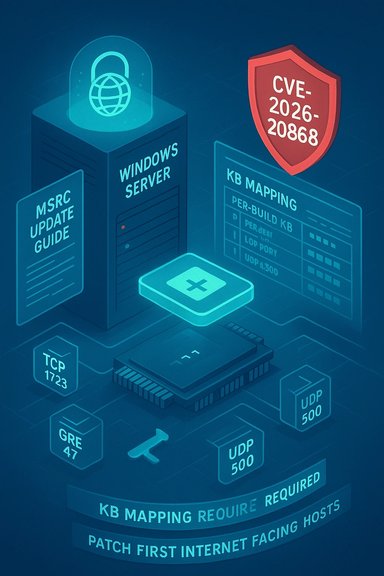
- Internet‑facing VPN gateways and DMZ RRAS concentrators (TCP 1723, GRE 47, UDP 1701, UDP 500, UDP 4500, TCP 443).
- RRAS hosts reachable from less‑trusted internal segments (partner networks, contractor networks).
- Servers that accept untrusted code (terminal servers, developer machines) where a local foothold could be chained with an RRAS EoP or RCE.
Typical impact
Successful exploitation can yield remote code execution under the RRAS process account (often SYSTEM), enabling:- Full host compromise (persistence, credential theft, lateral movement).
- Disruption of VPN/routing services (availability impact).
- Use of the gateway as a beachhead for enterprise‑wide aggression (ransomware, espionage).
Verification and confidence level
Vendor acknowledgement and verification procedure
Microsoft’s Security Update Guide lists the CVE entry, which is the strongest operational signal that a vulnerability is real and that fixes exist for affected builds. However, the MSRC UI is JavaScript driven and sometimes prevents automated scrapers from extracting the CVE→KB mapping; defenders must view the MSRC page in a browser or query the Microsoft Update Catalog to obtain the precise package for their OS build before patching.Cross‑referencing independent trackers
Industry vulnerability databases (NVD, CVE aggregators, vulnerability vendor feeds) have repeatedly cataloged RRAS CVEs and corroborate the RCE characterization for heap‑based defects. Examples of independent corroboration for recent RRAS RCEs include entries and technical summaries in NVD and commercial trackers, which align with vendor advisory language on the attack surface and suggested mitigations. Use these trackers to supplement your investigation, but reconcile any CVE→KB discrepancies directly with the vendor’s MSRC entry before mass deployment.What is not yet verifiable
- Public proof‑of‑concept (PoC) exploit code: at initial publication there is frequently no widely shared PoC; absence of a PoC does not imply low risk.
- Exact exploitation mechanics (payloads, heap grooming steps): vendor advisories commonly omit step‑by‑step exploit mechanics; any third‑party technical analysis claiming precise exploitation steps should be validated against multiple sources and, preferably, tested in a controlled lab environment.
Practical mitigation and remediation (0–72 hours)
The single most effective action is to apply the vendor patch; where that is not immediately possible, apply containment controls.Immediate prioritized actions
- Confirm whether any host in your environment runs the RRAS / RemoteAccess role:
- Get‑Service -Name RemoteAccess
- Get‑WindowsFeature | Where‑Object { $.Name -match "RemoteAccess" -or $.Name -match "Routing" }
- Map CVE‑2026‑20868 to the exact KB(s) for each OS build using Microsoft’s Security Update Guide or the Microsoft Update Catalog; do not rely solely on third‑party mirrors.
- Patch internet‑facing RRAS hosts first, then staged rings for internal hosts. Validate each stage before widespread rollout.
Short‑term compensating controls (if patching is delayed)
- Block or restrict RRAS‑related ports at the perimeter to only trusted management IPs:
- TCP 1723 (PPTP), GRE (IP protocol 47)
- UDP 1701 (L2TP), UDP 500 / UDP 4500 (IKE/IPsec)
- TCP 443 (SSTP)
- Temporarily stop and disable the RemoteAccess service on non‑critical servers:
- Stop‑Service -Name RemoteAccess -Force
- Set‑Service -Name RemoteAccess -StartupType Disabled
- Uninstall the RRAS role on servers that do not require it:
- Uninstall‑WindowsFeature -Name RemoteAccess -IncludeManagementTools
Why patch mapping matters
Third‑party CVE feeds have shown inconsistent CVE→KB mappings for RRAS advisories in past disclosure waves; incorrectly applied updates can waste time or leave systems unprotected. Use MSRC and the Microsoft Update Catalog as the authoritative mapping for your build.Detection, hunting and post‑patch validation
Network telemetry to watch
- Sudden traffic spikes to RRAS ports listed above.
- Repeated malformed negotiation packets or unusual payload patterns from single IPs (probing scanners).
- High‑entropy or abnormal payloads during RRAS negotiations that could indicate exploitation attempts.
Host signals to watch
- RRAS/RemoteAccess service crashes, generated crash dumps, or abnormal restarts.
- Unexpected child processes spawned from RRAS or process memory dumps that reveal suspicious DLLs or injected code.
- Creation of NTFS reparse points or symlink activity in RRAS configuration directories (relevant for local link‑following bugs in other RRAS advisories).
Forensic preservation checklist (if exploitation suspected)
- Isolate the host from networks.
- Capture full memory image and process dump for RemoteAccess.
- Collect system and application event logs, and preserve PCAPs for the suspected time window.
- Document file system changes and any created reparse points or symbolic links.
Post‑patch verification
- Confirm the patch applied: Get‑HotFix or Windows Update history.
- Validate RemoteAccess service starts cleanly and that VPN connectivity works from representative clients.
- Monitor logs for a period to detect repeated crash symptoms that could indicate an incomplete remediation.
Threat landscape and likely attacker behavior
Short term — what to expect
- Rapid internet scanning of RRAS‑related ports following public disclosure.
- Opportunistic automated exploit attempts against internet‑exposed VPN gateways.
- Attempts by low‑cost attackers and ransomware groups to weaponize reliable exploit primitives once they appear publicly.
Medium term — skillful actors
Highly skilled actors are capable of combining information leaked by one RRAS flaw with heap corruption primitives in another to bypass mitigations and gain reliable execution. This is why information‑disclosure bugs are operationally critical: they can materially lower the bar for exploitation of memory‑corruption defects.Operational playbook — a concise checklist
- Inventory: identify all hosts with the RRAS / RemoteAccess role installed now.
- Confirm KB mapping: consult the MSRC update guide in a browser and the Microsoft Update Catalog for each build.
- Patch ringed rollout: test → internet‑facing → internal. Monitor and validate after each ring.
- If unable to patch quickly: apply perimeter and host firewall restrictions; stop and disable RemoteAccess on noncritical hosts.
- Increase logging and SIEM rules for RRAS events; capture PCAPs for suspicious flows.
- Preserve forensic evidence and prepare IR escalation playbooks in case of suspected compromise.
Technical analysis and verification notes
- The pattern for recent RRAS CVEs leans heavily toward heap‑based buffer overflows and out‑of‑bounds reads in packet parsing logic; these lead to RCE or information disclosure depending on the exact flaw. Independent toxicity across vendors’ trackers and NVD entries supports this classification, but precise exploit mechanics for CVE‑2026‑20868 were not publicly documented at the time of advisory posting. Anyone claiming a fully reliable exploit chain for CVE‑2026‑20868 should be treated with caution until multiple independent technical analyses are published or a PoC is available.
- The authoritative source for per‑build remediation is the vendor’s update guide; other feeds are useful for reconnaissance but can contain inconsistent KB mappings. Confirm each update by viewing the MSRC advisory and the Microsoft Update Catalog.
- If a defender finds conflicting public claims (e.g., whether authentication is required, whether user interaction is necessary), treat MSRC’s wording as final and escalate ambiguity to vendor support or to the organization’s patch governance lead for risk acceptance.
Strengths of the current record — and risks to operations
Notable strengths
- Vendor acknowledgement (MSRC entry) implies patches exist and provides an authoritative update path. That enables rapid, verifiable remediation once the KB mapping is obtained.
- Established operational playbooks and community documentation exist for RRAS‑class issues (inventory commands, port lists, and mitigation patterns), which reduce remediation friction for organizations that already maintain good patch governance.
Potential operational risks
- Inventory gaps: RRAS is optional and often under‑tracked; leftover or unmanaged RRAS instances are a common vector for sustained exposure.
- CVE→KB mapping inconsistencies in third‑party aggregators can mislead patch rollouts — confirm in MSRC.
- If organizations delay patching due to change windows or compatibility concerns, they increase the window of opportunity for automated scanning and weaponized tooling.
Final assessment and recommended course of action
CVE‑2026‑20868 is a vendor‑acknowledged RRAS vulnerability with an RCE classification in the public catalog; the existence of a published MSRC entry is the highest confidence signal that the vulnerability is real and that vendor updates are available. However, operational decisions must be based on the exact KB mapping for each Windows build in your estate, which requires consulting the MSRC advisory in a browser or the Microsoft Update Catalog. Until patches are confirmed and deployed, assume network‑reachable RRAS endpoints are high‑risk and apply compensating controls (firewall restrictions, service stop/disable, role removal where unused). Action summary (urgent):- Immediately inventory RRAS instances and classify exposure.
- Obtain and verify the KB(s) that remediate CVE‑2026‑20868 for each build from Microsoft’s update guide.
- Patch internet‑facing RRAS hosts first; if patching is delayed, block RRAS ports at the perimeter and disable the RemoteAccess service on non‑critical machines.
- Increase detection and SIEM monitoring for RRAS anomalies and preserve forensic artifacts if compromise is suspected.
Source: MSRC Security Update Guide - Microsoft Security Response Center
